
The chief technology officer and co-founder of ransomwarehelp.com, a six-year-old Florida-based business that marketed itself as a specialized cryptographic data recovery firm, has been formally charged with wire fraud. Federal prosecutors unsealed an indictment this week in Rhode Island detailing a sophisticated deception wherein the enterprise allegedly lied to desperate cyberattack victims. Instead of deploying advanced computational algorithms to crack ransomware as advertised, the firm secretly funneled payments to threat actors for decryption keys, subsequently marking up the costs exorbitantly for services and technical engineering that were never rendered.
The defendant, 52-year-old Juan Ricardo Palacio Escobar—who operates across Miami, Florida, and Medellin, Colombia—now faces serious federal felony counts. The case exposes a dark and predatory niche within the cybersecurity ecosystem, where opportunistic intermediaries exploit organizations during their most vulnerable operational moments.
False Promises and Farcical Technical Claims
For six years, the website ransomwarehelp.com greeted digital extortion victims with a prominent, contradictory slogan: "Do not pay the ransom!" The portal aggressively marketed proprietary cryptographic tools and algorithms, claiming a 99% success rate in restoring 100% of encrypted data, servers, and enterprise systems to their pre-attack state. Furthermore, the firm boasted a massive phantom workforce of 80 experts boasting nearly three decades of collective experience in cybersecurity, forensic analysis, reverse engineering, and advanced cryptography.
However, investigators and industry experts quickly realized that the firm’s technical claims were not only fraudulent but mathematically and logically absurd. When preparing proposals for victims—such as a small accounting firm targeted by the Lockbit ransomware gang in 2024—RansomwareHelp claimed it would deploy "510 preconfigured forensic servers of the maximum quantitative capacity located in different parts of the world."
The company’s written proposals detailed elaborate, pseudo-scientific procedures involving the injection of brute-force encryption codes and reverse-engineering techniques. In one notable instance, the firm claimed it could break six types of encryption while citing entirely irrelevant password hashing algorithms, such as SHA-256, which are fundamentally one-way mathematical functions incapable of being "decrypted" in the manner described.
Paul Ihme, co-founder of the security firm Soteria, reviewed proposal documents provided by the victimized accounting firm. Ihme noted that the technical jargon was designed specifically to overwhelm and deceive non-technical business owners facing existential operational threats.
"If it were really true these guys could decrypt any ransomware out there, this guy would be a billionaire," Ihme observed. "They were going after people who don’t have any technical knowledge, are desperate, and don’t have anyone advising them about how any of this stuff works."

The Anatomy of the FBI Sting Operation
The federal case against Palacio stems from a proactive undercover sting operation coordinated by the Federal Bureau of Investigation. Federal agents executed the sting by creating a dual-layer simulation: they established a fictitious corporate entity posing as a ransomware victim, and they simultaneously operated a controlled, mock ransomware group.
Investigators posing as compromised corporate victims reached out to RansomwareHelp for emergency remediation, supplying a copy of a fabricated extortion note. True to its public-facing marketing material, RansomwareHelp immediately responded by reaffirming its strict corporate policy against negotiating with or paying threat actors.
Behind the scenes, however, Palacio immediately pivoted to capitalize on the situation. The indictment reveals that Palacio contacted the FBI’s undercover ransomware group, posing as a broker to negotiate the lowest possible price for a decryption key. Federal agents initially quoted a baseline price of 0.2 bitcoin, equivalent to approximately $13,000 at the time.
Less than 48 hours later, Palacio returned to the undercover agents posing as the victim firm. He falsely claimed that a rigorous diagnostic assessment had been completed successfully and quoted the fake company a decryption fee of $13,260.
The following day, Palacio engaged in a double-game by messaging the FBI’s fake ransomware group once more, successfully haggling the extortion price down to approximately $6,000 in bitcoin. Ultimately, Palacio charged the government’s undercover victim firm a total of $16,010—which included a $2,750 upfront diagnostic fee layered on top of the inflated $13,260 decryption charge—all while pocketing the difference as illicit profit without performing any actual cryptographic engineering.
The Mechanics of Obstruction: Deleting Ransom Notes
Investigators and independent cybersecurity analysts have uncovered how firms like RansomwareHelp maintained the illusion of exclusive capability. When engaged by a client, RansomwareHelp routinely insisted on gaining unrestricted remote access to the victim’s network using standard remote desktop utilities such as AnyDesk.
While presented to clients as a necessary technical measure to conduct rapid diagnostic assessments, independent security analysis suggests a far more insidious primary motive: the systematic purging of evidence.

In the case of the 2024 accounting firm incident analyzed by Soteria, security professionals discovered that all digital copies of the Lockbit ransom note had been meticulously deleted from the infected workstations. Typically, ransomware operators deploy identical text files containing direct contact links, darknet chat portals, and payment instructions across every directory on an infected system.
By scrubbing these notes from the client systems, RansomwareHelp ensured that the victim organization remained completely isolated from the threat actors. This prevented the victim from discovering the direct communication channels, realizing the true nature of the negotiations, or seeking alternative remediation options that would bypass the fraudulent intermediary.
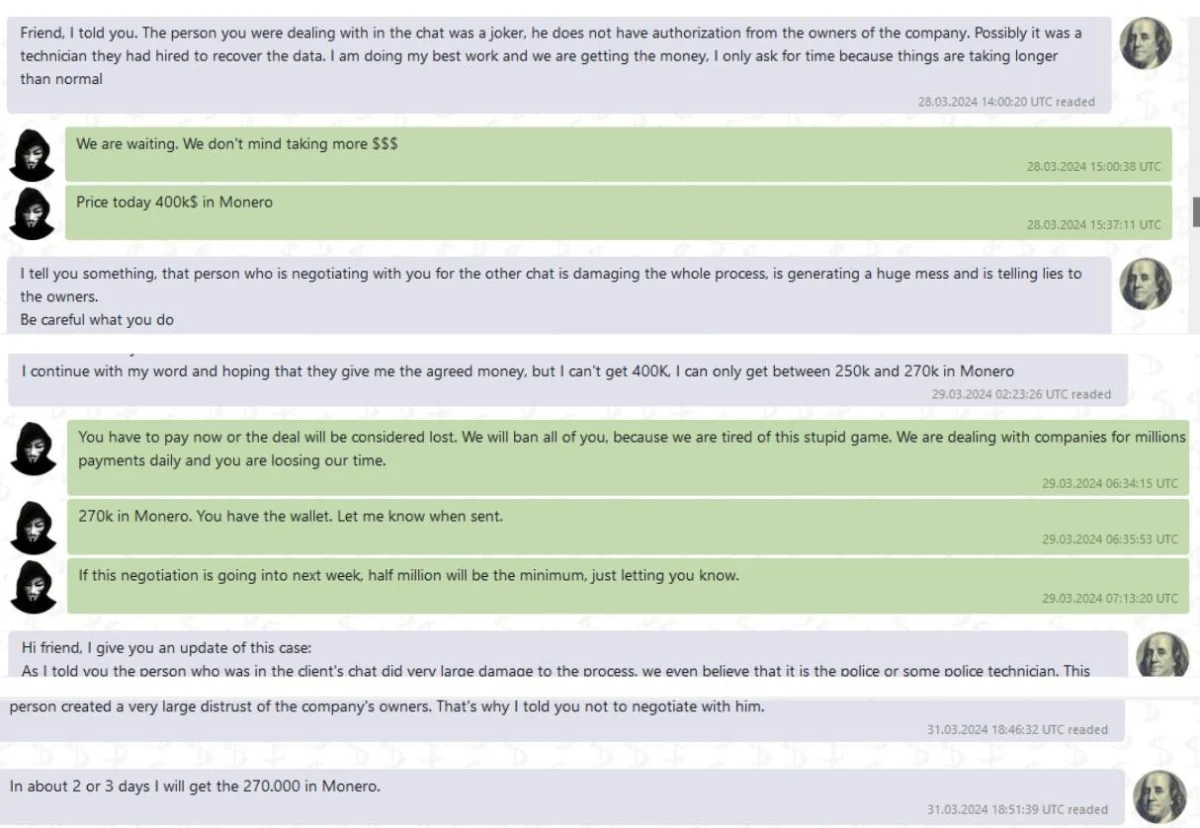
Despite these efforts, backup snapshots preserved a single hidden ransom note. When Soteria connected to the Lockbit chat server using the extracted credentials, they discovered that an unauthorized third party—later identified as RansomwareHelp—had already been actively negotiating with the extortionists for several days.
Awkward Intermediaries and Escalating Demands
The covert transcripts between RansomwareHelp and the Lockbit extortionists reveal a chaotic dynamic. As the victim firm eventually retained legitimate security counsel, a second negotiation stream was inadvertently opened with the ransomware group.
Panicked that their scheme would collapse, RansomwareHelp representatives frantically messaged Lockbit operators, begging them to ignore the parallel negotiations.
"I tell you something, that person who is negotiating with you for the other chat is damaging the whole process," RansomwareHelp pleaded in chat logs recovered by investigators. "Please do not change the price. I am doing my best to achieve it."
Lockbit operators, growing increasingly impatient and confused by the competing negotiation streams from the same corporate network, ultimately retaliated against the delays. The cybercriminal syndicate warned that the ransom demand would inflate by $100,000 for each day that negotiations stalled.
Faced with mounting financial demands and suspicious delays, the accounting firm followed expert advice, severed ties with RansomwareHelp, and partnered with a legitimate incident response provider. Utilizing transparent negotiation channels, the established security firm successfully negotiated a settlement at roughly half of the total cost initially demanded by RansomwareHelp.

A Broader Crackdown on Fraudulent Intermediaries
The indictment of Juan Ricardo Palacio Escobar does not represent an isolated incident, but rather the latest aggressive push by the United States Department of Justice (DoJ) to clean up an unregulated and increasingly corrupt tier of the cybersecurity services market. Over recent months, federal authorities have unsealed multiple high-profile criminal cases targeting individuals and firms accused of operating as predatory middlemen in ransomware incidents.
In October, federal authorities charged 54-year-old Edward Dubrovsky, an executive at Canadian cybersecurity firm Cybersteward, with cyber extortion and conspiracy. Though aspects of Dubrovsky’s legal proceedings remain sealed, the charges highlight growing federal scrutiny over how external consultants handle ransom negotiations.
In a parallel action announced around the same time, the DoJ charged MonsterCloud CEO Zohar Pinhasi, 50, with wire fraud and conspiracy. According to federal charging documents, Pinhasi’s firm allegedly marketed ransomware remediation services that promised to recover systems without paying hackers. In practice, Pinhasi allegedly bypassed his clients’ explicit instructions, secretly paying criminal syndicates approximately $8 million while billing his corporate clients a staggering $19 million for phantom technical services.
Furthermore, in July, a federal court sentenced Angelo Martino, a 41-year-old ransomware negotiator from Land O’Lakes, Florida, to 70 months in prison. Martino was convicted of conspiring directly with the notorious Blackcat/ALPHV ransomware group. Prosecutors established that Martino had systematically leaked confidential negotiation strategies and internal client positions from his own employer directly to the threat actors, empowering the criminals to maximize victim payouts in exchange for kickbacks.
Implications for the Cybersecurity Industry
The exposure of ransomwarehelp.com and the concurrent prosecution of executives across the remediation sector underscore a profound vulnerability for businesses under siege. When struck by ransomware, organizations often operate under extreme duress, fearing imminent bankruptcy, regulatory penalties, or catastrophic data loss. This desperation creates fertile ground for unscrupulous actors who market themselves as white-knight saviors while functioning as opportunistic brokers.
Industry experts emphasize that legitimate cybersecurity and incident response firms operate with radical transparency. Reputable providers maintain clear chains of custody, refuse to conceal direct communication channels with threat actors unless legally mandated under specific jurisdictions, and provide itemized engineering scopes that do not rely on fictitious computational claims or pseudo-scientific jargon.
As federal law enforcement expands its scrutiny, the arrest of Palacio and his peers serves as a stern warning to the broader cybersecurity consulting sector. The message from prosecutors is unequivocal: exploiting organizational panic under the guise of technical wizardry while secretly colluding with criminal extortion syndicates will be met with severe federal felony charges, substantial prison sentences, and the total dismantling of fraudulent digital enterprises.

