
The Korea Electric Power Corporation (KEPCO), South Korea’s state-controlled primary electricity provider and a foundational pillar of the nation’s critical infrastructure, has suffered a severe cybersecurity breach. The unauthorized intrusion compromised internal networks and exposed the sensitive personal and corporate data of more than 1.5 million individuals. The incident highlights the persistent vulnerabilities facing state-backed utilities and critical national infrastructure operators as they grapple with increasingly sophisticated cyber threats.
The security failure compromised two critical corporate systems: the KEPCO ON integrated customer electricity billing platform and the company’s electronic procurement system, known as SRM (Supplier Relationship Management). While the utility company moved swiftly to contain the breach by blocking external IP access and temporarily suspending impacted services, the exposure of large volumes of consumer and contractor records has triggered widespread concern among regulatory bodies, government authorities, and the public.
Chronology of the Cyber Attack and Discovery
The sequence of events surrounding the KEPCO data breach underscores the rapid progression from initial threat actor extortion to corporate discovery and regulatory intervention.
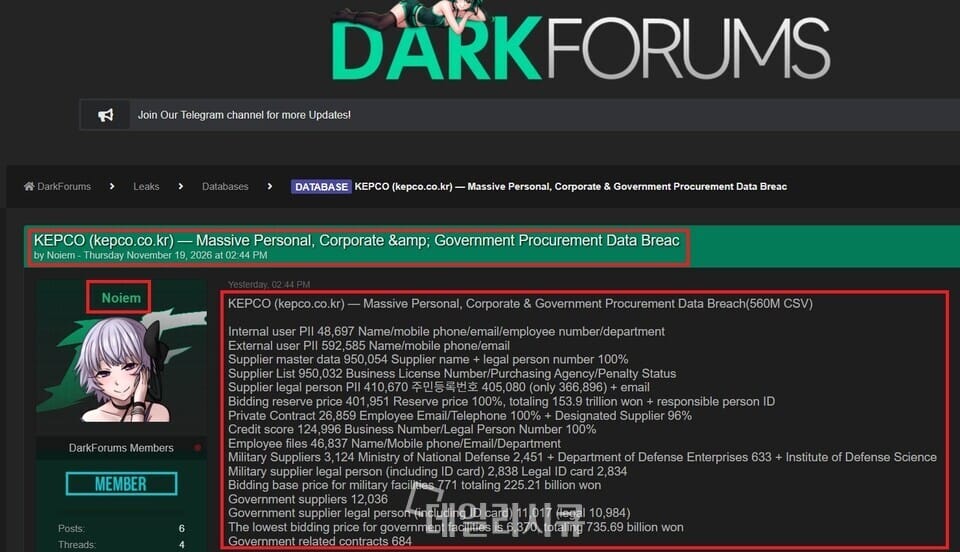
On November 19, a threat actor operating under the online moniker "Noiem" took to an underground hacker forum to publicly advertise a major data breach involving KEPCO. The attacker claimed to have successfully exfiltrated a vast trove of proprietary information, including KEPCO user data, supplier and contractor records, as well as highly sensitive bidding and contract documentation. Concurrently, South Korea’s Personal Information Protection Commission (PIPC) confirmed that KEPCO had received a direct extortion email from the hacker on the same day, detailing the data theft and threatening public exposure or misuse.
Following the extortion attempt and internal security alerts, KEPCO launched an exhaustive forensic investigation into its IT architecture. On Friday, November 20, the utility formally confirmed that unauthorized actors had successfully breached its internal networks and compromised data residing within the KEPCO ON and SRM platforms. Led by President Kim Dong-cheol, the organization acknowledged the security lapse in an official statement released on Sunday, November 22, noting that customer and corporate information had indeed been exposed.
Upon verifying the breach, KEPCO’s incident response teams enacted containment protocols. These measures included severing external IP access vectors to the compromised environments and temporarily suspending the affected digital services to prevent ongoing data exfiltration.
Systems Impacted and Nature of the Exposed Data
The breach targeted two distinct operational ecosystems within KEPCO’s digital infrastructure, each serving a critical function in the utility’s daily operations.
The first impacted platform, KEPCO ON, serves as the unified digital hub for South Korea’s residential and commercial electricity consumers. Through this integrated application, customers manage their accounts, review power consumption metrics, and process electricity bill payments. The compromise of this system directly threatens millions of citizens who rely on the platform for utility administration.
The second affected platform, the Supplier Relationship Management (SRM) system, functions as KEPCO’s enterprise-grade procurement and contracting portal. This system manages interactions, bids, tenders, and agreements with third-party vendors, suppliers, and contractors servicing the state-run power grid.
While KEPCO has not yet disclosed an exhaustive, itemized manifest of every affected data field, the compromised datasets fundamentally include sensitive Personally Identifiable Information (PII) belonging to customers, employees, and corporate contractors. This encompasses billing details, user credentials, vendor contact registries, internal corporate memos, and extensive transactional documentation related to government and commercial infrastructure procurement.
Attribution and the "Noiem" Persona

Cybersecurity researchers and domestic investigators have closely scrutinized the claims made by the threat actor known as "Noiem." While the timeline of Noiem’s November 19 forum post and direct extortion emails perfectly aligns with KEPCO’s internal detection logs and reports from the Personal Information Protection Commission, formal attribution to a specific state-sponsored APT (Advanced Persistent Threat) group or financially motivated cybercriminal syndicate remains under active investigation.
In public statements, KEPCO remarked that the unauthorized intrusion was facilitated by the utilization of "advanced technologies such as AI." Although the utility did not elaborate on the specific initial access vector—such as compromised credentials, a zero-day vulnerability, or sophisticated social engineering—the reference to advanced techniques suggests an automated or highly calculated breach methodology designed to bypass traditional perimeter defenses.
Official Responses, Regulatory Action, and Public Warnings
The scale of the KEPCO breach has prompted a coordinated multi-agency response across South Korea’s regulatory, financial, and law enforcement landscapes.
KEPCO has initiated direct communication protocols to notify all individuals whose personal or corporate data was compromised during the incident. Simultaneously, formal breach notifications have been filed with the Personal Information Protection Commission (PIPC) and relevant national data protection authorities. KEPCO is actively cooperating with government agencies and financial institutions to monitor for secondary exploitation, such as unauthorized financial transactions or corporate fraud stemming from leaked procurement records.
Government regulators have issued stern warnings to the public, emphasizing that the leaked data creates severe downstream risks for affected citizens and corporate partners. Security analysts point out that data sets containing PII paired with billing and procurement histories are prime ingredients for highly targeted spear-phishing campaigns, Business Email Compromise (BEC) schemes, and elaborate impersonation scams.
To mitigate potential fallout, South Korea’s Internet and Security Agency (KISA) and local law enforcement have advised potentially impacted individuals to remain highly vigilant. Citizens and contractors have been urged to report any suspicious communications, unexpected billing inquiries, or impersonation attempts to police authorities immediately.
Furthermore, cybersecurity advisories recommend that affected parties adopt stringent digital hygiene practices in the wake of the breach. Users are strongly cautioned against installing unverified mobile applications, inputting sensitive data into unsolicited online forms, or sharing multi-factor authentication (MFA) codes and personal verification details over unsolicited phone calls or text messages.
Broader Implications for Critical Infrastructure Security
The KEPCO data breach serves as a stark reminder of the escalating cyber threats confronting critical national infrastructure (CNI) worldwide. As energy grids, water systems, and transportation networks undergo digital transformation and integrate cloud-based billing, customer portals, and automated procurement systems, they simultaneously expand their digital attack surfaces.
State-owned utilities like KEPCO are prime targets for malicious actors ranging from financially driven ransomware syndicates to hostile nation-state actors seeking geopolitical leverage or economic espionage. The successful breach of systems handling 1.5 million records demonstrates that perimeter security alone is insufficient to protect mission-critical environments.
The incident is expected to trigger heightened regulatory scrutiny across South Korea’s energy and utility sectors. Lawmakers and cybersecurity watchdogs are likely to push for stricter compliance mandates, mandatory zero-trust architecture implementations, and regular third-party security audits for all entities managing critical state infrastructure.
As the investigation continues, KEPCO faces the arduous task of restoring consumer trust, fortifying its digital perimeters, and proving its capability to safeguard the backbone of South Korea’s electrical grid against increasingly advanced cyber threats.

