
The global cryptocurrency market is reeling from a historic security breach that has sent shockwaves through the financial sector, wiping out billions in market capitalization and triggering a cascade of liquidations across major digital asset exchanges. On Friday, the crypto market saw its total capitalization contract by 2.89%, falling to $2.6 trillion as investors reacted to reports that Binance, the world’s largest cryptocurrency exchange, had been compromised in an exploit involving the theft of an estimated $6.3 billion in digital assets. The breach, which experts and forensic blockchain analysts have linked to North Korea’s notorious “TraderTraitor” hacking syndicate, stands as the largest single security failure in the history of the cryptocurrency industry.
The Anatomy of the Breach
The intrusion appears to have been a sophisticated, multi-stage operation targeting the exchange’s infrastructure. While the exact technical vector remains under active investigation by cybersecurity firms and law enforcement agencies, early reports from TRM Labs, a prominent blockchain intelligence provider, have identified patterns consistent with the operational profile of North Korean state-sponsored threat actors. These groups have historically targeted decentralized finance (DeFi) protocols and centralized exchanges to circumvent international sanctions and fund state programs.
The magnitude of the theft—totaling $6.3 billion—surpasses all previous records in the crypto space, dwarfing the 2022 Ronin Network bridge exploit and the 2023 Multichain incident. The sheer volume of assets moved off the exchange’s platform necessitated an immediate, industry-wide response to prevent the rapid laundering of the stolen funds.
Chronology of the Crisis
The incident began early Friday, with anomalous on-chain activity flagging large-scale outflows from Binance-associated wallets. As automated security protocols detected the unauthorized movement, the exchange initiated emergency measures.
- Detection and Containment: Within hours of the initial detection, Binance moved to suspend all withdrawal operations, a move intended to ring-fence the breach and prevent further asset leakage.
- Inter-Exchange Coordination: Recognizing the threat, major ecosystem players, including stablecoin issuers Tether and Circle, mobilized to freeze assets associated with the exploit. Collaborative efforts resulted in the on-chain freezing of approximately $3 billion in stolen funds, mitigating the immediate financial damage to a degree.
- Official Communication: By midday, Binance co-CEO Richard Teng took to social media to address the escalating market panic. Teng emphasized that the exchange’s internal security audits had found no evidence of a compromise regarding user private keys, suggesting the exploit may have been facilitated through a different layer of the exchange’s infrastructure.
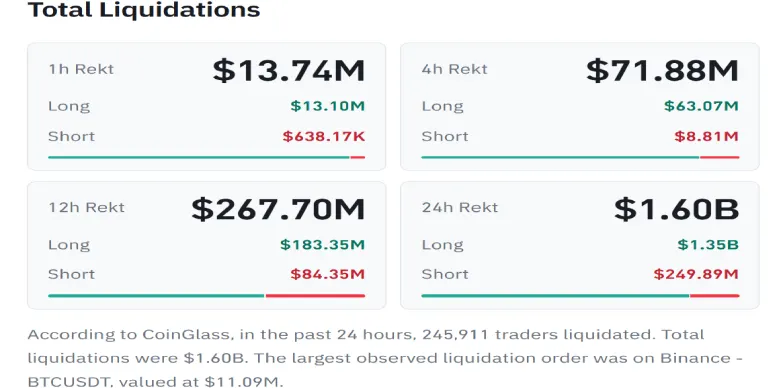
- Market Response: The news triggered an immediate sell-off across the board. Bitcoin, Ether, and XRP saw immediate declines of 3% or more, while the derivatives market bore the brunt of the volatility, with over $1.6 billion in leveraged futures positions liquidated within a 24-hour window.
Official Responses and Mitigation Efforts
Binance has publicly committed to covering all user losses resulting from the exploit, utilizing its substantial corporate reserves to maintain liquidity and customer trust. "Bottom line: your money is safe, and we’re covering every loss," Richard Teng stated in his official address. This commitment is seen as a strategic move to prevent a “run on the bank” scenario that often follows major exchange hacks.
The exchange is currently working in close coordination with international law enforcement agencies and cybersecurity experts to trace the movement of the remaining funds. The frozen $3 billion currently held in blacklisted addresses serves as a significant hurdle for the attackers, who now face the challenge of offloading assets that are effectively “tainted” on the primary liquid markets. Industry observers note that such high-profile freezes represent a maturation in how exchanges and stablecoin issuers handle systemic threats, utilizing centralized control over stablecoin smart contracts to effectively neutralize stolen liquidity.
Broader Market Implications and Technical Analysis
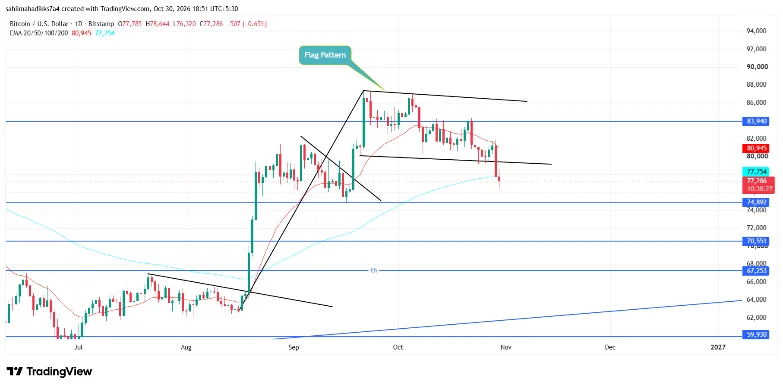
The breach has fundamentally shifted the market sentiment, ending a period of consolidation that had seen Bitcoin fluctuate between $87,000 and $79,500 for the past six weeks. This lateral trend had previously been interpreted as a “bull flag” formation, suggesting a potential continuation of the broader bullish momentum. However, the market’s reaction to the security news effectively invalidated this technical setup.
Bitcoin’s Breakdown
Bitcoin has fallen below its critical monthly support, currently trading at approximately $77,351. While the price is currently holding just above the 200-day exponential moving average (EMA), the breakdown has severely weakened the bullish thesis. Should the price fail to reclaim the $79,300 level, analysts are projecting a potential slide toward support levels at $70,500 and, subsequently, $67,252. The 200-day EMA remains the last line of defense for the bulls, and any sustained close below this level would likely confirm a shift to a bearish medium-term trend.
Ethereum and the Head-and-Shoulders Pattern
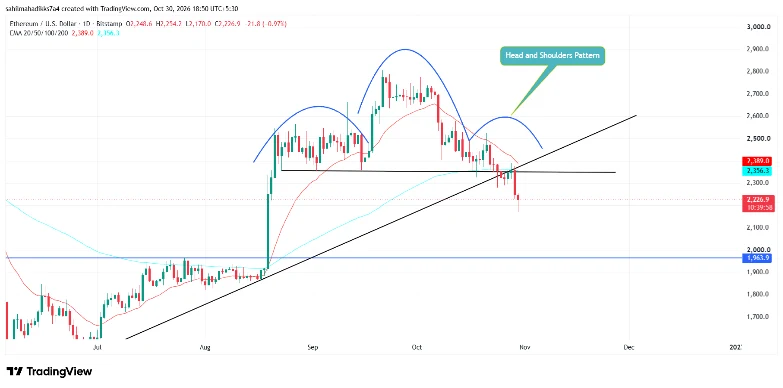
Ethereum has faced similar, if not more pronounced, pressure. Before the hack, the asset was exhibiting a classic “head and shoulders” bearish pattern, which had already placed the price under pressure. The breach acted as a catalyst for a definitive breakdown below the neckline support at $2,353. With sellers currently in control, the asset faces a potential 11% correction, with the next significant technical support level identified at $1,965. A recovery for Ethereum would require a swift rebound to the $2,350 level to invalidate the current bearish formation, a task made difficult by the prevailing climate of fear.
The XRP Outlook
XRP has also succumbed to the market-wide sell-off, breaching the $1.254 support level. Despite the breakdown, the asset is finding some stabilization at the $1.24 level, supported by the lower trendline of a falling wedge pattern. This pattern is often interpreted as a signal of weakening bearish momentum. While the asset remains in a downtrend, a breakout above the overhead trendline could provide a glimmer of optimism for investors. However, until such a breakout occurs, the risk of a continued slide toward $1.16 remains elevated.
Cybersecurity and Future Resilience
The incident highlights the ongoing vulnerability of even the most well-resourced centralized exchanges to state-sponsored threats. North Korea’s involvement, as alleged by analysts, brings a geopolitical dimension to the crisis. For the broader industry, the breach serves as a stark reminder of the risks inherent in holding large concentrations of digital assets in centralized custodial environments.
Industry analysts are calling for a reassessment of security protocols, particularly concerning the interaction between centralized exchanges and decentralized, on-chain finance protocols. The success of the "freeze" operations by Tether and Circle has been cited as a positive development, proving that centralized coordination can be an effective tool against illicit actors. However, critics argue that such measures also highlight the degree to which major stablecoins are centralized, posing their own questions regarding censorship and the nature of decentralized finance.
As Binance works toward resuming full withdrawal operations—a process expected to take at least 48 hours—the focus remains on transparency. The exchange’s ability to provide a full, forensic account of the exploit will be crucial in restoring investor confidence. Furthermore, the event is likely to trigger heightened regulatory scrutiny, with global financial watchdogs expected to demand more robust security disclosures from major exchange operators to prevent a repeat of such a catastrophic event.
The next few days will be critical for the market’s recovery. With major technical supports failing and the specter of state-sponsored cyber-warfare looming over the ecosystem, investors are advised to exercise caution. The market is currently in a state of high volatility, where sentiment is dictated by both the technical failure of price support levels and the unfolding narrative of the largest theft in digital asset history. As the dust settles, the industry must grapple with the reality that, as the total market cap grows to the trillion-dollar scale, it becomes an increasingly attractive target for the most sophisticated bad actors in the global landscape.
