• Home
  • About Us
  • Contact Us
  • Cookies Policy
  • Disclaimer
  • DMCA
  • Privacy Policy
  • Terms and Conditions
Dr Crypton
Secure Your Future in Crypto
Cryptography & Privacy

Why Apple iMessage Needs Disappearing Messages Now More Than Ever

by admin September 13, 2026
written by admin

In an era where digital communications are increasingly scrutinized, the fundamental goal of cryptography extends far beyond solving complex mathematical equations; it is to ensure that human beings can communicate securely and privately. Today, that mission is facing mounting pressure. Across various sectors, particularly within government agencies and federal contracting firms, employees and military veterans find themselves growing anxious about the permanence of their digital footprints. Concerns over professional retaliation based on online speech—including thoughts expressed via private text messaging—have created a climate of self-censorship and digital anxiety.

While end-to-end encryption in transit has become an industry standard, privacy advocates argue that securing data during transmission is only half the battle. As millions of mainstream users continue to rely on built-in native applications like Apple’s iMessage, a glaring security and privacy gap remains: the persistent, long-term storage of text conversations on devices and in cloud backups. Despite pioneering robust cryptographic protections, Apple’s continued omission of a native, per-conversation disappearing messages feature leaves its user base uniquely vulnerable in the modern threat landscape.

Dear Apple: add “Disappearing Messages” to iMessage right now

The Evolution of iMessage Security and the Modern Threat Landscape

Apple’s iMessage has long been celebrated for its robust cryptographic architecture. Since its inception in 2011, the platform has featured end-to-end encryption (E2EE), meaning that messages and attachments are locked with keys entirely unknown to Apple. Over the years, the tech giant has continued to modernize this framework. Notably, Apple introduced its PQ3 protocol, a state-of-the-art post-quantum cryptographic architecture designed to protect user data even against future quantum computing decryption capabilities.

However, cryptographers and security researchers point out a critical disconnect between theoretical security and practical user privacy. While PQ3 protects messages against speculative, high-tech adversaries wielding quantum computers, everyday users face immediate, tangible threats closer to home. If an individual gains physical access to an iPhone, bypasses the passcode, or compromises an insufficiently protected cloud backup, they gain access to a searchable, chronological archive of conversations spanning years. For federal employees, whistleblowers, activists, and ordinary citizens alike, a standard messaging app functioning as a permanent, searchable ledger of past thoughts and private interactions creates significant liability.

Dear Apple: add “Disappearing Messages” to iMessage right now

Industry Standards and the Missing Feature

The absence of disappearing messages within iMessage is increasingly conspicuous when compared against the rest of the messaging ecosystem. Nearly every major consumer communication platform—including Signal, WhatsApp, Meta Messenger, Snapchat, and Telegram—has long integrated ephemeral messaging options. These features allow users to establish an expiration window, ranging from minutes to months, after which messages automatically erase from both sender and recipient devices. Furthermore, these platforms typically exclude ephemeral chats from standard device backups or prevent expired messages from being restored, reinforcing the core premise of ephemerality.

Competitor Chronology and Feature Adoption:

Dear Apple: add “Disappearing Messages” to iMessage right now
  • 2014: Snapchat standardizes ephemeral content, popularizing auto-deleting media and chats.
  • 2016: Signal introduces disappearing messages, setting a privacy benchmark for encrypted communications.
  • 2020: WhatsApp rolls out disappearing message controls globally.
  • 2021: Telegram expands its auto-delete timer functionalities across all chat types.
  • 2025: Apple’s iMessage remains a notable holdout among major consumer messaging protocols, lacking native, per-chat ephemeral messaging controls.

By omitting this capability, Apple fails to provide what privacy advocates describe as the "blast radius containment" principle. Ephemeral messaging does more than clear storage space; it actively communicates to users that their conversations are designed to be temporary, granting psychological safety and mitigating the risks associated with long-term data retention.

Technical Realities of Apple’s Ecosystem

Examining Apple’s current software settings reveals partial mechanisms that fall short of true disappearing messages. Within iOS settings, users can navigate to the "Keep Messages" menu to dictate how long text threads remain on their device, with options such as one year. However, this is a global setting rather than a per-conversation toggle, meaning users must sacrifice entire historical archives to achieve brevity. Crucially, this setting applies strictly to the local device and does not purge messages from the communication partner’s phone.

Dear Apple: add “Disappearing Messages” to iMessage right now

For users seeking deeper protection, Apple offers Advanced Data Protection (ADP) for iCloud, which extends end-to-end encryption to iCloud backups. When enabled, ADP ensures that encryption keys remain solely on the user’s trusted devices, preventing Apple or external entities from accessing stored cloud data.

Yet, confusion persists regarding Apple’s "Messages in iCloud" feature. While Apple promotes the synchronization service as end-to-end encrypted, standard default settings for new iCloud backups historically permitted the storage of the encryption keys on Apple-managed servers. Consequently, unless a user explicitly activates Advanced Data Protection, the contents of the Messages in iCloud database remain accessible to anyone capable of breaching the user’s Apple account credentials. Even with ADP enabled, however, backups and local storage continue to preserve complete chat histories indefinitely, bypassing the need for ephemeral controls.

Implications and the Road Ahead

Dear Apple: add “Disappearing Messages” to iMessage right now

The ongoing absence of disappearing messages in iMessage highlights a broader debate over corporate responsibility in digital privacy. While security engineers at Apple frequently cite user dread of data loss as a primary driver against restrictive backup policies, critics argue that withholding fundamental privacy features actively harms vulnerable populations. Speculation surrounds Apple’s hesitation, ranging from potential regulatory pressures from international governments to legacy software architectures within the Messages application framework.

As the digital landscape evolves, the definition of secure communication must expand to encompass data lifecycle management. Post-quantum encryption protects data in transit, but true operational security requires giving users control over data at rest. For a company that consistently markets its brand around user privacy, bridging this gap by introducing native, flexible disappearing messages is no longer a luxury feature—it is a critical necessity for modern digital safety.


September 13, 2026 0 comment
0 FacebookTwitterPinterestEmail
FinTech Innovations

MeridianLink Acquires FinovateFall Standout Credit Mountain to Revolutionize the Lending Decline Experience

by admin September 13, 2026
written by admin

As the countdown to FinovateFall 2026 intensifies, the fintech ecosystem is buzzing with the news of a significant strategic acquisition that highlights the industry’s shift toward human-centric, AI-driven lending. MeridianLink, a prominent software provider for financial institutions and consumer reporting agencies, has officially acquired Credit Mountain, a Dallas-based financial wellness platform that rose to prominence after winning "Best of Show" at FinovateFall 2024. This acquisition marks a pivotal moment in how community banks and credit unions handle loan denials, transforming what was once a rigid regulatory hurdle into a growth-oriented engagement strategy.

The Strategic Vision Behind the Acquisition

The acquisition is designed to integrate Credit Mountain’s proprietary technology into the broader MeridianLink product ecosystem, specifically fueling the launch of two new flagship offerings: MeridianLink Pathway and MeridianLink Coach.

MeridianLink Pathway is engineered to automate the "adverse action" process—the mandatory notification a lender must send when rejecting a loan application. Traditionally, this is a sterile, legalistic communication that often marks the end of a relationship between a borrower and a financial institution. Pathway reimagines this as a consultative touchpoint. By providing declined borrowers with a personalized, compliant roadmap toward future loan eligibility, institutions can retain potential customers rather than losing them to competitors or non-bank lenders.

Complementing this is MeridianLink Coach, an AI-powered advisory tool slated for release later in 2026. Coach is designed to provide ongoing financial literacy and credit-building guidance to consumers, effectively turning the "decline" into a coaching opportunity that strengthens the borrower’s profile over time.

A Chronology of Growth and Innovation

The trajectory of Credit Mountain reflects the rapid maturation of the financial wellness sector. Founded in 2021 in Dallas, Texas, the startup sought to solve a fundamental disconnect in the lending lifecycle: the lack of constructive feedback for rejected applicants.

  • 2021: Credit Mountain is established with a mission to bridge the gap between loan applicants and financial health through actionable data.
  • September 2024: Credit Mountain takes the stage at FinovateFall 2024. Their live demo, which showcased the transformation of the end-to-end decline experience, captured the attention of the industry and earned the company the "Best of Show" designation.
  • August 2026: MeridianLink formally announces the acquisition of Credit Mountain, citing the startup’s ability to "turn loan declines into future lending opportunities."
  • September 2026: The industry gathers at FinovateFall 2026 to see how the next generation of fintech innovators is addressing similar challenges in financial inclusion and automation.

Data-Driven Implications for Community Lending

The importance of this acquisition cannot be overstated when considering the current state of the U.S. lending market. Serving over 1,800 community financial institutions and supporting 78 million credit union members, MeridianLink operates at a scale where small changes in conversion rates yield massive downstream impacts.

According to industry reports, consumer credit rejection rates have fluctuated significantly in the post-pandemic era due to tighter credit standards and rising interest rates. For many community lenders, the cost of customer acquisition (CAC) is a primary barrier to growth. When a loan is denied, that CAC is essentially written off as a sunk cost. By utilizing the Pathway technology, lenders can lower their long-term CAC by nurturing "near-prime" borrowers, effectively converting a rejected applicant into a loyal, qualified borrower within six to twelve months.

Furthermore, regulatory requirements for "adverse action" notices are stringent. By automating these notices within a compliant, digital-first framework, financial institutions reduce their operational burden while simultaneously enhancing the borrower’s experience—a dual benefit that is increasingly essential in a competitive digital lending landscape.

Official Perspectives on the Merger

The leadership teams of both organizations have framed the acquisition as a milestone for the "Lending Made Human" philosophy—a core tenet of MeridianLink’s operational strategy.

Larry Katz, CEO of MeridianLink, emphasized that the integration is about building long-term relationships rather than transactional throughput. "Through MeridianLink Pathway and the future launch of MeridianLink Coach, we’re helping community financial institutions transform the loan decline experience," Katz noted in a formal statement. "Pathway gives borrowers a personalized, compliant path toward future approval, while MeridianLink Coach delivers AI-powered guidance to help consumers strengthen their financial health over time."

Nathan Pinto, the founder of Credit Mountain, echoed this sentiment, noting that the union provides the scale necessary to bring his team’s vision to a wider audience. "Community financial institutions succeed when they help consumers achieve their financial goals," Pinto said. "This acquisition strengthens our ability to help more lenders serve more borrowers, build deeper relationships, and offer innovative lending experiences where every borrower has a clear path forward."

The Broader Impact on Fintech Ecosystems

The acquisition of Credit Mountain serves as a case study for the current trends driving M&A activity in the fintech sector. As banks and credit unions face pressure to modernize, they are increasingly looking to acquire niche, high-innovation startups to bolster their internal platforms.

The move also underscores the growing importance of "financial wellness" as a product category. Where fintech once focused primarily on transaction speed and interface design, the current frontier is financial advocacy. By integrating credit-building tools directly into the lending workflow, MeridianLink is positioning its client institutions as partners in the borrower’s success rather than mere gatekeepers of capital.

This shift has significant implications for financial inclusion. Many consumers are denied credit due to "thin files" or transient financial setbacks. If community lenders can provide the tools to improve these metrics, they are not only growing their own loan books but also contributing to broader economic mobility within the communities they serve.

Looking Ahead to FinovateFall 2026

As attendees prepare for FinovateFall 2026, the success of Credit Mountain serves as a roadmap for future innovators. The conference, which will take place from September 9 to 11, continues to be a bellwether for technologies that bridge the gap between complex backend systems and user-friendly consumer applications.

The integration of Credit Mountain into the MeridianLink suite is expected to reach full implementation by the end of 2026. Industry analysts will be watching closely to see how effectively the "Pathway" and "Coach" features are adopted by MeridianLink’s vast network of community financial institutions. If successful, the model could set a new industry standard for how credit decisions are communicated and how financial institutions engage with the millions of consumers who fall just short of the approval threshold.

In conclusion, the acquisition is more than just a consolidation of technology; it represents a fundamental change in the "spirit" of lending. By choosing to invest in the potential of the declined borrower, MeridianLink is demonstrating that in an era of AI and automation, the most effective competitive advantage remains the ability to build trust and foster long-term loyalty. As the industry convenes in September, the conversation will undoubtedly revolve around how this partnership will redefine the "Path to Yes" for consumers across the United States.

September 13, 2026 0 comment
0 FacebookTwitterPinterestEmail
FinTech Innovations

American Workers Face Severe Financial Squeeze as Persistent Inflation Outpaces Slowing Wage Growth

by admin September 13, 2026
written by admin

The economic reality for millions of households across the United States has taken a difficult turn, as fresh macroeconomic data underscores a widening gap between the rising cost of living and stagnant employee compensation. According to figures released by the U.S. Bureau of Labor Statistics, consumer prices increased at an annual rate of 3.4% in August, while average hourly earnings managed only a 3.1% gain over the same twelve-month period. When adjusted for inflation, real average hourly wages actually declined by 0.1% from the previous month and dropped 0.3% compared to August of the prior year. This ongoing divergence has triggered renewed concerns among economists, financial institutions, and policy analysts regarding the erosion of consumer purchasing power and the broader stability of household balance sheets.

The return of negative real wage growth marks a frustrating reversal of fortune for an American labor force that had experienced a sustained period of healing. For months leading up to the spring, incremental gains in hourly pay had generally outpaced the rate of inflation, offering households a much-needed buffer against the cumulative price shocks left in the wake of the post-pandemic economic landscape. However, structural shifts in commodity markets, coupled with renewed upward pressure on essential goods and services, have effectively wiped out those hard-won economic gains. As everyday necessities command a larger share of household budgets, consumer confidence is waning, and discretionary sectors are bracing for a prolonged period of reduced activity.

Chronology of the Inflation-Wage Gap and Recent Economic Shifts

To understand the gravity of the current economic climate, analysts look back at the trajectory of inflation and wage growth over the past several years. Following the historic spikes in consumer prices that peaked in 2022, the Federal Reserve embarked on an aggressive monetary tightening campaign, raising benchmark interest rates to cool an overheated economy. Throughout 2024 and much of 2025, inflation gradually cooled toward the central bank’s long-term targets. During this stabilization phase, nominal wage growth—driven by a tight labor market and competitive hiring practices—remained robust enough to exceed headline inflation figures. By late 2024 and early 2025, many workers felt that their paychecks were finally catching up to the elevated price tags on grocery shelves and utility bills.

The turning point arrived in the spring of this year. As winter transitioned into spring, international energy markets experienced renewed volatility, leading to a sharp spike in gasoline and crude oil prices. This energy shock rippled quickly through supply chains, manufacturing, and transportation networks, injecting fresh inflationary pressures into the broader economy. At the same time, the broader labor market began to cool, with job openings leveling off and nominal wage growth slowing down from its previous peaks. By April, the delicate equilibrium that had favored workers dissolved. Year-over-year consumer price indices began to outpace average hourly earnings once again, setting the stage for the negative real wage contractions reported by the Bureau of Labor Statistics through the summer months.

Expert Perspectives and Reactions from Financial Institutions

Industry leaders and financial economists have voiced mounting concern over the speed at which purchasing power is deteriorating. Heather Long, chief economist at Navy Federal Credit Union, highlighted the human toll of these macroeconomic indicators in a recent broadcast interview. She pointed out that a substantial segment of the American populace is objectively worse off today than they were earlier in the year, as incremental salary increases are routinely swallowed by higher bills at the checkout counter and the fuel pump.

"Things were getting better, and now that improvement has blown up," Long noted, describing the difficulty of watching positive economic trends unravel due to renewed cost pressures. She emphasized that while low unemployment and nominal wage increases initially masked the underlying pain of cumulative inflation, the persistent gap has finally reached a threshold where families can no longer absorb the losses without altering their daily lives.

Financial advisors and credit counselors echo these sentiments, noting an uptick in inquiries from clients struggling to balance fixed obligations with variable living expenses. Banking executives report that consumers are increasingly relying on revolving credit lines and credit cards to bridge the gap between pay periods, a trend that threatens to elevate household debt burdens and delinquency rates if interest rates remain elevated.

Underlying Data: The Anatomy of Consumer Strain

A closer examination of the latest economic data reveals that the overall inflation rate of 3.4% masks deeper pain points concentrated in the non-negotiable pillars of household expenditure: housing, food, and energy. While prices for certain durable goods and electronics have stabilized or even declined due to repaired supply chains, the cost of basic survival remains stubbornly high.

Housing costs, encompassing both rental markets and homeownership expenses such as property taxes and maintenance, continue to register significant year-over-year gains. Concurrently, grocery prices have stabilized at a permanently higher plateau rather than retreating to pre-pandemic baselines, forcing families to allocate a historically high percentage of their disposable income simply to feed themselves. When combined with fluctuating gasoline prices, these recurring, non-discretionary expenses consume the vast majority of an average worker’s paycheck.

This dynamic leaves households with very little financial margin for error. According to proprietary research from PYMNTS Intelligence, consumer spending habits are bifurcating sharply based on income tiers and existing savings cushions. The data demonstrates that consumers with minimal financial flexibility have exhausted their capacity to absorb further price hikes, leaving them with few options other than cutting back on essential quantities or completely eliminating discretionary purchases.

Disparities in Consumer Spending and Financial Vulnerability

The impact of the ongoing inflation-wage mismatch is not distributed evenly across the population. Insights from the PYMNTS Consumer Expectations Index illustrate a stark divide in how different demographic segments are responding to the persistent cost-of-living squeeze.

Among consumers who live paycheck to paycheck and report difficulty paying their monthly bills, economic pressure has forced widespread retrenchment. Data from the index indicates that 53% of this vulnerable cohort reduced their spending on nonessential categories—such as dining out, entertainment, and leisure travel—over the preceding year. Interestingly, a minority of 23% within this group reported increased nonessential spending, often driven by unavoidable life events or the psychological fatigue of continuous budgeting.

A similar pattern emerges among paycheck-to-paycheck consumers who manage to pay their bills on time but lack significant savings. Within this group, 41% cut back on discretionary outlays, while 27% increased them. These figures suggest that even households that appear stable on the surface are frequently operating on razor-thin margins, where a single unexpected expense or another tick upward in utility bills can derail their financial equilibrium.

In contrast, consumers who do not live paycheck to paycheck present a distinctly different spending profile. This segment represents the only category where increases in nonessential spending outpaced reductions: 30% of these financially secure respondents reported spending more on discretionary items, compared to 27% who reported spending less.

The divergence highlights a growing K-shaped economic reality. Households with robust savings portfolios, home equity, and higher baseline incomes retain the financial capacity to absorb inflationary shocks and continue participating in discretionary markets. Conversely, lower- and middle-income workers who rely strictly on hourly wages or salaries are finding their budgets squeezed to the breaking point, as every dollar earned is immediately claimed by rising bills.

Broader Implications for the Economy and Retail Sectors

The widening gap between inflation and wage growth carries significant implications for the broader U.S. economy, particularly given that consumer spending accounts for roughly two-thirds of national gross domestic product (GDP). When real wages contract, the foundational engine of economic growth begins to sputter.

Retailers, restaurants, hospitality providers, and entertainment venues are already feeling the pinch of cautious consumer behavior. Companies catering to middle- and lower-income demographics report increased price sensitivity, resistance to price hikes, and a noticeable shift toward private-label goods and discount retailers. To maintain sales volumes, many consumer-packaged-goods companies and restaurant chains are being forced to offer promotional discounts and value menus, potentially squeezing corporate profit margins.

Furthermore, the persistent strength of inflation relative to wage growth complicates the policy outlook for the Federal Reserve. Central bankers are tasked with balancing a dual mandate of achieving maximum employment and stable prices. While labor markets show signs of cooling, the stubbornness of inflation—fueled in part by housing and service sector costs—suggests that policymakers may need to maintain a cautious stance on interest rates, keeping borrowing costs elevated for a longer duration than some market participants initially anticipated.

Looking Ahead: What to Expect in the Months to Come

As the autumn season progresses, economists and financial analysts will be monitoring upcoming employment reports, consumer price indices, and retail sales data to determine whether the negative real wage trend is a temporary blip or a more entrenched structural challenge.

Much will depend on energy market stability, global supply chain developments, and the resilience of the labor market. If wage growth fails to accelerate or if inflation refuses to recede toward the Federal Reserve’s 2% target, American households will face continued hardship, forcing policymakers and business leaders to reevaluate their strategies for navigating a complex and uncertain economic landscape. For the average American worker, however, the immediate priority remains finding ways to stretch a tightening paycheck across an increasingly expensive daily life.

September 13, 2026 0 comment
0 FacebookTwitterPinterestEmail
FinTech Innovations

Mark Wahlberg to Discuss Strategic Investment and Entrepreneurial Evolution at TechCrunch Disrupt 2026

by admin September 13, 2026
written by admin

Mark Wahlberg’s trajectory from a pop culture icon to a multifaceted business mogul represents one of the most successful transitions from the entertainment sector to the world of institutional finance and venture capital. While his filmography—highlighted by Academy Award-nominated performances in The Fighter and breakout roles in Boogie Nights—has kept him in the global spotlight for three decades, his influence now extends into the boardrooms of burgeoning startups and the strategic planning of wealth management firms. This October, Wahlberg will take the main stage at TechCrunch Disrupt 2026 in San Francisco to provide a granular look at the discipline, mentorship, and analytical rigor that define his current business philosophy.

The Evolution of a Multi-Hyphenate Mogul

The transition from Hollywood star to venture capitalist is rarely linear, yet Wahlberg has navigated this path by leveraging his personal brand to cultivate a diverse portfolio. His business ventures include a robust production company, an expansive restaurant footprint, and significant holdings in the apparel and fitness industries. Beyond these commercial interests, his philanthropic efforts, most notably the Mark Wahlberg Youth Foundation, have provided a foundation for community engagement, supporting inner-city youth for over 25 years.

However, the upcoming session at TechCrunch Disrupt marks a shift in focus. Wahlberg will be joined by Bruce K. Lee, the founder and CEO of Keebeck Wealth Management. This partnership is emblematic of a broader trend: high-net-worth individuals from the entertainment industry are increasingly moving away from passive celebrity endorsements toward active, institutional-level investing. Under the guidance of seasoned financial experts like Lee, Wahlberg has transitioned his focus toward the complexities of the healthcare and wellness sectors, signaling a move toward long-term, high-impact capital allocation.

Chronology of an Entrepreneurial Pivot

To understand the significance of this shift, one must look at the timeline of Wahlberg’s career expansion. In the early 2000s, Wahlberg focused primarily on establishing his production credentials, eventually leading to the success of HBO’s Entourage. By the 2010s, he had diversified into consumer-facing brands, such as his activewear and restaurant enterprises.

The current decade has been defined by a transition toward private equity and venture capital. By aligning himself with institutional advisors, Wahlberg has begun to treat his capital with the same intensity he once reserved for film production. This maturation process involves the unlearning of traditional “celebrity-driven” investment instincts in favor of data-driven market analysis and risk assessment—a topic he intends to explore in detail during his fireside chat at Disrupt 2026.

Mark Wahlberg is coming to TechCrunch Disrupt 2026, and he wants to talk about your work, not his

The Institutionalization of Celebrity Capital

Industry analysts have noted that the “celebrity investor” archetype is undergoing a professionalization phase. Where once athletes and actors were known for speculative bets on retail or hospitality, current market data shows a pivot toward specialized technologies, particularly in health-tech, AI, and biotechnology.

According to recent industry reports on private wealth management, the shift among high-profile individuals toward venture capital has seen a 15% year-over-year increase in participation in Series A and Series B funding rounds. Wahlberg’s specific interest in healthcare reflects a broader societal move toward preventative wellness and life-science innovation. By working with firms like Keebeck Wealth Management, Wahlberg is moving away from the “gut-check” style of investing that characterizes many celebrity portfolios and toward a strategy based on rigorous due diligence, long-term exit planning, and portfolio diversification.

Strategic Implications for the Tech Ecosystem

The presence of a high-profile figure like Wahlberg at a premier technology event such as TechCrunch Disrupt serves as a barometer for the intersection of culture and capital. For startup founders, the primary interest lies in the “deal flow” and the strategic value of high-profile backers.

Wahlberg’s participation is expected to address the mechanics of this access. He is set to discuss how he utilizes his reputation to build trust in competitive markets and how he navigates the inherent volatility of the startup landscape. For the tech ecosystem, his insights offer a rare glimpse into the "other side" of the cap table. Founders will be looking for answers regarding what a sophisticated investor—one with the benefit of decades of experience in high-pressure creative industries—looks for in a pitch.

TechCrunch Disrupt 2026: The Global Stage

TechCrunch Disrupt 2026, scheduled for October 13–15 at the Moscone West center in San Francisco, continues to serve as the industry’s central hub for innovation. The event is slated to host over 10,000 attendees, featuring more than 250 industry leaders across 200 sessions. The inclusion of the Wahlberg-Lee session reflects the event’s broader mission to bridge the gap between legacy industries and cutting-edge technology.

The event’s agenda is meticulously designed to cover the full lifecycle of a startup, from ideation to IPO. By placing Wahlberg’s discussion within the context of these broader sessions, the organizers are providing a holistic view of the modern business environment. Attendees can expect to hear about the specific challenges of scaling in the current economic climate, the role of mentorship in avoiding catastrophic business failures, and the importance of adapting to rapid technological shifts.

Mark Wahlberg is coming to TechCrunch Disrupt 2026, and he wants to talk about your work, not his

Professional Analysis: The Path Forward

From a structural standpoint, the partnership between Wahlberg and institutional managers like Lee is a model for how public figures can effectively mitigate the risks associated with venture investing. Many celebrity-backed ventures fail due to a lack of operational discipline or a failure to distinguish between "brand value" and "business value." Wahlberg’s public commitment to learning the "institutional-level" ropes suggests a pivot toward sustainable growth rather than the short-term gains often associated with high-profile brand associations.

Furthermore, the focus on healthcare technology is a calculated strategic move. As global populations age and the demand for personalized health solutions increases, the healthcare sector has become one of the most stable and high-growth areas for venture capital. Wahlberg’s move into this space, combined with the analytical backing of wealth management experts, provides a blueprint for others in his field to follow.

Final Preparations for Attendees

As the September 25 deadline for ticket price increases approaches, the anticipation surrounding the keynote sessions at Disrupt 2026 continues to mount. The event remains a critical juncture for startup founders, venture capitalists, and corporate strategists alike. The session with Wahlberg and Lee is anticipated to be one of the most attended, as it represents a confluence of media, finance, and technology that defines the contemporary business era.

For those planning to attend, the event offers more than just networking; it provides an opportunity to observe how seasoned professionals synthesize decades of career experience into a coherent, forward-looking investment strategy. By analyzing the mistakes of the past—which Wahlberg has promised to address candidly—and understanding the mechanics of modern capital allocation, attendees will gain actionable insights into how to survive and thrive in an increasingly volatile global economy.

In conclusion, the conversation between Mark Wahlberg and Bruce K. Lee at TechCrunch Disrupt 2026 is more than a celebrity appearance; it is a serious examination of the professionalization of the modern investor. As the lines between entertainment, technology, and finance continue to blur, the lessons shared on the main stage in San Francisco will likely resonate far beyond the walls of the Moscone Center, shaping the way investors and founders alike approach the next decade of innovation.

September 13, 2026 0 comment
0 FacebookTwitterPinterestEmail
FinTech Innovations

Global Fintech Capital and Strategic M&A Surge Amid the Rise of Autonomous AI Agents

by admin September 13, 2026
written by admin

The global financial technology landscape is undergoing a profound structural evolution, characterized by monumental strategic acquisitions and an aggressive influx of venture capital directed toward artificial intelligence integration, cross-border payment infrastructure, and digital asset rails. Recent developments across international markets highlight a clear shift in industry priorities: traditional fintech operators are consolidating long-term partnerships through multi-hundred-million-dollar buyouts, while early- and growth-stage companies race to build the backend plumbing required for an economy increasingly driven by autonomous software.

This wave of capital deployment comes at a critical technological inflection point. Industry analysts note that enterprise software is no longer being designed exclusively for human end-users. With the rapid maturation of coding agents, automated discovery tools, and algorithmic decision-makers, the next generation of software consumers may never visit a traditional product homepage or sit through a commercial software demonstration. Instead, autonomous agents developed by firms like Anthropic, OpenAI, and various open-source communities are actively discovering financial products, evaluating technical libraries, installing software development kits (SDKs), and executing API calls entirely on behalf of human users. Consequently, fintech platforms are under immense pressure to architect infrastructure capable of seamlessly accommodating machine-driven commerce.

Major M&A: Consolidating Partnerships and Expanding Global Footprints

The most prominent headline in the sector is Chime’s definitive agreement to acquire Stride Bank, N.A., for $590 million in an all-cash transaction. Stride, a nationally chartered financial institution, has served as Chime’s primary banking partner for more than seven years, providing the regulatory foundation and charter framework that enabled Chime to scale its consumer banking offerings nationwide. Upon the formal closure of the transaction, Stride will be rebranded as Chime Bank, N.A., operating as a wholly-owned subsidiary of the fintech giant. Leadership from both companies emphasized that the vertical integration of their operations will establish an end-to-end financial platform explicitly engineered for the artificial intelligence era, streamlining compliance, core processing, and product deployment.

Simultaneously, cryptocurrency and digital asset infrastructure firm Circle announced its acquisition of Singapore-based cross-border payments company Tazapay for $400 million. This strategic maneuver is designed to significantly broaden Circle’s operational capabilities well beyond its core stablecoin business, specifically strengthening its infrastructure for international business-to-business payments and liquidity movement across emerging markets. By integrating Tazapay’s established local payment rails and regulatory compliance frameworks across Asia and other key regions, Circle aims to accelerate the global utility of USDC for enterprise settlements.

In the Middle East and North Africa (MENA) region, regional payment giant PayTabs has entered into an agreement to acquire the MENA operations of Amazon Payment Services for approximately $100 million. This acquisition grants PayTabs immediate, deeply entrenched access to advanced payment infrastructure and merchant networks across multiple high-growth economies in the region. In a related European banking and payments consolidation move, UniCredit has acquired a strategic equity stake in VC Trade, a German digital marketplace operator with a decade-long track record supporting digital lending markets. Additionally, ACI Worldwide has announced plans to acquire UK-based paytech Cranium, integrating Cranium’s advanced card switching capabilities directly into ACI’s Connetic for Cards platform.

Venture Capital Funding: Powering AI, Lending, and Compliance Rails

Beyond multi-hundred-million-dollar acquisitions, the venture capital ecosystem has delivered substantial funding rounds to specialized financial technology startups. The financing rounds span several distinct sub-sectors, reflecting diverse investor confidence in alternative lending, embedded finance, wealth-tech, and AI-driven security governance.

In the consumer and lending space, Split Pay secured $125 million across its Series A and Series B funding rounds, led by Khosla Ventures, with additional participation from Thrive Capital and prominent technologist Max Levchin. Split Pay addresses liquidity challenges for renters and mortgage holders by allowing them to pay their housing bills on time while deferring up to half of the payment for a duration of up to 30 days. Similarly, London-based fintech Triver raised $10.8 million to scale its data- and AI-driven underwriting platform designed specifically for small business working capital loans.

Wealth management and financial advisory infrastructure also captured significant investor attention. Savvy Wealth announced a $100 million Series C funding round to expand its technology and back-office infrastructure platform tailored for independent financial advisors. In Australia, wealth-building platform Pearler secured a $12 million Series A round led by Portage. Meanwhile, Celigence announced a $100 million funding round led by Mortgage Treasury to scale AngelAi, its financial decision-making and transaction platform. Aqua completed a $15 million Series A round led by Arthur to expand its turnkey alternative investment solutions for wealth managers and institutional firms, while fund operations provider Fundcraft secured €12 million (approximately $13.9 million) in strategic growth financing co-led by Riverside Acceleration Capital and CCAP Investments.

The Intersection of Stablecoins, Cross-Border Rails, and Regulated Infrastructure

As global commerce becomes increasingly digitized, startups building the bridge between traditional fiat currencies and blockchain-based stablecoins are attracting top-tier institutional backing. Paytech Latitude confirmed a $35 million Series A round led by Oak HC/FT, with participation from New Enterprise Associates (NEA), Coinbase Ventures, Lightspeed Faction, OpenFX, and Wilson Sonsini, bringing the company’s total raised capital to $43 million. Latitude specializes in connecting stablecoins directly to hyper-local payment rails, providing enterprises with a single, highly regulated compliance layer to facilitate frictionless currency conversion and movement worldwide. The firm is currently licensed or approved to operate in 45 U.S. markets while actively pursuing international regulatory approvals.

Regional fintech ecosystems, particularly in the Middle East and Europe, are also demonstrating robust momentum. Nayla, a Saudi Arabian fintech startup, raised an $18 million Pre-Series A round co-led by Idrisi Ventures and BLOMINVEST to scale its AI-powered financing solutions for micro-businesses. In Dubai, AI financial platform Oro secured $3 million in a round co-led by MH Ventures and Mapleblock Capital. In France, Olenbee raised $8.1 million to connect employee benefit programs directly to payment cards, while Outline secured $3 million led by Founders Future to scale its automated forecasting tools. Furthermore, Abwab.ai secured a $4 million seed round co-led by Speedinvest and Middle East Venture Partners to expand its AI-driven credit infrastructure for regional financial institutions.

Security, Governance, and the Rise of Agentic AI Infrastructure

The rapid proliferation of enterprise artificial intelligence and autonomous software agents has simultaneously introduced complex cybersecurity and governance challenges, prompting venture capitalists to heavily back risk-management platforms.

Cymphony, an AI governance and security platform, announced a $30 million funding round co-led by Sequoia Capital and the SMBC Fin Atlas Beyond Fund. Cymphony’s software continuously maps every AI agent and human employee within an enterprise ecosystem, providing real-time visibility into system access privileges, sensitive data interactions, and the specific security risks generated by autonomous workflows.

Similarly, Ireland-based cybertech firm ZeroRisk secured a $10 million Series A round led by MiddleGame Ventures, with participation from Elkstone, to expand its cybersecurity assistance products for digital payment providers. In the agentic fintech category, Lightsage announced $4 million in seed funding led by Nexus Venture Partners, with strategic backing from prominent technology executives including former Salesforce CTO Steven Tamm, Postman CEO Abhinav Asthana, Apollo CEO Matt Curl, and DocuSign President and General Manager of Growth Robert Chatwani. Lightsage operates a specialized platform that executes large-scale simulations across conversational answer engines and coding agents, measuring brand visibility and operational outcomes for corporate clients.

Additional early-stage venture rounds highlight continued innovation across niche verticals:

  • Piston secured a $15 million Series A round led by FPV Ventures, alongside Spark Capital and Pear VC, to scale its cardless payments platform connecting commercial vehicle fleets and gas stations.
  • Zeal raised $10 million in funding to connect point-of-sale payment terminals with advanced merchant-intelligence and customer loyalty applications.
  • Intermezzo attracted $10 million from investors including Crosslink Capital, UKG Ventures, CloudPay, and Character Capital to build its AI-powered global payroll platform.
  • Sav closed a $3.5 million Pre-Series A round led by Phoenix Venture Partners to scale its AI-native open finance and wealth management platform.
  • Botsi raised a $1.5 million seed round with participation from Telegraph Ventures and Plain Sight Capital to fund its consumer subscription application analysis tools.

Broader Implications for the Financial Sector

The sheer volume and diversity of capital flowing into fintech reflect an industry transitioning from experimental digitalization to foundational infrastructure hardening. Acquisitions like Chime’s buyout of Stride Bank and Circle’s purchase of Tazapay demonstrate that mature fintech leaders are prioritizing structural permanence, regulatory independence, and global scale. Simultaneously, the strong appetite for AI security platforms like Cymphony and specialized cross-border stablecoin rails like Latitude underscores the market’s acute awareness of upcoming technological bottlenecks.

As autonomous software agents assume greater autonomy in executing financial transactions, discovering products, and managing enterprise operations, the fintech companies that succeed will be those that have successfully embedded compliance, security, and algorithmic efficiency into their core architecture. The recent convergence of billions of dollars in M&A activity and venture capital signals that the foundational framework for the next era of digital finance is rapidly being built.

September 13, 2026 0 comment
0 FacebookTwitterPinterestEmail
NFT & Digital Assets

Rarible Launches Branded Onchain Storefronts with VeeFriends to Redefined Digital Commerce

by admin September 13, 2026
written by admin

As global commerce increasingly migrates onto distributed ledgers, digital storefronts are rapidly transforming into the primary front page and engagement hubs for modern brands. Marking a significant milestone in this evolution, NFT marketplace platform Rarible has officially announced the launch of its customizable, branded onchain storefronts. To pioneer this new initiative, Rarible has partnered with VeeFriends, the globally recognized entertainment and intellectual property company founded by entrepreneur Gary Vaynerchuk in 2021.

The collaboration introduces a dedicated, native onchain environment designed to merge digital asset ownership, immersive brand storytelling, and frictionless user accessibility. By bridging the gap between decentralized technology and mainstream consumer habits, the initiative seeks to establish a blueprint for how brands interact with digital communities, trade intellectual property, and cultivate long-term customer loyalty in an increasingly digital-first economy.

Rarible Launches Branded Onchain Storefronts With VeeFriends

Background and Evolution of VeeFriends

To understand the strategic significance of this launch, it is necessary to examine the trajectory of VeeFriends since its inception. Launched in May 2021 by serial entrepreneur, author, and marketing expert Gary Vaynerchuk, VeeFriends initially emerged as a collection of 250 distinct hand-drawn characters minted as non-fungible tokens (NFTs) on the Ethereum blockchain. Each character was meticulously designed to embody specific human traits, professional aspirations, and leadership qualities, reflecting Vaynerchuk’s overarching philosophy on business, empathy, and self-awareness.

Over the subsequent years, VeeFriends expanded far beyond its origins as a digital collectible portfolio. The universe rapidly evolved into a multifaceted pop-culture brand spanning published comic books, animated series, consumer packaged goods, global conferences, and exclusive real-world experiences. This diversification helped VeeFriends transition from a niche web3 project into a mainstream cultural touchstone with an exceptionally dedicated, active global community.

Because the brand’s entire ethos relies heavily on community connection, storytelling, and direct consumer engagement, leadership identified onchain architecture as the logical next step for its digital ecosystem. The new partnership with Rarible provides VeeFriends with a permanent, branded digital destination tailored specifically to its expansive universe.

Rarible Launches Branded Onchain Storefronts With VeeFriends

A Unified Hub for Digital Collectibles and Lore

The newly deployed VeeFriends onchain storefront on Rarible functions as a comprehensive ecosystem rather than a traditional, transactional marketplace. Historically, acquiring and displaying digital assets required navigating fragmented marketplaces where items were stripped of their contextual narratives, utility statistics, and lore. The new storefront seeks to solve this fragmentation by housing the entire catalog of VeeFriends digital collectibles within a single, highly curated digital environment.

Visitors to the storefront are greeted by a dynamic interface that integrates rich media, character backgrounds, statistical data, and direct pathways into the broader VeeFriends universe. This design philosophy treats the digital storefront as a destination in its own right, where fans can explore the mythology and history behind each collectible before making a purchase. By combining commerce with rich storytelling, the platform elevates the purchasing process from a simple financial transaction into an interactive brand experience.

Overcoming Friction: Onboarding and Payment Innovations

One of the most persistent barriers to mainstream adoption within the digital asset sector has been the technical friction associated with cryptocurrency wallets, seed phrases, gas fees, and complex onboarding procedures. To ensure the VeeFriends storefront is accessible to everyday consumers—not just crypto-native enthusiasts—Rarible integrated advanced user-experience infrastructure for the launch.

Rarible Launches Branded Onchain Storefronts With VeeFriends

The platform incorporates the VeeFriends Wallet powered by Privy, an enterprise-grade web3 wallet infrastructure provider. This integration allows fans and collectors to create secure accounts and sign in using conventional credentials, such as a standard email address, entirely bypassing the need to manage complex cryptographic keys or browser extensions.

Furthermore, the integration of Crossmint payment infrastructure removes traditional financial hurdles by enabling purchases through familiar, mainstream payment methods. Consumers can acquire digital collectibles using standard credit cards, Apple Pay, or Google Pay, bridging the gap between traditional ecommerce habits and decentralized infrastructure.

In addition to simplified onboarding, the storefront is integrated into the broader $RARI rewards ecosystem, powered by the independent RARI Foundation. Under this program, active participants engaging with the storefront may qualify for ecosystem rewards, adding an extra layer of incentive for community members.

Rarible Launches Branded Onchain Storefronts With VeeFriends

Strategic Implications for Onchain Brand Commerce

The launch of branded storefronts arrives at a critical juncture for digital commerce. As major global brands seek ways to monetize digital assets and foster deeper connections with younger, digitally native demographics, the demand for modular, customizable onchain infrastructure has accelerated.

Traditional ecommerce models rely heavily on centralized intermediaries that take substantial cuts of revenue and limit a brand’s ability to interact directly with its consumer base. In contrast, onchain storefronts empower brands and creators to operate autonomously. These modular spaces allow companies to execute direct-to-consumer sales, facilitate secondary market trading, and maintain absolute ownership over their customer relationships and brand narratives.

Industry analysts note that as intellectual property holders look for ways to protect margins and enhance digital engagement, the adoption of decentralized storefronts is expected to surge. By removing intermediaries, brands can experiment with dynamic pricing, loyalty token gating, and interactive ownership models that were previously impossible within legacy ecommerce frameworks.

Rarible Launches Branded Onchain Storefronts With VeeFriends

The Road Ahead: Rarible Studio and Future Rollouts

The deployment of the VeeFriends storefront represents the initial phase of a much broader roadmap for Rarible. Company leadership confirmed that in the coming weeks, a select group of additional iconic brands and creators will launch their own customized storefronts on the platform, each tailored to reflect their unique brand identity and community requirements.

Crucially, Rarible is preparing to roll out Rarible Studio, a dedicated management dashboard designed to give brands complete, autonomous control over building, customizing, and scaling their onchain storefronts. Through Rarible Studio, enterprises of all sizes will be able to deploy their own branded digital hubs without requiring extensive technical development resources, democratizing access to enterprise-grade web3 infrastructure.

As commerce continues its steady migration onto distributed ledgers, the boundary between brand websites and digital marketplaces is dissolving. Initiatives like the Rarible and VeeFriends partnership suggest that the future of digital retail will be defined by immersive, direct-to-consumer onchain environments where community, culture, and commerce intersect natively on the internet.

September 13, 2026 0 comment
0 FacebookTwitterPinterestEmail
Tech & Startup News

Insight Partners Co-Head Devin Parekh Discusses AI Risks, Venture Capital Concentration, and Liquidity Realities at StrictlyVC New York

by admin September 13, 2026
written by admin

In an industry dominated by vocal investors seeking constant visibility across podcasts and social media platforms, Insight Partners co-head Devin Parekh maintains a starkly traditional approach. After 26 years of co-running the heavyweight investment firm—which currently manages approximately $90 billion in assets—Parekh prefers to let the firm’s robust portfolio drive its reputation. Speaking candidly during a sit-down interview with TechCrunch at the StrictlyVC event in New York City, Parekh offered a rare, unvarnished look into the inner workings of elite venture capital, addressing major industry talking points including artificial intelligence safety risks, venture market concentration, cross-investing in competing frontier AI labs, and the imperative importance of returning liquidity to limited partners (LPs).

The StrictlyVC gathering served as a prominent convergence point for venture capitalists, founders, and tech executives navigating a rapidly shifting economic landscape. Within this high-stakes environment, Parekh addressed complex realities facing modern technology investing, ranging from massive mega-rounds in foundational AI to the ongoing recovery of the broader software exit market.

Evaluating AI Safety and Pragmatic Healthcare Innovation

The dialogue immediately turned to the broader societal implications of artificial intelligence, a topic dominating public discourse following recent high-profile departures within leading AI labs over safety concerns. When questioned about whether alarms raised by AI researchers regarding existential risk amounted to mere hysteria, Parekh adopted a pragmatic risk-reward framework.

While acknowledging the theoretical danger of a non-state actor leveraging an open-source model to synthesize biological threats, Parekh emphasized that the probabilistic benefits far outweigh the speculative hazards. He pointed to the dramatic compression of timelines for drug discovery and disease eradication as transformative milestones that the world cannot afford to forgo. Drawing from his governance experience as a board member at NYU Langone Health, Parekh highlighted how machine learning models already process massive datasets—analyzing millions of historical patient records to identify hidden clinical risk factors, such as forecasting an incidental 25% probability of a cardiovascular event for a patient presenting for entirely unrelated symptoms.

From an institutional perspective, Parekh argued that scaling healthcare capabilities is an absolute necessity given global demographic shifts, specifically an aging population juxtaposed against an acute shortage of trained medical professionals. Comparing current technological anxieties to historical shifts like next-generation drone warfare, he posited that human societies consistently absorb technological risks while progressively raising global living standards.

Portfolio-Driven Strategy Versus Industry Noise

Addressing Insight Partners’ deliberate quietude relative to its massive scale, Parekh criticized the modern tendency for venture capitalists to fashion themselves as universal macroeconomic and geopolitical pundits. Rather than utilizing digital soapboxes to comment on global crises or public health emergencies, Insight adheres to a disciplined operational philosophy centered on structural performance.

This philosophy is reflected in the firm’s flexible, temporal approach to global asset deployment. Unlike firms locked into rigid geographic or strategy allocations, Insight’s recent history across its sequential funds demonstrates fluid adjustments between early-stage venture, growth equity, and buyouts. However, macroeconomic conditions have drastically altered this mix. High interest rates, conservative debt markets for software enterprises, and compressed exit multiples have stalled buyout activity, leading Insight to abstain from major buyout transactions since 2024.

Navigating Inflationary Valuations and Early-Stage Pivots

Venture-stage valuations, conversely, have surged at a velocity reminiscent of the frothy market peaks of 2021—a historical parallel that carries inherent peril. Parekh noted that traditional venture mechanics dictate that follow-on funding rounds should incorporate newly accumulated operating data, allowing investors to pay higher prices for substantially reduced enterprise risk. In the current hyper-accelerated funding environment, however, rounds close so rapidly that incremental operational data is virtually nonexistent. Consequently, investors find themselves paying premium prices without benefiting from risk reduction.

Insight’s strategic response to this valuation inflation has been a calculated pivot toward earlier-stage investments. By deploying scale funds into smaller initial bets—writing checks in the $20 million to $25 million range rather than massive $500 million tickets—the firm retains the capital flexibility to double down aggressively on proven winners. Parekh cited the cybersecurity firm Wiz as a prime operational example, where an initial Series A check was followed by continuous capital deployment, maximizing financial returns while insulating the broader fund from catastrophic downside risk.

Geographic Dispersion and the Evolution of Talent Concentration

Discussing global deal flow, Parekh observed that elite talent has largely flattened across international markets, neutralizing historical geographic barriers. He pointed to Insight’s competitive pursuit of Stockholm-based legal-tech company Legora—a deal ultimately secured by General Catalyst after a direct pitch by Insight partner Jeff Horing—as evidence of borderless founder distribution.

Nevertheless, certain technology sectors exhibit intense geographic clustering. While artificial intelligence infrastructure talent remains deeply concentrated in San Francisco, verticalized applications follow distinct industry hubs. For instance, financial technology talent remains anchored in New York, as demonstrated by companies like Ramp. This structural divergence allows vertical AI investing to maintain a far more geographically diverse footprint than foundational infrastructure plays.

Co-Investing in Frontier Rivals: OpenAI and Anthropic

One of the most provocative discussions centered on Insight Partners’ decision to hold stakes in rival foundational model giants OpenAI and Anthropic—a practice historically viewed as a strict taboo within venture capital due to potential conflicts of interest and governance entanglements.

Parekh clarified that the viability of cross-investing in direct competitors depends entirely on the investment stage. Early-stage investors executing Series A rounds, such as Khosla Ventures with OpenAI, assume board seats and direct governance responsibilities that inherently preclude investing in competing entities. However, at later stages—when institutional investors operate off the board and function primarily as financial stockholders—the dynamic shifts. Insight evaluated OpenAI as a dominant consumer-facing play while viewing Anthropic through the lens of a rigorous enterprise strategy.

As capital requirements for foundational labs escalated into tens of billions of dollars, traditional exclusivity demands dissolved. Nevertheless, Insight maintains strict information-sharing restrictions and avoids direct co-investments in competing companies at earlier development stages to respect founder sensitivities regarding intellectual property and revenue overlap.

The LP Liquidity Imperative and the Danger of Concentration Risk

A central theme of Parekh’s analysis was the critical importance of liquidity management and capital return metrics, known as DPI (Distributed to Paid-In capital), for institutional limited partners. Parekh issued a stark warning regarding first- and second-time fund managers who have accumulated massive pools of capital without returning meaningful cash distributions, predicting that many will fail to raise subsequent funds.

Reflecting on Insight’s own evolution, Parekh acknowledged that the firm historically fell into the trap of holding winning positions indefinitely under the assumption that asset valuations would perpetually double. However, institutional LPs require consistent cash realization events. Over the preceding two years, Insight successfully returned more than $20 billion to its limited partners through strategic secondary sales and initial public offerings, proving that liquidity remains paramount even for mature, multi-billion-dollar fund families.

Addressing the macro-level trend of massive capital concentration in a handful of frontier AI labs—which captured roughly half of all venture dollars during the first half of the year—Parekh cautioned against excessive portfolio concentration. While acknowledging that specialized outlier funds like Founders Fund and Thrive Capital have executed highly concentrated strategies with remarkable success, historical data across long-term market cycles heavily favors broad portfolio diversification.

Market Outlook and the Path Forward for IPOs

Looking ahead, Parekh anticipates a stabilizing wave of public market listings over the next 12 to 18 months. With mega-scale entities such as SpaceX, Anthropic, and OpenAI approaching potential public debuts at multi-trillion-dollar valuations, the broader financial markets are demonstrating an unprecedented capacity to absorb massive liquidity events.

Ultimately, Parekh’s insights at StrictlyVC underscored a fundamental truth of institutional investing: while technological revolutions continuously redefine the boundaries of innovation, enduring financial success remains tethered to disciplined risk assessment, proactive liquidity management, and an unwavering commitment to portfolio diversification across long-term market cycles.

September 13, 2026 0 comment
0 FacebookTwitterPinterestEmail
Tech & Startup News

LG Smart TV Privacy Controversy Sparks Industry-Wide Debate Over Ambient Surveillance and Data Collection

by admin September 13, 2026
written by admin

Electronics manufacturing giant LG has found itself at the center of a mounting international controversy following the release of a comprehensive, two-hour investigative video report by the popular tech outlet Gamers Nexus. The expose raised alarming questions regarding the data privacy practices of modern smart televisions, alleging that LG models surreptitiously record ambient user audio even when the display is powered down. Furthermore, the report accused the company of harvesting extensive metadata, including detailed inventories of connected local network devices, precise geographic location markers, and proprietary wireless network configurations without explicit, informed consumer consent.

The allegations have sent shockwaves through the consumer electronics sector, triggering widespread anxiety among privacy advocates, legal experts, and everyday consumers alike. In the days following the initial publication of the report, the digital ecosystem responded with a deluge of reaction videos, critical analyses, and practical tutorials. Prominent tech channels such as Linus Tech Tips and RTINGS weighed in with investigative content, featuring titles like How to Stop Smart TV Spying and LG Isn’t the Only TV Company Spying on You. These responses underscore a growing public awareness that the living room has quietly transformed into a data-harvesting frontier, where the boundary between entertainment appliance and surveillance device has become increasingly blurred.

Chronology of the Controversy

The sequence of events leading to the current public relations crisis began with the meticulous technical dissection conducted by Gamers Nexus. By monitoring network traffic packets, examining firmware behavior, and analyzing the background processes running on contemporary LG smart television operating systems, the investigative team documented data packets being transmitted during idle states—specifically when the physical screen appeared dormant.

Within 48 hours of the video going live on YouTube, the report accumulated millions of views, sparking an immediate viral reaction across social media platforms like Reddit, X (formerly Twitter), and Hacker News. Tech-savvy consumers began testing their own home setups, utilizing local firewalls and packet inspectors to verify whether their hardware was exhibiting similar data-exfiltration behaviors.

Recognizing the escalating severity of the backlash, which threatened to severely dent consumer confidence ahead of upcoming product cycles, LG leadership mobilized a rapid response. The corporation formally denied the allegations across several major news networks and published a definitive corporate statement on its global newsroom portal entitled Understanding Privacy on LG Smart TVs. This multi-pronged defensive strategy aimed to reassure the market that the company operates in strict compliance with international privacy frameworks and consumer protection laws.

Anatomy of the Allegations and LG’s Official Defense

The core of the Gamers Nexus investigation focused on two main areas: ambient audio capture and aggressive telemetry collection. According to the original report, the hardware’s internal listening apparatus remained active and capable of processing auditory data well beyond the boundaries of an intentional, user-initiated voice command session.

In its formal rebuttal, LG categorically rejected these interpretations, attempting to demystify the mechanics behind its natural language processing and remote-control features. The company’s official statement offered technical clarification regarding how voice interaction pathways are managed within its proprietary operating system:

"LG smart TVs do not continuously record or transmit users’ conversations. Speech-to-text processing begins only if a user activates a voice interaction through a supported wake-word feature or by pressing the voice (or AI) button on the remote control. Audio used for wake-word detection is processed locally on the TV and, if no wake word is detected, audio is not converted to text, stored, or transmitted. Voice-recognition results and related technical logs may be generated as part of processing a voice command. These records are associated with specific voice interactions and do not indicate continuous recording of conversations occurring outside an active voice recognition session."

Expanding further upon these technical safeguards, LG asserted that speech-recognition outputs are utilized strictly to facilitate immediate voice-driven conveniences. The company explicitly noted that "speech-recognition results may be used to support voice-related features but are not uploaded later when the TV is offline or when connectivity is restored."

In addition to addressing audio surveillance claims, LG defended its data telemetry practices by directing public attention toward its Automatic Content Recognition (ACR) technology. ACR is an advanced software utility embedded in modern smart displays that monitors pixels on the screen and audio output to recognize what content is being viewed—whether through cable broadcasts, streaming services, or physical media like Blu-ray discs. The system then leverages this viewing habit data to serve personalized content recommendations and targeted advertising. LG emphasized in its defense that features like ACR are entirely optional, requiring explicit opt-in consent during the initial out-of-box setup wizard or via the system settings menu at any point during ownership.

Parsing the Corporate Rhetoric: Lingering Doubts

Despite LG’s definitive denials and detailed technical explanations, privacy advocates and legal analysts remain deeply skeptical. Much of the ongoing friction centers on the precise phrasing utilized in corporate communications. Observers have pointed out potential semantic loopholes in statements such as LG’s assertion that its televisions "do not continuously record or transmit users’ conversations."

Critics argue that such carefully constructed wording leaves ample room for alternative interpretations. For instance, if hardware does not continuously record, does it record sporadically? If systems do not capture conversations, do they nevertheless capture ambient noise, environmental sound signatures, or incidental speech fragments? Furthermore, the distinction between local processing and cloud transmission does not entirely eliminate privacy concerns, as local caching and subsequent telemetry dumps can still expose sensitive behavioral patterns to third-party data brokers.

Legal scholars note that modern privacy policies for smart devices are frequently written in dense, impenetrable legalese that forces consumers into a binary choice: accept comprehensive data collection or accept a degraded product experience characterized by disabled features and restricted functionality. When advanced features like voice assistants and content recommendation engines are buried deep within complex menu structures, the validity of "informed consent" comes under serious legal and ethical scrutiny.

The Broader Smart TV Ecosystem and Surveillance Capitalism

The controversy surrounding LG is by no means an isolated incident; rather, it is symptomatic of a broader structural shift in the consumer electronics industry commonly referred to as surveillance capitalism. In recent years, the business model of television manufacturing has undergone a fundamental transformation. Hardware manufacturers frequently sell modern smart displays at or near cost—or even at a net loss—relying instead on post-purchase monetization strategies to ensure long-term profitability.

These monetization vectors include platform licensing fees, targeted digital advertising displayed directly on the home screen, and the aggregation and resale of granular viewing telemetry to advertisers, data brokers, and market research firms. Because televisions now serve as primary aggregation hubs for household entertainment, they possess immense value to advertisers seeking to map consumer behaviors across multiple devices connected to the same local area network (LAN).

A report published by consumer advocacy organizations and academic researchers previously highlighted that nearly all major smart TV operating systems—including platforms developed by Samsung, Roku, Vizio, and Amazon—employ some form of Automatic Content Recognition and aggressive telemetry gathering. These systems routinely catalog every device sharing a local Wi-Fi router, mapping the domestic footprint of the user to build comprehensive consumer profiles that persist long after the television has been powered off via the remote.

Implications for Regulation and Consumer Trust

The fallout from the LG surveillance controversy is expected to accelerate regulatory scrutiny from government bodies such as the Federal Trade Commission (FTC) in the United States and the European Data Protection Board (EDPB) abroad. Regulators are increasingly taking a hardline stance against dark patterns—user interface designs that trick users into surrendering privacy rights—and opaque data collection practices embedded within consumer IoT (Internet of Things) devices.

For manufacturers, the incident serves as a cautionary tale regarding the fragility of consumer trust in an era where digital privacy is valued as a fundamental human right. As smart appliances become more sophisticated, integrating advanced artificial intelligence and ambient listening capabilities, the demand for radical transparency will only intensify.

Ultimately, the confrontation between LG and its consumer base highlights an urgent, long-running debate over how to strike a sustainable balance between technological convenience and personal privacy. Consumers increasingly desire the seamless integration offered by voice assistants and hyper-personalized content curation, but they expect these features to operate within strict, transparent boundaries that respect the sanctity of the private home. Moving forward, the industry must recognize that maintaining consumer trust requires more than carefully worded public relations statements; it demands verifiable accountability, simplified privacy controls, and an unwavering commitment to data minimalism. It is a vital conversation for the modern digital age—one that would undoubtedly be more productive if it did not consistently require a major breach of consumer confidence to initiate.

September 13, 2026 0 comment
0 FacebookTwitterPinterestEmail
Artificial Intelligence & Tech

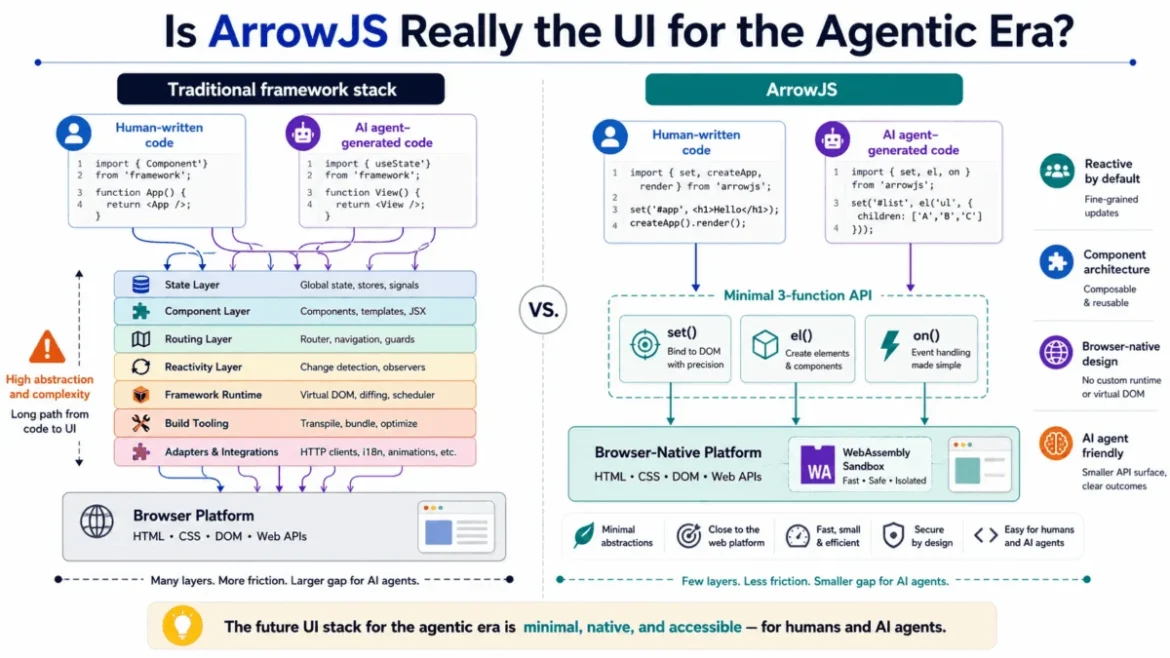
ArrowJS and the Emergence of the First UI Framework Designed for the Agentic Era

by admin September 13, 2026
written by admin

For the past decade, the JavaScript ecosystem has operated on a comfortable assumption: developers write the code, frameworks organize it, and browsers render it. React, Vue, Angular, and their vast ecosystems were all architected with a human at the keyboard in mind. This paradigm, however, is undergoing a profound transformation as AI coding agents—such as Anthropic’s Claude Code, GitHub Copilot, and Cursor—begin to generate significant portions of production-grade code. As these autonomous agents become integral to the software development lifecycle, a critical friction point has emerged: frameworks optimized for human cognitive patterns often prove difficult for AI models to navigate effectively.

The Breakdown of Human-Centric Abstractions

The core challenge lies in the nature of existing frameworks. React, currently the dominant library with over 39% market share among professional developers, relies on a complex set of conventions. Rules regarding hook execution order, the nuances of controlled versus uncontrolled components, and the necessity of JSX compilation create a high barrier for AI agents. While human developers internalize these patterns through practice, AI models rely on statistical probability. When a framework’s abstractions are dense, an agent’s tendency to produce "plausible-looking but broken" code increases, leading to hallucinations in syntax or misapplications of architectural rules.

Vue.js and Svelte, while offering distinct advantages in readability and performance respectively, present similar hurdles. Vue’s reactivity system, while elegant, introduces a framework-specific layer between intent and execution. Svelte, which achieves superior performance by compiling components into vanilla JavaScript, requires agents to master a unique, compiler-dependent syntax. In each instance, the abstraction layer—while beneficial for human productivity—becomes a source of "noise" for an agent operating on large-scale pattern recognition.

The Genesis of ArrowJS

Recognizing these limitations, the development team behind ArrowJS released a stable 1.0 version in early 2026. Marketed as the first UI framework built specifically for the "agentic era," ArrowJS fundamentally reorients the relationship between the framework and the code-generator. Its architecture is built on the premise that if a framework mimics the underlying primitives of the web platform, the surface area for AI error is significantly reduced.

The framework’s design is characterized by three core pillars that prioritize machine-readability:

  1. Platform-Native Primitives: ArrowJS eschews custom build steps and proprietary JSX compilation. Instead, it leverages tagged template literals—a standard JavaScript feature—to define UI components. This ensures that the code generated by an agent is essentially standard JavaScript, requiring no complex transpilation.
  2. Minimalist API Surface: The entire framework is contained within three functions: reactive, html, and component. This extreme simplicity serves a functional purpose; the entire documentation fits within a tiny fraction of a standard 200,000-token context window. This allows an AI agent to "hold" the entire framework in its operational memory, reducing the likelihood of context-based errors.
  3. Sandboxed Execution: Perhaps the most significant innovation is the inclusion of a WebAssembly (Wasm) sandbox. This allows the application to execute AI-generated code in complete isolation from the main browser thread. By sandboxing untrusted or generated UI components, developers can safely render content generated by an AI on-the-fly, mitigating the security risks historically associated with dynamic code execution.

Chronology of the Agentic Shift

The transition toward agent-ready tooling did not happen in a vacuum. The timeline of this shift highlights a rapid acceleration in AI capabilities:

  • 2023: The rise of LLM-powered coding assistants like GitHub Copilot introduces "code completion" as a standard workflow.
  • 2024: The emergence of IDE-integrated agents such as Cursor and v0.dev shifts the focus from simple completion to multi-file project generation.
  • 2025: Industry data indicates that AI-generated code contributes to approximately 25-30% of new feature development in high-growth startups.
  • Early 2026: ArrowJS 1.0 launches, representing the first explicit attempt to design a framework for the agent rather than for the developer.

Comparative Analysis and Industry Implications

The debate surrounding ArrowJS is not merely technical; it is strategic. Proponents of established frameworks argue that React’s massive ecosystem, which includes a decade of design systems, testing utilities, and community-driven solutions, provides a level of maturity that a new, minimalist framework cannot match. Critics of the "minimalist" approach point to companies like Vercel and their development of v0.dev, which utilize existing React conventions to generate highly accurate UI components. The argument here is that instead of simplifying the framework for the AI, the industry should focus on training more capable agents that can handle the complexity of existing, proven standards.

However, for specialized use cases—such as dynamic data visualization, adaptive dashboards, and generative AI interfaces—the utility of ArrowJS is becoming increasingly clear. Data scientists and machine learning engineers working with frameworks like FastAPI or Streamlit often find that integrating a full React stack for minor UI modifications creates significant "infrastructure overhead." ArrowJS, by contrast, offers a lightweight, secure alternative that allows AI agents to act as dynamic UI architects.

Official Perspectives and Market Reality

While the maintainers of ArrowJS argue that the industry is at a "fork in the road," the broader developer community remains cautious. As of mid-2026, the project has garnered roughly 3,500 stars on GitHub. While this reflects a growing interest, it remains a fraction of the adoption seen by legacy libraries.

"The fundamental question," notes Vinod Chugani, an expert in AI-driven workflows, "is whether ‘agent-friendliness’ will become a standard requirement for all future web technologies, or if it will remain a niche optimization for specific generative applications. As agent capabilities improve, the friction caused by complex frameworks may decrease, effectively making the ‘minimalist’ argument moot. But for now, ArrowJS is the only tool that addresses the specific challenges of agentic code generation head-on."

Broader Impact on Software Development

The existence of ArrowJS signals a broader shift in how we conceive of software architecture. We are moving away from an era where human readability is the sole metric for code quality. In the agentic era, machine-readability, safety, and architectural transparency become equally vital.

The security implications of sandboxed execution cannot be overstated. As enterprise applications increasingly allow AI to influence or generate frontend code, the risk of "prompt injection" in the UI layer becomes a primary concern. ArrowJS’s focus on Wasm-based isolation provides a template for how future web frameworks might handle the inherent risks of autonomous code generation.

Ultimately, ArrowJS is not attempting to replace the Reacts of the world in the enterprise space. Instead, it is establishing a proof-of-concept for how infrastructure must evolve when the primary consumer of an API is not a human developer, but a machine agent. Whether this approach becomes a standard or remains a specialized tool, it has successfully forced a conversation about the limitations of current development workflows. As teams continue to integrate agentic AI into their production stacks, the demand for frameworks that prioritize agentic efficiency is likely to grow, potentially forcing even the largest ecosystems to adapt their design philosophies to ensure compatibility with the next generation of autonomous developers.

September 13, 2026 0 comment
0 FacebookTwitterPinterestEmail
Artificial Intelligence & Tech

Get closer to the game with Gemini and Pixel

by admin September 13, 2026
written by admin

In a landmark strategic shift for sports technology integration, Google has officially announced a multi-year partnership with five of the world’s most prestigious football institutions: Arsenal FC, FC Barcelona, FC Bayern München, Liverpool FC, and Paris Saint-Germain. By designating Gemini and Google Pixel as the Official Consumer AI and Official Smartphone Partners, the technology giant aims to bridge the gap between high-performance athletics and fan-facing digital experiences. This collaboration marks a significant pivot in how top-tier football clubs leverage artificial intelligence to enhance matchday engagement, content creation, and the global visibility of women’s sports.

A New Era for Football Fan Engagement

The integration of Google’s AI ecosystem into the daily operations of these five clubs represents a fundamental change in the sports-technology landscape. Traditionally, football clubs have relied on internal media teams to capture matchday atmosphere; however, the deployment of Gemini—Google’s advanced AI assistant—is designed to act as an on-demand, hyper-personalized resource for supporters.

As fans navigate the complexities of modern football, where tactical setups and squad rotations change in minutes, Gemini provides a utility layer that can dissect formations in real-time. By utilizing its agentic capabilities, the tool can sift through vast archives of head-to-head historical data, allowing fans to settle debates and gain tactical insights without leaving the context of their matchday experience. This service aims to transform the passive act of watching a game into an active, data-informed experience.

Capturing the Raw Emotion of the Pitch

Parallel to the AI implementation, the partnership designates the Google Pixel as the official device for capturing behind-the-scenes narratives. The "Shot on Pixel" series is central to this initiative, moving away from traditional, highly polished broadcast footage to focus on the raw, unfiltered moments that define professional sports.

Media teams at these clubs will utilize the advanced camera hardware and AI-powered image processing of the Pixel 11 to produce content that feels more authentic and immediate. This initiative addresses a long-standing desire among fans for "all-access" perspectives, including tunnel footage, training ground interactions, and the spontaneous reactions of players during high-stakes matches. By standardizing the equipment used by social media departments, Google is creating a consistent, high-fidelity visual identity for these five clubs across digital platforms.

Bridging the Visibility Gap in Women’s Football

A primary pillar of this partnership is the commitment to addressing the systemic disparity in media coverage between men’s and women’s professional football. Despite record-breaking attendance figures at women’s tournaments—such as the 91,648 fans who filled Camp Nou for a UEFA Women’s Champions League match in 2022—the women’s game has historically struggled to achieve parity in daily media coverage.

Google’s strategy involves an equitable allocation of resources across both the men’s and women’s sides of the partnering clubs. By deploying the same AI-driven content generation and high-end smartphone capture tools for both divisions, the company aims to amplify the reach of the women’s game. This initiative is designed to provide professional-grade visibility to female athletes, ensuring that their narratives, statistics, and highlights are presented with the same technical rigor as their male counterparts. Industry analysts suggest that this parity in digital presentation is essential for the long-term commercial growth of women’s football, as it helps create a more compelling product for sponsors and global broadcasters.

The Technological Evolution of Sports Marketing

The chronology of this partnership follows a broader trend of technology firms embedding themselves into the sports value chain. Over the past decade, the transition has moved from simple sponsorship logos on jerseys to deep-level integration of data, cloud computing, and machine learning.

Get closer to the game with Gemini and Pixel
  • Phase One (2015-2018): Focus on digital infrastructure, with clubs moving their historical archives and internal communications to cloud-based systems.
  • Phase Two (2019-2023): Focus on data analytics for coaching staff, utilizing AI to track player fatigue and performance metrics.
  • Phase Three (2024-Present): The current phase, characterized by direct-to-consumer AI interfaces that bring professional-level data insights directly to the mobile devices of the global fan base.

Google’s move is a clear attempt to capitalize on this third phase. By controlling both the data-processing agent (Gemini) and the primary hardware interface (Pixel), the company creates a closed-loop ecosystem. For the fans, this means less time spent searching through multiple sports news websites and more time interacting with a unified platform that provides curated, accurate, and context-aware football information.

Strategic Implications for the Partner Clubs

For Arsenal, FC Barcelona, FC Bayern München, Liverpool, and PSG, this partnership is not merely a branding exercise. It is a necessary upgrade to their digital infrastructure. As these clubs compete for a global audience, the ability to generate unique, high-quality content at scale is a competitive advantage.

The financial and operational implications are significant:

  1. Content Production Costs: By standardizing equipment and using AI to assist in editing and data synthesis, clubs can potentially lower their content production costs while increasing output.
  2. Global Reach: The partnership provides the clubs with a direct line to Google’s massive, cross-platform user base, potentially tapping into new demographics of fans who are tech-oriented but perhaps less traditional in their consumption of football media.
  3. Data Sovereignty: While Google provides the tools, the clubs retain the ability to curate the content, ensuring that the brand identity of each institution remains distinct even while using the same underlying technological framework.

Addressing the Future of Fan Engagement

As the season progresses, the integration will likely expand. Experts anticipate that future iterations could include personalized AI-generated match summaries delivered to fans immediately after the final whistle, as well as augmented reality features for Pixel users to view live stats overlaid on the pitch during matches.

The collaboration has been met with positive initial reactions from the digital marketing sector, which views this as a blueprint for how legacy sports brands can modernize their image. By shifting the focus from "advertising" to "enabling," Google has positioned its products as essential utilities rather than intrusive advertisements.

However, the success of this partnership will ultimately depend on adoption rates. While the target demographic of tech-savvy football supporters is vast, the challenge lies in ensuring that the AI tools feel like a natural extension of the fan experience rather than an unnecessary complication. The clubs are betting that the intersection of real-time data and high-quality, authentic storytelling will create a stickier, more loyal fan base.

Closing the Loop: The Road Ahead

As these five iconic clubs and Google move forward, the global football community will be watching closely to see how these tools influence the broader culture of the sport. From the training pitches of Bavaria to the vibrant atmosphere of the Emirates Stadium, the marriage of Gemini and Pixel with these footballing giants represents one of the most ambitious technology-sports integration projects to date.

By prioritizing accessibility, equality in coverage, and a deeply personalized fan experience, this partnership is set to define a new standard for how technology interacts with the world’s most popular sport. Whether through the lens of a Pixel camera or the analytical capabilities of Gemini, the distance between the fan in the stands—or at home—and the action on the pitch is effectively narrowing, signaling a future where the game is always within reach, powered by the next generation of artificial intelligence.

September 13, 2026 0 comment
0 FacebookTwitterPinterestEmail
Newer Posts
Older Posts

Recent Posts

  • The Evolution of the Web3 Wallet: From Private-Key Vault to the Command Center of the Agentic Web
  • Ethereum Foundation Announces Annual Protocol AMA Session Scheduled for September 16
  • Kraken Expands Its Digital Asset Offerings with the Official Listing of Doppler Finance (Xdp)
  • CSD BR and Ripple Collaborate to Integrate XRP Ledger into Brazilian Financial Market Infrastructure
  • Web3 Venture Funding Surges to Record $22 Billion in Third Quarter 2025 Driven by Institutional Adoption

Recent Comments

No comments to show.
  • Facebook
  • Twitter

@2021 - All Right Reserved. Designed and Developed by PenciDesign


Back To Top
Dr Crypton
  • Home
  • About Us
  • Contact Us
  • Cookies Policy
  • Disclaimer
  • DMCA
  • Privacy Policy
  • Terms and Conditions

We are using cookies to give you the best experience on our website.

You can find out more about which cookies we are using or switch them off in .

Dr Crypton
Powered by  GDPR Cookie Compliance
Privacy Overview

This website uses cookies so that we can provide you with the best user experience possible. Cookie information is stored in your browser and performs functions such as recognising you when you return to our website and helping our team to understand which sections of the website you find most interesting and useful.

Strictly Necessary Cookies

Strictly Necessary Cookie should be enabled at all times so that we can save your preferences for cookie settings.