
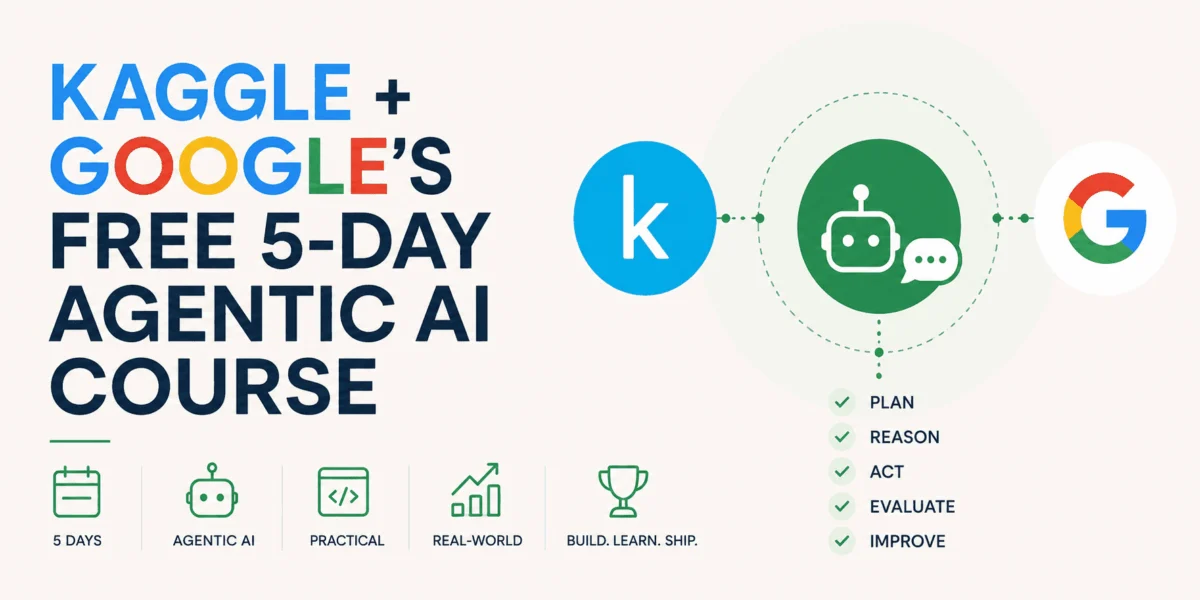
The landscape of artificial intelligence education reached a significant milestone in late 2025 as Google and Kaggle transitioned their record-breaking "5-Day AI Agents Intensive" into a permanent, self-paced learning resource. This move follows an unprecedented surge in global interest, where more than 1.5 million developers and enthusiasts registered for the live cohort in November 2025. Unlike traditional Massive Open Online Courses (MOOCs) that often suffer from low completion rates, this intensive saw high levels of engagement, resulting in over 11,000 verified capstone project submissions. This high conversion rate from registration to technical output underscores a shifting paradigm in how technical professionals consume high-level AI education and the growing demand for specialized "agentic" skill sets.
The decision to open the curriculum to the public as a self-paced Kaggle Learn Guide marks a strategic effort by Google to democratize the development of autonomous AI systems. As the industry moves beyond simple chat interfaces and prompt engineering, the focus has shifted toward "agents"—AI systems capable of planning, using tools, and executing multi-step workflows with varying degrees of autonomy. This transition is viewed by industry analysts as the "next frontier" of the generative AI era, moving from passive content generation to active task execution.
Historical Context and the Evolution of the Intensive Series
The 2025 Agentic AI Intensive did not emerge in a vacuum. It was the direct successor to the 2024 Generative AI (GenAI) Intensive, an event that originally drew 140,000 participants. The 2024 program eventually led to a rerun that secured a Guinness World Record for the largest virtual AI conference, signaling a massive appetite for structured, vendor-backed technical training. While the 2024 curriculum focused on the fundamentals of Large Language Models (LLMs) and basic integration, the 2025 iteration narrowed its scope significantly to address the complexities of agentic workflows.
In June 2026, the organizers further expanded the program with a refreshed run themed around "vibe coding"—a term popularized by industry leaders like Andrej Karpathy to describe a high-level approach to programming where developers focus on intent and architectural "vibes" while AI handles the syntactic heavy lifting. This iterative approach to the curriculum ensures that the material remains relevant in a field where six months can represent an entire generation of technological progress.
Technical Framework: The Five-Day Curriculum Breakdown
The curriculum is structured into five distinct modules, each designed to bridge the gap between theoretical understanding and production-ready implementation. Each module pairs a technical whitepaper with two hands-on codelabs utilizing the Gemini API and Google’s Agent Development Kit (ADK).
Day 1: Foundations of Agentic Architecture
The program begins by defining the specific parameters of an "agent." Participants are challenged to distinguish between simple automated workflows and true agentic systems. The core focus is on agent architectures, teaching developers how to build single-agent systems before progressing to multi-agent environments where different models collaborate to solve complex problems. This foundational day addresses the critical question of "agentic necessity"—determining whether a task actually requires an autonomous agent or if it can be more efficiently handled by a deterministic script.
Day 2: Tool Use and the Model Context Protocol (MCP)
On the second day, the curriculum introduces the concept of "tool use" or "function calling." This is the mechanism through which an LLM interacts with the physical or digital world, such as querying a database or sending an email. A significant portion of this module is dedicated to the Model Context Protocol (MCP), an emerging industry standard that facilitates interoperability between agents and external systems. Furthermore, the course emphasizes "human-in-the-loop" (HITL) design. This architectural choice ensures that for high-stakes or long-running operations, the agent must seek human approval, addressing a primary safety concern in autonomous AI deployment.
Day 3: Context Engineering and Persistent Memory
One of the most significant hurdles in AI development is the "stateless" nature of standard LLM calls. Day three focuses on context engineering and the creation of stateful agents. This involves building systems that can remember user preferences and past interactions across multiple sessions. By implementing long-term memory structures, developers can move away from "goldfish" models that reset after every interaction, allowing for more sophisticated, personalized user experiences.
Day 4: Quality Control and Observability
As AI systems move into production, the "black box" nature of LLMs becomes a liability. The fourth day of the intensive addresses agent quality through the lens of logging, tracing, and metrics. Participants learn how to evaluate not just the final output of an agent, but the intermediate steps of its reasoning and tool selection. This focus on "evals" (evaluations) is considered by many senior engineers to be the most critical skill for shipping reliable AI products, as it provides the data necessary to debug non-deterministic systems.
Day 5: Scaling from Prototype to Production
The final day covers the "last mile" of development. This includes the implementation of agent-to-agent protocols and the deployment of systems to managed runtimes, specifically the Vertex AI Agent Engine. This module is designed to transition a project from a local development environment (such as a Python notebook) into a scalable, cloud-hosted infrastructure capable of serving real-world users.
Supporting Data and Technological Requirements
The success of the course is attributed in part to its accessibility. The prerequisites are intentionally focused: a working knowledge of Python and basic experience with LLM APIs. By setting this entry bar, the program targets the vast middle-ground of the developer community—those who are proficient in coding but have not yet specialized in AI engineering.
Data from the November 2025 cohort suggests that the "hands-on" nature of the codelabs was the primary driver of completion. Unlike theoretical courses, the Google-Kaggle partnership provided participants with cloud credits and access to the Gemini 1.5 Pro and Flash models, allowing them to build and test in real-time without incurring significant personal costs. The 11,000 capstone submissions represent a diverse array of applications, ranging from automated research assistants to complex supply-chain optimizers, demonstrating the versatility of the agentic framework.
Industry Implications and Expert Analysis
The massive turnout for this intensive reflects a broader shift in the global labor market. As organizations increasingly seek to integrate AI into their core business processes, the demand for "AI Engineers"—a role distinct from traditional Data Scientists—has skyrocketed. AI Engineers focus on the orchestration of models rather than the training of the models themselves.
Industry experts suggest that by providing this curriculum for free, Google is positioning its Vertex AI and Gemini ecosystems as the standard for enterprise agent development. "The goal is to create an ecosystem of developers who are fluent in Google’s specific agentic protocols," noted one independent tech analyst. "When 1.5 million people learn to build agents using your tools, you aren’t just teaching; you’re setting the industry standard for the next decade of software engineering."
The emphasis on "Agent Quality" on Day 4 has been particularly praised by the developer community. In a field often criticized for "hype," the focus on rigorous evaluation and tracing suggests a move toward maturity. It acknowledges that building an agent is relatively easy, but building a reliable agent is a complex engineering challenge.
Future Outlook: The Democratization of Agentic AI
The transition of the 5-Day AI Agents Intensive into a permanent Kaggle Learn Guide ensures that the knowledge remains accessible as the technology continues to evolve. For the global developer community, this represents a significant opportunity to upskill in a high-demand area without the financial barriers often associated with specialized technical certifications.
The inclusion of the "vibe coding" philosophy in later iterations of the course also points to a future where the barrier to entry for complex system design continues to lower. As agents become better at understanding high-level intent, the role of the developer may shift from writing code to auditing the logic and safety of agent-generated workflows.
In conclusion, the Google and Kaggle Agentic AI course stands as a benchmark for technical education in the mid-2020s. Its combination of massive scale, rigorous technical depth, and a focus on production-ready skills has created a new blueprint for how the tech industry addresses the rapid evolution of artificial intelligence. For the 1.5 million who have already participated, and the millions more who now have access to the self-paced materials, the course provides the foundational tools necessary to navigate and build the next generation of autonomous digital systems.

