The landscape of private digital communication has undergone a significant architectural shift as the widely utilized secure messaging application Signal officially released version 8.30. This milestone release marks the culmination of a multi-year engineering effort to bring robust, end-to-end encrypted chat backups to every supported operating system in the application’s ecosystem, encompassing Android, iOS, Linux, macOS, and Windows.
For years, the absence of a standardized, seamless, and deeply secure cross-platform backup solution was viewed by privacy advocates and casual users alike as one of Signal’s primary friction points. While competitors such as WhatsApp and Telegram offered cloud-based synchronization and backup paradigms—often at the expense of metadata privacy or comprehensive zero-knowledge encryption—Signal prioritized a strict data-minimization philosophy. The introduction of version 8.30 signals a refined balance between uncompromising cryptographic security and modern user convenience, ensuring that migrating chat histories between disparate devices or recovering from hardware loss no longer requires sacrificing peace of mind.
The Genesis and Evolution of Signal’s Backup Architecture
The journey toward a universal backup infrastructure began nearly a year prior to the version 8.30 deployment, when Signal initially introduced secure cloud-based backups to its Android user base. Prior to that rollout, Android users relied on localized, file-based backups that required manual handling, while iOS users faced even stricter limitations, often having to rely on full Apple iCloud device backups to restore chat histories. Desktop applications, meanwhile, operated almost entirely in isolation, requiring fresh device linkages that left historical messages behind.
Recognizing the architectural complexities of creating a unified system that could function seamlessly across mobile and desktop environments without compromising user privacy, Signal’s engineering team devised a dual-track strategy. This strategy separated the storage and management of text-based message archives from media attachments, optimizing synchronization efficiency while maintaining stringent cryptographic guarantees.
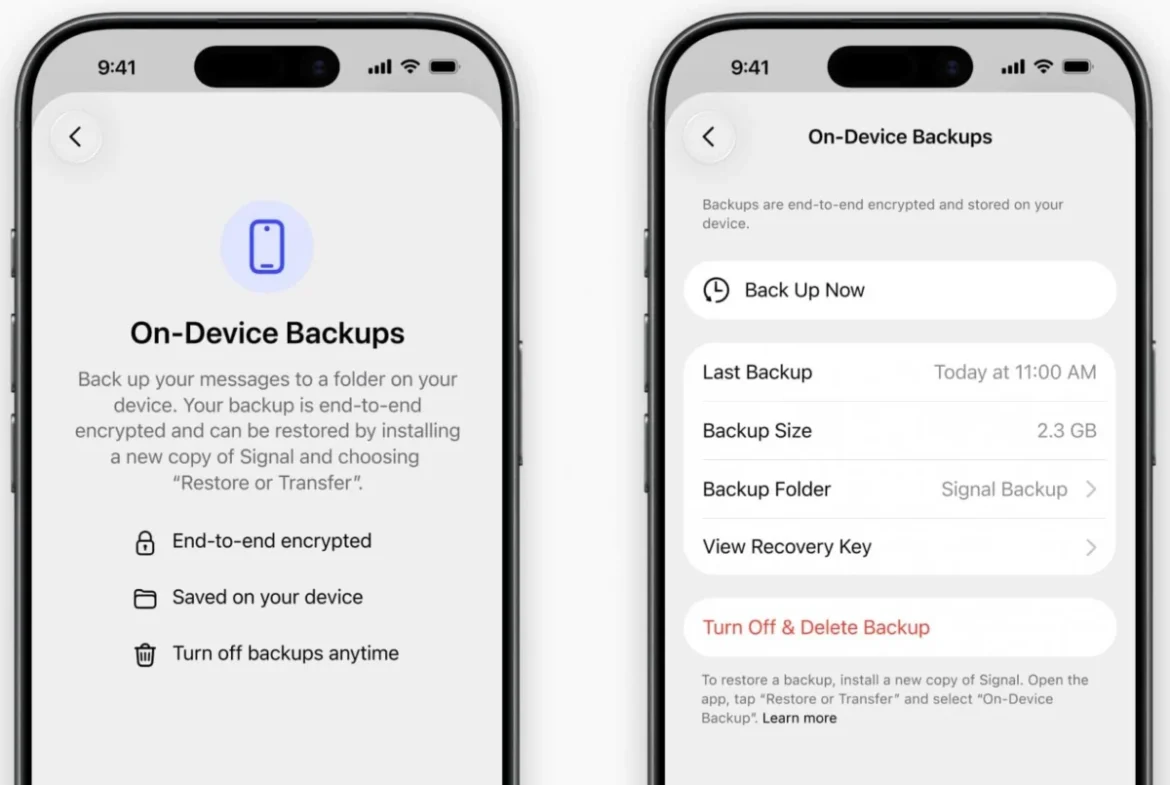
With the deployment of version 8.30, this architecture has been finalized and standardized. The update revamps the legacy Android backup format to align with the new cross-platform standard, while simultaneously introducing local, on-device backups to iOS and desktop clients. Furthermore, the update introduces a direct iPhone-to-iPhone transfer mechanism utilizing a local, end-to-end encrypted Wi-Fi Aware link, drastically improving the speed and reliability of device migrations for Apple users.
Anatomy of the Backup Options: Hosted versus Local
Signal’s newly completed backup ecosystem provides users with two distinct pathways for preserving their conversational data, catering to different storage needs, threat models, and financial commitments.
The first option involves Signal-hosted cloud backups. Under this model, free-tier users are granted backup storage limited to 45 days of media history and a strict 128-kilobyte restriction per individual message. For users requiring long-term archiving of extensive media libraries, paid subscription tiers expand this capacity up to 100 gigabytes.
Crucially, both hosted and local backups are protected by robust encryption standards, requiring a unique user-generated recovery key to decrypt the underlying data. However, hosted backups incorporate an additional layer of security: a supplemental encryption key that rotates daily within a Trusted Execution Environment (TEE). This design ensures forward secrecy, meaning that even if long-term storage parameters were somehow compromised, historical daily sessions remain protected by ephemeral cryptographic states.
The second option focuses entirely on on-device, local backups. Unlike the cloud-hosted alternative, local backups feature no artificial size restrictions, allowing users to store exhaustive chat logs and large media files directly on their hardware. According to technical specifications released by the platform, a single on-device backup recovery key possesses the mathematical capability to decrypt all past backup files it has encrypted, regardless of the physical storage medium housing them.
The Security Implications and Adversarial Landscape
While the implementation of zero-knowledge, end-to-end encrypted backups represents a major victory for digital privacy, it has simultaneously introduced new vectors of interest for sophisticated threat actors. Because the recovery key is the single point of failure required to unlock a user’s entire messaging history, it has rapidly become a high-value target in the realm of digital espionage and cybercrime.
Shortly after Signal first introduced its backup recovery key mechanisms, intelligence agencies and advanced persistent threat (APT) groups took notice. Cybersecurity analysts and threat intelligence reports have documented instances where nation-state actors—including groups linked to foreign intelligence services—have incorporated the targeting of Signal backup recovery keys into their operational scopes. Adversaries recognize that compromising a target’s device or intercepting recovery keys during cloud synchronization can yield a treasure trove of sensitive, previously encrypted communications.
This adversarial attention underscores a fundamental tenet of operational security: encryption is only as secure as the endpoints managing the keys. Signal’s engineering choices—such as separating media from the main backup archive and ensuring duplicate files are stored only once—help mitigate the physical footprint of stored data, but users remain ultimately responsible for the safekeeping of their recovery credentials.
Technical Enhancements and Storage Optimizations in Version 8.30
Beyond the expansion of backup support to iOS and desktop operating systems, Signal version 8.30 introduces several under-the-hood optimizations designed to streamline data management and network efficiency.
Chief among these improvements is the decoupling of media files from the primary backup archive. In previous iterations, backing up a chat history often resulted in bloated files and redundant data storage. The new system ensures that duplicate media files are stored only once across the archive, eliminating excessive synchronization loops and conserving valuable device storage.
For premium or paying users, version 8.30 introduces an advanced storage-management feature. Users can now opt to purge old media files from their local device storage—retaining only lightweight thumbnails—while maintaining the ability to automatically and dynamically retrieve full-resolution media files on-demand from their hosted cloud backups. This hybrid approach mirrors the cloud-storage optimization techniques seen in mainstream consumer operating systems, tailored specifically to a privacy-centric messaging protocol.
Handling of Ephemeral Data and Disappearing Messages
A critical design consideration for any secure messaging platform is the handling of ephemeral data, specifically features designed to auto-delete messages after a specified duration. Signal’s version 8.30 establishes strict rules governing how disappearing messages interact with the new backup architecture.
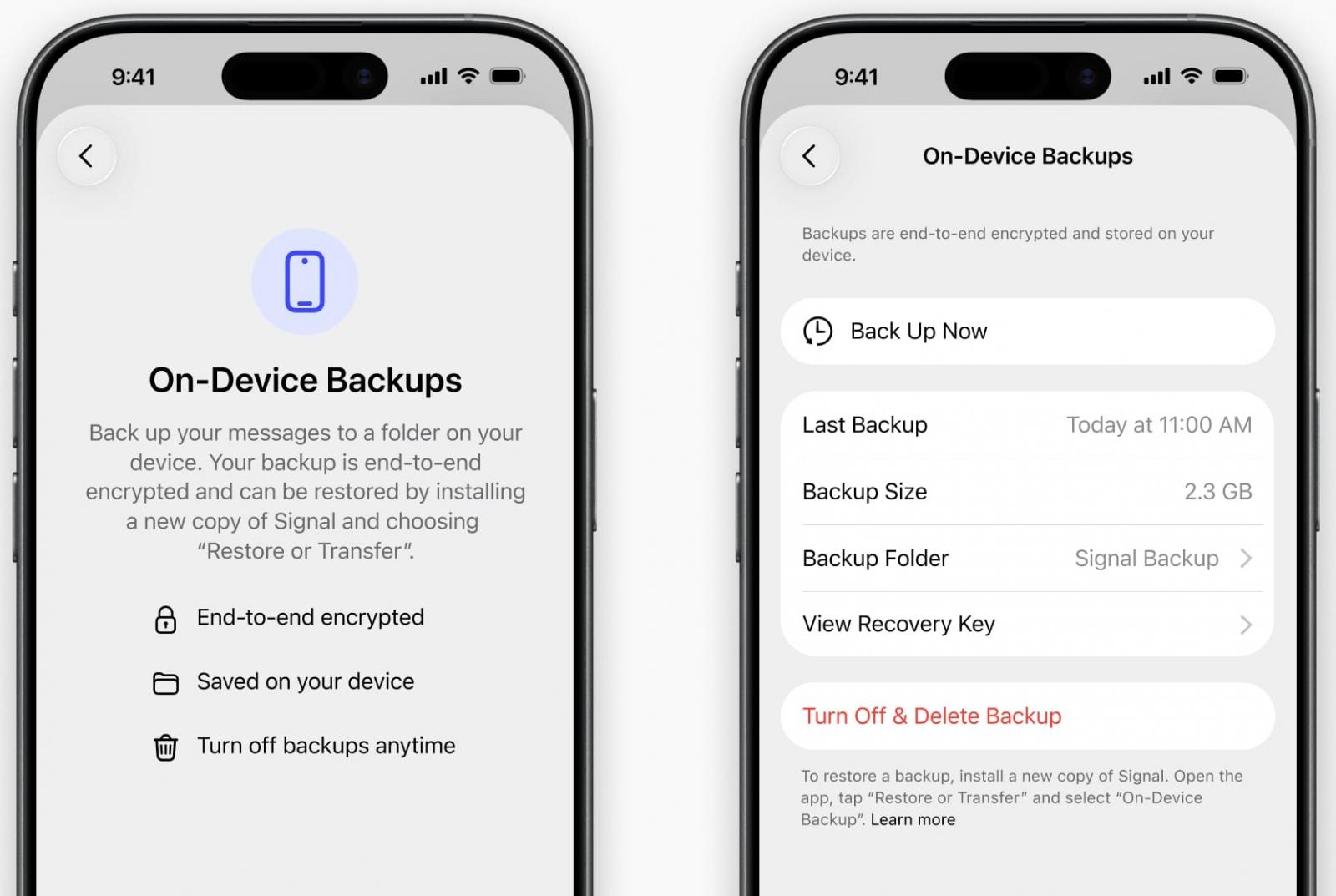
The backup system is explicitly programmed to ignore disappearing messages configured to vanish within 24 hours on both hosted and local backup methods. By intentionally excluding these ultra-short-term messages from the archive, Signal ensures that the spirit of ephemerality is not violated by persistent storage archives.
For users who maintain both hosted and local backups simultaneously, the platform clarifies that generating a cloud backup does not overwrite or wipe existing local archives. However, during the restoration process, any expired disappearing messages encountered within local backups will be systematically skipped, preventing resurrected digital ghosts from populating restored chat logs.
Direct Device-to-Device Transfers for iOS
Addressing a long-standing pain point for Apple device users, the iOS client release in version 8.30 introduces a native, direct iPhone-to-iPhone transfer capability. Rather than routing device migrations exclusively through external cloud services or cumbersome computer backups, users can now establish a local, end-to-end encrypted Wi-Fi Aware link between their old and new iPhones.
Signal engineers note that this direct-transfer protocol significantly improves both the speed and the reliability of setting up a new device. When a new device is successfully linked from a primary device, the system automatically queries and retrieves older attachments that may have previously been missing from the local chat history, ensuring a seamless continuity of the user experience.
Broader Industry Impact and Future Outlook
The completion of Signal’s universal backup rollout marks a mature transition for the non-profit organization. By solving the complex engineering hurdles of multi-platform, end-to-end encrypted synchronization without compromising its core cryptographic principles, Signal has raised the benchmark for privacy-focused consumer software.
With the first phase of the overarching backups project now officially complete, statements from the organization indicate that engineering resources will pivot toward optimizing non-backup systems, protocol performance, and core messaging infrastructure.
As digital surveillance grows increasingly sophisticated and regulatory pressures on encrypted communications mount globally, Signal’s architecture serves as a blueprint for how privacy advocates can scale secure technologies to meet mainstream expectations. However, as threat actors continue to pivot their tactics toward endpoint compromise and key extraction, the ultimate success of these features will rely equally on user vigilance and ongoing cryptographic hardening by the development community.