
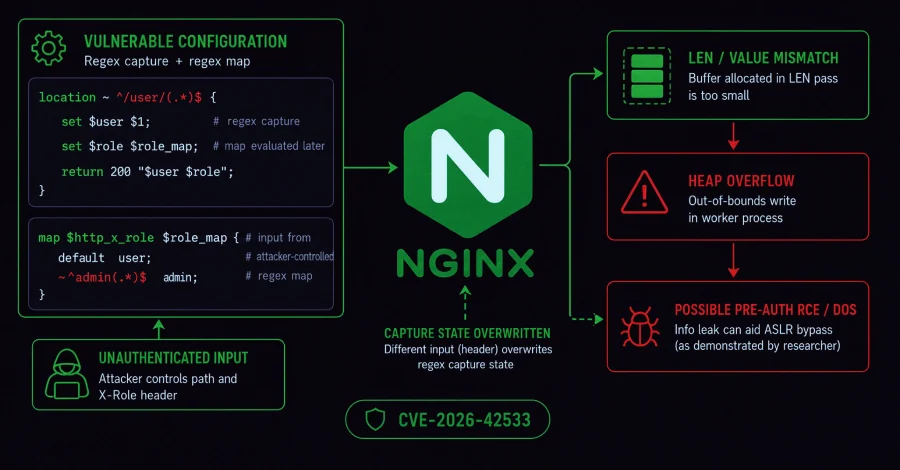
F5 has released critical security patches for a severe vulnerability, tracked as CVE-2026-42533, affecting its widely used NGINX web server and related products. The flaw, a heap buffer overflow, can be triggered by a remote, unauthenticated attacker through specially crafted HTTP requests, potentially leading to a denial of service (DoS) or, under specific conditions, remote code execution (RCE). The patches were deployed on July 15, with NGINX 1.30.4 (stable), 1.31.3 (mainline), and NGINX Plus 37.0.3.1 addressing the issue. Users running earlier versions are strongly advised to upgrade their installations immediately.
Understanding the Severity: NGINX’s Ubiquitous Role
NGINX, pronounced "engine-x," is an open-source web server that also functions as a reverse proxy, load balancer, mail proxy, and HTTP cache. Renowned for its high performance, stability, rich feature set, and low resource consumption, NGINX powers a significant portion of the world’s web infrastructure. According to various market surveys, NGINX is consistently one of the most popular web servers, handling traffic for over a third of the internet’s busiest websites, including major content providers, social networks, and cloud services. Its critical role means that any severe vulnerability, especially one allowing unauthenticated remote access, poses a substantial threat to global internet stability and security.
A heap buffer overflow, such as CVE-2026-42533, occurs when a program writes data past the end of an allocated block of memory on the heap. This can corrupt adjacent data, leading to unpredictable program behavior, crashes, or, in more severe cases, allow an attacker to execute arbitrary code. In the context of NGINX, a crash in a worker process would result in a denial of service, rendering the server temporarily unavailable. The potential for remote code execution, however, is far more alarming, as it could grant an attacker full control over the compromised server, allowing for data exfiltration, further network penetration, or the deployment of malicious payloads. The fact that this vulnerability can be exploited without authentication further elevates its risk profile, making it accessible to a wide range of threat actors.
The Technical Deep Dive: A Flaw in NGINX’s Script Engine
The heart of CVE-2026-42533 lies within NGINX’s script engine, a core component responsible for assembling strings from directives at request time. Specifically, the vulnerability manifests under a very particular configuration: when a regex-based map directive’s output variable is referenced in a string expression after a capture from an earlier regex match.
NGINX’s script engine employs a two-pass evaluation mechanism for processing these string expressions. In the first pass, the engine calculates the necessary buffer size required to accommodate the resulting string. Subsequently, a second pass writes the actual bytes into the allocated buffer. The critical flaw emerges because both passes read from the same shared capture state. When a map‘s regex is evaluated between these two passes, it inadvertently overwrites this shared capture state.

This sequence of events creates the buffer overflow:
- First Pass (Sizing): The engine measures the buffer size based on the original capture, typically a reference like
$1from a location match. - Intervening Action: The
mapdirective’s regex is evaluated, overwriting the shared capture state with a potentially different, attacker-controlled value. - Second Pass (Writing): The engine proceeds to write the string content into the previously allocated buffer, but now it uses the new, attacker-sized capture state.
Since the buffer was sized for the smaller, original capture, and the writing pass attempts to fill it with a larger, attacker-controlled value, the buffer overflows. Both the length of the overrun and the content written beyond the buffer’s boundaries can be directly controlled by the attacker via their crafted HTTP request. This precise control over memory corruption is what makes heap overflows so dangerous, as it can be leveraged to manipulate program execution flow.
Chronology of Discovery and Patch Deployment
The vulnerability was independently reported to F5 by more than a dozen security researchers, highlighting the widespread attention and concern this flaw generated within the cybersecurity community. This collaborative, independent discovery process underscores the vigilance of researchers in identifying critical issues in widely deployed software. F5 publicly acknowledged these contributions, specifically crediting Mufeed VH of Winfunc Research and NGINX maintainer Maxim Dounin for their roles in the fix.
The patches for CVE-2026-42533 were released on July 15, 2026.
- NGINX Stable Branch: Upgraded to version 1.30.4.
- NGINX Mainline Branch: Upgraded to version 1.31.3.
- NGINX Plus: Upgraded to version 37.0.3.1.
The vulnerability’s lineage is remarkably long, impacting every NGINX version from 0.9.6 through 1.31.2. This extensive range stretches back to 2011, the year regex support was introduced to the map directive, meaning that systems that have not been rigorously updated for over a decade could be susceptible if they employ the specific vulnerable configuration.
Severity Assessment: CVSS Scores and Attack Complexity
F5 has assigned CVE-2026-42533 a high severity rating, reflected in its Common Vulnerability Scoring System (CVSS) scores. On the newer CVSS v4 scale, it scores 9.2, indicating a critical threat. On the older CVSS v3.1 scale, it scores 8.1.

To understand these scores, it’s helpful to break down the CVSS metrics:
- CVSS v3.1 Base Score (8.1, High):
- Attack Vector (AV): Network: Exploitable remotely over the network, without physical access.
- Attack Complexity (AC): High: F5’s initial assessment indicated that specialized conditions or techniques are required to successfully exploit the vulnerability. This typically implies that not just any crafted request will work, but specific, perhaps complex, conditions must be met.
- Privileges Required (PR): None: An attacker does not need any special access or accounts on the target system.
- User Interaction (UI): None: No human interaction (e.g., clicking a link) is required from the victim.
- Scope (S): Unchanged: The vulnerability affects resources only within its security scope.
- Confidentiality (C): High: Significant disclosure of information.
- Integrity (I): High: Significant modification of information.
- Availability (A): High: Significant disruption of service.
The CVSS v4 score of 9.2 further underscores the critical nature, often pushing it into the "Critical" category. While F5 initially rated the attack complexity as "High," this assessment has been challenged by independent research, as detailed below.
The Researcher’s Perspective: Stan Shaw’s Alarming Insights
Among the researchers who reported the flaw, Stan Shaw, publishing under the pseudonym "cyberstan," has provided a particularly detailed and concerning write-up of CVE-2026-42533 on his blog. Shaw’s analysis goes significantly further than F5’s official advisory, particularly regarding the potential for remote code execution.
While F5’s advisory conditions RCE on Address Space Layout Randomization (ASLR) being disabled or bypassable, Shaw argues that the vulnerability itself provides the necessary bypass. ASLR is a crucial security feature employed by modern operating systems to randomize the memory locations of executable code and data, making it significantly harder for attackers to predict memory addresses required for RCE exploits. Shaw’s assertion that the flaw can circumvent ASLR means that RCE might be achievable on default, hardened systems, not just those with weakened security configurations.
Shaw’s research revealed that when the clobbered capture (the attacker-controlled value) is smaller than the original capture, the oversized buffer allocated in the first pass can return uninitialized heap data. On a default Ubuntu 24.04 build, Shaw demonstrated that a single unauthenticated GET request is sufficient to recover the critical memory addresses needed to construct a functional RCE payload. This effectively bypasses ASLR by leaking memory layout information.
"A reader of the F5 advisory could reasonably conclude this is DoS-only on default systems. It is not," Shaw emphatically stated in an interview with The Hacker News. This stronger claim, which Shaw asserts hit 10 out of 10 in his own testing, significantly elevates the perceived risk of CVE-2026-42533. Shaw has responsibly chosen to withhold specific exploitation details and a proof-of-concept (PoC) for now, allowing organizations a window to patch before exploit code becomes publicly available. This aligns with standard responsible disclosure practices, balancing the need for awareness with the risk of enabling malicious actors.
Affected NGINX Ecosystem and Downstream Products

The impact of CVE-2026-42533 extends beyond the core NGINX server and NGINX Plus. F5’s advisory lists several other critical NGINX-based products as affected, including:
- NGINX Ingress Controller: A key component in Kubernetes environments, responsible for managing external access to services within a cluster.
- NGINX Gateway Fabric: Part of F5’s modern application delivery stack.
- NGINX App Protect WAF: A web application firewall offering advanced security capabilities.
- NGINX Instance Manager: Used for centralized management of NGINX instances.
At the time of publication, F5 had not yet listed fixed builds for these four downstream products. This delay means that organizations relying on these integrated NGINX solutions might face a temporary gap in protection, even if their core NGINX servers are updated. This highlights a common challenge in the software supply chain, where vulnerabilities in foundational components often propagate across an ecosystem, requiring coordinated patching efforts. The Hacker News reached out to F5 for clarification on the timeline for these additional product fixes and the completeness of the suggested mitigations, but no response was available at publication.
Mitigation Strategies and Their Limitations
The most robust and complete defense against CVE-2026-42533 is to upgrade NGINX installations to the patched versions: 1.30.4 (stable), 1.31.3 (mainline), or NGINX Plus 37.0.3.1. Given the potential for RCE and the impending public release of a proof-of-concept, this should be treated as an urgent priority for all affected organizations.
For those who are unable to patch immediately, F5’s advisory suggests a temporary mitigation: switching affected regex maps to named captures instead of numbered captures ($1, $2, etc.). Stan Shaw confirms that this approach closes the primary exploitation path and covers most vulnerable configurations.
However, Shaw’s detailed research also uncovered a crucial limitation to this temporary mitigation. He found that a narrower exploitation path remains open even when using named captures. If a map directive defines the same named group as the location regex, the same heap overflow can be triggered through a secondary code path. Shaw confirmed this variant with AddressSanitizer, a powerful memory error detector. This critical detail, not mentioned in F5’s official advisory, reinforces his conclusion: "Upgrading to 1.30.4 / 1.31.3 is the only complete fix." Organizations relying on the temporary mitigation should be aware of this remaining exposure.
Identifying vulnerable configurations can be complex, as exposure depends on specific NGINX configuration directives rather than just the version number. To assist administrators, Shaw has developed and released a configuration scanner on GitHub (0xCyberstan/CVE-2026-42533-Config-Scanner). This tool automates the process of checking NGINX configurations, following include directives, and specifically flagging only the exploitable ordering: a regex-based map whose variable appears in a string expression alongside a numbered capture from an earlier regex, with the capture written ahead of the map variable. While the scanner itself does not exploit the vulnerability, it provides a valuable resource for identifying at-risk systems.
A Pattern of Vulnerabilities: NGINX’s Two-Pass Engine Under Scrutiny

CVE-2026-42533 is not an isolated incident but rather the third heap overflow vulnerability disclosed in NGINX’s expression-evaluation code within approximately two months. This emerging pattern raises concerns about the underlying design of this critical component.
The preceding vulnerabilities include:
- Rift (CVE-2026-42945): Disclosed in May, this flaw was also a heap buffer overflow. Its trigger involved a stale flag within the script engine, leading to incorrect buffer sizing. Alarmingly, an exploit for Rift was made public within days of its disclosure, and active exploitation in the wild followed swiftly, underscoring the rapid transition from vulnerability disclosure to active threat.
- Overlapping Captures Bug (CVE-2026-9256): Discovered just days after Rift, this vulnerability resided in the rewrite module and also involved a heap overflow stemming from issues with overlapping captures during string processing.
All three vulnerabilities share a common architectural weakness: NGINX’s two-pass script engine. In each case, the first pass measures the size required for a buffer, and the second pass writes data into it. The flaw arises when an unexpected state change or interaction between directives causes the conditions or assumptions from the first pass to be invalidated by the time the second pass executes. Whether it’s a stale flag, overlapping captures, or clobbered capture state, the root cause remains the same: the write operation outruns the size measured by the initial pass because the engine trusts its own initial measurement without re-validating the underlying data state. This pattern suggests a systemic design challenge within this specific NGINX component that warrants deeper investigation and potential re-architecture to prevent future occurrences of similar memory safety issues.
Call to Action and Future Outlook
As of July 20, 2026, CVE-2026-42533 had not yet been added to CISA’s Known Exploited Vulnerabilities (KEV) catalog, nor had any public exploit code appeared. However, the experience with Rift (CVE-2026-42945), where public exploits and active exploitation emerged rapidly after disclosure, serves as a stark warning. Stan Shaw’s commitment to publishing his own proof-of-concept 21 days after the patch release means that the window of opportunity for attackers to develop their own exploits is rapidly closing.
Organizations running NGINX versions 0.9.6 through 1.31.2, particularly those with configurations matching the identified vulnerable pattern, face an immediate and critical risk. The urgency to upgrade to NGINX 1.30.4, 1.31.3, or NGINX Plus 37.0.3.1 cannot be overstated. Relying solely on temporary mitigations, especially given Shaw’s findings about their incompleteness, is a precarious strategy. The security community will be closely monitoring the situation for the release of PoC code and any signs of active exploitation, which would necessitate an even more rapid response from system administrators worldwide. The continued discovery of critical flaws in foundational internet technologies like NGINX underscores the ongoing challenge of securing complex software and the critical role of vigilant patching.

