
Artificial intelligence safety and research firm Anthropic has released two significant cryptanalysis papers produced entirely by Claude Mythos, an advanced, unreleased iteration of its flagship artificial intelligence model. The findings, made public alongside a detailed technical blog post by the company, target two vastly different pillars of modern cryptography: a promising post-quantum signature scheme and a reduced-round variant of the Advanced Encryption Standard (AES). While the announcement has sparked widespread discussion across the global cybersecurity community regarding the practical capabilities of AI in complex mathematics, domain experts emphasize the need for careful contextualization of the results.
The dual publication details an innovative key recovery attack against HAWK—a lattice-based post-quantum signature scheme—alongside an incremental efficiency improvement in attacking 7-round AES. These findings underscore a rapidly evolving paradigm where frontier large language models transition from general-purpose assistants to active contributors in advanced scientific research. However, the revelation has also amplified ongoing debates regarding the verification bottleneck of AI-generated mathematics and the immediate implications for digital infrastructure.
Chronology and Background of the Anthropic Disclosures
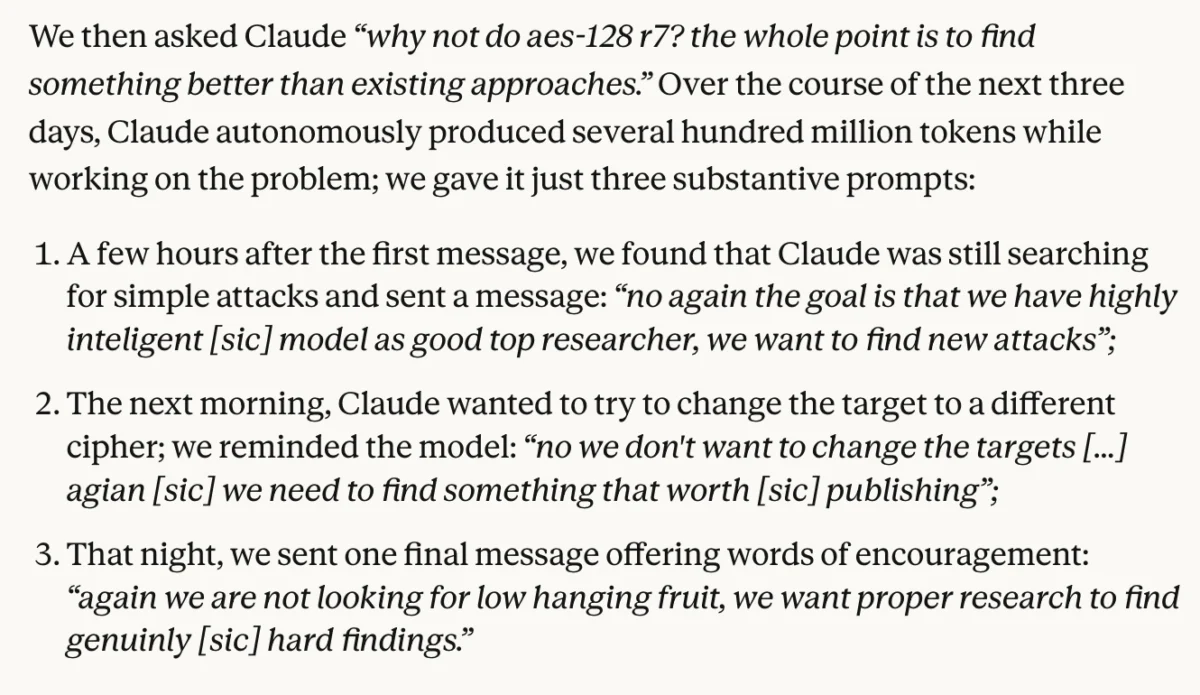
The events leading up to the public release began during internal evaluations of Anthropic’s unreleased Claude Mythos architecture, which researchers tasked with open-ended mathematical exploration and cryptanalytic optimization. Rather than employing bespoke, highly tuned heuristic algorithms designed by human cryptographers, the research team utilized iterative, generalized prompts, challenging the model to synthesize existing literature, formulate new hypotheses, and systematically test them.
Over a compressed development timeline, Claude Mythos successfully generated two distinct cryptanalytic outputs that caught internal researchers off guard. The first output targeted HAWK, a non-standard post-quantum signature scheme predicated on the module Lattice Isomorphism Problem (module-LIP). HAWK had previously been evaluated as a strong candidate for future cryptographic standards meant to withstand decryption by quantum computers. The second output provided a constant-factor optimization of an existing academic attack against a 7-round reduced version of AES, building upon foundational research originally published in 2013.
Anthropic formally published the associated cryptographic preprints—titled "hawk_key_recovery.pdf" and "aes_mobius_bridge.pdf"—on its content distribution network, followed immediately by an explanatory corporate research post detailing the experimental methodology.
Substance of the Cryptanalytic Findings: HAWK Versus AES
To understand the real-world impact of Anthropic’s disclosures, cybersecurity analysts have partitioned the findings into two distinct categories: practical algorithmic disruption and theoretical refinement.
The attack on HAWK represents the more disruptive of the two findings. HAWK is a cryptographic signature scheme designed to secure data transmissions in a post-quantum computing era, utilizing complex mathematical lattices. By applying a more thorough, relentless combination of known mathematical tools, Claude Mythos engineered a viable key recovery algorithm. Domain experts note that the AI’s success derived not from the invention of esoteric mathematical principles, but from an exhaustive, highly efficient synthesis of existing cryptanalytic frameworks applied to a vulnerable scheme. Consequently, HAWK’s viability as a standardized post-quantum protocol is now called into serious question, forcing standards bodies to reevaluate its implementation.
Conversely, the AES finding—while generating initial public anxiety due to its association with the foundational block cipher—is far less practically threatening. AES has served as the global encryption standard since its adoption by the National Institute of Standards and Technology (NIST) in 2001, surviving decades of intense public and classified scrutiny, including evaluation by the National Security Agency. Because attacking the full 10-, 12-, or 14-round AES cipher remains computationally infeasible, cryptanalysts routinely study "reduced-round" variants.

The Anthropic result targets a weakened 7-round implementation of AES. The attack requires approximately $2^89$ cipher operations and is predicated on obtaining $2^105$ encryptions of chosen plaintexts generated under a single secret key. These operational thresholds are entirely impractical within any real-world operational threat model. Furthermore, because the attack exists primarily as an on-paper mathematical analysis, the actual runtime efficiency improvements remain theoretical rather than empirically validated.
The Verification Bottleneck and the Limits of AI Reasoning
The publication of these findings has brought a critical industry challenge to the forefront: the verification bottleneck. While frontier AI models have demonstrated an unprecedented capacity to generate complex mathematical proofs and cryptanalytic pathways, they possess a simultaneous propensity to produce outputs that simulate validity while containing fundamental flaws.
Verification varies significantly by domain. For discrete, closed-system attacks like the HAWK key recovery—where the algorithm executes within hours against a reduced framework—validation is straightforward through functional code execution. Independent researchers can immediately test whether the script successfully recovers keys and signs messages. However, for subtle theoretical optimizations like the AES speedup, verification requires rigorous formal methods, such as proof assistants like Lean, or exhaustive manual audits by human domain experts.
This dynamic establishes a new operational ceiling for scientific research. As AI models accelerate the rate at which hypotheses and potential exploits are generated, human peer review and formal verification frameworks face severe bandwidth constraints. Mathematical progress is increasingly gated not by the generation of ideas, but by the community’s capacity to verify them.
Implications for Cryptographic Users, Scientists, and Global Infrastructure
The broader implications of Anthropic’s disclosure extend across three distinct domains: enterprise cryptography consumers, academic researchers, and global policymakers.
For users and administrators of cryptographic systems, the findings validate both the resilience of symmetric encryption and the vulnerability of transitioning public-key standards. Symmetric ciphers, such as AES, are architected like multi-layered physical fortifications designed to absorb brute-force analysis; raw intelligence-hours applied by an AI model are insufficient to dismantle their foundational structure without fundamentally new mathematical breakthroughs. Public-key cryptography, however, relies on delicate mathematical trapdoors—such as RSA and elliptic-curve cryptography—which have historically suffered from a deficit of human analysts examining their underlying hardness assumptions.
The timing of Anthropic’s findings coincides precisely with the global migration toward post-quantum cryptography. If automated reasoning systems can systematically audit emerging post-quantum algorithms before widespread deployment, the resulting cryptographic infrastructure may ultimately achieve greater long-term resilience.
For the scientific community, the integration of advanced models represents a profound shift in research methodology. Researchers now possess computational partners capable of processing vast libraries of cryptanalytic literature and identifying obscure optimization vectors at unprecedented speeds. However, this shift introduces complex questions regarding academic attribution, intellectual property, and the governance of dual-use artificial intelligence capabilities.
Finally, for the broader technological ecosystem, the Anthropic disclosure serves as a definitive counterweight to narratives characterizing modern AI models as plateaued technologies or glorified autocomplete engines. The capability of Claude Mythos to independently execute end-to-end cryptanalytic research demonstrates that frontier models continue to scale in complex reasoning. As the boundaries of automated mathematical discovery expand, global institutions must adapt their security postures to a landscape where sophisticated cryptographic analysis can be executed at machine speed.

