
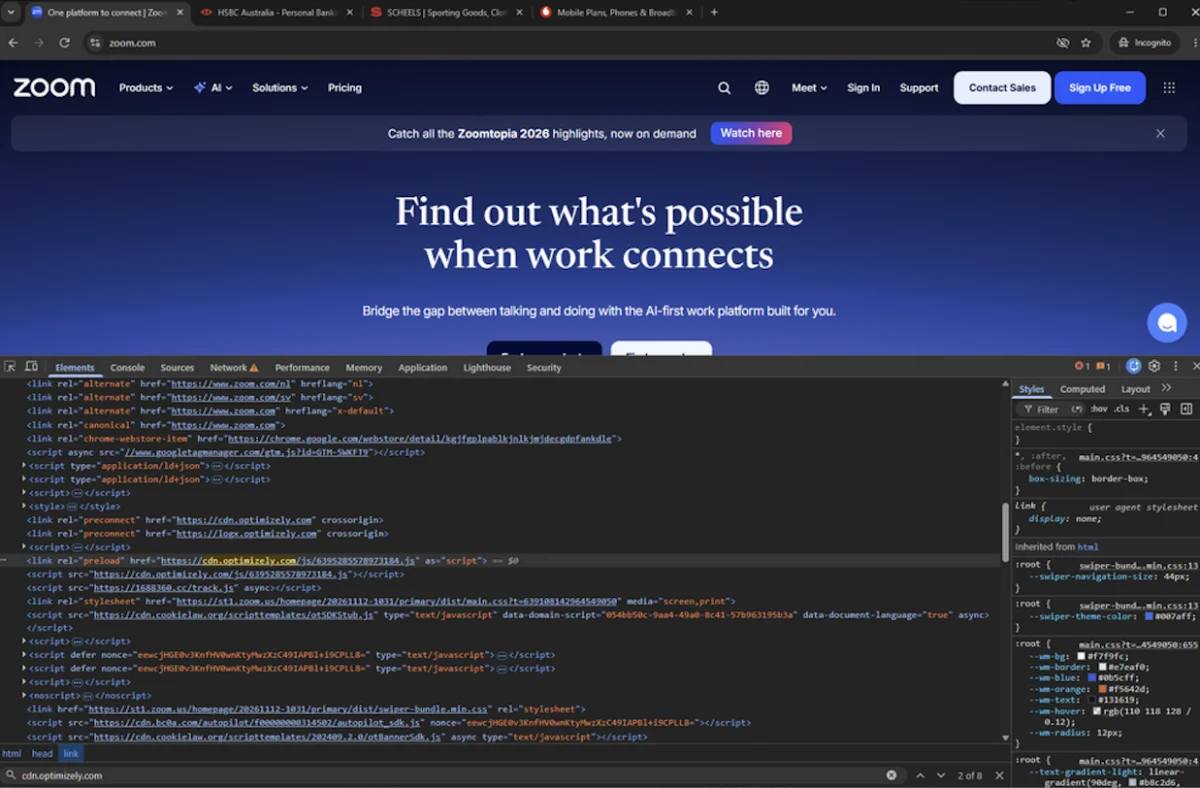
In an urgent reminder of the fragile interconnectedness of the modern digital ecosystem, at least 178 high-profile web destinations unwittingly served malicious software exploits to millions of unsuspecting visitors. The multi-pronged cyberattack stemmed from a security compromise involving Optimizely, a widely adopted platform that enterprise websites use to customize user experiences and run feature experimentation. Security experts revealed that data-stealing payloads were silently injected into household-name domains, including the British Broadcasting Corporation (BBC), CNN, Equifax, Ledger, and Zoom.
The incident highlights a systemic vulnerability across the internet: the widespread failure of website operators to enforce strict security boundaries on third-party code. As modern websites increasingly rely on external vendors to power everything from analytics to user interface tweaks, a single point of failure at a supply chain vendor can instantly snowball into a massive, global security crisis.
Anatomy of the Exploit: How the Optimizely Breach Unfolded
The security incident began when malicious actors successfully compromised a component of Optimizely’s Experimentation platform. According to an extensive technical analysis published by security firm Report URI, the breach went live on November 16, injecting malicious JavaScript code directly into the workflows of 178 major organizations.
Scott Helme, a security researcher at Report URI, noted that the threat actors were actively refining their attack infrastructure throughout the day. The primary payload was rebuilt a staggering 26 times within a 24-hour window. This dynamic restructuring allowed the attackers to evade early signature-based detection mechanisms while deploying a multi-purpose malware kit designed to siphon sensitive user data.
The injected scripts were capable of harvesting payment card details, browser cookies, and system screenshots. Furthermore, the malware featured malicious functionality designed to monitor cryptocurrency transactions, quietly swapping legitimate user-facing payment addresses with wallets controlled by the threat actors.
Compounding the severity of the incident, the compromised websites also served specialized exploit code targeting legacy mobile devices. Specifically, the payload included instructions tailored to exploit known vulnerabilities in older Apple iPhones and iPads. These zero-click exploit kits—often referenced in threat intelligence circles by names such as "DarkSword" and "Coruna"—chain together multiple distinct security flaws. When executed, they grant complete administrative control over outdated devices without requiring any user interaction, allowing attackers to silently extract stored data.
The Mechanics of a Supply Chain Vulnerability
To understand how a third-party script can inflict such sweeping damage, security analysts point to the fundamental way modern web architecture functions. Many top-tier web properties refuse to render core content unless visitors consent to running dozens of third-party JavaScript files. JavaScript is a powerful, highly privileged web scripting language that executes directly on a user’s device, granting it the ability to read browser displays, track user behavior, and dynamically alter a webpage’s layout.
Optimizely’s product architecture requires its JavaScript snippets to be embedded as close to the top of a webpage’s Hypertext Markup Language (HTML) document as possible. Zach Edwards, a security researcher at Infoblox and co-founder of the ad-tracking firm DecryptAds, explained that this placement ensures the script is one of the first elements to render, a necessity for accurate A/B testing and performance metrics.
"To make the product work as expected, this code is set up to fire immediately on-page load, and not restrict rendering behind a consent dialog box," Edwards noted. Consequently, the supply chain attack bypassed typical user interaction hurdles. Victims did not need to click a malicious link or accept a prompt; the payload was served and executed the exact moment a user loaded an impacted page.
Optimizely Responds and Remediation Efforts Underway
Faced with mounting scrutiny, Optimizely moved quickly to isolate and contain the breach. In a formal statement released following the incident, the company confirmed that on November 16, it identified an unauthorized party exploiting a specific vulnerability within Optimizely Experimentation to inject malicious JavaScript into targeted customer projects.
"We acted swiftly to contain the incident and have fully remediated the identified vulnerability," Optimizely stated in an official release.
The company outlined a comprehensive remediation checklist, which included blocking access to the vulnerable path, deploying a permanent software patch, purging the malicious code from all impacted customer projects, terminating active user sessions, revoking security tokens, and resetting credentials for affected accounts. Additionally, Optimizely partnered with cloud infrastructure provider Cloudflare to deploy hardcoded network-level protections capable of intercepting and neutralizing any subsequent delivery attempts of the malicious code.

While internal remediation concluded rapidly, Optimizely confirmed it has engaged specialized third-party cybersecurity forensics firms to conduct a comprehensive, independent investigation into how the initial breach occurred. On November 18, the company published an initial incident report detailing its preliminary findings.
The Defense Gap: The Role of Content Security Policies
Despite the rapid response from Optimizely, security professionals emphasize that the true vulnerability lies in the lax security postures of the downstream websites that chose to run the compromised code. The most effective defense against this category of supply chain attack is the implementation of a Content Security Policy (CSP).
A CSP is an HTTP response header that allows site operators to restrict the domains from which a browser is permitted to load resources, such as scripts, images, and stylesheets. If a website enforces a strict CSP, an unauthorized or malicious third-party script injected via a compromised vendor will be blocked by the browser, rendering the attack harmless.
However, data gathered by Report URI reveals a startling lack of adoption among enterprise websites. Out of the 178 organizations impacted by the Optimizely incident:
- 68 websites had no Content Security Policy deployed whatsoever.
- 50 websites utilized a CSP, but their policies were configured too permissively, allowing both the malware payload and subsequent data exfiltration to proceed.
- Only 24 websites—representing a meager 15 percent of the affected total—had robust CSPs configured in a way that fully blocked the malicious script.
Broader web telemetry paints an equally grim picture. Data collected by crawler.ninja, a daily scanner run by Scott Helme that analyzes the top one million websites on the internet, indicates that overall CSP deployment across the web’s busiest properties hovers at a paltry 10 percent.
"Organizations are running all this code, but they don’t know what it’s doing," Helme remarked. "This is why we keep seeing such large-scale breaches in places where there are no checks and rules in place on the code we’re running, so this was kind of inevitable."
Financial Impact and the Threat of Automated Exploits
While the optics of having major brands like the BBC and Zoom unwittingly distribute malware are severe, the immediate financial and operational damages appear relatively contained. According to tracking metrics compiled by Report URI, the threat actors managed to siphon approximately $7,500 worth of cryptocurrency from affected users before the infrastructure was neutralized. The exact volume of compromised payment card records and harvested browser cookies remains unknown, though forensic audits are ongoing.
Nevertheless, security analysts warn that the relatively low financial yield should not breed complacency. The ease with which the Optimizely infrastructure was weaponized—combined with the automated capabilities increasingly afforded to attackers via artificial intelligence—signals a dangerous new baseline for web security. In the past, crafting complex multi-stage exploit chains required significant manual labor; today, generative tools allow threat actors to pivot, rebuild, and optimize payloads in real time.
Mitigation Strategies for End Users and Web Operators
For enterprise website operators, the primary takeaway from the Optimizely incident is the urgent need to audit third-party dependencies and invest the necessary engineering hours into deploying restrictive Content Security Policies. While configuring a CSP can be technically challenging and prone to breaking site functionality if mismanaged, security experts argue that it is a non-negotiable safeguard in an era defined by software supply chain compromises.
For everyday internet users, relying solely on website operators to secure the browsing experience is no longer viable. Historically, cybersecurity guidance urged consumers to install traditional antivirus software and enable local firewalls. Today, security professionals argue that modern ad-blocking and script-blocking browser extensions function as the true frontline firewall.
Tools equipped with advanced request-filtering capabilities can automatically intercept unauthorized third-party JavaScript files before they execute in the browser. While aggressive script-blocking can occasionally disrupt the usability of complex web applications, security advocates maintain that the trade-off is well worth the protection against silent, drive-by malware infections.
As the digital economy grows increasingly reliant on modular, cloud-based vendors, the Optimizely incident serves as a stark warning: trusted JavaScript does not automatically equate to trustworthy code. Until enterprise governance catches up with the complexities of modern web development, the digital frontier will continue to resemble the Wild West.

