
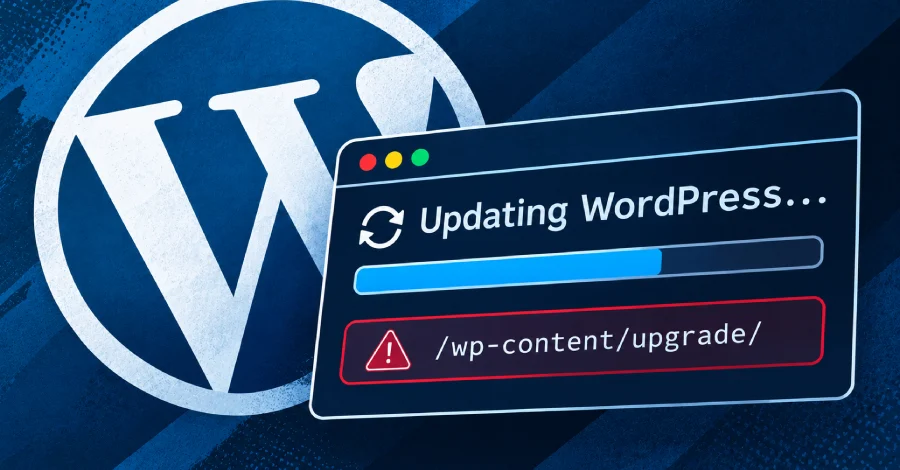
WordPress administrators are facing a paradoxical security challenge: the very mechanism designed to secure their websites is currently serving as a potential vector for exploitation. A critical vulnerability, tracked as CVE-2026-119977, has been identified by Picus Security researcher Umut Bayram. The flaw allows unauthorized remote attackers to execute arbitrary code on servers during the WordPress core update process. Despite the release of security patches in version 7.1.4 and corresponding backported fixes, the update process itself remains inherently dangerous for certain configurations, as the site must rely on vulnerable, unpatched code to facilitate the installation of the security fix.
Understanding the Mechanics of the Vulnerability
The vulnerability stems from how the WordPress core handles file extraction during updates. When a site initiates a core update, particularly one utilizing a complete package, the system creates a temporary directory within the wp-content/upgrade folder. This directory serves as a staging area where the new version of the WordPress core is unpacked. This staging directory includes the WordPress installer, which is designed to be accessible to the web server to facilitate the installation process.
Because this directory resides within the web root, it is potentially reachable by external parties. An attacker who can predict the directory name or identify it through reconnaissance can access the installer before the system deletes the temporary files. By manipulating the environment, an attacker can effectively run code with the permissions of the web server. This is particularly dangerous as it allows for the unauthorized creation of configuration files, such as wp-config.php, which can grant the attacker full control over the database and the entire site infrastructure.
The core issue, as highlighted by technical analysis, is that the update process relies on the existing, unpatched code to perform the file extraction. In versions 5.9 and later, the directory naming convention is predictable, as it is based on the name of the downloaded update file. While the recently released patch introduces random naming for this directory, the site must first run the update using the old, vulnerable logic to reach the point where the new, secure logic is installed. This creates a small but significant window of opportunity for attackers to strike during the update transition.
Chronology and Scope of the Threat
The discovery of CVE-2026-119977 has prompted immediate action from cybersecurity authorities. The U.S. Cybersecurity and Infrastructure Security Agency (CISA) added the flaw to its Known Exploited Vulnerabilities (KEV) catalog earlier this week, signaling that the vulnerability is not merely theoretical but is actively being weaponized in the wild.
The impact of this flaw is widespread, affecting WordPress core versions from 4.7 through 7.1.3. For versions 4.6 and older, which have reached their end-of-life status and no longer receive official security support, there is no direct patch available. The vulnerability is estimated to have existed since version 2.7, released in 2008, underscoring a long-standing architectural oversight in the platform’s update delivery system.

The timeline of the exploitation attempts aligns with the release of the security patches. Reports from security firm Wordfence indicate that malicious activity surged within minutes of the vulnerability’s disclosure and the subsequent release of the 7.1.4 update. Attackers have been observed using automated scripts to scan for the temporary wp-content/upgrade directory, attempting to time their requests to coincide with the brief window when a site is in the process of upgrading.
Implications for Web Infrastructure
The implications of this vulnerability are profound, given the ubiquity of the WordPress content management system. As the engine behind approximately 43% of all websites on the internet, any vulnerability that facilitates remote code execution (RCE) represents a systemic risk to the global digital ecosystem.
The severity of the flaw has been quantified with a CVSS score of 8.1 out of 10, indicating a high-risk level. While the window of opportunity for an attack—the duration during which the temporary directory is exposed—may be measured in mere seconds, the potential impact of a successful exploit is total. Once an attacker gains the ability to execute PHP code with server-level privileges, they can bypass all internal authentication, exfiltrate sensitive database information, or deploy persistence mechanisms such as backdoors and web shells.
Furthermore, the reliance on automated background updates—a feature designed to improve security by ensuring sites are always running the latest version—may inadvertently increase the attack surface. Since the update process is the same for both manual and automated updates, servers that are configured to pull updates automatically are equally susceptible if an attacker initiates a request at the exact moment the server begins the update sequence.
Mitigation and Strategic Recommendations
In light of the risks identified by security researchers, administrators are advised to adopt a proactive defense strategy. The most effective mitigation technique involves restricting web access to the wp-content/upgrade directory. Since WordPress manages this directory locally on the server disk, blocking external web access does not interfere with the platform’s ability to perform updates. Administrators can implement this by configuring their web server (e.g., Nginx or Apache) to deny requests to this specific path.
For organizations with high security requirements, a manual update process is recommended. This involves:
- Backing up: Creating a comprehensive snapshot of the database and all file assets.
- External Extraction: Downloading and unpacking the latest WordPress core release into a directory outside the web root.
- Core Replacement: Carefully copying the core files into the site directory while ensuring that sensitive files such as
wp-config.phpand thewp-contentdirectory remain untouched. - Database Migration: Running the necessary database update scripts to finalize the transition.
By avoiding the use of the built-in, web-facing updater, administrators can eliminate the possibility of an attacker interacting with the temporary installer files. It is important to note that using the WP-CLI command wp core update does not provide an additional layer of safety, as it utilizes the same internal update logic and temporary file structure as the web-based interface.

Analyzing the Response and Future Challenges
The disclosure of this vulnerability highlights the ongoing tension between ease-of-use and security in software development. While the WordPress core team has moved to address the flaw by introducing random naming conventions for temporary directories, the inherent design challenge remains: updating a system while the system itself is active.
Security analysts have noted that the "partial versus complete" update debate is secondary to the version of the updater code currently residing on the site. If a site is running a version that has not yet been patched, it remains vulnerable regardless of whether it attempts a full core update or a partial patch. This creates a dependency loop that is difficult to break without fundamental changes to the deployment architecture.
The emergence of exploit code on public platforms like GitHub shortly after the announcement of the CVE serves as a reminder of the rapid weaponization of software vulnerabilities. Threat actors are increasingly monitoring security advisories and commit logs to reverse-engineer patches and develop functional exploits before the majority of the user base has had the opportunity to apply the necessary updates.
For the vast number of WordPress sites still running legacy versions (4.6 and earlier), the situation is particularly dire. Without a vendor-provided fix, these sites are perpetually exposed to potential exploitation. Migration to a modern, supported version of WordPress is the only viable path to long-term security. Organizations that cannot migrate due to legacy dependencies should consider implementing robust web application firewalls (WAFs) and virtual patching solutions to mitigate the risk until a full system overhaul can be performed.
As the digital landscape becomes increasingly hostile, the incident surrounding CVE-2026-119977 serves as a critical case study for developers and administrators alike. It emphasizes that security is not a "set it and forget it" feature but a continuous process that requires vigilance, especially during the very maintenance windows intended to bolster defenses. Moving forward, the industry is likely to see a greater focus on isolated update environments and pre-deployment integrity checks, reducing the reliance on the existing server environment to facilitate its own upgrades.

