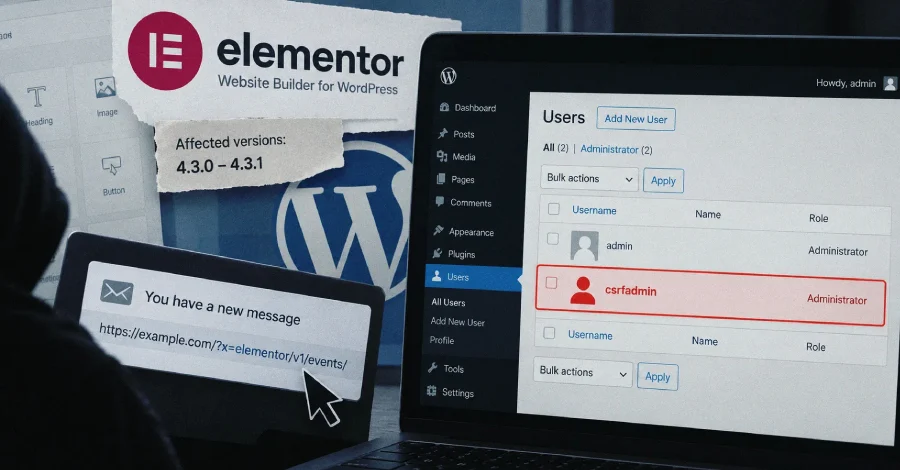
A high-severity security vulnerability identified within the Elementor Website Builder WordPress plugin has sent ripples through the web development community, placing more than two million websites at risk of complete administrative compromise. The flaw, which functions as a Cross-Site Request Forgery (CSRF) exploit, allows an unauthenticated attacker to trick a logged-in administrator into executing unauthorized commands, including the creation of new, rogue administrative accounts. With Elementor serving as one of the most ubiquitous tools in the WordPress ecosystem—boasting over 10 million active installations—the discovery underscores the persistent fragility of complex third-party integrations.
The Technical Anatomy of the Vulnerability
The vulnerability stems from a flaw in how the plugin’s "Editor Events" module handles REST API requests. Security researchers at Patchstack, who performed the detailed analysis of the bug, discovered that the module incorrectly skips CSRF protection for any request that includes the specific string "elementor/v1/events/" within the request URI.
In a standard, secure WordPress environment, REST API requests should be subject to strict verification to ensure they originate from an authorized user acting intentionally. However, due to the way this specific module was coded, the verification process can be bypassed entirely. Because the request URI is processed alongside the query string, an attacker can manipulate a URL to include the "elementor/v1/events/" string as a harmless-looking parameter at the end of a request. By doing so, they effectively trick the plugin into disabling its security checks for that specific transaction.
This mechanism grants the attacker access to the entire REST API surface of the target site. This is not limited to Elementor’s own functions; it extends to the core WordPress API and the APIs of every other plugin installed on the site. An attacker could, for example, leverage this to reach the "/wp/v2/users" endpoint to register a new user with administrative privileges, essentially handing the keys of the website over to an external party.
Chronology of the Discovery and Remediation
The security flaw was identified and reported by a researcher operating under the alias "Saggre." Following the established principles of responsible disclosure, the vulnerability was communicated to the Elementor development team, allowing them time to investigate the report, verify the findings, and develop a patch before the details were made public.
The timeline of the incident is as follows:
- Version 4.3.0 Release: The vulnerable "Editor Events" proxy was introduced in version 4.3.0 of the Elementor plugin.
- Discovery: Researcher "Saggre" identified the flaw and alerted the maintainers.
- Verification: Security analysts confirmed that the bug was a critical CSRF bypass with a CVSS score of 8.8, indicating a high level of severity and potential for exploitation.
- Remediation: On September 24, 2024, Elementor released version 4.3.2, which included a definitive fix for the vulnerability.
- Public Disclosure: Following the patch, Patchstack released a detailed advisory on September 26, 2024, to inform site administrators of the risks and the necessity of updating their software.
The Scale of the Threat
The gravity of this situation is compounded by the sheer popularity of Elementor. According to official statistics from the WordPress.org plugin repository, Elementor is installed on over 10 million active websites. While only versions 4.3.0 and 4.3.1 contained the faulty code, the window of time those versions were available allowed for widespread adoption. Data suggests that more than two million sites were running these specific versions at the time the vulnerability was disclosed.
For site owners, the attack vector is particularly insidious because it does not require the attacker to have any specialized access or a complex technical setup. The exploit can be triggered via a simple link. An attacker could embed this malicious link in an email, a forum post, a chat message, or a comment section on the victim’s own site. If an administrator clicks that link while logged into their dashboard, the browser automatically executes the REST API call as that user, creating the rogue account without the administrator ever realizing their session has been compromised.

Security Implications for the WordPress Ecosystem
This incident highlights a recurring challenge in the WordPress security landscape: the "supply chain" risk posed by third-party plugins. WordPress core is generally hardened against common vulnerabilities, but when site owners install third-party plugins, they are effectively extending the "trusted" perimeter of their site to code developed by outside entities.
When a major, widely-used plugin like Elementor introduces a flaw, the impact is magnified exponentially. In this case, the use of a REST API proxy—a feature designed to improve functionality—introduced a bypass that circumvented the site’s primary defense against unauthorized actions. The fact that this bypassed not just the plugin’s own functions, but the core WordPress API, serves as a sobering reminder of how interconnected modern web environments have become.
Security analysts have noted that the "Editor Events" module was not even present in versions of Elementor prior to 4.3.0. This means that, in a counter-intuitive turn of events, the vulnerability was introduced as part of a feature update, rather than being a long-standing bug. This serves as a reminder that even legitimate, well-intentioned feature updates can inadvertently weaken a system’s security posture if thorough testing and code audits are not prioritized.
Recommendations and Best Practices
The primary recommendation from security experts is for all site administrators to verify their current version of the Elementor plugin immediately. Any site running version 4.3.0 or 4.3.1 should be updated to version 4.3.2 or higher as a matter of urgency.
Beyond the immediate patch, security professionals recommend a multi-layered approach to protecting WordPress installations:
- Strict Update Management: Administrators should enable automatic updates for plugins whenever possible, or maintain a rigorous manual update schedule to ensure that patches are applied as soon as they are released by developers.
- Principle of Least Privilege: Site owners should ensure that administrative accounts are limited to those who absolutely require them. If a rogue administrator account is created, it is vital to audit existing users frequently to detect any unauthorized additions.
- Use of Security Plugins: Utilizing a robust Web Application Firewall (WAF) or security-focused plugin can help identify and block suspicious REST API requests, providing an extra layer of defense against CSRF and similar injection attacks.
- Audit Logs: Maintaining detailed logs of administrative activity can help site owners trace the source of an incident if a security breach occurs. Being able to see exactly when a new user was created and which IP address initiated the request is invaluable for forensic analysis.
- Environment Isolation: For high-stakes websites, performing updates on a staging site before pushing them to production can reveal compatibility issues or potential security regressions before they impact the live environment.
Broader Industry Impact
The Elementor incident serves as a significant case study for the WordPress community, which has seen an increase in automated attacks targeting plugin vulnerabilities over the past few years. As threat actors become more sophisticated in their use of scanners to identify outdated plugins, the time between a vulnerability’s disclosure and its weaponization has narrowed significantly.
While Elementor’s prompt response and the subsequent release of a patch deserve recognition, the incident highlights the ongoing need for transparency and collaboration between security researchers and plugin developers. The ability to disclose these issues responsibly is the best mechanism for preventing widespread data loss or site defacement.
As the digital landscape continues to evolve, the reliance on third-party tools will not decrease. Therefore, the responsibility lies with both the developers—to implement secure coding practices and conduct thorough audits—and the site administrators—to remain vigilant and prioritize security hygiene. As of the latest updates, no widespread reports of successful large-scale exploitation have been confirmed, but the presence of the vulnerability in millions of installations remains a significant concern for the global web community. The path forward involves continued investment in automated security testing, tighter controls on API access, and a renewed commitment to the "security-first" development lifecycle.