
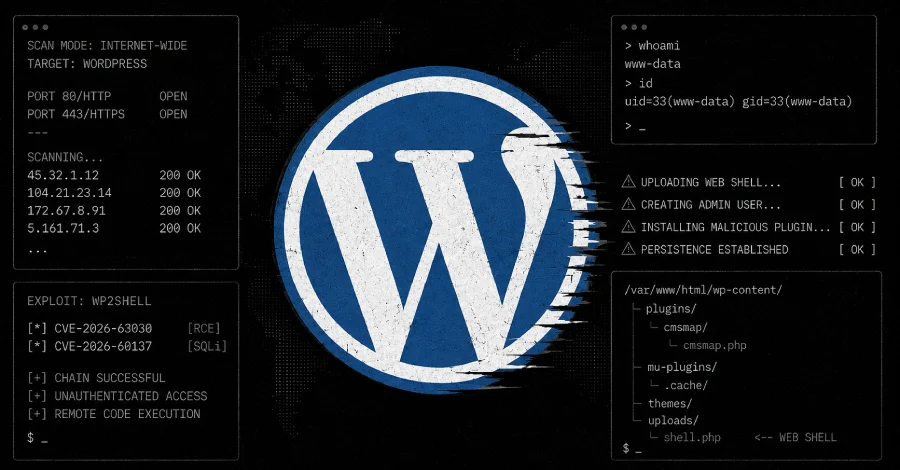
A critical wave of cyberattacks has begun targeting WordPress installations worldwide, leveraging a potent combination of two recently disclosed security vulnerabilities, collectively codenamed "wp2shell," to achieve unauthenticated remote code execution (RCE) and facilitate complete compromise of affected websites. These flaws, tracked as CVE-2026-63030 and CVE-2026-60137, represent a severe threat to the digital infrastructure underpinning a significant portion of the internet, prompting urgent calls for mitigation and enhanced security vigilance from site administrators and cybersecurity experts globally.
The Unveiling of wp2shell: A Critical Threat to WordPress
The digital security landscape shifted dramatically in the early hours of Saturday morning (UTC) when evidence of successful exploitation of these vulnerabilities began to surface. Initially, attackers were observed utilizing publicly available exploit code to exfiltrate hashed credentials from vulnerable systems. This initial phase rapidly escalated to full remote code execution as more technical details of the exploit chain became public, signifying a rapid operationalization of the threat by malicious actors.
Jake Knott, a principal security researcher at watchTowr, underscored the severity and widespread nature of the ongoing attacks in a statement to The Hacker News. "From our vantage point across a global client base, we are seeing widespread impact of this vulnerability across organizations of every size and every vertical," Knott stated, highlighting the indiscriminate nature of the threat. This indicates that no sector or organizational scale is immune, from small personal blogs to large enterprise websites, if they are running vulnerable WordPress versions. The sheer ubiquity of WordPress, powering approximately 43% of all websites on the internet, makes any critical vulnerability in its core a matter of global concern, potentially impacting millions of sites and their users.
Technical Anatomy of the Exploit Chain
The wp2shell exploit chain is particularly insidious because it requires no prior authentication, allowing anonymous attackers to gain full control over a default WordPress installation. This "no preconditions" characteristic, as described by Searchlight Cyber, means that even a newly installed WordPress site without any additional plugins or custom configurations is immediately vulnerable. The attack vector leverages a two-part vulnerability chain, beginning with a route confusion bug and culminating in a powerful SQL injection that paves the way for RCE.
Ben Marr, a security engineer at Intruder, provided a detailed explanation of the exploit’s mechanics. "This exploit utilizes a two-part vulnerability chain to achieve unauthenticated SQL injection on a stock WordPress installation with a single HTTP request," Marr explained. The initial entry point is identified as CVE-2026-60137, a "route confusion bug in the REST API batch endpoint." This flaw enables attackers to bypass crucial authentication checks, allowing them to invoke internal WordPress handlers that would typically require specific permissions. This effectively opens a backdoor into the system.
Following the authentication bypass, the attack proceeds to exploit a critical flaw arising from the "improper sanitization of the ‘author__not_in’ parameter within ‘WP_Query’ when untrusted data is passed to it by a plugin or theme." This SQL injection vulnerability allows crafted input to manipulate the database queries, leading to unauthorized access or modification of data. While CVE-2026-60137 is present in WordPress versions from 6.8 onwards, the full RCE capability (CVE-2026-63030) specifically affects versions from 6.9 and later, including all versions released since December 2025. This latter vulnerability, CVE-2026-63030, culminates in unauthenticated remote code execution, but crucially, it is only exploitable when persistent object caching is not in use. This specific condition highlights a potential mitigation factor for some sites, but the broader risk remains significant given the diverse configurations of WordPress environments. Due to the extreme severity and active exploitation of these issues, detailed technical specifications of the exploit have been prudently withheld by security researchers to prevent further proliferation of attack methodologies.

AI-Assisted Discovery and Its Implications
Adding another layer of intrigue to this developing story is the method of discovery for the exploit chain. Searchlight Cyber revealed that these critical vulnerabilities were uncovered using OpenAI GPT 5.6 Sol, a cutting-edge artificial intelligence model. The discovery process, which took over 10 hours, underscores the rapidly evolving role of AI in cybersecurity, particularly in the realm of vulnerability research. While AI has long been used in defensive capacities, its increasing sophistication in identifying complex exploit chains signals a new era for both offensive and defensive security operations. This particular discovery comes shortly after OpenAI reportedly limited the rollout of GPT 5.6 Sol, as per a related report, perhaps indicating an awareness of its powerful capabilities and potential for misuse. The ability of AI to sift through vast amounts of code and identify subtle logical flaws that might escape human detection presents both a tremendous opportunity for proactive security and a daunting challenge for defenders who must contend with increasingly sophisticated AI-driven attacks.
Global Reach and Intensifying Exploitation
The initial telemetry data collected by KEVIntel paints a clear picture of the global spread of these attacks. KEVIntel’s sensors have linked at least 13 unique IP addresses from a diverse range of countries—including Switzerland, Germany, the U.K., Indonesia, Lithuania, the Netherlands, and Singapore—to the active exploitation of CVE-2026-63030. This geographical dispersion of attacking IP addresses suggests a decentralized, potentially opportunistic, and widespread campaign rather than a highly targeted, localized effort.
Further confirming the intensifying threat, watchTowr reported a dramatic increase in attack volume following the public release of exploit code. Their honeypots, designed to attract and monitor cyber threats, registered "tens of thousands of exploitation attempts" in a short period. This indiscriminate "spraying" of the internet indicates that threat actors are conducting mass scanning campaigns, attempting to compromise as many vulnerable WordPress sites as possible before patches can be universally applied. Cloudflare’s blog on WordPress vulnerabilities further corroborated these findings, reiterating the specific conditions under which CVE-2026-63030 can lead to unauthenticated RCE, particularly the role of persistent object cache in determining exploitability. The rapid transition from vulnerability disclosure to widespread, automated exploitation is a hallmark of critical flaws in widely used software, emphasizing the shrinking window defenders have to act.
Post-Exploitation Activities and Observed Tactics
Google-owned Wiz, a prominent cloud security subsidiary, has been closely monitoring the situation and provided valuable insights into the scope of vulnerability and subsequent post-exploitation activities. At the time these CVEs were initially published, Wiz’s data indicated that a staggering 60% of organizations utilizing WordPress had at least one vulnerable instance. More alarmingly, 25% of these organizations were exposing a vulnerable server directly to the internet, making them prime targets for the wp2shell exploits. While these figures have reportedly dropped as organizations scramble to apply fixes, the initial exposure highlights a significant attack surface.
Wiz researchers Shahar Dorfman and Gili Tikochinski detailed several post-exploitation activities observed after successful abuse of the two flaws. These include:
- Deployment of a 150 KB Web Shell: Attackers have been observed deploying a sophisticated web shell, deceptively disguised as a legitimate WordPress security plugin named "CMSmap." This web shell functions as a "full-featured attack platform," providing adversaries with extensive control over the compromised system. Its capabilities include file management (uploading, downloading, deleting files), direct database access, network reconnaissance (port scanning), batch code injection, and various privilege escalation modules, notably including MySQL User-Defined Function (UDF) exploitation. The use of a web shell like this allows attackers persistent access and a comprehensive toolkit for further malicious operations.
- Creation of Backdoor Administrator Accounts: In a significant number of incidents, more than 100 backdoor administrator accounts have been created post-exploitation. These accounts grant attackers full administrative privileges, allowing them to bypass normal security controls and maintain persistent access even if the initial vulnerability is patched.
- Deployment of Fake WordPress Plugins: Attackers have leveraged their administrative access to deploy fake WordPress plugins. These malicious plugins serve as a vector to gain further code execution, download secondary tools, or embed persistent backdoors, expanding the scope of compromise.
- Attempts to Install Overlord RAT: In at least one documented case, a threat actor was observed repeatedly attempting to install "Overlord RAT," a Golang-based remote access trojan. The deployment of a RAT indicates an intent to establish long-term control over the compromised server, potentially turning it into a botnet member, command-and-control server, or a platform for further attacks.
Wiz researchers also noted "high-volume scanning activity without subsequent post-exploitation, suggesting opportunistic mass-scanning campaigns seeking to identify vulnerable targets alongside legitimate security scanning activity." While they have "yet to identify lateral movement or data exfiltration" in all cases, monitoring and investigation are ongoing, implying that such activities are likely objectives once initial compromise is achieved. These observed tactics underscore the sophisticated and multi-stage nature of modern cyberattacks, where initial exploitation is often just the first step in a broader campaign to achieve data theft, system disruption, or further network penetration.

The Broader Landscape of WordPress Security
The wp2shell vulnerabilities underscore the inherent challenges in securing widely adopted software like WordPress. Its immense popularity, driven by its ease of use, extensive plugin ecosystem, and open-source nature, also makes it a prime target for malicious actors. The diverse user base, ranging from individuals with limited technical expertise to large corporations, means that patch management and security best practices are not uniformly applied, leaving a vast number of potential targets. The constant interplay between core WordPress updates, theme updates, and plugin updates creates a complex environment where vulnerabilities can emerge from any component. This incident highlights the critical need for proactive security measures and a robust patching strategy for any organization or individual relying on WordPress for their online presence.
Urgent Call to Action: Mitigation and Defensive Strategies
In light of the ongoing and widespread exploitation, immediate action is paramount for all WordPress administrators. Defenders are strongly recommended to inspect their WordPress instances thoroughly for any signs of compromise, regardless of whether they believe their systems have been patched. This includes, but is not limited to:
- Inspect for New Administrator Accounts: Scrutinize the list of user accounts for any newly created, unauthorized administrator accounts. Any suspicious accounts should be immediately disabled or deleted.
- Examine Installed Plugins: Check for any unknown or suspicious plugins that may have been installed. Malicious plugins, particularly those disguised as legitimate security tools like "CMSmap," should be removed.
- Scan for Suspicious Files: Conduct comprehensive file integrity checks and scans for any unfamiliar files, especially within core WordPress directories, the
wp-contentdirectory, and theuploadsfolder. The presence of web shells or other malicious executables is a clear indicator of compromise. - Apply Patches Immediately: Ensure that WordPress installations are updated to the latest secure version as soon as possible. While specific patch versions for CVE-2026-63030 and CVE-2026-60137 have not been detailed in the provided content, it is standard practice for WordPress to release security updates for critical vulnerabilities. Site owners should consult official WordPress security advisories and their hosting providers for the most current patching information.
- Leverage Persistent Object Caching: For CVE-2026-63030, deploying or verifying the use of persistent object caching can help mitigate the RCE component of the vulnerability. This is a crucial step for sites running affected versions that cannot immediately update.
- Implement Web Application Firewalls (WAFs): A WAF can provide an additional layer of defense by filtering malicious traffic and potentially blocking known exploit patterns before they reach the WordPress application.
- Regular Backups: Maintain regular, off-site backups of both database and file systems to ensure that in the event of a compromise, a clean restore can be performed.
- Principle of Least Privilege: Ensure that all user accounts and system processes operate with the minimum necessary permissions.
- Security Monitoring: Implement robust security monitoring to detect unusual activity, unauthorized access attempts, or sudden changes in website behavior.
Implications for Web Security and the Future
The wp2shell incident serves as a stark reminder of the continuous and evolving nature of cyber threats. It highlights several critical implications for web security:
- Supply Chain Risk: The reliance on widely used software components, such as WordPress, creates a significant supply chain risk. A vulnerability in a core component can ripple through millions of dependent systems.
- The AI Arms Race: The discovery of these vulnerabilities by an AI model like GPT 5.6 Sol underscores the accelerating "AI arms race" in cybersecurity. As AI becomes more capable, both attackers and defenders will leverage it, necessitating continuous innovation in defensive strategies.
- Proactive vs. Reactive Security: The rapid exploitation of these flaws emphasizes the need for a proactive security posture, including regular audits, vulnerability scanning, and immediate patching, rather than a reactive approach once a breach has occurred.
- User Responsibility: Ultimately, the security of a WordPress site often rests on the shoulders of its administrator. Education on security best practices, diligent patch management, and vigilance against suspicious activities are more critical than ever.
As cybersecurity researchers continue to monitor the situation, the wp2shell vulnerabilities stand as a testament to the ever-present threat to digital assets and the imperative for continuous vigilance and robust defensive measures in the interconnected world. The full extent of the damage from these exploits may take weeks or months to fully materialize, making immediate action and ongoing scrutiny essential for all WordPress users.

