
At 16:49:48 UTC on Friday, August 28, 2026, a Solana-based wallet—funded just three hours prior with 1.79 SOL via a bridge from Ethereum—executed the first of over 21,000 transactions that would systematically drain thousands of user accounts belonging to Avici, a prominent Solana-focused neobank. By the time the incident concluded, 1,685 users had seen their balances liquidated, totaling $500,859.22 in losses. This breach was not a result of compromised private keys or standard phishing; rather, it exploited a critical vulnerability in a shared smart contract architecture used by Avici and several other programs within the burgeoning self-custodial crypto card market.
The incident highlights a growing tension in the financial technology sector: the gap between the marketing promise of "non-custodial" finance and the technical reality of how these assets are governed. While Avici’s terms of service explicitly stated that the company would not hold custody of user collateral, the underlying smart contract infrastructure—managed by the card-issuing company Rain—contained an authorization flaw that allowed an attacker to bypass security checks. This event has forced a broader audit of the $1.1 billion monthly crypto card industry, raising questions about transparency, issuer reliance, and the legal status of digital assets in the event of platform failure.
The Anatomy of the August 28 Breach
The attack vector was surgically precise. The perpetrator’s wallet, identified on-chain as FVNFzqAny8spWdPmYw6RQ9TkYa29ueFFiqCFD1gQnCEj, targeted a vulnerability in the signature-verification instruction of a Rain-controlled Solana program. By manipulating signature and message offsets, the attacker effectively tricked the program into accepting a single signature as the required dual-authorization for administrative actions. Once the attacker granted themselves "Collateral Admin" status, they were able to initiate asset withdrawals from individual user accounts.
The chronology of the event reveals the speed at which modern on-chain exploits unfold. The initial exploit began at 16:49:48 UTC, and the final malicious transaction was recorded at 19:18:52 UTC. In the interim, the attacker managed to successfully process approximately 17,500 transactions. By 19:03:18 UTC, while the drain was still in progress, the attacker initiated a series of deBridge orders to move approximately 1.1 million USDC from the Solana network to Ethereum. These funds were subsequently funneled into Tornado Cash in a standard "laddered" withdrawal pattern, effectively obscuring the trail of the stolen capital.
Rain’s response was rapid but highlighted the centralized nature of what is often marketed as decentralized infrastructure. The company patched the affected Solana programs between 19:18 and 19:43 UTC, mere minutes after the drain concluded. Following the patch, Rain and the affected programs, including Avici and Tria, committed to full refunds. While this prevented a public relations catastrophe, it underscored a reality that the industry rarely discusses: the "non-custodial" cardholder was ultimately saved by the corporate balance sheet of a venture-backed firm, not by the inherent security of the blockchain itself.
The State of the Crypto Card Market: $1.1 Billion and Counting
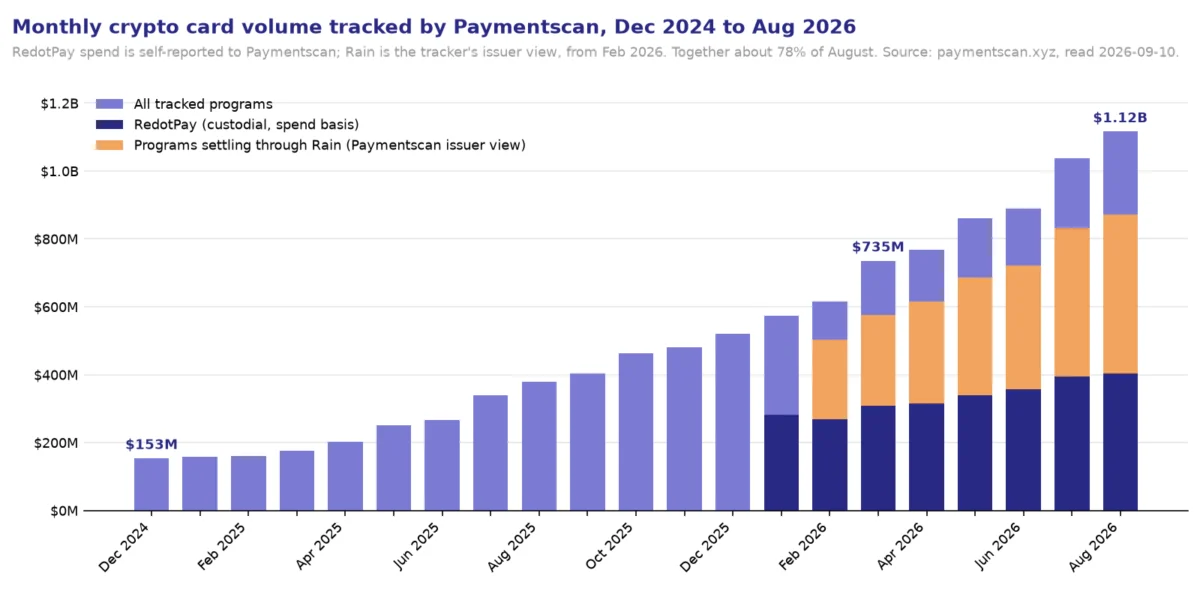
According to data from Paymentscan, the crypto card industry has seen explosive growth. As of August 2026, monthly transaction volume hit $1.116 billion across 11 million individual transactions and nearly 290,000 active addresses. This marks the second consecutive month that the sector has exceeded the billion-dollar milestone, following a steady climb from $153 million in December 2024.
However, these figures carry significant caveats. A substantial portion of this volume—nearly 42%—is routed through Rain, which acts as the infrastructure provider for numerous smaller programs. Furthermore, the reliance on self-reported data from major players like RedotPay makes it difficult to ascertain the true level of risk within the ecosystem. When adjusting for on-chain verifiable spend, the actual figures are closer to $545 million, representing a 55% increase since March 2026. This discrepancy highlights the lack of standardized reporting in the crypto payments space, where market share is often conflated with user activity.

The Custody Spectrum: Five Models of Risk
To understand why some cards were vulnerable while others remained secure, one must look at the legal and technical "custody models" currently in operation. The industry generally falls into five distinct categories, ranging from total loss of ownership to true self-custody.
- Sold to the Operator: In this model, such as that employed by KAST, the user’s deposit is legally considered a sale of assets. The user no longer owns the cryptocurrency but instead holds a debt claim against the platform. In the event of a bankruptcy, these users are merely unsecured creditors.
- Held in Custody: Platforms like RedotPay and Revolut act as custodians. While they claim to hold assets for the user, these assets are often subject to general liens and may be reachable by the platform’s creditors during insolvency proceedings.
- Fiat Conversion: Exchange-based cards, such as those from Crypto.com or Kraken, often do not hold crypto on the card at all. Assets are converted to fiat at the moment of the transaction, and the fiat is held in regulated bank accounts. While this offers the most protection, it is dependent on the regulatory status of the bank, not the security of the blockchain.
- Program-Managed Smart Contracts: This was the model utilized by Avici and Tria. The collateral sits in a smart contract. While the user technically owns the assets, the "upgrade authority"—the power to change the rules of the contract—is often held by the program manager (in this case, Rain). The August breach occurred because this authority was centralized, not distributed.
- Direct Authorization Vaults: Gnosis Pay and Ether.fi Cash represent the most secure tier. Here, the user retains control over a smart contract (a "Safe") where funds remain until an authorization is explicitly signed. Even if the program manager fails, the user’s assets remain in their own vault, inaccessible to the provider.
The "Third National" Concentration Risk
A significant systemic risk identified in the 2026 data is the concentration of issuers. Seven major programs—KAST, Avici, Ether.fi, Plasma One, Solayer, Payy, and Tria—all name "Third National" as their card issuer. Investigations reveal that Third National is not a bank in the traditional sense, but a Puerto Rico-based money transmitter and a subsidiary of Signify Holdings (Rain).
This creates a "single point of failure" scenario. When an infrastructure provider like Rain faces a technical exploit, the impact is not isolated to one brand but ripples across the entire portfolio of programs that rely on their shared codebase. The August incident demonstrated that while the brands appear distinct to the consumer, they are fundamentally tethered to the same administrative keys and contract logic.
Regulatory Horizons and Future Implications
The industry is currently facing a dual challenge: increasing regulatory scrutiny and the natural consolidation of infrastructure. With the European Union’s Anti-Money Laundering Regulation (EU 2024/1624) set to take full effect in July 2027, the era of anonymous, no-KYC crypto cards is nearing an end. The new rules effectively ban anonymous prepaid cards loaded with crypto, forcing providers to either implement rigorous identity verification or face exclusion from EU merchant terminals.
For the self-custodial sector, the lessons of August 2026 are clear. "Non-custodial" is a marketing term that fails to describe the reality of governance. The security of a card program is not merely about whether the user holds their private keys, but about who holds the upgrade keys to the smart contracts, whether those contracts have been audited for the specific version currently in production, and how the program is financed.
As the industry matures, the survivors will likely be those who can provide the highest degree of technical transparency. Ether.fi and Gnosis Pay have set a new standard by publishing contract addresses and governance modules, allowing users to verify for themselves where their money sits. In contrast, programs that hide behind opaque "licensed partners" and "proprietary infrastructure" remain inherently vulnerable.
Ultimately, the August exploit serves as a stark reminder that while the blockchain provides a ledger of truth, the surrounding financial infrastructure—the bridges, the issuers, and the administrative authorities—is only as robust as its weakest line of code. For the 1,685 users who were made whole, the experience was a fortunate reprieve. For the industry, it is a definitive call to move away from centralized "non-custodial" templates toward architectures that truly prioritize user sovereignty over administrative convenience.

