
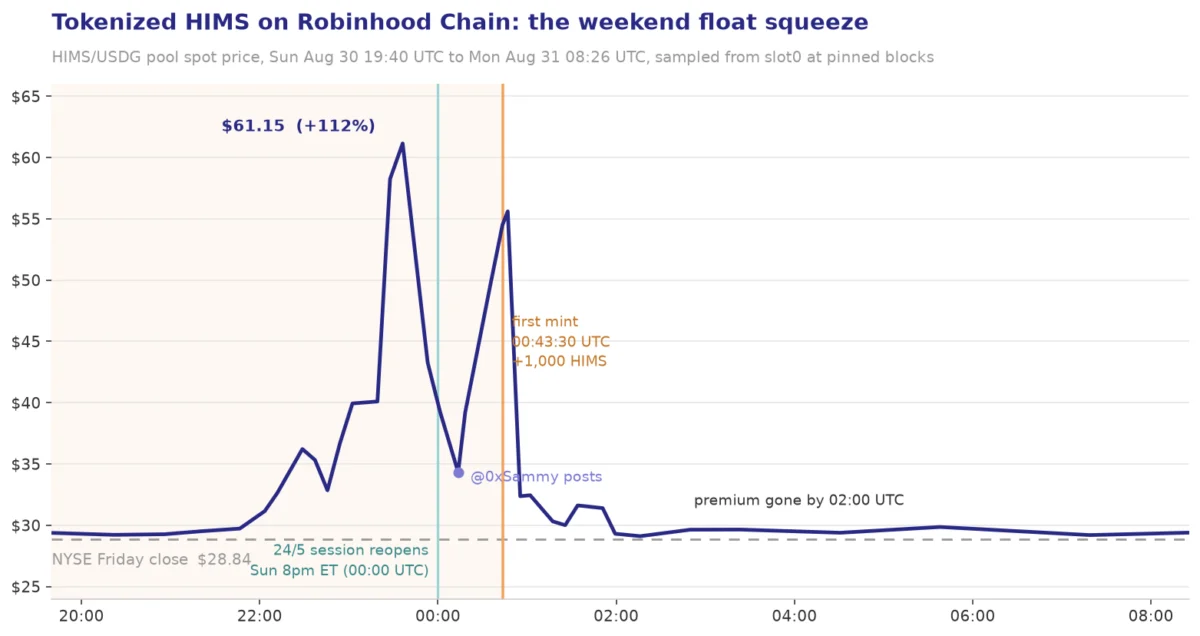
At 23:36:14 UTC on Sunday, August 30, 2026, the tokenized version of Hims & Hers Health, Inc. stock trading on the Robinhood Chain hit a valuation of $61.15 within its primary USDG liquidity pool. This figure represented a staggering divergence from the underlying asset’s performance, as the real-world share had concluded its Friday session on the New York Stock Exchange at $28.84. This anomaly was not driven by any corporate action, earnings report, or material news from Hims & Hers. Instead, it was the result of a deliberate, algorithmic market manipulation orchestrated through a memecoin titled "BONER," which systematically vacuumed the available on-chain supply of the HIMS token into its own liquidity pool. Because the issuer’s mechanism for minting new stock tokens remained dormant during the weekend, the limited float became a captive asset, susceptible to extreme price volatility.
A Chronology of the Dislocation
The event unfolded over a high-stakes 48-hour window, beginning shortly after the NYSE market close on Friday, August 28. As liquidity on decentralized exchanges (DEXs) often thins during weekends, the Robinhood Chain—an Arbitrum Orbit L2 network designed to host tokenized equities—faced a structural test.
On Friday at 21:21 UTC, a redemption event occurred, removing 400 tokens from the circulating supply. This reduction in float, combined with the lack of weekend minting capabilities, left only 15,226.8 tokens available on-chain. Throughout the weekend, the BONER memecoin, which had been paired directly against HIMS in a Uniswap v4 liquidity pool, began to experience significant buying pressure. Because the BONER liquidity pool was the most efficient route for traders to move in and out of the memecoin, every dollar of memecoin demand effectively acted as a market buy order for the HIMS token.
By 23:53 UTC on Sunday, the HIMS/USDG pool had been drained of depth. With only 92 HIMS tokens remaining in the primary dollar pool against $135,000 in USDG reserves, the price of the tokenized equity became hyper-sensitive. The resulting squeeze pushed the token to a 112% premium over its last known NYSE trade price. The volatility did not normalize until the equity markets entered their pre-market phase on Monday, August 31. At 00:43:30 UTC, the first issuance of 1,000 new HIMS tokens hit the chain, marking the beginning of the end for the squeeze. By 02:00 UTC, as the issuer continued to mint and sell tokens to meet demand, the premium had completely evaporated, and the token price returned to within 2% of the Friday close.
Structural Anatomy: The Robinhood Chain Design
To understand why this occurred, one must analyze the architecture of the Robinhood Chain. Launched in July 2026, the network utilizes tokenized debt securities—not direct equity ownership—to track stock prices. These tokens are redeemable for cash via authorized participants. The pegging mechanism relies on an elastic supply: the issuer mints tokens when its broker acquires shares on the open market and burns them upon redemption.
However, a critical vulnerability exists: the issuer only mints or burns when the underlying stock exchange is active. During the weekend, the "mint switch" is effectively turned off. Because these tokens are fully composable and transferable ERC-20 assets, they can be pooled by any third party without permission. The BONER memecoin developers leveraged this by creating a BONER/HIMS pair, which became the primary liquidity hub for the memecoin. By design, this locked the majority of the available HIMS float into a pool where it served as the collateral for a speculative memecoin, rather than as a liquid market for the stock token itself.

Supporting Data and Market Impact
The data recorded on-chain confirms the severity of the liquidity trap. As of the peak of the squeeze, the total on-chain supply of HIMS was a mere 15,226.8 tokens, worth approximately $440,000—a negligible fraction of the company’s 225 million outstanding shares. The following table summarizes the key metrics during the most volatile phase:
| Time (UTC) | HIMS Price | Premium to Close |
|---|---|---|
| Sun 22:28 | $36.22 | +25.6% |
| Sun 23:36 | $61.15 | +112.0% |
| Mon 00:43 | $54.50 | +89.0% |
| Mon 00:55 | $32.37 | +12.3% |
The rapid collapse of the premium—falling from 93% to 12% in just 12 minutes following the initial minting event—demonstrates the effectiveness of arbitrage in restoring the peg once supply constraints were lifted. In total, 18,750.5 new HIMS tokens were minted within nine hours of the market opening, effectively doubling the float and diluting the cornered market.
Broader Implications for Tokenized Real-World Assets (RWAs)
The HIMS event serves as a definitive case study in the risks of "Distributed vs. Represented" assets. While the tokens are fully distributed and permissionless, the underlying valuation mechanism remains strictly tethered to the traditional, permissioned financial system. The "squeeze" lived entirely in the temporal gap between the Friday market close and the Monday market open.
This event has significant implications for both issuers and participants:
- For Issuers: The event highlights the necessity of maintaining "standing inventory" or liquidity reserves that can be deployed even when the primary stock exchange is closed. Relying solely on real-time minting exposes the asset to extreme pricing dislocations during non-trading hours.
- For Traders: The squeeze serves as a warning that on-chain "spot prices" for tokenized stocks are not necessarily representative of the asset’s fair market value. During low-liquidity windows, these prices are merely reflective of the internal state of a specific, potentially manipulated, liquidity pool.
- For Regulators: The episode underscores a jurisdictional anomaly. Robinhood’s stock tokens are restricted from US retail investors, yet the memecoins paired against them are not. This creates a two-tiered market where participants barred from the primary instrument can still influence its price through speculative derivatives, effectively bypassing the intended guardrails of the tokenized equity platform.
Future Outlook
Industry observers and decentralized finance (DeFi) researchers, such as the analyst @0xSammy, have suggested that this "playbook" is now public. By targeting small-float stock tokens and pairing them with high-velocity memecoins, actors can manufacture artificial supply crunches. Similar activity has already been observed with tokenized NVIDIA shares and potential targets on the most-shorted-stocks list.
Ultimately, the HIMS event concluded without damaging the underlying equity; the NYSE opened on Monday to a standard market session, completely insulated from the chaos of the chain. However, the incident marks a maturation point for the Robinhood Chain. As the platform scales, the tension between the 24/7 nature of blockchain liquidity and the 9-to-5 schedule of traditional equity markets will require more robust liquidity management. Whether the issuer chooses to implement pre-minting protocols or simply accepts that these tokens will trade at premiums and discounts during weekends remains to be seen. For now, the "BONER" squeeze stands as a cautionary tale of what happens when high-finance engineering meets the unbridled volatility of memecoin markets.

