
The United Kingdom has officially levied sweeping economic sanctions against Cryptomus, a sophisticated and chameleonic cryptocurrency payment gateway. Financial intelligence experts and blockchain analytics firms have identified the platform as a pivotal conduit for high-risk and illicit capital, processing transactions related to ransomware campaigns, illicit narcotics distribution, darknet market operations, financial fraud, and cybercrime-as-a-service providers. According to international regulators, these channels have actively assisted the Russian state and its domestic financial institutions in circumventing Western financial restrictions imposed in the wake of the ongoing geopolitical conflict.
Announced on October 8, the U.K. Foreign, Commonwealth & Development Office (FCDO) issued targeted sanctions against Cryptomus—which has operated under various corporate aliases, including Certa Payments and Xeltox Enterprises. The punitive measures enforce an immediate asset freeze on any holdings tied to Cryptomus within United Kingdom financial institutions, while simultaneously prohibiting British citizens, corporations, and digital entities from conducting business or providing virtual asset services to the platform. Alongside Cryptomus, the U.K. government extended its sanctions net to encompass several associated virtual payment platforms, specifically VexPay, TokenSpot, and the Tsunami Payments service, signaling a coordinated crackdown on the infrastructure facilitating Russian sanctions evasion.
The Evolution of an Illicit Payment Hub
Cryptomus emerged onto the digital finance landscape in 2022, quickly establishing itself as an indispensable settlement layer for dozens of Russian-nexus cryptocurrency exchanges and underground websites marketing cybercrime toolkits. Investigative reports published in late 2024 detailed how the platform systematically converted digital currency into fiat cash via Russian banking institutions, effectively creating a financial bridge for transnational criminal syndicates.
Faced with mounting international scrutiny, law enforcement investigations, and regulatory pressure, the platform adopted a chameleon-like strategy of rebranding and restructuring. Most notably, following a landmark enforcement action by Canadian authorities in late 2025—which slapped Cryptomus with a record-breaking administrative monetary penalty of CAD $176 million for severe anti-money laundering (AML) compliance failures—the platform pivoted. While formally appealing the Canadian fine, its operators launched a parallel, no-KYC (Know Your Customer) service operating under the moniker "Heleket."
Blockchain analytics firms quickly established that Heleket functioned as a seamless continuation of Cryptomus, absorbing its transactional volume and maintaining uninterrupted processing services for high-risk clients. Telegram support logs from late 2025 and 2026 revealed customer service agents denying operational ties between the two entities, despite overwhelming blockchain attribution data linking the underlying wallet infrastructures and administrative personnel.
A Timeline of Regulatory Escalation
The dismantling of the Cryptomus-Heleket ecosystem represents the culmination of years of tracking by international blockchain intelligence firms, independent investigators, and cross-border financial regulators:

- 2022: Cryptomus launches operations, rapidly scaling its transaction volume by onboarding underground Russian exchanges, ransomware affiliates, and darknet merchants.
- December 2024: Investigative reports expose the mechanics by which Cryptomus facilitates the conversion of cryptocurrency into physical cash within Russian banks, utilizing shell corporate structures.
- April 2026: Leading blockchain analytics firm TRM Labs releases an intelligence dossier indicating that Cryptomus has processed in excess of $7 billion in cumulative transactions since its inception, including funds tied to child sexual abuse material (CSAM) vendors, terrorist financing cells, and human trafficking networks. TRM notes a temporary dip in volume following the introduction of superficial KYC checks, prompting the creation of the unverified Heleket parallel platform.
- October 2025: Canada’s financial intelligence and regulatory authorities levy a historic CAD $176 million fine against Cryptomus for pervasive systemic anti-money laundering violations.
- October 8, 2026: The United Kingdom issues formal economic sanctions against Cryptomus, Heleket, VexPay, TokenSpot, and Tsunami Payments, freezing local assets and criminalizing financial engagement with the networks.
Quantitative Scale of Illicit Transactions
The sheer magnitude of capital handled by Cryptomus and its successor iterations has drawn stark warnings from the global analytics community. Prominent blockchain intelligence provider Chainalysis published an evaluation on October 8 detailing the systemic role these platforms play in supporting the wartime Russian economy and transnational organized crime.
According to Chainalysis telemetry, Cryptomus and Heleket rapidly outpaced traditional cryptocurrency mixing services in their capacity to absorb and obfuscate illicit funds. At its peak in late 2025, the number of flagged illicit counterparties transacting with the platform surged to more than 900 unique entities in a single calendar month. TRM Labs’ cumulative assessment further contextualizes the platform’s footprint, noting that the multi-billion-dollar transaction ledger encompassed not only sanctions evasion vectors for the Russian state, but also monetization channels for globally proscribed criminal enterprises, including narcotics cartels and ransomware gangs such as LockBit and BlackCat affiliates.
The Limitations of Monetary Fines Versus Sanctions
The decision by the United Kingdom to utilize economic sanctions rather than relying solely on domestic regulatory fines highlights a fundamental shift in how Western governments address transnational cybercrime and sanctions evasion.
Renowned blockchain investigator Richard Sanders, who spent months mapping the opaque corporate and technical infrastructure of Cryptomus, emphasized the profound legal and operational distinction between financial penalties and state-level sanctions. In public analyses following the U.K. announcement, Sanders noted that Canada’s CAD $176 million fine—while historically significant—ultimately proved uncollectible and unenforceable given the shell-company architecture of the platform.
"A fine does not stop a cryptocurrency payment processor from processing payments," Sanders observed. "Sanctions kill the operation. The distinction matters."
By freezing domestic institutional access and designating the platforms as sanctioned entities, the U.K. effectively cuts off Cryptomus and Heleket from liquidity pools, institutional banking rails, and Western cloud or domain infrastructure, delivering a disruptive blow that financial penalties alone cannot achieve. Furthermore, security analysts have pointed out that this enforcement marks a historic milestone: it represents the first known instance of a "Five Eyes" intelligence-sharing nation (comprising Australia, Canada, New Zealand, the United Kingdom, and the United States) formally sanctioning a cryptocurrency enterprise incorporated within the jurisdiction of another Five Eyes partner.
Phantom Regulation and the Western Sahara Shell Game

A central mystery surrounding the rapid ascent and operational impunity of Cryptomus and Certa Payments has been the question of their regulatory authorization. How did a newly minted digital asset enterprise secure legal standing to offer global financial services?
Deep-dive corporate investigations into the ownership lineage of Certa Payments uncovered an elaborate web of shell structures pointing toward an unconventional jurisdiction. The sole shareholder of Certa Payments was identified as a 25-year-old Ukrainian national. Alongside her role at Cryptomus, she served as the principal director of several other corporate entities, including the WS Management and Advisory Corporation.
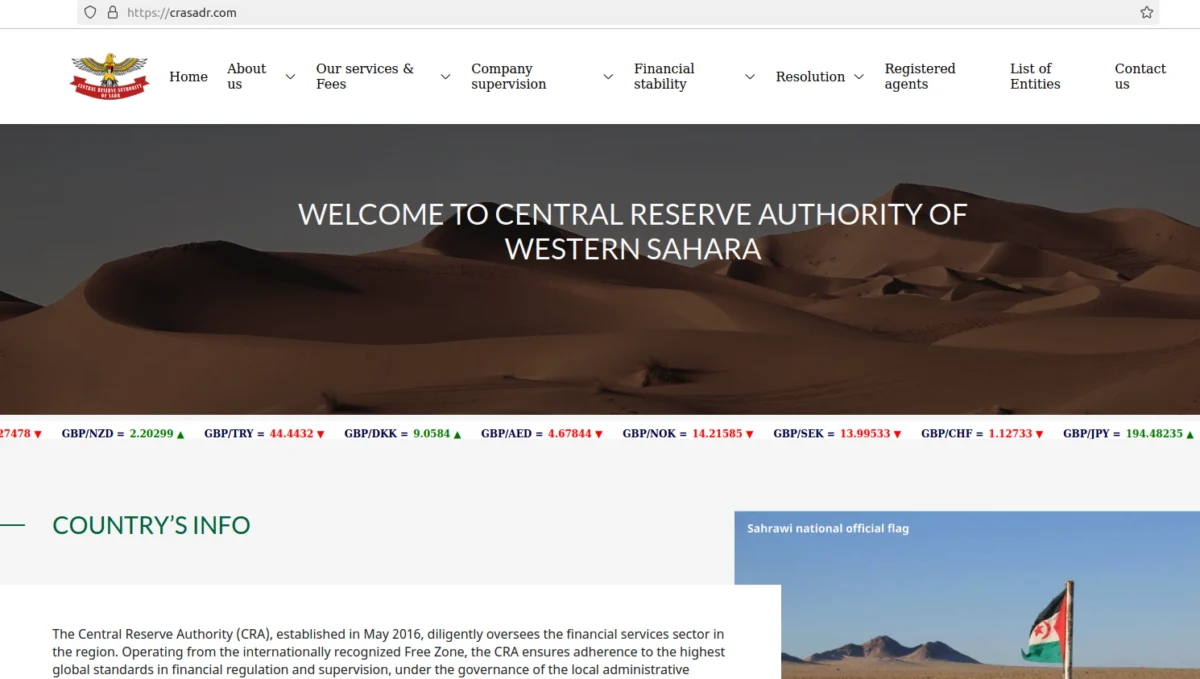
WS Management and Advisory Corporation positioned itself as an exclusive, sovereign regulatory body responsible for licensing cryptocurrency exchanges, foreign exchange brokers, and online gaming operators within the disputed territory of Western Sahara in northwest Africa—a region lacking widespread international recognition as a sovereign state.
Through web portals such as crasadr.com, the purported Central Reserve Authority of the Western Sahara offered prospective corporate applicants swift business incorporation, banking setup assistance, and regulatory licensing. Technical infrastructure analysis revealed that early corporate domains utilized by Certa Payments shared hosting servers and network footprints with rasd-state.ws, the official web presence of the fictitious regulatory authority. This revelation exposed a synthetic regulatory arbitrage scheme: criminal-friendly payment processors were essentially licensing themselves through self-invented authorities located in geopolitical blind spots to project a veneer of legitimacy to traditional banking partners and liquidity providers.
Broader Implications for Global Crypto Compliance
The coordinated actions taken against Cryptomus, Heleket, and their sister platforms underscore the accelerating convergence of traditional national security policy and decentralized finance oversight. As nation-states increasingly weaponize the international financial system to isolate sanctioned economies like Russia, cryptocurrency gateways that function as unregulated parallel banking systems have become prime targets for geopolitical enforcement.
Legal and compliance experts suggest that the downfall of Cryptomus will serve as a definitive test case for cross-border digital asset enforcement. With Western jurisdictions demonstrating a willingness to pierce through opaque ownership layers, dismantle phantom regulatory authorities, and bypass uncollectible administrative fines in favor of sweeping economic sanctions, the operational calculus for cybercrime-as-a-service providers and sanctions-evasion intermediaries has fundamentally changed. The era of unchecked, cross-border pseudo-anonymous payment processing is facing an unprecedented wave of state-backed resistance.

