
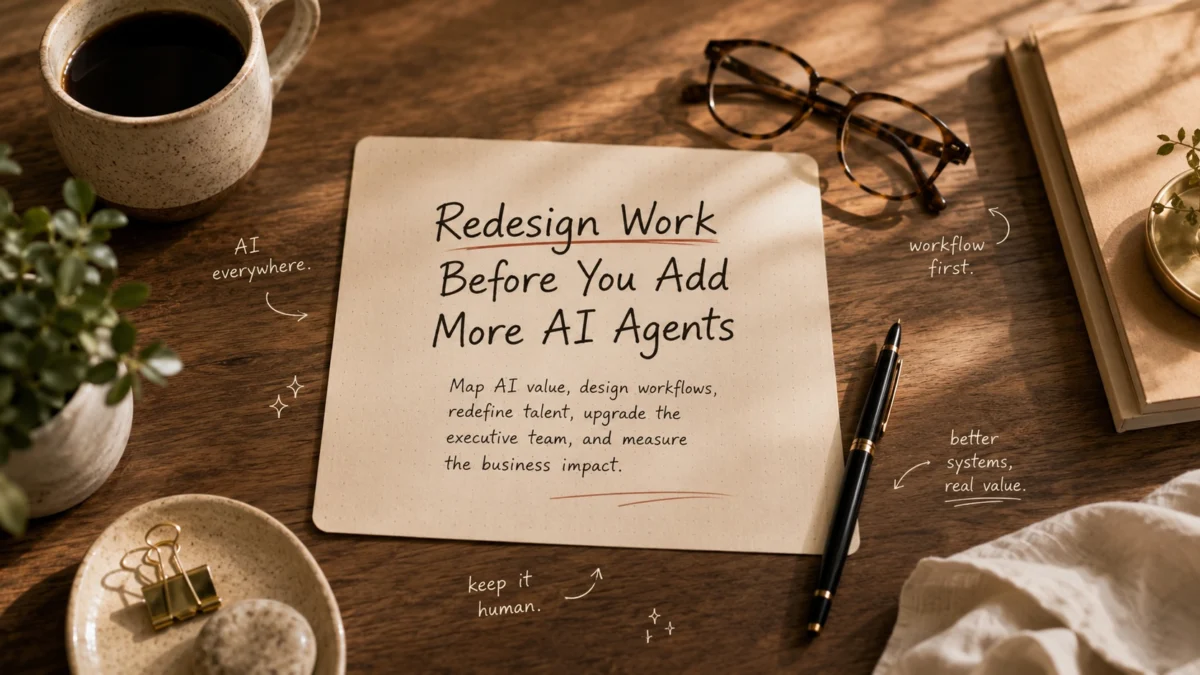
The global enterprise landscape is currently witnessing a profound paradox: while artificial intelligence has been integrated into nearly every software suite and corporate strategy, the fundamental ways in which work is executed remain largely unchanged. Despite the proliferation of generative AI tools and agentic capabilities, many organizations find themselves trapped in a cycle of "old work" powered by "new tech." Current observations of enterprise teams reveal a persistent reliance on fragmented data sources, manual Excel-based reconciliations, and undocumented handoffs. While the tools have evolved, the underlying workflows continue to mirror the manual processes of the previous decade, leading to a bottleneck that prevents AI from delivering its promised economic value.
The Disconnect Between AI Adoption and Workflow Evolution
In the years following the initial generative AI boom of 2023, the corporate world shifted its focus from simple chatbots to "Agentic AI"—systems capable of executing multi-step tasks autonomously. However, recent field studies across various industries suggest that the excitement surrounding these agents often hits a wall of operational reality. Teams frequently report high levels of enthusiasm for AI, yet their daily routines remain tethered to legacy habits. Critical business intelligence often stays trapped in the minds of employees or is scattered across ephemeral channels such as chat threads, slide decks, and emails, never making it into the structured systems that AI agents need to function effectively.
The prevailing response to this friction has been a "layering" strategy: placing a conversational AI interface on top of existing, messy data silos in the hope that natural language processing will bridge the gap. Industry analysts and workflow consultants argue that this approach is fundamentally flawed. AI becomes a source of genuine business value only when it is deeply integrated into the core products and business processes of an organization. This requires a painful but necessary step: the complete redesign of workflows before the introduction of more agents or tools.
The 2024–2026 AI Trajectory: A Chronology of Implementation
To understand the current state of enterprise AI, it is essential to look at the timeline of its integration. In 2023, the "Year of Experimentation" saw companies deploying thousands of small-scale pilots, largely focused on individual productivity tasks like email drafting and summarization. By 2024, the focus shifted toward "Platform Integration," where AI was embedded into existing CRM and ERP systems.

As we move toward 2026, the industry is entering the "Era of Agentic Orchestration." According to the BCG 2026 AI Radar, corporate spending on AI is expected to double over the next twelve months. The focus has moved from "What can AI do?" to "How can AI agents work together?" This shift is driven by a top-down mandate; nearly three-quarters of CEOs now identify as the primary decision-makers for AI strategy, viewing the technology not as an IT initiative but as a core pillar of business survival.
Supporting Data: The Concentration of AI Value
Research from leading global consultancies underscores the necessity of a focused, workflow-first approach. McKinsey’s "Talent to Value" research highlights a stark reality in enterprise AI deployment. Using the pharmaceutical giant Johnson & Johnson as a benchmark, the study noted that while the company experimented with nearly 900 generative AI use cases, a staggering 80% of the total value was generated by only 10% to 15% of those initiatives. This suggests that broad-based "siloed" use cases—where AI is used for isolated tasks—deliver diminishing returns compared to deep, end-to-end process transformations.
Furthermore, Microsoft’s 2026 Work Trend Index reveals a widening gap between "standard users" and "AI super-users." The most advanced users are no longer just writing better prompts; they are actively rethinking how work gets done. These users utilize agents for complex, multi-step workflows and are instrumental in creating shared AI standards for their teams. This data suggests that the next frontier of competitive advantage lies in the ability to design systems where humans and agents collaborate within a redesigned operational framework.
Redesigning the Talent Model: From Roles to Systems
As workflows evolve, the definition of the "valuable employee" is undergoing a radical transformation. The PwC 2026 Global AI Jobs Barometer indicates that roles requiring specialized AI skills are growing eight times faster than the overall job market. More significantly, these roles command a wage premium of approximately 62%. However, the skills in demand are not merely technical.
The most valuable employees in the modern AI workplace are "Workflow Designers." These individuals possess the ability to identify the right business problems, map out current processes, pinpoint weak handoffs, and implement AI solutions that are scalable. Unlike the prompt engineers of the early 2020s, these professionals focus on system design. They determine which parts of a workflow should be handled by an autonomous agent and which parts require the irreplaceable nuance of human judgment.

Industry experts suggest that companies should identify these "super-users" within their existing ranks and give them a formal mandate to document and redesign workflows. This moves AI from being a "side project" to becoming the primary engine of operational efficiency.
The Governance Gap: A Risk to Scaling
Despite the aggressive investment in AI agents, a critical vulnerability remains: governance. Deloitte’s 2026 State of AI in the Enterprise research found that only 21% of organizations have a mature governance model for autonomous AI agents. Approximately 80% of companies lack the necessary infrastructure for real-time monitoring, decision boundaries, and audit trails.
Without these safeguards, the deployment of agentic AI can create "hidden technical debt." An agent might accelerate one specific task—such as generating a financial report—but if that report contains hallucinations or fails to adhere to compliance standards, it creates more work for the human reviewers down the line. The success of an AI strategy must therefore be measured by the "full workflow outcome" rather than the speed of a single task.
Strategic Recommendations for the Executive Suite
For CEOs and senior leaders, the transition to an AI-driven organization requires a shift in management philosophy. Based on the current market data and successful case studies, a three-pronged approach is recommended:
1. Identify High-Value Pools
Instead of funding hundreds of minor pilots, leadership must identify the "value pools" where AI can create a disproportionate advantage in cost reduction, growth, or innovation. This requires asking the critical question: "Which 10% of our AI initiatives will drive 80% of our future value?"

2. Transition to Human-Agent Systems
The traditional method of hiring for a specific "role" is becoming obsolete. Organizations must instead design "systems" where the workflow is the priority. This involves deciding which steps are automated, which are augmented, and where "human-in-the-loop" checkpoints are mandatory to maintain quality and ethical standards.
3. Implement Multi-Layered Measurement
The performance of an AI strategy cannot be captured by a single metric. Organizations should adopt a three-layered measurement system:
- Efficiency Metrics: Tracking speed and cost reduction at the task level.
- Quality Metrics: Measuring decision accuracy, reliability, and the reduction of errors.
- Strategic Metrics: Evaluating the impact on customer experience, revenue growth, and the ability of the workforce to scale operations without a linear increase in headcount.
Broader Implications: The Competitive Divide
The implications of this shift are clear: the divide between companies that "buy AI" and companies that "redesign work" will define the winners of the late 2020s. Those who treat AI as a mere software upgrade will likely see stagnant productivity and rising costs as they layer complex technology on top of broken processes. Conversely, organizations that take the "slow and painful" step of mapping and improving their workflows will unlock the true potential of agentic AI.
As the BCG 2026 AI Radar suggests, half of all CEOs believe their professional legacy will depend on getting AI implementation right. This is no longer a matter of technological adoption; it is a matter of fundamental organizational architecture. The goal is not to have AI everywhere, but to have AI working where it matters most, within a system designed for the realities of a digital-first economy.
In conclusion, the path forward for the enterprise is not found in the next model update or the latest agentic tool. It is found in the rigorous, often unglamorous work of process redesign. By focusing on the 10% of initiatives that drive the most value, empowering workflow-centric talent, and closing the governance gap, businesses can finally bridge the chasm between AI’s potential and its actual business impact. The question for every leader is no longer whether they are using AI, but whether the work itself has evolved to meet the capabilities of the technology.

