
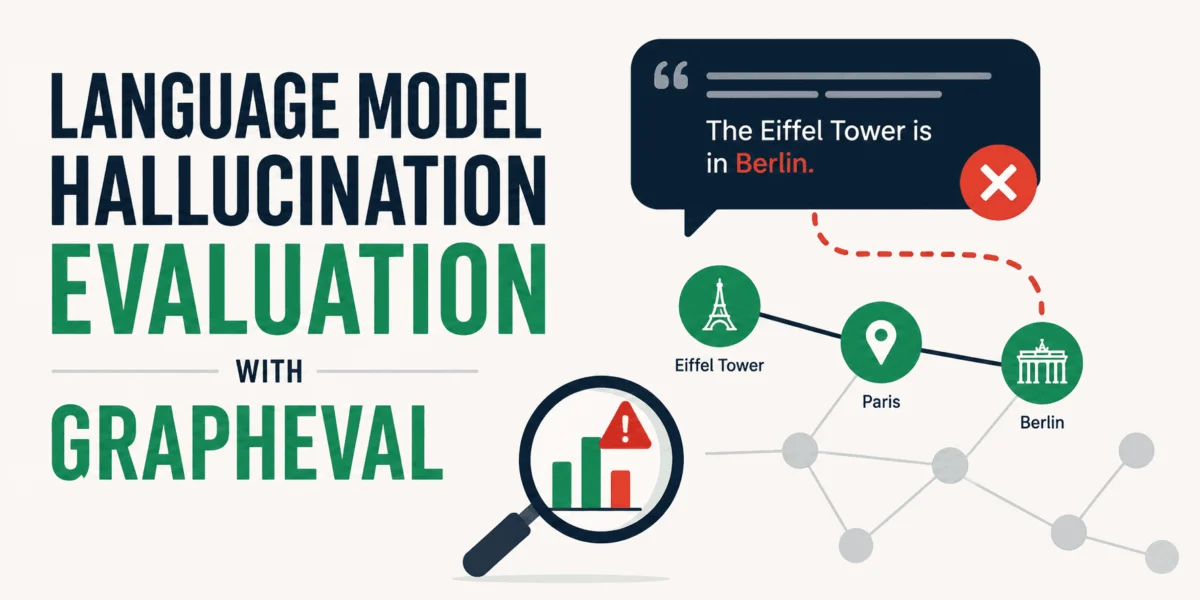
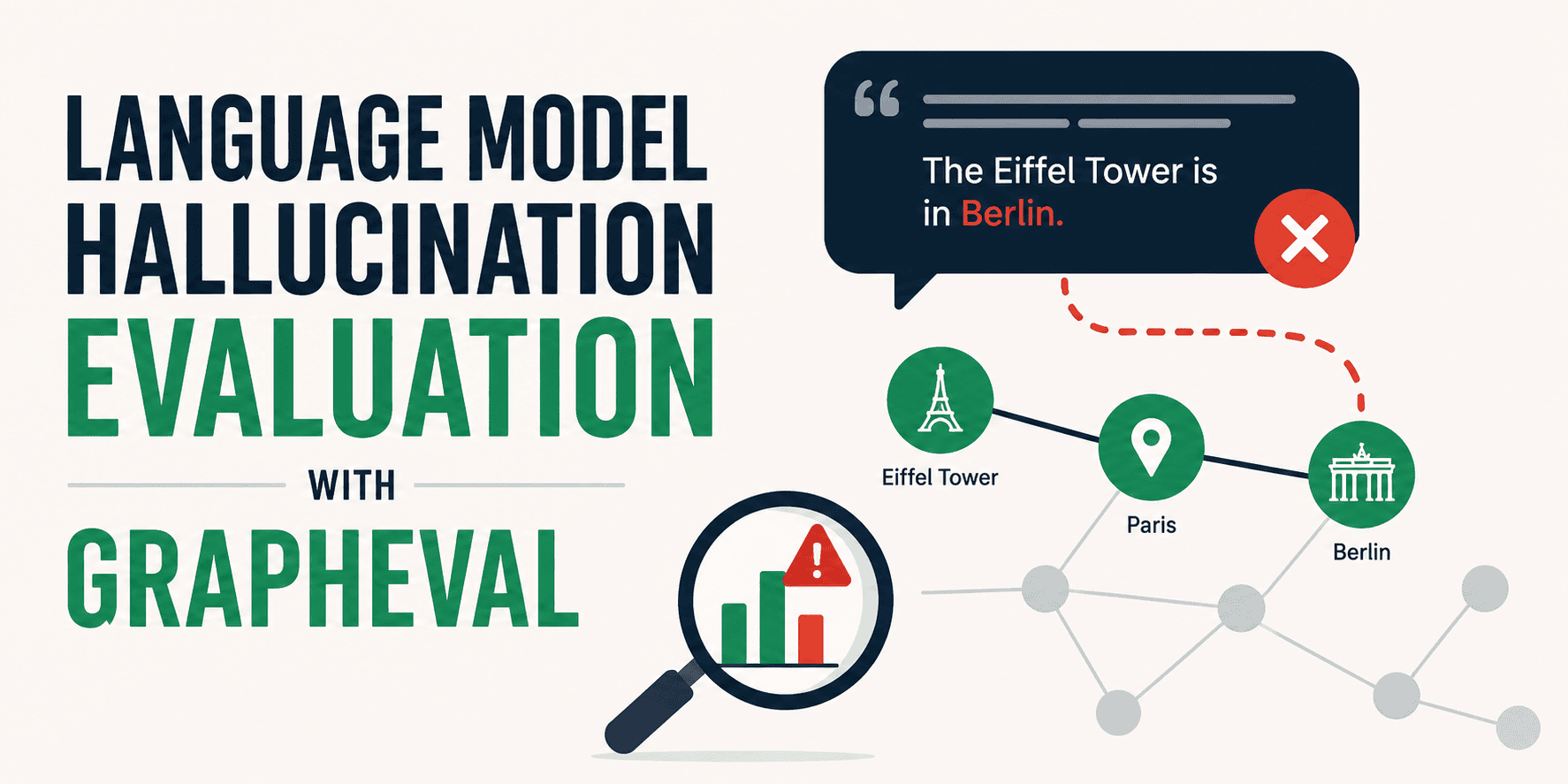
The rapid proliferation of large language models (LLMs) across enterprise and consumer sectors has brought the issue of "hallucinations" to the forefront of artificial intelligence research. Hallucinations occur when an LLM generates a response that is factually incorrect, logically inconsistent, or entirely fabricated, often due to limitations in the model’s internal knowledge or errors in the probabilistic token-prediction process. While the industry has made significant strides in improving the generative capabilities of these models, the development of robust, explainable, and methodological frameworks for diagnosing and evaluating these errors has lagged behind. In response to this challenge, researchers at Amazon have proposed a novel evaluation framework known as GraphEval. This methodology utilizes knowledge graphs to provide a granular, transparent analysis of LLM outputs, moving beyond traditional scoring metrics to offer a localized "map" of where specific factual breakdowns occur.
The Problem of Hallucination in Modern AI Systems
As LLMs like GPT-4, Claude, and Llama 3 are integrated into critical workflows—ranging from medical diagnosis assistance to financial forecasting—the cost of factual errors has escalated. Industry data suggests that hallucination rates can vary significantly depending on the task; for example, in summarization tasks, hallucination rates have been observed between 3% and 10%, while in creative or open-ended generation, the rate can climb as high as 27%.
Current evaluation methods often rely on metrics such as BLEU, ROUGE, or BERTScore. While these are useful for measuring linguistic similarity or semantic overlap between a model’s output and a reference text, they frequently fail to capture factual accuracy. A model could produce a sentence that is grammatically perfect and semantically similar to the source material while still containing a critical factual error. Furthermore, many existing "black-box" evaluation tools provide a single numerical score without explaining why a specific passage was flagged as inaccurate. This lack of transparency makes it difficult for developers to debug models or for enterprises to trust AI-generated insights.
GraphEval: A Two-Stage Knowledge-Based Approach
The GraphEval framework, as detailed in recent research from Amazon Science, addresses the limitations of traditional metrics by introducing a structured, two-stage process that leverages the formal logic of knowledge graphs (KGs). By converting unstructured text into a series of interconnected nodes and edges, the framework allows for a precise comparison between the model’s claims and a verified ground-truth context.
The methodology operates through two distinct phases: Knowledge Graph Extraction and Natural Language Inference (NLI) Verification.
Stage 1: Knowledge Graph Extraction
In the first stage, the framework processes the LLM-generated response to identify its core factual claims. These claims are extracted in the form of "triples"—a standard data structure in knowledge representation consisting of a Subject, a Relationship, and an Object (e.g., "GraphEval," "uses," "Knowledge Graphs"). By decomposing a complex paragraph into these atomic units of information, the framework strips away linguistic flourishes and focuses solely on the underlying assertions. In a production environment, this extraction is typically performed by an auxiliary, highly accurate "evaluator" model or a specialized information extraction pipeline.
Stage 2: Fact Verification via Natural Language Inference
Once the triples are extracted, they must be validated against a "ground truth" source. This source context is usually derived from a vector database in a Retrieval-Augmented Generation (RAG) system or a curated internal knowledge base. GraphEval utilizes a Natural Language Inference (NLI) model to compare each triple against the source context.
The NLI model categorizes the relationship between the ground truth and the triple into three categories:
- Entailment: The ground truth supports the claim.
- Neutral: The ground truth neither supports nor contradicts the claim.
- Contradiction: The ground truth directly refutes the claim.
In the GraphEval framework, any triple that does not result in an "entailment" classification is flagged as a hallucination. This binary threshold ensures that only information explicitly supported by the source data is permitted, a critical requirement for high-stakes enterprise applications.
Technical Implementation and Simulation
To understand the practical utility of GraphEval, one can look at a simulated implementation using open-source tools such as the Hugging Face transformers library, networkx for graph construction, and the DeBERTa-v3 model for NLI tasks.
Consider a scenario where an LLM is asked to define GraphEval. The model might generate a response that correctly identifies its purpose but incorrectly claims it requires an "expensive enterprise server farm" to operate. A human reader might miss this nuance, but the GraphEval framework identifies it through systematic decomposition.
The extraction process would yield three triples:
- (GraphEval, is, evaluation framework)
- (GraphEval, uses, Knowledge Graphs)
- (GraphEval, requires, expensive enterprise server farm)
When these are compared against the actual research paper (the ground truth), the first two triples result in "entailment." However, because the research paper makes no mention of hardware requirements, the third triple is labeled "neutral." Under the GraphEval logic, this is flagged as a hallucination.
The final component of the framework is visualization. By using libraries like matplotlib, developers can generate a "Hallucination Map." In this visual representation, grounded facts are connected by green edges, while hallucinated claims are connected by red edges. This provides immediate, interpretable feedback on exactly which part of the model’s response is untrustworthy.
Chronology of Hallucination Detection Research
The development of GraphEval represents a significant milestone in a decade-long effort to make AI more reliable.
- 2014–2018: Early research focused on "word overlap" metrics. These were sufficient for early translation models but failed as LLMs became more sophisticated.
- 2019–2021: The rise of Transformer models led to the development of BERTScore and other embedding-based metrics. While better at understanding meaning, they remained "black boxes."
- 2022: The "ChatGPT moment" made hallucination a household term, leading to the development of SelfCheckGPT, which uses multiple model iterations to check for consistency.
- 2023–2024: Researchers shifted toward "External Verification" frameworks. Amazon’s GraphEval (2024) represents the current frontier, moving away from simple consistency checks toward structured, knowledge-based verification.
Industry Implications and Broader Impact
The implications of the GraphEval framework extend far beyond academic research. In the corporate world, the "black box" nature of AI has been a primary barrier to adoption.
Legal and Compliance: For legal departments, GraphEval offers an audit trail. If an AI-generated contract summary contains an error, the framework can show exactly which sentence was hallucinated and which source document it failed to align with. This level of traceability is essential for meeting regulatory requirements like the EU AI Act.
Cost Efficiency: While running an LLM for every evaluation can be expensive, the GraphEval approach allows for the use of "Small Language Models" (SLMs) for the NLI stage. Models like DeBERTa-v3-small are computationally lightweight and can be run locally, significantly reducing the cost of continuous monitoring in production environments.
Developer Productivity: By localizing errors to specific triples, GraphEval allows developers to perform "root cause analysis." If a model consistently hallucinates about a specific topic, developers can identify whether the issue lies in the retrieval step (the wrong documents are being fed to the model) or the generation step (the model is ignoring the provided context).
Conclusion and Future Outlook
Amazon’s GraphEval framework highlights a critical shift in the AI industry: the move from "bigger models" to "better oversight." As LLMs continue to integrate into the fabric of global infrastructure, the ability to detect and visualize errors becomes as important as the ability to generate text. By marrying the structural rigor of knowledge graphs with the semantic power of NLI models, GraphEval provides a scalable, explainable solution to the hallucination problem.
The future of this research likely involves "real-time" GraphEval integration, where the framework acts as a filter, catching hallucinations before they ever reach the end-user. As these diagnostic tools become more sophisticated, the "black box" of AI will continue to become more transparent, paving the way for safer and more reliable autonomous systems. In the words of the research community, the goal is no longer just to make models smarter, but to make them more accountable.

