
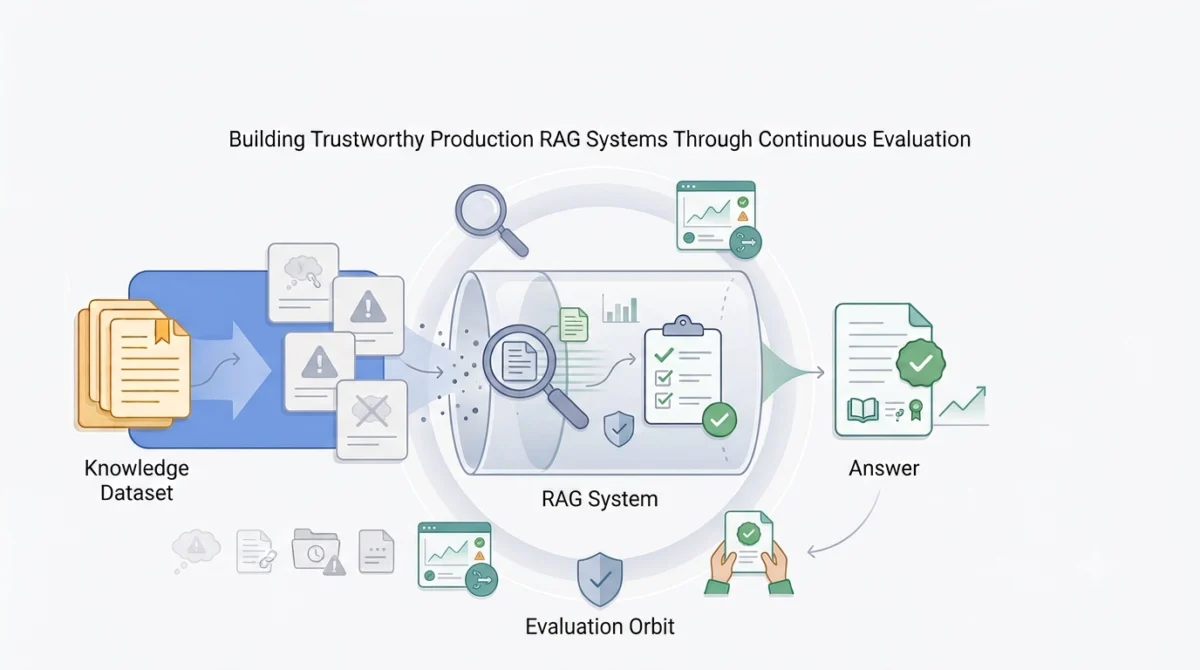
The rapid adoption of Retrieval-Augmented Generation (RAG) within enterprise environments has highlighted a significant challenge for developers and stakeholders: the phenomenon of the "silent failure." In these scenarios, a RAG system appears to function correctly—fetching documents, processing them through a generative model, and producing a fluent, grammatically correct response—yet the output is factually incorrect, incomplete, or based on outdated information. Unlike traditional software bugs that throw clear exceptions, RAG failures often manifest as confident hallucinations or retrieval misses that are difficult to detect without a rigorous, automated evaluation framework. To address these vulnerabilities, organizations are moving toward a multi-tiered evaluation pipeline that combines high-quality benchmarking, automated metrics, and human-in-the-loop oversight to ensure production reliability.
The Shift from Experimental to Production-Grade RAG
In the early stages of generative AI development, many organizations relied on "vibe-based" evaluation, where developers manually tested a handful of queries to see if the results felt correct. However, as RAG systems are integrated into critical business functions—such as customer support, legal discovery, and internal knowledge management—the margin for error has narrowed. A system that provides a perfectly phrased answer based on a document that is three versions out of date is not just a technical failure; it is a business risk.
The core of a production-grade RAG system lies in its ability to distinguish between a retrieval failure (where the system fails to find the correct document) and a generation failure (where the system finds the right document but misinterprets it). Without a structured evaluation process, debugging these systems becomes an exercise in guesswork. Experts in the field now advocate for a systematic approach that evolves from manual checks to automated, cost-aware pipelines integrated directly into the Continuous Integration and Continuous Deployment (CI/CD) lifecycle.
Establishing the Foundation: The Golden Dataset
The first and most critical step in any RAG evaluation strategy is the creation of a "golden dataset." This consists of a curated set of questions with known, verified answers and specific references to the source documents. Industry data suggests that skipping this step is the primary reason why RAG projects fail to transition from proof-of-concept to production.
A robust golden dataset must go beyond simple factual lookups. While easy questions provide a baseline, they rarely represent the failure modes seen in the wild. A high-quality dataset entry includes the question, the ground truth answer, the source document identifier, and a category label. These categories should include:
- Single-Fact Lookups: Basic questions answered by a single document.
- Multi-Hop Reasoning: Questions that require synthesizing information from multiple disparate documents.
- Conflicting or Stale Documents: Scenarios where multiple versions of a document exist, requiring the system to identify the most recent or authoritative source.
- No-Answer Expected: Queries that should result in a "I don’t know" or "information not found" response rather than a guess.
The category of "stale documents" is particularly vital in enterprise settings where document stores naturally accumulate legacy versions of policies or technical manuals. If a RAG system cannot distinguish between a 2022 policy and a 2024 update, its utility is severely compromised.
The Chronology of Evaluation: From Manual to Automated
The implementation of a RAG evaluation pipeline typically follows a specific chronological progression as the application matures.
Phase 1: The Manual Gut-Check
Before deploying complex libraries, developers must conduct a manual pass of the golden set. This phase involves running the 20 to 30 core questions through the pipeline and comparing the outputs side-by-side with the ground truth. This "sanity check" often reveals glaring issues such as broken prompt templates, retriever failures, or instances where the model ignores the provided context entirely.
Phase 2: Automated Scoring via RAGAS
Once the basic pipeline is stable, organizations transition to automated frameworks like RAGAS (Retrieval Augmented Generation Assessment). RAGAS utilizes Large Language Models (LLMs) to score the system across four key dimensions:
- Context Precision: Measuring the signal-to-noise ratio of the retrieved chunks.
- Context Recall: Ensuring that the retrieved documents actually contain the information required to answer the question.
- Faithfulness: Checking if the generated answer is derived exclusively from the retrieved context, effectively acting as a hallucination check.
- Answer Relevancy: Determining how well the final response addresses the original user query.
While RAGAS provides a repeatable, quantitative metric, it has a "structural ceiling." Because it is an LLM scoring another LLM, it may not catch instances where a source is "faithfully" summarized but factually outdated.
Phase 3: The Custom LLM Judge
To bridge the gap between generic metrics and domain-specific requirements, enterprises are increasingly deploying "Custom LLM Judges." This involves using a high-capability model (such as Gemini 1.5 Pro or GPT-4o) with a specific rubric to grade answers. This judge can be programmed to look for numeric accuracy, adherence to brand tone, or the presence of mandatory legal disclaimers. By providing the judge with the "Source Document Date," developers can specifically test for "recency awareness," ensuring the system flags uncertainty when dealing with potentially outdated information.
Operationalizing Evaluation: Human-in-the-Loop and CI/CD Integration
The ultimate goal of a RAG evaluation pipeline is to move it out of a researcher’s notebook and into the standard software development lifecycle. This involves two major components: managing human review and enforcing quality gates.
The Role of Human Oversight
Despite the power of automated judges, human expertise remains the gold standard. However, manual review is expensive and slow. To optimize this, teams use "disagreement triggers." If the RAGAS score and the Custom Judge score for a specific query differ significantly, that query is automatically escalated to a human reviewer. This targeted approach ensures that expensive human time is spent on the most ambiguous cases. Industry benchmarks indicate that LLM-to-human agreement typically hovers in the 80-85% range; a lower percentage usually suggests that the ground truth itself is ambiguous and needs refinement.
Integration with CI/CD Gates
For a RAG system to remain reliable over time, evaluation must be part of the build process. A "CI Gate" ensures that any change to the retrieval logic, chunking strategy, or prompt engineering is automatically tested against the golden dataset. If a new code commit causes a regression—such as a 5% drop in context precision—the build is blocked. This prevents "quiet regressions" where an optimization for one type of query accidentally breaks another.
Monitoring Semantic Drift and Production Performance
A significant risk in enterprise RAG is "semantic drift." This occurs when the live document corpus changes or when user behavior shifts away from the initial test cases. To combat this, developers must sample a small percentage of live production queries weekly. By running these real-world queries through context precision and faithfulness checks (which do not require a ground truth answer), teams can detect if the system is beginning to struggle with new types of data or questions.
Analysis of Implications: Trust as the Core Metric
The implementation of a rigorous RAG evaluation framework has broader implications for the adoption of AI in the corporate world. As organizations move past the "hype" phase of generative AI, the focus is shifting toward accountability and safety.
A failure in a RAG system used for medical advice or financial planning can have catastrophic consequences. By building evaluation pipelines that explicitly test for "conflicting documents" and "no-answer scenarios," companies are building the "trust infrastructure" necessary for AI deployment. Furthermore, the cost-aware tiering of these evaluations—running cheap checks on every commit and expensive human reviews on a schedule—allows for sustainable scaling.
The move toward automated, multi-dimensional evaluation signals a maturation of the field. It acknowledges that LLMs are not "black boxes" that either work or don’t, but rather components of a complex software system that can be measured, tuned, and guarded with the same rigor as traditional databases or APIs.
Conclusion
Building a RAG system is a relatively straightforward task, but maintaining a production-ready RAG system that is consistently accurate and reliable requires a sophisticated evaluation architecture. The transition from a single-person project to an enterprise-grade application necessitates a shift toward the systematic use of golden datasets, automated scoring, and human oversight.
By implementing these six steps—building a dataset, performing manual checks, automating with RAGAS, deploying custom judges, incorporating human review, and monitoring for drift—development teams can move from a state of uncertainty to one of data-driven confidence. In the current landscape, the most successful RAG applications will not necessarily be the ones with the largest models, but the ones with the most robust evaluation pipelines, capable of catching errors before they ever reach a stakeholder’s screen.

