
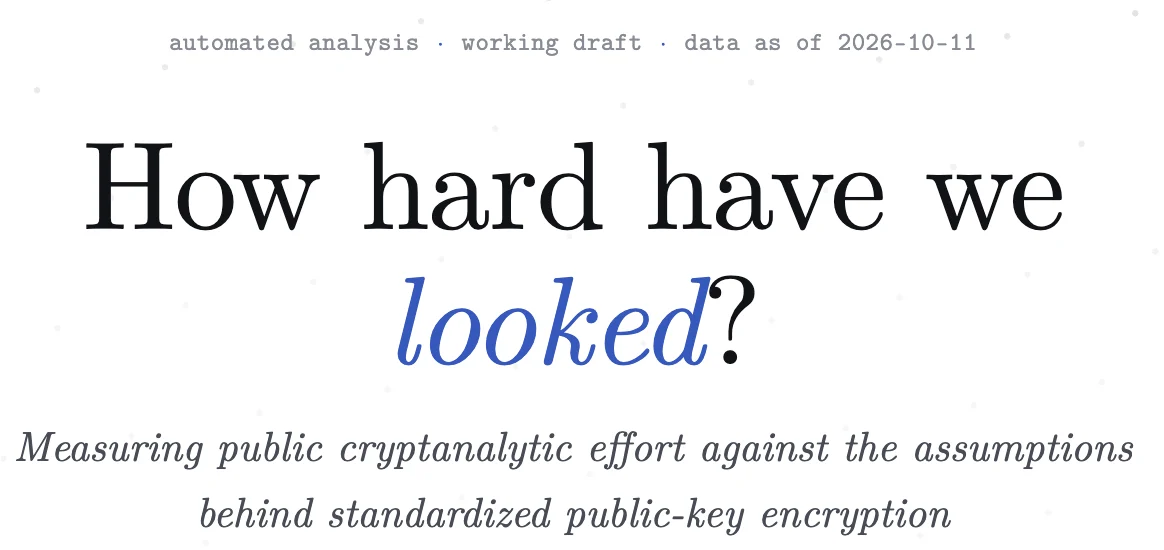
The landscape of modern cybersecurity research has reached a notable milestone with the public launch of Bits of Work, a new specialized web resource designed to estimate the total accumulated human-hours dedicated to cryptanalyzing the fundamental mathematical problems underpinning contemporary public-key cryptography. Announced via a research portal initiative, the project leverages advanced artificial intelligence models, including Anthropic’s Claude and OpenAI’s GPT-6 Astra, to survey, aggregate, and analyze historical cryptographic research outcomes. As the global cryptographic community confronts the looming paradigm shift of quantum computing and continuous scrutiny over cryptographic standards, this database attempts to bring empirical metrics to a domain that has historically relied on qualitative assessments of algorithmic security.
Background Context and Motivation
Public-key cryptography forms the foundational trust layer of the modern digital economy, securing everything from global financial transactions and state-level intelligence communications to everyday messaging applications and web browsing via TLS/SSL. Protocols such as RSA, Diffie-Hellman, and various elliptic-curve cryptography (ECC) schemes derive their security guarantees from the perceived intractability of underlying mathematical problems, such as integer factorization, the discrete logarithm problem, and lattice-based assumptions.
However, quantifying the exact margin of security these algorithms possess against concerted attack has always presented a formidable challenge. While cryptographers can mathematically prove the complexity bounds of specific attacks under idealized models, determining the real-world resistance of a cryptographic primitive often correlates directly with the sheer volume of human intellect, computational experimentation, and analytical hours directed toward breaking it.
Until now, the collective human capital—measured in researcher-years or human-hours—expended by academia, government intelligence agencies, and private corporations to analyze these mathematical problems has remained largely unquantified, scattered across decades of academic literature, conference proceedings, and classified or semi-public research archives. The creators of the new platform sought to address this gap by systematically auditing historical cryptanalysis results to establish a baseline of human effort.
Methodology and Artificial Intelligence Integration
Building a comprehensive ledger of historical cryptanalysis requires parsing vast quantities of technical literature, historical accounts, and academic papers published over the past half-century. To tackle this data-intensive undertaking, the project developers utilized advanced large language models, specifically collaborating with Claude and GPT-6 Astra.
These AI systems were tasked with assisting in the systematic survey of historical cryptanalytic milestones, parsing bibliographic data, estimating researcher headcounts, tracking project timelines, and weighting the complexity of various analytical breakthroughs. The developers readily acknowledge that this endeavor involves complex methodological choices that are open to academic debate. Factors such as how to account for collaborative research teams, part-time academic investigations versus dedicated state-sponsored cryptanalytic projects, and the varying depth of individual contributions introduce inherent variables that are difficult to standardize.
Despite these challenges, the platform aims to provide a structured starting point for debate. By making the methodology transparent and inviting public critique, the project team hopes to refine the dataset through open-source collaboration. The source code and data repositories have been made accessible via GitHub, allowing cryptographers, historians of science, and quantitative analysts to submit issues, propose methodological adjustments, and contribute additional historical data points.
Chronology of Cryptanalytic Evolution
To understand the context of the data presented on the new platform, it is instructive to examine the chronological progression of public-key cryptanalysis over the past fifty years:
- 1976: Whitfield Diffie and Martin Hellman publish "New Directions in Cryptography," introducing the concept of public-key cryptography and sparking a new era of academic and governmental cryptanalytic research.
- 1977: The introduction of the RSA cryptosystem by Ron Rivest, Adi Shamir, and Leonard Adleman. RSA quickly becomes the benchmark against which future public-key schemes are measured, immediately drawing intense scrutiny from the global mathematical community.
- 1990s: The advent of advanced factoring techniques, most notably the General Number Field Sieve (GNFS), which drastically reduces the computational and analytical complexity required to factor large composite numbers, forcing a steady increase in recommended RSA key lengths.
- 2000s–2010s: Widespread adoption of Elliptic Curve Cryptography (ECC) and the maturation of pairing-based cryptography. Cryptanalysts shift substantial focus toward analyzing the Weil and Tate pairings, as well as index calculus attacks on specific curve families.
- 2016–Present: The National Institute of Standards and Technology (NIST) Post-Quantum Cryptography (PQC) standardization process drives an unprecedented wave of cryptanalytic evaluation targeting lattice-based, code-based, and multivariate-quadratic algorithms, pushing researchers to quantify the security margins of new cryptographic primitives.
Supporting Data and Initial Findings
While the portal at bitsofwork.org is currently positioned as an ongoing work-in-progress, the initial datasets offer fascinating insights into the distribution of human effort across different cryptographic problems. Preliminary metrics on the site highlight stark disparities in how research hours have been allocated historically:
- Factorization-Based Schemes (RSA): Unsurprisingly, RSA has commanded the lion’s share of cumulative human-hours since the late 1970s. Because of its ubiquity in early internet security, generations of computer scientists, mathematicians, and codebreakers have scrutinized its algebraic properties, leading to highly optimized specialized and general number field sieve algorithms.
- Discrete Logarithm Problems (Finite Fields and Elliptic Curves): The effort expended on discrete logarithm variants represents another massive pillar of historical cryptanalysis. While finite field cryptography received early attention, elliptic curve cryptography experienced a more targeted, highly specialized wave of analysis, often driven by standardization bodies evaluating backdoor concerns and implementation vulnerabilities.
- Post-Quantum Primitives: Newer mathematical problems, such as Learning With Errors (LWE) and module-lattice problems underpinning NIST-selected post-quantum standards, currently exhibit a much smaller footprint of cumulative human cryptanalytic hours compared to RSA or traditional ECC. This discrepancy is a central point of discussion in ongoing debates regarding the readiness of post-quantum standards for long-term deployment.
Community Reception and Initial Reactions
The release of the platform has generated immediate discussion within academic cryptography circles and online security forums. Cryptographers and information security professionals have begun examining the site to evaluate whether the estimated human-hour metrics align with historical realities.
Initial community feedback has praised the project for tackling a notoriously difficult and overlooked metric in security engineering. Quantifying the "work" in public-key encryption has long been intuitive rather than empirical; security practitioners often speak of an algorithm being "well-studied," but translating that phrase into quantifiable human-hours provides a fresh dimension for evaluating cryptographic confidence.
At the same time, academic commentators have raised standard methodological questions typical of historical scientometrics. For instance, distinguishing between theoretical cryptanalysis (discovering new mathematical properties or attack vectors) and applied cryptanalysis (optimizing code to run on massive compute clusters) remains a complex boundary to define. Furthermore, accounting for classified research conducted by signals intelligence agencies—such as the United States National Security Agency (NSA) or its international counterparts—presents a fundamental blind spot, as historical discoveries made behind closed doors rarely come with reliable records of researcher headcount or hours logged.
Broader Implications and Future Outlook
The implications of quantifying historical cryptanalytic work extend far beyond academic curiosity. As the cybersecurity industry navigates the complex transition toward post-quantum cryptography, decision-makers in government and enterprise must evaluate the risk profiles of legacy algorithms versus newly minted post-quantum standards.
One of the central debates in modern cryptography revolves around confidence levels: Does an algorithm that has survived thirty years of intense human scrutiny inherently possess a lower probability of harboring a fatal flaw than an algorithm introduced five years ago, even if both are backed by rigorous worst-case complexity proofs? By providing a clearer picture of the cumulative human-hours invested in analyzing specific mathematical problems, projects like Bits of Work offer a quantitative lens through which to view this heuristic.
If an established public-key scheme represents hundreds of thousands of hours of failed attacks by brilliant minds, that metric serves as a practical, albeit imperfect, indicator of resilience. Conversely, identifying areas where cryptanalytic effort has been sparse can highlight potential blind spots that require targeted academic funding and peer review before broad commercial implementation occurs.
As the site continues to evolve through community contributions on GitHub and ongoing refinements assisted by artificial intelligence models, it is expected to serve as a valuable reference tool for cryptographers, historians of technology, and policy-makers shaping the future of global digital security standards. Researchers interested in exploring the current datasets or contributing to the methodology can access the portal directly at bitsofwork.org.

