

A sophisticated credit card skimming campaign has compromised the shared analytics infrastructure of Convertr, a prominent Brazilian e-commerce platform, exposing the sensitive payment card data of countless online shoppers across dozens of major fashion brands. The security incident, which came to light in late October 2026, highlights the escalating risks associated with supply chain vulnerabilities in modern digital retail. By hijacking a self-hosted analytics tracker, malicious actors gained deep, persistent access to the checkout workflows of high-profile online storefronts, redirecting confidential financial information directly to infrastructure controlled by cybercriminals.
The ongoing campaign has been attributed to a well-known Brazilian cybercrime gang that has actively targeted online merchants since at least July 2024. Operating with a high degree of technical proficiency, this threat actor group has systematically focused its efforts on compromising prominent e-commerce platforms and content management systems, including Magento, OpenCart, and WooCommerce. Convertr itself serves as a foundational digital backbone for numerous large-scale fashion and retail brands operating within Brazil, collectively processing an estimated R$2 billion ($370 million USD) in annual sales volume. Because the platform integrates deeply into the checkout architectures of its client merchants, a single point of failure at the platform level cascades into a massive, multi-tenant security crisis.
Anatomy of the Supply Chain Compromise
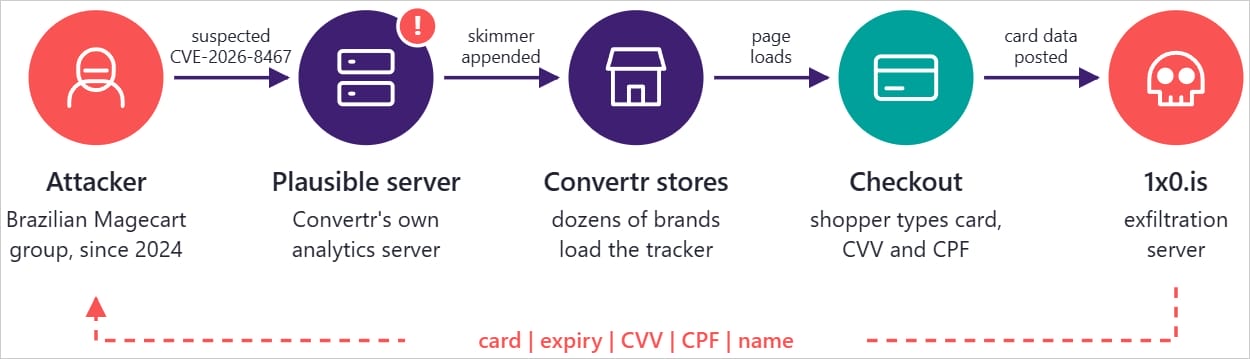
The security incident was first uncovered and publicly detailed by e-commerce cybersecurity firm Sansec on October 24, 2026. According to Sansec’s technical investigation, the attackers successfully compromised Convertr by targeting a self-managed server dedicated to hosting Plausible—an increasingly popular, open-source alternative to Google Analytics designed to track user behavior without compromising privacy.
While formal confirmation is still pending, cybersecurity researchers strongly suspect that the initial intrusion leveraged CVE-2026-8467, an unauthenticated remote code execution vulnerability impacting outdated installations of the Plausible Community Edition. Because organizations frequently lag behind on patching internal auxiliary tooling like analytics servers, threat actors actively scan for and exploit these neglected administrative blind spots to gain a critical foothold within corporate networks.

Once initial access was secured, the attackers did not immediately deploy their malicious payloads. Instead, they subtly modified the legitimate Plausible analytics tracker file living directly on Convertr’s internal infrastructure. Because this tracking script was dynamically loaded onto the checkout pages of every single merchant operating on the Convertr platform, the malicious modification effectively weaponized the supply chain.
Initial iterations of the credit card skimmer relied on generic form-field pattern matching, capturing input fields based on common naming conventions used across standard e-commerce templates. However, demonstrating a high level of operational adaptation and refinement, the threat actors deployed a significantly more targeted script by October 26. This updated variant was specifically calibrated to recognize and harvest data from Convertr’s proprietary payment API field names, ensuring a higher rate of successful data extraction while minimizing computational noise.
Chronology of the Incident
The timeline of the Convertr supply chain attack illustrates the rapid deployment capabilities of modern cybercrime syndicates targeting the retail sector:
- July 2024: The Brazilian threat actor group behind the operation intensifies campaigns targeting platforms running Magento, OpenCart, and WooCommerce.
- October 24, 2026: E-commerce security firm Sansec identifies the malicious modification of the Plausible tracker hosted on Convertr’s infrastructure and issues public warnings.
- October 26, 2026: The attackers upgrade their skimming script, shifting from generic field detection to precise targeting of Convertr’s unique payment API field names.
- Late October 2026: Convertr acts on threat intelligence reports, removing the malicious skimmer code, upgrading its Plausible Community Edition instance to a patched version, and initiating notifications to affected merchants and payment processors.
- Post-Remediation Window: Security researchers emphasize that browser caching mechanisms may continue to serve the malicious script to returning visitors for up to 24 hours following the initial server-side cleanup.
Broader Implications for E-Commerce and Digital Supply Chains
The attack against Convertr underscores a critical and persistent challenge in modern web security: the third-party dependency risk. E-commerce platforms rely on a vast ecosystem of external scripts, ranging from advertising trackers and customer support widgets to performance analytics tools. When an organization integrates these third-party tools directly into sensitive environments like checkout pages, they inadvertently extend a high level of trust to outside vendors and open-source packages.
If an attacker manages to compromise an analytics script, they effectively bypass traditional perimeter defenses. Because the script originates from what the browser perceives as a trusted or expected source, security policies often permit it to execute freely, read DOM elements, and exfiltrate data via standard HTTP requests or DNS tunneling. This technique, commonly associated with Magecart-style digital skimming, transforms helpful business intelligence utilities into silent, high-yield espionage tools.
Furthermore, the incident sheds light on the cascading vulnerabilities introduced by self-hosted open-source software. While companies frequently invest heavily in securing their primary transaction databases and customer relationship management systems, auxiliary infrastructure—such as internal analytics dashboards, staging servers, and log management utilities—are often left unpatched for extended periods. Attackers view these secondary assets as low-hanging fruit, utilizing them as stepping stones to pivot toward core business logic systems.
Official Responses and Mitigation Measures
In the wake of Sansec’s disclosures, Convertr took immediate corrective action. Security updates confirmed that the company successfully purged the malicious skimmer from its infrastructure and applied necessary patches to its Plausible analytics deployment. Additionally, Convertr management initiated direct communication channels with impacted merchants and associated payment providers to coordinate downstream risk mitigation and fraud monitoring.
Despite these server-side remediation efforts, cybersecurity analysts continue to sound the alarm regarding persistent browser caching. Because web browsers cache static scripts to optimize loading speeds, shoppers who visited an affected checkout page prior to the fix may continue to execute the cached, malicious script from their local machine for up to 24 hours. Consequently, Sansec has strongly advised consumers to explicitly clear their browser caches before attempting any new online purchases on affected storefronts.
For consumers who believe they may have exposed their payment card details during the compromised window—specifically anyone who completed a transaction on a Brazilian retail site featuring the string checkout.convertr in the URL address path since October 24—immediate action is required. Financial experts recommend contacting issuing banks without delay to request card blockages and monitor statements for unauthorized activity.
As digital skimming operations grow increasingly sophisticated, security professionals urge both merchants and consumers to adopt robust defensive postures. Retail platforms must enforce strict Content Security Policies (CSPs) to restrict unauthorized script execution and maintain rigorous patch management across all auxiliary servers. Meanwhile, consumers are increasingly turning to modern financial safety tools, such as disposable virtual payment cards that automatically expire immediately following a single transaction, thereby neutralizing the long-term utility of harvested credit card credentials.

