
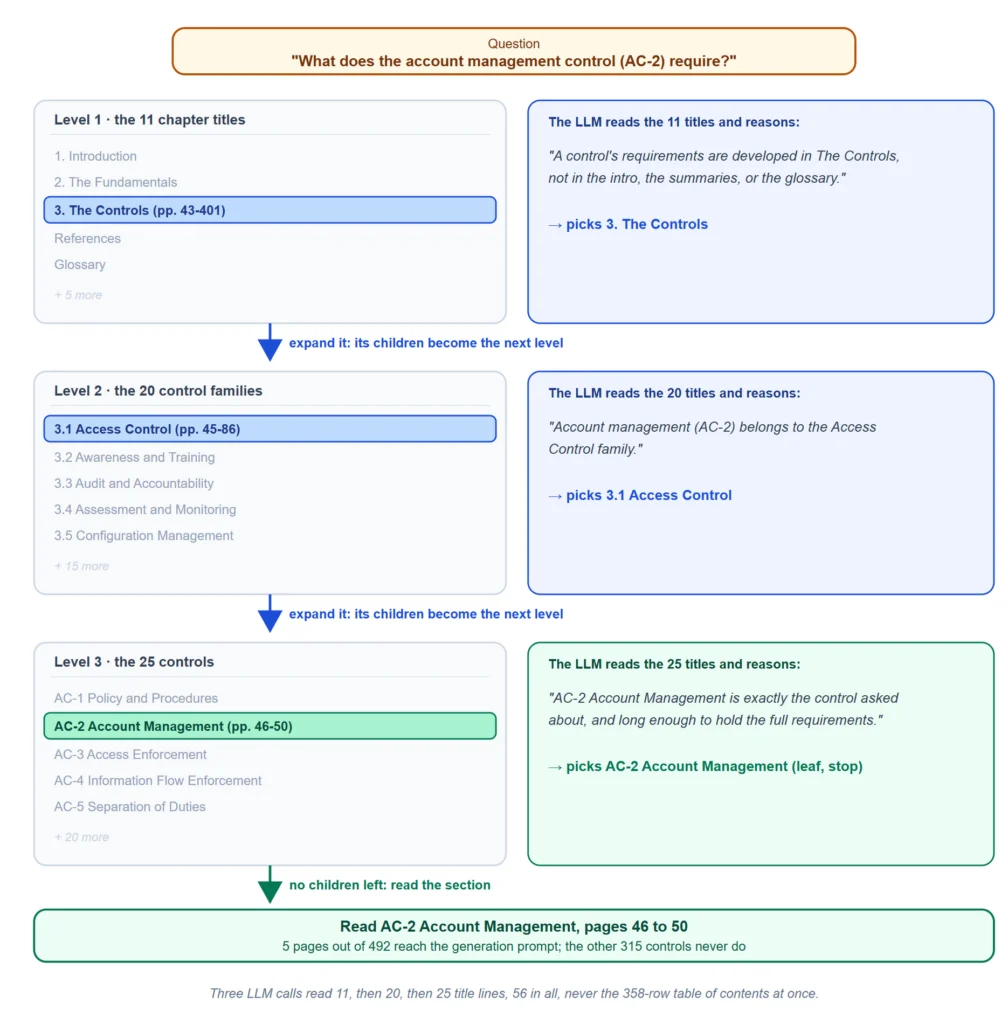
The evolution of Retrieval-Augmented Generation (RAG) has reached a critical juncture where the limitations of "naive" retrieval are becoming a significant bottleneck for enterprise-grade applications. As organizations attempt to process massive technical corpora, such as the 492-page NIST SP 800-53 security control framework, the industry is shifting away from simple flat-vector searches toward more sophisticated, hierarchical architectures. This transition is driven by the "needle in a haystack" problem, where traditional top-k retrieval methods struggle to distinguish between semantically similar but contextually distinct sections of a long-form document. By implementing a hierarchical retrieval system that mimics the mental model of a human expert, developers can significantly enhance both the precision of AI responses and the cost-efficiency of the underlying infrastructure.
The Crisis of Context in Enterprise Document Intelligence
In the context of Enterprise Document Intelligence, the primary challenge is not the lack of data, but the overwhelming volume of it. National Institute of Standards and Technology (NIST) Special Publication 800-53, "Security and Privacy Controls for Information Systems and Organizations," serves as the gold standard for federal information system security. However, its sheer density—comprising twenty control families and hundreds of individual requirements—poses a unique challenge for standard RAG pipelines.

When a user queries a system about a specific requirement, such as "What does the account management control require?", a naive RAG system typically breaks the 492-page document into smaller chunks, embeds them into a vector space, and retrieves the most similar segments. Because the terms "account," "management," "control," and "access" appear on nearly every page of a security manual, the vector search returns a fragmented "blur" of results. The system may retrieve the correct control (AC-2) alongside irrelevant glossary entries, audit logs, or similar but distinct controls like AC-3 (Access Enforcement). This results in a generation model that must "guess" which information is relevant, leading to higher token costs and a significant risk of hallucination.
The fundamental philosophy for overcoming this is to "amplify the expert." An expert human reader does not scan 500 pages simultaneously. Instead, they utilize the Table of Contents (ToC) to navigate from broad chapters to specific sections. This hierarchical approach—moving from the top level down to the leaf nodes—is the core mechanism of the hierarchical retrieval brick.
The Structural Framework: Building the Navigational Loop
The implementation of hierarchical retrieval requires a shift from flat text processing to structural analysis. This process begins with sophisticated document parsing. While many PDF parsers return a continuous stream of text, an enterprise-ready system must reconstruct or extract the document’s native outline. In the case of NIST SP 800-53, the parser generates a relational dataframe (referred to as a toc_df), which maps every heading, its hierarchical level, and its corresponding page range.

For this specific NIST document, the Table of Contents contains 358 individual entries across three levels of depth. Providing the entire 358-line ToC to a Large Language Model (LLM) in a single prompt is inefficient and exceeds the optimal context window for precise reasoning. Instead, the retrieval process is engineered as a bounded loop.
The Logic of the Recursive Descent
The hierarchical loop operates on three primary control surfaces: a trigger, a termination condition, and a recovery mechanism.
- The Trigger: The process begins at the highest level of the document structure. The LLM is presented with only the top-level chapter titles (e.g., the eleven main chapters of the NIST manual). Each entry is presented as a compact line containing the title and page range.
- The Reasoning Step: A specialized function,
reason_on_toc, asks the model to pick the most relevant branch based on the user’s query. If the question is about "Account Management," the model identifies "Chapter Three: The Controls" as the relevant starting point. - The Descent: Once a branch is selected, the system "opens" that section, revealing its immediate children. The loop repeats, moving from the chapter level to the "Family" level (e.g., Access Control), and finally to the specific "Control" level (e.g., AC-2).
- Termination: The loop terminates when the system reaches a "leaf" (a section with no further sub-headings) or a section that is small enough to be processed in its entirety (typically defined by a page-count threshold).
This method ensures that the LLM never processes more than a few dozen lines of structural data at a time, maintaining high focus and reducing the "lost in the middle" phenomenon common in long-context prompts.

Performance Metrics: Tokens vs. Precision
Hierarchical retrieval offers a rare "win-win" in software engineering: it improves performance while simultaneously reducing costs.
Precision Gains
In a flat retrieval model, the answer for AC-2 (which spans five pages) might be interleaved with five pages of neighboring, irrelevant controls. By using a top-down router, the system commits to the specific "AC-2 Account Management" section by name. It retrieves the entire five-page block as a single, coherent unit. This structural integrity ensures that the generation model receives the complete context intended by the document’s authors, leading to far more accurate and authoritative answers.
Token Efficiency
The financial implications are substantial. A naive pipeline might embed 492 pages and pay for vector search and retrieval across the entire corpus for every query. In contrast, the hierarchical router only "reads" the structural map. In a typical run for a NIST query, the system might process 56 short lines of text across three small LLM calls to navigate the ToC, followed by the five pages of the actual answer. The remaining 315 controls and 480+ pages of text never enter the prompt, resulting in a dramatic reduction in per-query token expenditure.

Technical Implementation and Keyword Integration
While semantic reasoning by the LLM is the primary driver of the descent, the system also utilizes a "keyword tally" as a secondary tie-breaker. This is particularly useful when document titles are ambiguous or when a term is defined in one section but used extensively in another.
For instance, the term "least privilege" is a core concept in "Access Control" but may be defined in the "Glossary." By including a keyword tally—a count of how many query-relevant terms appear within a specific branch—the system provides the LLM with an additional data point to decide whether to descend into a technical section or pivot to a reference section. This hybrid approach combines the strengths of traditional keyword search with the sophisticated reasoning capabilities of modern transformer models.
Scaling to the Corpus Level: From Documents to Folders
The principles of hierarchical retrieval are not limited to single, long documents. The same logic applies to a corpus of thousands of documents. In a multi-document environment, the "top level" of the hierarchy becomes the file list itself.

In this expanded architecture, the retrieval system first evaluates a list of document titles and one-line summaries to select the relevant files. Once the files are selected, the system descends into each file’s specific Table of Contents. This creates a multi-layered map where the number of levels grows, but the fundamental "pick, open, repeat" logic remains unchanged. This scalability is essential for legal, medical, and governmental organizations that manage vast repositories of interconnected regulations and manuals.
Chronology of Development in Document Intelligence
The development of this hierarchical retrieval brick is part of a broader shift in AI architecture. Earlier iterations of RAG focused primarily on the "Generation" aspect, assuming that better models would compensate for poor retrieval. However, as the industry matured through 2023 and 2024, it became clear that "Garbage In, Garbage Out" remained the rule.
The timeline of this specific methodology moved through several key phases:

- Phase 1: Document Parsing: Moving beyond basic OCR to recognize the relational shape of PDFs.
- Phase 2: Question Parsing: Understanding if a user is asking for a specific fact or a comprehensive listing.
- Phase 3: Hierarchical Routing: The current phase, focusing on navigating document structures to minimize noise.
- Phase 4: Corpus-Level Intelligence: Integrating these document-level insights into global search infrastructures.
Implications for the Future of Enterprise AI
The move toward hierarchical retrieval signifies a maturing of the AI field. It acknowledges that LLMs are most effective when they are given clear, structured, and scoped tasks rather than being asked to "find the needle" in a massive data dump.
By automating the way an expert navigates a table of contents, organizations can build systems that are not only more accurate but also more transparent. Users can see the "reasoning path" the AI took—from chapter to family to control—providing a clear audit trail for how a specific answer was derived. This transparency is vital for compliance-heavy industries where the source of a security requirement is as important as the requirement itself.
In conclusion, hierarchical retrieval represents a strategic pivot in how we build enterprise RAG systems. By leveraging the existing structural intelligence of documents like NIST SP 800-53, developers can create AI agents that are faster, cheaper, and significantly more precise. This approach does not just process data; it understands the map of the information, ensuring that the AI remains a focused tool rather than a confused search engine.

