

French cooperative banking giant Crédit Mutuel Arkéa has found itself at the center of a major cybersecurity incident after hackers successfully exploited a third-party service provider to initiate unauthorized financial transfers totaling an estimated $133 million (118 million euros). The sophisticated breach forced the institution to temporarily suspend certain operational systems, spark a massive cross-border investigation, and issue urgent warnings to its millions of members regarding a secondary wave of opportunistic phishing attempts.
While the headline-grabbing figure suggests a catastrophic financial loss for the institution, Crédit Mutuel Arkéa has repeatedly emphasized that individual customer assets remain entirely unaffected. The unauthorized transactions were executed directly through the bank’s own corporate and institutional accounts rather than dipping into personal retail savings or checking deposits. Nevertheless, the scale of the exploit, the rapid conversion of stolen funds into privacy-friendly cryptocurrency, and the method of entry via an external vendor highlight ongoing vulnerabilities in the interconnected digital supply chain of modern European banking.
Anatomy of the Attack: The Third-Party Vector
Crédit Mutuel Arkéa is a cornerstone of the French cooperative banking sector. Boasting more than 5.8 million members and managing approximately 211.5 billion euros in total assets, the group operates multiple regional federations and specialized financial subsidiaries. Because institutions of this magnitude rely on vast ecosystems of software vendors, cloud providers, and IT contractors, they present an expansive attack surface to determined threat actors.
According to technical disclosures and official statements released by the bank, the threat actors did not breach Crédit Mutuel Arkéa’s core infrastructure directly. Instead, they leveraged an initial foothold within a service provider’s platform to bypass standard perimeter security controls. By exploiting this third-party access vector, the hackers managed to authenticate into the banking network and execute unauthorized transfers to external financial organizations.
Significantly, the bank explicitly ruled out any operational involvement or vulnerability stemming from Fortuneo, one of its most prominent online banking subsidiaries. Furthermore, internal forensics have definitively ruled out human error on the part of bank personnel, categorizing the assault instead as a highly coordinated, multi-stage cyberattack orchestrated by advanced persistent threat actors or specialized financial cybercrime syndicates.

The Chronology of Discovery and Laundering
The unfolding of the incident began not with an official corporate press release, but with real-time on-chain surveillance. The timeline of the crisis highlights the critical gap that often exists between digital asset theft and traditional law enforcement response times.
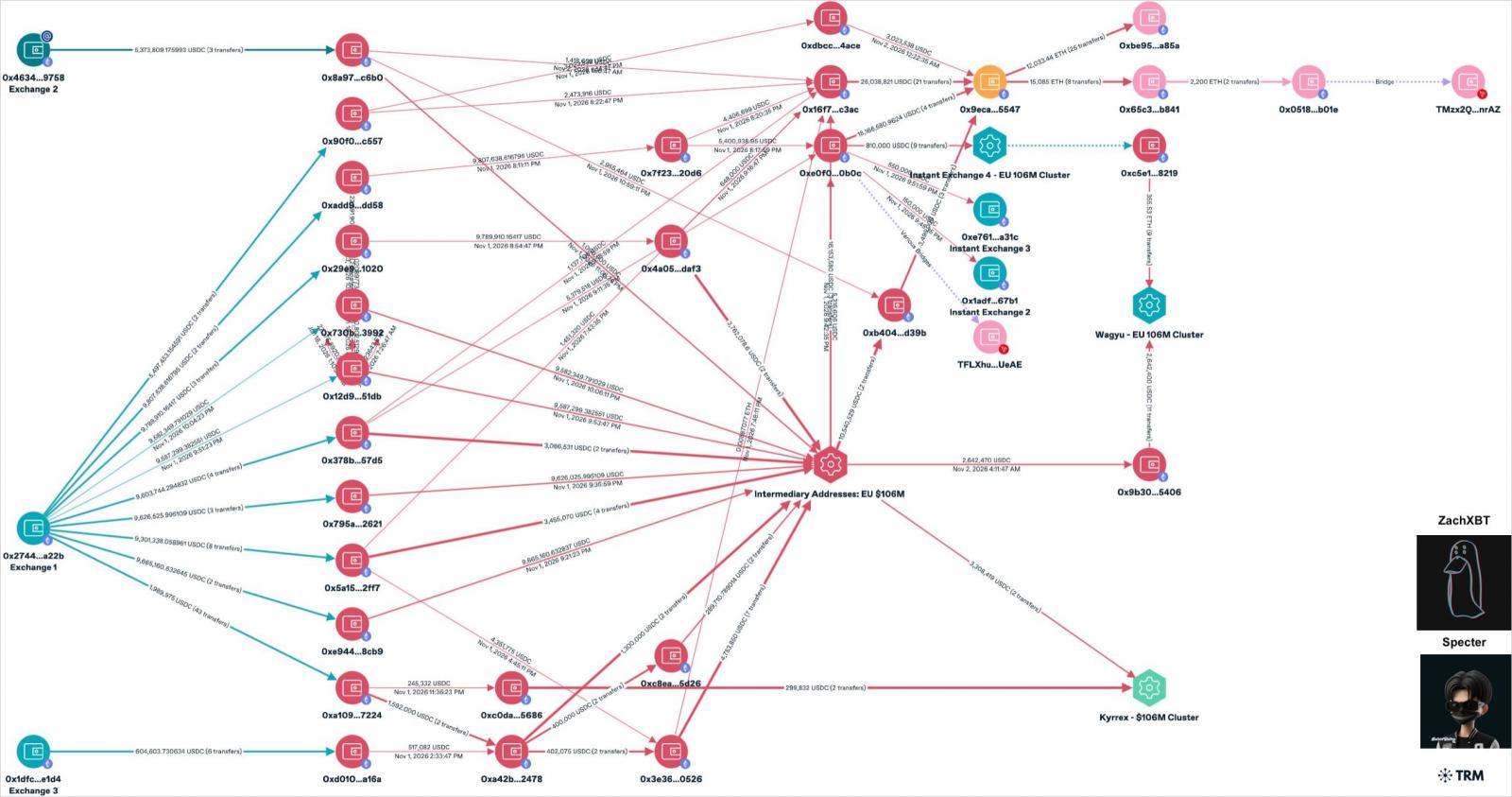
November 1, 2026: Unauthorized withdrawals and large-scale asset movements begin across multiple centralized exchange accounts. The transfers systematically drain funds through external banking channels.
November 2, 2026: Blockchain security investigator ZachXBT breaks the story to the public. Using decentralized ledger tracking, ZachXBT issues widespread warnings via Telegram regarding massive unauthorized withdrawals. Initial on-chain estimates place the pilfered sum at approximately 118 million euros—roughly equivalent to $133 million USD—which the perpetrators rapidly convert into stablecoins such as USDC (USD Coin) and USDT (Tether) to obfuscate the paper trail.
November 3, 2026: Due to the absence of public identification or immediate institutional disclosure during the first 48 hours, the attackers successfully launder an estimated $30 million of the stolen proceeds through various decentralized protocols and mixing services. Blockchain analysts note that this window of opacity severely hampers the ability of European Union law enforcement agencies to freeze assets before they vanish into privacy-centric networks.
November 4, 2026: Facing mounting public scrutiny and the circulation of blockchain intelligence reports, Crédit Mutuel Arkéa formally acknowledges the cyberattack. In an official communication translated and distributed to stakeholders, the bank asserts that the incident is "now closed and under control" and that standard banking operations are progressively returning to normal functionality.
Institutional Response and Damage Control
In the wake of the disclosure, Crédit Mutuel Arkéa moved swiftly to reassure both retail and institutional clients. The bank published detailed updates across its official communication channels and set up dedicated frequently-asked-questions (FAQ) pages to address customer anxieties.

"Crédit Mutuel Arkéa wishes to reassure all its clients — across its federations and subsidiaries — that this incident has no impact on their assets; it has merely resulted in a delay in the execution of certain transfer transactions," the bank stated in its formal declaration.
While the institution confirmed the general magnitude of the financial hit, executives stopped short of explicitly validating ZachXBT’s exact 118 million euro figure. When pressed by industry observers on whether the $133 million estimate was accurate, bank representatives maintained a cautious stance: "Do you confirm that 118 million euros were stolen? We do not confirm this information and can only validate the order of magnitude."
The bank confirmed that while a substantial sum was spirited away, intervention mechanisms allowed security teams and partner institutions to successfully block and intercept a portion of the funds before they could be fully liquidated or transferred out of reach. Judicial authorities, specialized cybercrime police units, and regulatory bodies have since been brought in to map out the precise modus operandi, identify the threat actors, and trace the remaining digital assets.
Secondary Risks: The Phishing Wave
Major cyber incidents frequently spawn opportunistic secondary attacks, and the Crédit Mutuel Arkéa breach proved no exception. Capitalizing on the public anxiety surrounding the bank’s temporary system suspensions and delayed transfers, malicious actors launched targeted phishing campaigns aimed at the bank’s millions of members.
Crédit Mutuel Arkéa issued strict warnings cautioning clients to remain hyper-vigilant against unsolicited emails, text messages, and phone calls. Cybercriminals posing as bank representatives began contacting customers under the guise of "resolving account issues" stemming from the cyberattack, attempting to trick individuals into divulging sensitive personal credentials, two-factor authentication codes, or banking passwords.
To combat this secondary threat, the bank implemented an aggressive communication strategy, advising clients never to share sensitive data over phone or email and urging them to independently verify any suspicious contact by calling their designated bank advisor directly using official, pre-established phone numbers.
Broader Implications for the European Banking Sector
The cyberattack on Crédit Mutuel Arkéa underscores a persistent and evolving vulnerability within the global financial ecosystem: third-party vendor risk. As banks increasingly digitize their services and outsource non-core IT functions, cloud hosting, and software maintenance to external vendors, they inadvertently expand their attack surfaces. A compromise at a minor contractor can thus serve as a master key to a multi-billion-dollar financial institution.
Furthermore, the incident highlights the growing convergence between traditional banking infrastructure and cryptocurrency blockchain networks. Cybercrime syndicates increasingly rely on centralized exchange accounts and stablecoins like USDC and USDT to launder fiat currency rapidly across borders, bypassing traditional banking freezes and evading international law enforcement jurisdictions within minutes.
For European regulators, the incident serves as a stark reminder of the urgency behind frameworks such as the Digital Operational Resilience Act (DORA), which imposes stringent risk-management and third-party oversight requirements on financial institutions operating within the EU. The rapid timeline in which the Arkéa hackers managed to convert and launder tens of millions of dollars before authorities could intervene demonstrates that regulatory compliance alone is insufficient; real-time threat intelligence sharing and cross-border crypto-asset tracking must become standard operating procedure.
As investigations continue, Crédit Mutuel Arkéa remains under pressure to provide deeper transparency regarding the specific service provider breached and the systemic flaws that allowed the unauthorized fund transfers to clear internal verification protocols. For now, the bank’s primary focus remains securing its perimeter, supporting law enforcement agencies in recovering the remaining stolen capital, and restoring absolute confidence among its 5.8 million cooperative members.

