The architecture of the global internet is undergoing a structural paradigm shift, moving past the boundaries of traditional web applications and the decentralized ledgers of Web3 toward what industry researchers have termed the "Post Web." According to a comprehensive market thesis released by venture capital firm Outlier Ventures, this forthcoming era is defined not merely by the automation of execution, but by the automation of intention. At the heart of this transformation lies the "Agentic Layer"—a foundational stratum within the modern technology stack where autonomous artificial intelligence agents act directly on behalf of human users. These systems possess the capacity to interpret high-level goals, navigate complex virtual environments, make decentralized decisions, and execute actions autonomously across distributed ledger systems.
To understand the magnitude of this shift, technology historians and blockchain architects often look back at the trajectory of digital infrastructure over the past three decades. The early internet, known colloquially as Web1, provided a static, read-only medium for the dissemination of information. Web2 introduced interactivity, user-generated content, and platform capitalism, binding user data and digital identity to centralized corporate gatekeepers such as Google, Meta, and Amazon. Subsequently, Web3 emerged as a decentralized antidote, utilizing blockchain technology and smart contracts to introduce programmable money and trustless ownership. While Web3 successfully established a decentralized financial and organizational infrastructure, industry analysts note that it still required substantial human effort to function: users had to manually write code, initiate transactions, manage private keys, and dictate exact execution parameters.
The Post Web seeks to resolve this friction by introducing programmable agency. As Greysen Cacciatore, a research associate at Outlier Ventures, observed in the firm’s recent structural thesis, "AI agentic systems mark the beginning of a new paradigm. With their capabilities to orchestrate intention, navigate complex virtual environments, and achieve sophisticated outcomes, they are poised to transform the global economy."
Distinguishing Bots from Autonomous Agents
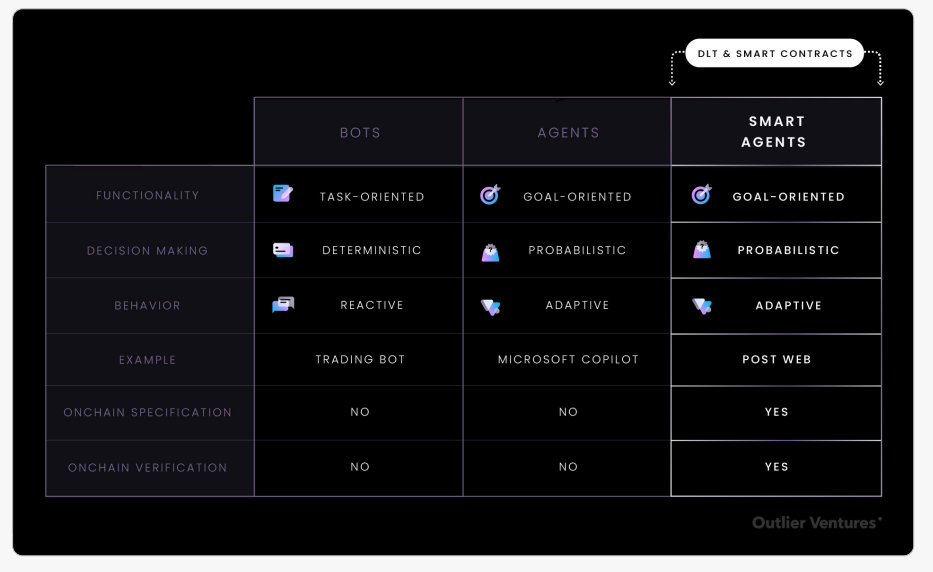
A common point of confusion among enterprise technologists and casual observers alike is the distinction between conventional bots, standard automation scripts, and next-generation AI agents. While software scripts and automated bots have populated the internet for decades, their utility has historically been constrained by rigid limitations. Traditional bots are deterministic, relying on fixed input-output loops to follow predefined instructions. They are fundamentally reactive, task-oriented, and utterly devoid of the capacity to learn or adapt from their surrounding context.
In stark contrast, AI agents are probabilistic, goal-oriented, and dynamically adaptive systems. Rather than simply executing a repetitive task—such as scraping a website or sending an automated email—agents are designed to pursue overarching outcomes. They operate effectively within complex, unpredictable virtual environments, continuously learning from experience, optimizing their decision-making processes, and collaborating with other digital entities. This behavioral evolution effectively transforms digital interactions from static, mechanical processes into living, context-aware operations capable of sophisticated reasoning.
The Emergence of Smart Agents as Economic Actors
The natural evolution of these systems has given rise to a specialized subclass known as "Smart Agents." Outlined extensively in the Outlier Ventures thesis, Smart Agents represent the next step in artificial intelligence, bridging the gap between cognitive models and distributed ledger technology (DLT). Unlike standard AI models that rely solely on application programming interfaces (APIs) or centralized data feeds, Smart Agents possess the capability to directly interact with blockchain infrastructure, smart contracts, and decentralized protocols.
These entities are capable of owning native cryptographic tokens, cryptographically signing transactions, and autonomously executing complex smart contracts. Consequently, Smart Agents function as legitimate economic participants within the digital landscape. They can manage digital assets, verify ownership rights, enforce legal and computational agreements, and orchestrate intricate, multi-step workflows in real time.
To ensure these autonomous economic actors operate safely without destabilizing financial networks or falling victim to malicious exploits, the architectural framework relies on advanced cryptographic verification and structured human oversight models. These mechanisms establish a robust trust framework where algorithmic efficiency and human governance coexist, paving the way for fully autonomous digital economies.
Classification and Taxonomy of Smart Agents
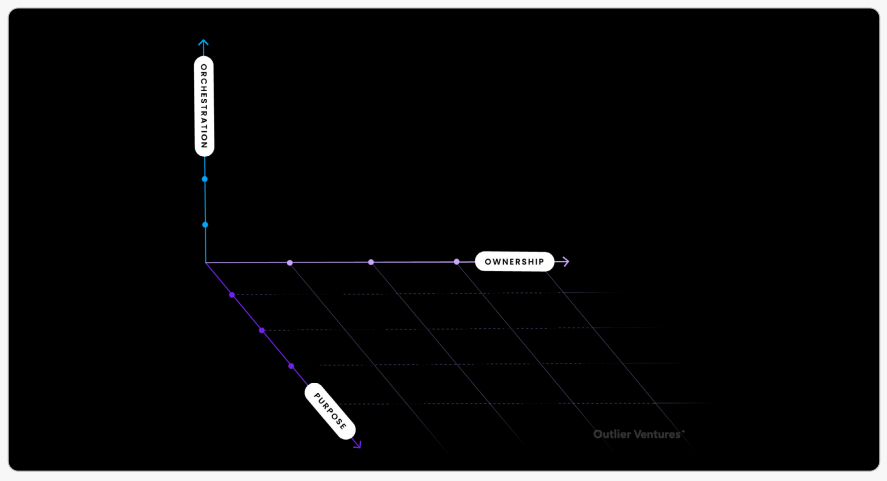
The ecosystem of the Post Web is not monolithic; rather, it comprises a diverse taxonomy of smart agents categorized across three primary structural axes: orchestration, ownership, and ultimate purpose. This multi-tiered classification reflects the sheer variety of operational environments these agents are expected to inhabit.
Some agents are designed for micro-orchestration, managing localized tasks within a single decentralized application, while others function as macro-orchestrators, coordinating complex workflows across multiple cross-chain protocols. In terms of ownership, agents range from strictly private, personal entities serving an individual user to decentralized, autonomous organizations (DAOs) governed collectively by token holders. Their purposes are similarly diverse, spanning automated liquidity provision, algorithmic supply chain management, decentralized governance participation, and personalized digital concierge services.
This diversity of form and function suggests that the future internet will behave less like a rigid network of static web pages and more like a biological ecosystem—alive with self-directing entities continuously optimizing for efficiency, value creation, and institutional coordination.
The Role of Interoperability and the Open-Source Ethos
As the foundational architecture of the Agentic Web continues to be constructed, industry leaders are increasingly emphasizing the lessons learned during the development of Web3. Drawing inspiration from technology strategist Chris Dixon’s foundational observations on network architecture, analysts stress that the design of a network ultimately dictates who builds it and who reaps its economic rewards. History demonstrates that open, permissionless protocol networks built on shared, transparent standards consistently outperform closed, rent-extractive corporate silos.
For the emerging agentic economy, this distinction is not merely philosophical; it is a critical practical requirement. Without interoperable, standardized frameworks, the Agentic Web risks reproducing—and severely exacerbating—the technological fragmentation that currently plagues the modern internet. To prevent this, the maturation of composable communication standards is paramount. Emerging protocols such as the Model Context Protocol (MCP), Agent-to-Agent (A2A) communication standards, x402, and Agent Communication Protocols (ACP)—championed by ecosystems like Virtuals—represent the vital connective tissue of the future web.
Importantly, the evolution of these protocols must remain anchored in a core Web3 ethos: open-source transparency, decentralization, and cryptographic accountability. By leveraging distributed ledgers to keep agents accountable and transparent, the development community can ensure that agency itself is decentralized, preventing any single corporate entity from monopolizing the cognitive infrastructure of the future.
Broader Implications and Market Impact
The transition to an intent-based internet carries profound economic and societal implications. By shifting the burden of digital execution from humans to autonomous smart agents, society may witness a dramatic reduction in administrative friction, transaction costs, and cognitive overhead. Mundane digital tasks—ranging from portfolio rebalancing and tax compliance to complex legal negotiations and multi-party resource allocation—will be handled seamlessly in the background by specialized agents acting on verified user intent.
Furthermore, the integration of AI agents with decentralized finance and smart contracts introduces a new velocity of capital. Transactions can occur at machine speed, optimized by probabilistic algorithms that react instantaneously to global market shifts. However, this transition also presents novel regulatory, security, and ethical challenges. Questions surrounding legal liability for agent-driven financial transactions, the prevention of autonomous flash-crashes, and the protection of user privacy remain active areas of research and debate among policymakers, computer scientists, and legal scholars.
Conclusion: The Awakening of the Digital Landscape
The emergence of the Post Web and its accompanying Agentic Layer signifies much more than a routine upgrade to backend computing infrastructure. It represents a fundamental re-architecting of how humanity interacts with technology, data, and one another. By placing agency at the absolute core of the digital experience, the internet is evolving from a passive tool into a responsive, living network.
As reinforcement learning, large-scale language models, and decentralized compute continue their rapid convergence, the day is fast approaching when human users will no longer need to navigate convoluted software interfaces or execute multi-step digital processes manually. Instead, individuals will simply express their intent, leaving autonomous smart agents to coordinate, negotiate, and deliver the desired outcomes across an interconnected, verifiable global economy.