

The modern digital ecosystem has long struggled with a fundamental architectural tension: the inherent conflict between robust web security protocols and the fundamental right to individual user privacy. Every time a consumer navigates to a mainstream website, visits a digital storefront, or logs into a protected portal, they are routinely subjected to intrusive verification procedures, ranging from traditional cryptographic handshakes to frustrating anti-abuse systems like CAPTCHAs. For decades, mitigating traffic abuse, preventing automated bot attacks, and filtering malicious traffic have required systems to track, log, and analyze user behavior across disparate browsing sessions. However, the maturation of cryptographic engineering—most notably through the widespread operational deployment of anonymous credentials—has begun to offer a viable path toward reconciling web security with total user anonymity.
Building upon foundational theoretical concepts, the implementation of anonymous credentials has transitioned from academic thought experiments into massive, industrial-scale infrastructure. At the center of this paradigm shift is Privacy Pass, a standardized cryptographic protocol suite that currently protects billions of web browsing sessions daily. Developed cooperatively by academic researchers and industry engineers, Privacy Pass enables users to authenticate themselves to major web resources—such as content delivery networks and mobile operating systems—without permitting the issuing authorities or the destination websites to link the user’s initial identity to their subsequent browsing activity. As global internet standards bodies formalize these mechanisms into official Internet Engineering Task Force (IETF) Request for Comments (RFC) specifications, understanding the underlying mathematics, deployment models, and systemic trade-offs of anonymous credentials has become essential for technologists, policymakers, and privacy advocates alike.
The Core Architecture and Theoretical Foundations of Anonymous Credentials
To comprehend the scale and operational mechanics of modern privacy-preserving technologies, one must first examine the foundational components of an anonymous credential system. At its core, any standard anonymous credential framework involves three distinct entities: an Issuer responsible for vetting and distributing credentials, a Resource (such as a website or web service) that requires proof of authorization before granting access, and a User who acquires and subsequently presents the credential.
In a traditional authentication flow, the entity verifying the user’s identity is also the entity maintaining the access logs, naturally creating a comprehensive dossier of user activity. Anonymous credential systems disrupt this surveillance vector by decoupling the issuance phase from the redemption phase. During the initial acquisition phase, the Issuer authenticates the User through standard non-anonymous channels—such as verifying an active account, checking a subscription status, or confirming a payment method. Once verified, the Issuer dispenses a cryptographic credential.
However, the defining innovation of the system occurs during the redemption or presentation phase. When the User presents the credential to access a Resource, the verification protocol is engineered using blinding techniques—originally conceptualized by cryptographer David Chaum in the early 1980s—to ensure that neither the Issuer nor the Resource can correlate the presentation transaction back to the specific issuance event. The Issuer cannot track where or when the credential is used, and the Resource learns nothing about the user’s true identity beyond the single, cryptographically verified fact that the presenter holds a valid credential.
While theoretically elegant, early implementations of these cryptographic primitives suffered from performance bottlenecks, high computational overhead, and a lack of standardized interoperability across different software vendors. Over the past decade, however, collaborative engineering efforts by researchers from organizations like Cloudflare, Apple, Google, and academic institutions transformed these vintage cryptographic concepts into lightning-fast, highly optimized production standards.
Privacy Pass: From Academic Theory to Ubiquitous Global Deployment
Privacy Pass stands today as the most widely deployed anonymous credential standard across the global internet. Originally designed by Cloudflare researchers to help users bypass repetitive, user-hostile CAPTCHA challenges without sacrificing their browsing privacy, the protocol has expanded far beyond its initial use case. Today, an identical or closely related protocol is embedded directly into major operating systems, web browsers, and foundational web infrastructure tools worldwide.

Apple famously integrated the protocol into its ecosystem under the marketing and technical designation Private Access Tokens. Simultaneously, Google incorporated the standard into its Chromium browser architecture and Privacy Sandbox initiative through Private State Tokens. Even competitors and corporate entities with historically complex stances on consumer data tracking—such as Microsoft within the Edge browser environment and the privacy-focused Brave browser—have adopted the standard. Billions of devices now execute Privacy Pass operations natively in the background, authenticating routine web traffic while shielding user identities from persistent tracking mechanisms.
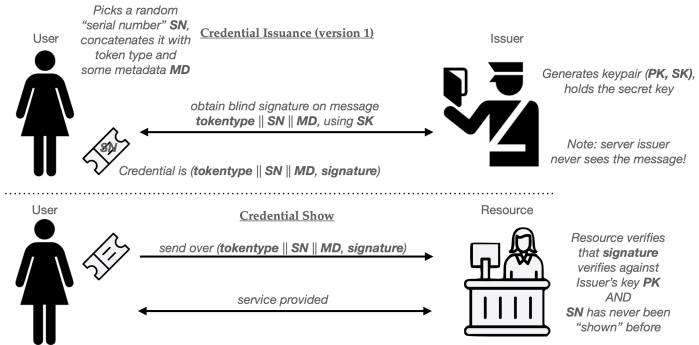
The technical specifications governing Privacy Pass are formally documented within IETF RFCs 9576, 9577, and 9578. Despite supporting various deployment configurations, the core protocol remains a remarkably faithful, highly optimized execution of Chaumian blind signatures. The mechanics of the standard issuance and redemption cycle operate through a precise cryptographic sequence:
- Token Generation: The User’s client software generates a secret token value along with a unique serial number and arbitrary metadata.
- Blinding: The client mathematically "blinds" the token before transmitting it to the Issuer. This blinding operation ensures the Issuer signs the token without ever seeing its underlying plaintext value.
- Blind Signing: The Issuer validates that the requesting user is legitimate, applies a cryptographic signature to the blinded token, and returns it to the client.
- Unblinding: The client removes the cryptographic blinding factor, resulting in a fully valid, independently verifiable credential consisting of a token type, metadata, serial number, and signature.
To present this credential to a web Resource, the client submits the unblinded token alongside the relevant metadata and serial number. The Resource then verifies the signature against the Issuer’s public key, checks that the serial number has not been previously expended to prevent double-spending attacks, and grants access to the requested web service.
Metadata Binding and Session-Specific Credentials
A critical advancement in the evolution of Privacy Pass is the inclusion of metadata fields within the cryptographic token structure. Designated in technical documentation as MD, this metadata string allows client software to cryptographically bind a credential to a specific application, target domain, or designated timeframe.
For instance, if a user intends to access a specific news publication or secure web portal on a given date, the client can request a credential bound specifically to that domain name and date string. Once the metadata is established during the issuance phase, it cannot be modified by either the user or the intermediary systems. This prevents stolen or intercepted credentials from being reused across unrelated web properties or harvested for long-term tracking.
Furthermore, Privacy Pass supports an alternative operational model known as session-specific credentials. In this real-time issuance flow, the user does not pre-fetch a stockpile of tokens prior to browsing. Instead, upon encountering an access barrier—such as an anti-abuse challenge on a Cloudflare-protected web property—the user’s browser initiates a dynamic credential issuance and redemption cycle concurrently within the ongoing web session.
While session-specific credentials offer distinct advantages for real-time traffic management and sudden bot-mitigation efforts, they introduce notable trade-offs:
- Operational Availability Dependency: Because credentials must be generated in real-time, the Issuer’s infrastructure must maintain continuous uptime. If the Issuer experiences an outage, users cannot acquire fresh credentials, effectively locking them out of the protected web resource.
- Timing Correlation Vulnerabilities: Real-time issuance introduces potential metadata leakage vectors, specifically timing correlation attacks. If an entity operates both the Resource and the Issuer, comparing the precise timestamps of incoming issuance requests and redemption presentations could theoretically allow the operator to link a user session to an identity.
Despite these theoretical vulnerabilities, large-scale empirical deployments—such as Cloudflare’s infrastructure handling hundreds of thousands of transactions per second—create massive traffic mixing effects that render practical timing correlation attacks exceedingly difficult to execute against individual consumers.
Cryptographic Underpinnings: Publicly Verifiable vs. Privately Verifiable Tokens
A central engineering challenge in designing Privacy Pass was selecting the appropriate cryptographic primitives to balance speed, security, and architectural flexibility. The IETF specifications outline two primary issuance protocols utilizing distinct mathematical frameworks to achieve these goals.
The first protocol relies on publicly verifiable tokens, implementing blind RSA signatures closely resembling David Chaum’s original 1980s architecture. The primary benefit of public verifiability is that web Resources can independently verify the authenticity of a token using only the Issuer’s public key. The Issuer and the Resource are not required to share secret key material, preserving a clean separation of powers between the service provider and the identity verifier.
However, RSA-based blind signatures present notable performance and resource constraints. Secure implementation of RSA requires large public keys—typically a minimum of 2,048 bits to achieve modern cryptographic security equivalents. Consequently, RSA-based signatures are computationally expensive to generate and result in larger transmission payloads, increasing latency on resource-constrained mobile devices.
To address performance bottlenecks, Privacy Pass includes a second protocol option optimized for extreme speed: privately-verifiable tokens. These tokens utilize elliptic-curve-based primitives and oblivious Message Authentication Codes (MACs) driven by oblivious pseudorandom functions. While elliptic-curve cryptography (ECC) provides exceptional processing speed and minimal signature sizes, it introduces a structural compromise: the verifying Resource must possess the Issuer’s secret key material to validate the credential. This tighter coupling limits the decentralized deployment flexibility inherent in public-key architectures.
Broader Implications and the Future of Web Privacy
The massive, silent deployment of Privacy Pass across billions of global devices demonstrates that complex cryptographic protocols can be successfully integrated into the foundational fabric of the internet without disrupting the user experience. By trading persistent tracking identifiers for single-use cryptographic wristbands, the technology successfully reconciles the commercial necessity of web security and bot mitigation with the fundamental imperative of consumer privacy.
Yet, Privacy Pass remains an intentionally narrow solution. It functions fundamentally as a binary authorization mechanism: a fast, efficient system designed to answer the single question of whether an entity possesses a valid credential. It does not natively solve complex, multi-attribute verification challenges—such as age assurance, credential attribute selection, or localized authorization compliance—without requiring continuous, chatty communication loops between the user and the issuing authority.
As regulatory frameworks worldwide increasingly mandate privacy-preserving digital verification standards—particularly regarding age gating and identity validation on digital platforms—the limitations of single-use wristband credentials will necessitate more advanced architectural frameworks. The ongoing exploration of zero-knowledge proof credentials and decentralized attribute-based encryption systems represents the logical next frontier in cryptographic engineering. As industry leaders like Google and Apple continue to propose and standardize zero-knowledge protocols, the digital landscape is poised to witness a profound evolution in how trust, security, and privacy are balanced in the modern web era.

