
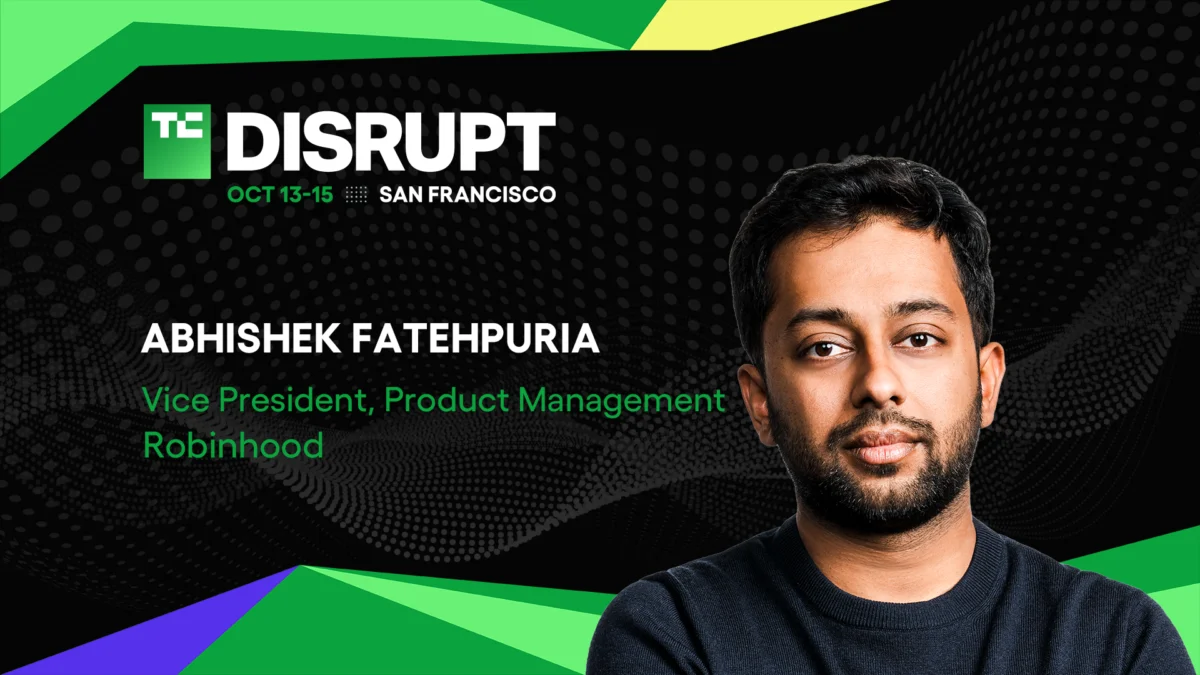
The financial services landscape is undergoing a profound transformation as legacy boundaries between banking, investment, and technology continue to dissolve. Once a disruptor known primarily for pioneering commission-free stock trading, Robinhood Markets has spent the last several years methodically pivoting to become an all-encompassing financial ecosystem. This shift, which reflects a broader industry movement toward "super-apps," will be a primary focal point at TechCrunch Disrupt 2026. During the event, Abhishek Fatehpuria, Vice President of Product Management for Brokerage at Robinhood, will headline the Smart Money Stage to discuss the complexities of scaling trusted financial products in an era defined by rapid technological adoption and evolving consumer expectations.
A New Era of Financial Integration
The fundamental premise of the modern financial consumer has shifted. Users no longer compartmentalize their financial lives into disparate silos—bank accounts, brokerage portfolios, and crypto wallets. Instead, they demand a unified, intuitive interface that mirrors the seamless UX found in leading consumer technology products. For firms like Robinhood, this necessitates a delicate balancing act: providing sophisticated, AI-driven financial tools while maintaining the high level of security and regulatory trust inherent to the industry.
Robinhood’s evolution from a specialized trading platform to a comprehensive financial hub has been marked by a series of aggressive product expansions. The company has moved beyond equities to incorporate high-yield cash accounts, credit products, retirement planning, and even prediction markets. As of August 2026, the company reported an impressive footprint of 28.6 million funded customers and a staggering $384 billion in total platform assets, underscoring the success of its transition from a niche brokerage to a central hub for personal finance.
The Chronology of Transformation
Robinhood’s trajectory over the past decade serves as a masterclass in fintech scaling. Initially launched in 2013, the app captured the market’s attention by eliminating transaction fees, effectively democratizing access to the stock market for a younger, mobile-first demographic. However, the company quickly realized that to achieve long-term sustainability, it needed to increase its "share of wallet" by capturing more than just trading activity.
In 2021, the company’s initial public offering (IPO) served as a catalyst for further diversification. Following the public listing, Robinhood began to accelerate its product roadmap. By 2024 and 2025, the company had fully embraced the "super-app" model, launching high-interest savings vehicles and credit cards that integrated directly with existing investment portfolios. The move into prediction markets—a burgeoning sector of the financial services industry—has further accelerated this growth, with the company reporting 4.7 billion event contracts traded in August 2026 alone, a 15-fold increase year-over-year.

Data-Driven Growth and AI Integration
The shift toward a multi-product ecosystem is evidenced by the company’s most recent financial disclosures. Robinhood Banking, for instance, has successfully attracted over $3 billion in deposits, suggesting that the platform’s ease of use is successfully migrating users away from traditional banking institutions. Simultaneously, the credit card division has reached a significant milestone, surpassing $100 million in annualized revenue.
A significant driver of this expansion is the integration of artificial intelligence. Robinhood is currently deep in the testing phase of "Agentic Trading"—a suite of AI-powered agents designed to execute complex strategies across equities, options, and cryptocurrencies on behalf of the user. In the second quarter of 2026, nearly 100,000 customers adopted these AI-powered accounts, signaling a growing consumer comfort level with automated financial decision-making. These tools, powered by the company’s "Cortex" AI infrastructure, represent the next frontier in lowering the barrier to entry for sophisticated investment strategies.
Industry Implications and Expert Perspectives
The strategy employed by Robinhood is reflective of a wider trend across the fintech sector. Competitors, ranging from traditional retail banks to neobank startups, are all attempting to solve the same puzzle: how to keep a user engaged within a single ecosystem.
For industry observers and investors, this trend presents both opportunity and risk. While a broader product suite increases revenue potential and customer lifetime value, it also introduces significant operational complexity. Maintaining the "trust" factor—which is the bedrock of the banking sector—becomes exponentially more difficult as a company adds more moving parts, such as prediction markets and private equity access.
Fatehpuria’s upcoming session at TechCrunch Disrupt 2026, titled "Winning the Modern Financial Consumer," is expected to provide insights into how product teams navigate these challenges. For founders and product leaders, the core lesson lies in the ability to layer complexity onto a platform without degrading the user experience. The challenge is not just in building the technology, but in ensuring that the user remains empowered rather than overwhelmed.
TechCrunch Disrupt 2026: A Hub for Innovation
The event, which will be held from October 13–15 at the Moscone West in San Francisco, brings together more than 10,000 founders, venture capitalists, and industry decision-makers. As the financial services industry undergoes a structural realignment, the conversations at Disrupt will be critical for those looking to understand the future of the digital economy.

The conference provides a platform for analyzing how companies, from startups to established public entities like Robinhood, are adapting to the changing demands of the next generation of consumers. Whether the goal is to understand the impact of AI on asset management or to dissect the business models that allow for such rapid expansion, the insights shared by industry leaders like Fatehpuria are instrumental for anyone participating in the fintech space.
Looking Toward the Future
The convergence of banking, crypto, and AI is not a fleeting trend but a fundamental rewrite of the financial services playbook. Companies that fail to provide a seamless, integrated experience risk losing relevance as consumers gravitate toward platforms that offer convenience, accessibility, and personalization.
Robinhood’s current path suggests a belief that the future of finance is inherently mobile, social, and automated. As the company continues to scale its international operations and refine its private markets offerings, the focus will remain on whether it can sustain its growth while navigating an increasingly complex regulatory and competitive environment.
For those looking to attend TechCrunch Disrupt 2026, early registration is currently open. Attendees can save up to $200 on tickets if they register before September 25 at 11:59 p.m. PT. Furthermore, the event offers group discounts of up to 30% for teams of four or more, encouraging organizations to bring their leadership teams to engage with the latest developments in technology and business strategy.
The shift in the financial services landscape is undeniable. As the line between a trader and a bank customer continues to blur, the organizations that will succeed are those that view their customers as holistic individuals rather than segmented account holders. By attending sessions such as those hosted on the Smart Money Stage, industry professionals can gain the necessary perspective to navigate this transition effectively. As the financial sector moves toward a more integrated, AI-centric future, the lessons learned at events like TechCrunch Disrupt will be vital for staying ahead of the curve.
Ultimately, the goal of these platforms is to solve the paradox of choice. By offering a comprehensive suite of services within a single, trusted environment, Robinhood is not just changing how people trade; it is changing how an entire generation interacts with their money. As the industry watches these developments unfold, the focus will remain on the intersection of innovation and stability—a balance that is becoming increasingly essential in the modern global economy.

