

The modern internet operates on a persistent tension between personalization and privacy. For decades, websites and content delivery networks have relied on telemetry, IP tracking, and continuous profiling to separate legitimate users from malicious bots, scrapers, and denial-of-service attackers. However, these traditional anti-abuse mechanisms have systematically eroded user anonymity, enabling massive tracking ecosystems that monitor individual browsing habits across disparate platforms. In response to this systemic vulnerability, the cryptographic engineering community has championed anonymous credentials—mathematical frameworks that allow a user to authenticate their legitimacy to a resource without revealing their identity or enabling cross-site tracking.
Building upon foundational theoretical models introduced in academic literature, the cryptographic standard known as Privacy Pass has emerged as the world’s most widely deployed anonymous credential system. Operating quietly across billions of devices through implementations by technology giants such as Cloudflare, Apple, Google, and Microsoft, Privacy Pass bridges the gap between theoretical cryptography and planetary-scale engineering. As standard bodies finalize its protocols and engineers evaluate its limits, Privacy Pass represents both a monumental triumph for practical privacy engineering and a stark reminder of the architectural limitations inherent in early-generation cryptographic protocols.
Evolution of Anonymous Credentials: From Theory to Global Deployment
The conceptual architecture of anonymous credential systems relies on a triad of participants: an Issuer responsible for verifying user identities and distributing credentials through non-anonymous channels; a Resource, such as a website or content delivery network, that consumes the credential to grant access; and the User, who holds and presents the credential. The core engineering challenge lies in the presentation phase. When a user presents a credential to a Resource, the underlying cryptographic math must prevent any collusion between the Resource and the Issuer—or either party acting independently—from linking that presentation back to the specific issuance event.
For decades, these concepts remained largely theoretical, confined to academic papers and cryptographic journals. The foundational breakthrough traces back to the early 1980s, when cryptographer David Chaum introduced the concept of blind signatures. Chaum’s protocol allowed a signer to sign a message blindly, meaning the signer produces a valid signature on a message without ever seeing the message’s contents. This mathematical trick ensures that when the signature is later unblinded and presented, the issuer cannot correlate the final token with the original interaction.
It was not until the late 2010s that researchers, notably from Cloudflare alongside academic partners, recognized that Chaumian blind signatures could be practically applied to solve a frustrating everyday problem: the ubiquitous CAPTCHA. By allowing a trusted issuer (such as a device manufacturer or browser vendor) to vouch for a user’s humanity ahead of time, a device could acquire anonymous cryptographic tokens. These tokens could later be exchanged to bypass CAPTCHAs and anti-abuse checks on protected websites without exposing user identities or browsing histories. This realization catalyzed the development of Privacy Pass, transitioning a 1980s cryptographic primitive into a modern protocol standard formalized under Internet Engineering Task Force (IETF) Request for Comments (RFC) 9576, 9577, and 9578.
The Mechanics of Privacy Pass: Blind Signatures and Single-Use Wristbands
At its architectural core, Privacy Pass is designed for maximum simplicity and execution speed. It offers classic single-use "wristband" credentials—binary cryptographic tokens that carry essentially one bit of semantic information: "I am a legitimate, verified user."
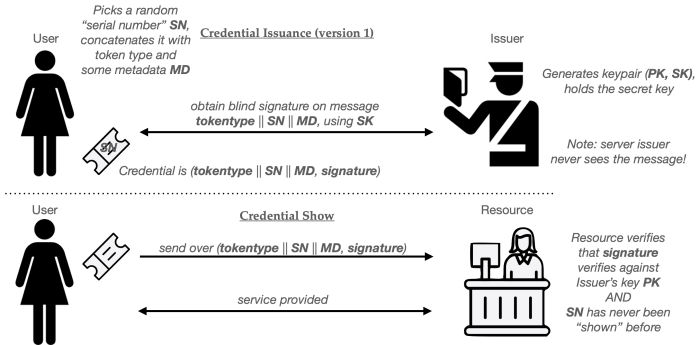
The standard protocol flow relies on public-key blind signatures. The mechanics operate through a structured sequence:

- The user generates a secret token and blinds it using a cryptographic blinding factor, effectively masking its contents.
- The user transmits the blinded token to the Issuer alongside proof of eligibility (such as satisfying a CAPTCHA or verifying an active operating system license).
- The Issuer signs the blinded token using its private key and returns the signature to the user.
- The user removes the blinding factor, yielding a valid credential tuple consisting of a token type, metadata, a serial number, and the signature.
To redeem or "show" this credential to a Resource, the user transmits the unblinded token and signature. Because the signature was generated blindly, the Issuer cannot link the redemption event to the original issuance transaction, preserving user anonymity against timing and graph analysis.
However, a fundamental architectural innovation within the modern Privacy Pass standard is the inclusion of metadata (MD). This metadata string allows applications to bind a credential to a specific context, such as a target domain name and a precise timeframe (e.g., nyt.com || 2026-03-31). Crucially, the Issuer remains entirely blind to this metadata string, as it is selected exclusively by the User during the token preparation phase. Once bound, the metadata cannot be altered, ensuring that tokens cannot be repurposed across disparate domains or extended beyond their intended operational lifecycle.
Real-Time Issuance versus Pre-Issued Credentials: Engineering Trade-Offs
Privacy Pass supports two distinct issuance paradigms: pre-issued credentials and session-specific real-time credentials. In the pre-issued model, users gather a batch of tokens in advance and store them locally on their devices. This provides exceptional resilience; even if the Issuer experiences a catastrophic server outage, users can continue presenting their pre-fetched credentials to access protected Resources seamlessly.
Conversely, session-specific credentials operate in real-time. In this workflow, the user initiates a connection to a Resource (such as a Cloudflare-protected property), is redirected to the Issuer to complete an immediate challenge, and receives a credential tailored exclusively to that active session. This real-time issuance flow guarantees that the resulting token cannot be stockpiled or used for future sessions, offering granular real-time traffic control for network operators.
Despite its operational utility, real-time issuance introduces notable engineering vulnerabilities. Chief among these is dependency risk: if the Issuer’s infrastructure goes offline, access to the dependent Resource grinds to a halt. Furthermore, real-time issuance creates theoretical exposure to timing correlation attacks. If an adversary or a vertically integrated entity controls both the Resource and the Issuer, comparing the precise millisecond timestamps of incoming issuance requests and downstream token redemptions could theoretically allow them to correlate user sessions.
Industry Adoption and Ecosystem Fragmentation
The most remarkable aspect of Privacy Pass is not its underlying cryptographic novelty—which relies on decades-old mathematical principles—but its staggering scale of industrial adoption. Under various proprietary branding monikers, the standard has been integrated into nearly every major web browser and content delivery network operating today.
Cloudflare pioneered the deployment to mitigate automated scraping and bot traffic while minimizing friction for human visitors. Apple implemented an identical protocol architecture under the marketing term "Private Access Tokens," deeply integrating it into iOS and macOS to authenticate client devices without exposing Apple IDs or device serial numbers to third-party web operators. Google deployed corresponding architecture via "Private State Tokens" within the Chromium ecosystem, while the Brave browser and Microsoft Edge integrated the standards to satisfy cross-platform compatibility requirements. Consequently, billions of internet transactions rely on Privacy Pass protocols daily, often without the end-user possessing any awareness of the cryptographic negotiations occurring beneath the surface.
Cryptographic Primitives: Public Verifiability versus Execution Speed
When evaluating the cryptographic implementation of Privacy Pass, engineers must navigate a fundamental trade-off between verification flexibility and computational overhead. The IETF specifications outline two primary issuance pathways reflecting this dichotomy:
-
Publicly Verifiable Tokens: Utilizing blind RSA signatures, these tokens allow any independent Resource to verify a credential using only the Issuer’s public key. The Issuer and Resource do not need to share secret key material. However, RSA-based schemes require large keys—typically 2,048 bits or higher—to achieve modern symmetric-equivalent security levels. This mathematical requirement increases network payload sizes and elevates the CPU cost of cryptographic operations.
-
Privately Verifiable Tokens: To achieve maximum execution speed, Privacy Pass defines an alternative issuance framework leveraging oblivious Pseudorandom Functions (OPRFs) and elliptic-curve primitives. These tokens are exceptionally fast to generate and verify. The architectural penalty, however, is that the verifier (the Resource) must possess the Issuer’s secret keying material to validate a credential, introducing key management complexities and limiting decentralized deployment models.
Notably, because the cryptographic community lacks a standardized, high-performance toolbox for elliptic-curve blind signatures, Privacy Pass explicitly avoids elliptic-curve blind signature schemes, forcing architects to choose between the public verifiability of heavy RSA signatures or the high speed of symmetrically bound OPRFs.
Limitations and the Horizon of Zero-Knowledge Credentials
While Privacy Pass has successfully scaled to protect billions of users against automated abuse, its architectural utility remains fundamentally constrained. Privacy Pass tokens are, by design, single-use binary wristbands. They answer only a binary question: does the presenting entity possess a valid token?
This architectural simplicity renders Privacy Pass ill-equipped for more complex, nuanced policy enforcement requirements dominating contemporary regulatory discourse—most notably, digital age verification. A binary wristband token cannot prove that a user is over the age of 18 without revealing their exact birthdate or requiring continuous, active communication loops with an issuing authority every time a restricted webpage is visited. Attempting to force complex attribute assertions into Privacy Pass’s rigid metadata structures quickly violates core privacy and performance parameters.
Recognizing these limitations, the cryptographic and engineering communities are actively moving beyond first-generation blind signature frameworks. Emerging initiatives—including advanced zero-knowledge credential proposals currently moving through standardization pipelines by major technology firms like Google—aim to transcend the limitations of binary tokens. These advanced cryptographic systems allow users to prove complex predicates (such as "age > 18" or "holds a valid jurisdictional license") derived from a certified credential without disclosing underlying personal data or enabling tracking links across disparate verifiers.
As Privacy Pass continues to serve as the invisible backbone of modern web security, its widespread adoption proves that large-scale cryptographic privacy engineering is viable. Yet, as regulatory demands shift toward granular, attribute-based compliance, the industry’s focus is inevitably pivoting toward the next frontier of zero-knowledge cryptography.

