
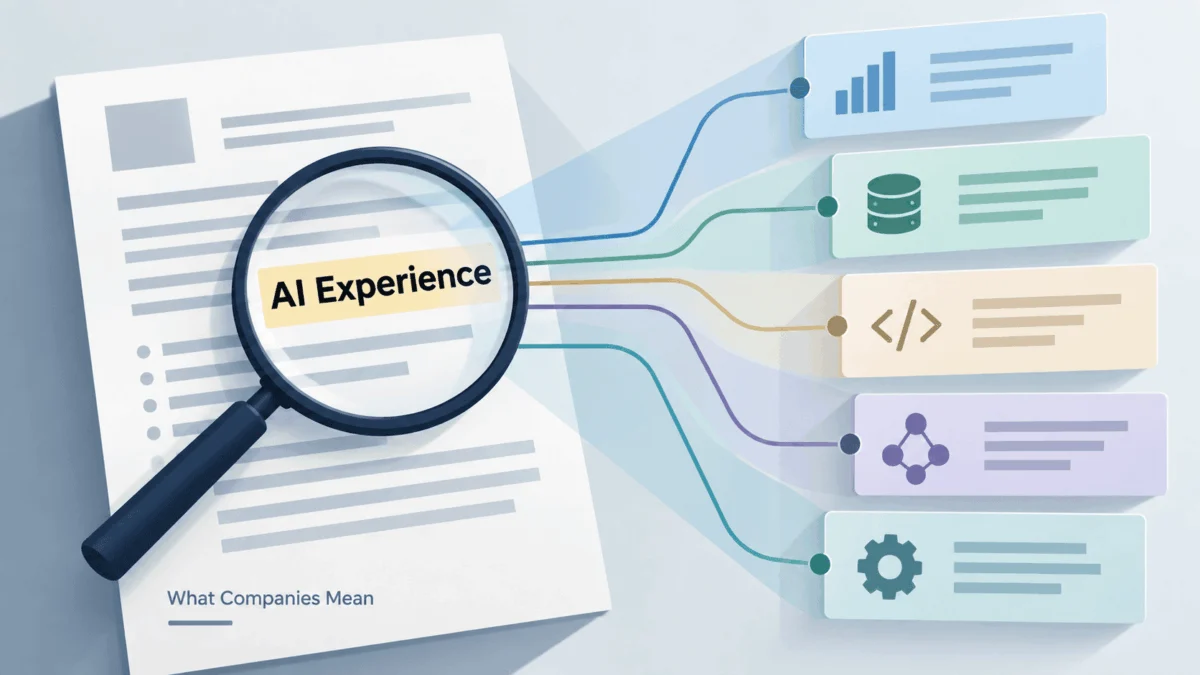
In the contemporary labor market, the phrase "AI experience" has ascended to the top of the hierarchy of requirements for data analysts, statisticians, and researchers. As organizations across the globe pivot toward artificial intelligence, recruitment teams have integrated this terminology into thousands of job descriptions. However, a systemic analysis of current hiring trends reveals that "AI experience" lacks a standardized technical definition, functioning more as a shorthand for organizational aspirations rather than a discrete, quantifiable skill set. This ambiguity presents a significant challenge for job seekers, who must navigate a landscape where a requirement for "AI experience" at a retail conglomerate may represent an entirely different set of expectations than the same requirement at a biotech startup or a quantitative hedge fund.
The Evolution of the "AI Experience" Requirement
The widespread adoption of this phrase correlates with the rapid acceleration of large language model (LLM) integration and generative AI deployment since late 2022. Prior to this period, job postings typically specified discrete technical proficiencies, such as "experience with Python-based scikit-learn" or "expertise in neural network architectures." The sudden shift toward the nebulous term "AI experience" marks a transition in corporate hiring strategies, moving from specific tool-based requirements toward a desire for generalist adaptability.
Market data from major recruitment platforms indicates that mentions of "AI" or "machine learning" in job listings have increased by over 400% since 2021. This surge is driven by a "fear of missing out" (FOMO) among corporate leadership, who view the inclusion of AI-related keywords as a signal of digital maturity. Consequently, hiring managers—often under pressure from executive teams to modernize—include the term without necessarily defining the specific competencies required for the role. This creates a disconnect between the candidate’s perception of "AI" as a specialized technical field and the employer’s perception of "AI" as an operational tool.
Decoding the Four Dimensions of AI Proficiency
To effectively navigate this environment, candidates must categorize the "AI experience" requirement into one of four functional domains. Understanding these categories is essential for framing a resume that translates traditional statistical expertise into the language of modern machine learning.
The first category, "AI Literacy and Tool Adoption," centers on the ability to leverage existing commercial tools. Employers in this group are not looking for model builders; they are looking for employees who can use AI-enabled interfaces to streamline workflows, such as using automated data cleansing tools or generative models for drafting reports.
The second category, "Informed Conceptual Application," requires an understanding of how AI models function theoretically. Here, the focus is on a candidate’s ability to interface with data science teams, interpret model outputs, and communicate the limitations of predictive systems to business stakeholders. This is where statistical background is most valuable, as it provides the foundation for critical thinking regarding model validity and data bias.
The third category, "Hands-on Model Implementation," represents the traditional interpretation of data science. Companies requiring this level of experience are looking for practitioners who can design, train, and deploy models. While the terminology has shifted, the underlying skills—regression analysis, supervised learning, and feature engineering—remain identical to those found in traditional statistical training.
The fourth category, "Domain-Specific AI Strategy," is the most senior. It involves high-level architectural decisions: determining whether a business problem even warrants an AI solution, calculating the cost-benefit analysis of deployment, and managing the risks associated with data privacy and model governance.
Bridging the Gap Between Statistics and AI
The fundamental misconception held by many job applicants is that their traditional statistical training is obsolete in the face of modern AI. On the contrary, the core principles of statistics—probability, inference, and experimental design—constitute the backbone of all robust AI systems. The transition from "statistician" to "AI practitioner" is primarily a matter of vocabulary translation.
For instance, where a resume might list "built predictive regression models to forecast quarterly demand," a hiring manager searching for "AI experience" reads this as "experience with supervised learning and predictive modeling." The shift in terminology is merely a surface-level change. Employers value the underlying reasoning: the ability to assess data quality, define a target variable, and rigorously evaluate the performance of a model. Candidates who highlight their ability to think critically about assumptions, error rates, and the interpretability of outputs are often more competitive than those who merely list a catalog of software frameworks.
Fact-Based Analysis: Reading the Job Posting as a Data Document
When evaluating a job posting, it is critical to treat the document with the same analytical skepticism applied to an unverified dataset. A standard job description often lists "aspirational requirements"—a laundry list of every skill a team might desire in a perfect, yet non-existent, candidate. "AI experience" appearing as a minor bullet point in a long list of qualifications often carries significantly less weight than responsibilities detailed in the "Day-to-Day" section of the document.
A strategic approach to analyzing these postings involves looking for modifiers. If a posting states that AI experience is "preferred" rather than "required," it often signals that the employer is looking for a generalist who can grow into the role. Conversely, if the description demands specific tools—such as PyTorch, TensorFlow, or LangChain—the role belongs firmly in the third category of hands-on implementation.
Furthermore, the seniority level of the position serves as an essential indicator of intent. For junior roles, "AI experience" is almost always a proxy for "adaptability and comfort with new technology." For mid-level roles, it implies "informed collaboration," or the ability to bridge the gap between technical teams and business leadership. For senior roles, it refers to "strategic judgment," where the primary responsibility is to prevent the organization from deploying inefficient or ethically problematic AI solutions.
Addressing Common Misconceptions
There is a prevalent belief that one must list every tool touched on a resume, from OpenAI’s API to legacy SQL databases. This often proves counterproductive. Recruiters and hiring managers consistently report that they prioritize evidence of sound judgment over a comprehensive list of software. A candidate who can explain the reasoning behind a choice—and why a specific model was rejected—demonstrates the high-level analytical thinking that companies are truly seeking.
Similarly, the fear of being disqualified for not having built a machine learning model from scratch is largely misplaced. Most corporate roles prioritize the application of existing tools to specific business problems over the creation of proprietary architecture. The ability to interpret results, identify data leakage, and communicate risk to non-technical leadership is a high-value skill set that many companies struggle to find.
The Role of Credentials and Certifications
While certifications can bolster a resume, they are secondary to the demonstration of practical reasoning during the interview process. Hiring managers at the analyst and researcher levels are less concerned with a candidate’s history of completed online courses and more concerned with their ability to identify when an AI system is producing a hallucination or an erroneous output. The capacity to explain the "why" and "how" of a model’s failure is significantly more persuasive than any certificate of completion.
Conclusion
"AI experience" is a starting point for dialogue rather than a rigid qualification. It is a marketing term used to describe a broad range of organizational needs, ranging from simple tool proficiency to complex strategic oversight. By recognizing that their statistical training already encompasses the foundational principles of artificial intelligence, professionals can translate their existing experience into the language of the modern job market. The successful candidate is one who approaches the job posting as a dataset to be analyzed, identifying the specific category of "AI" the company requires and framing their expertise to demonstrate that they possess the critical thinking and technical grounding necessary to solve the firm’s most pressing problems.

