
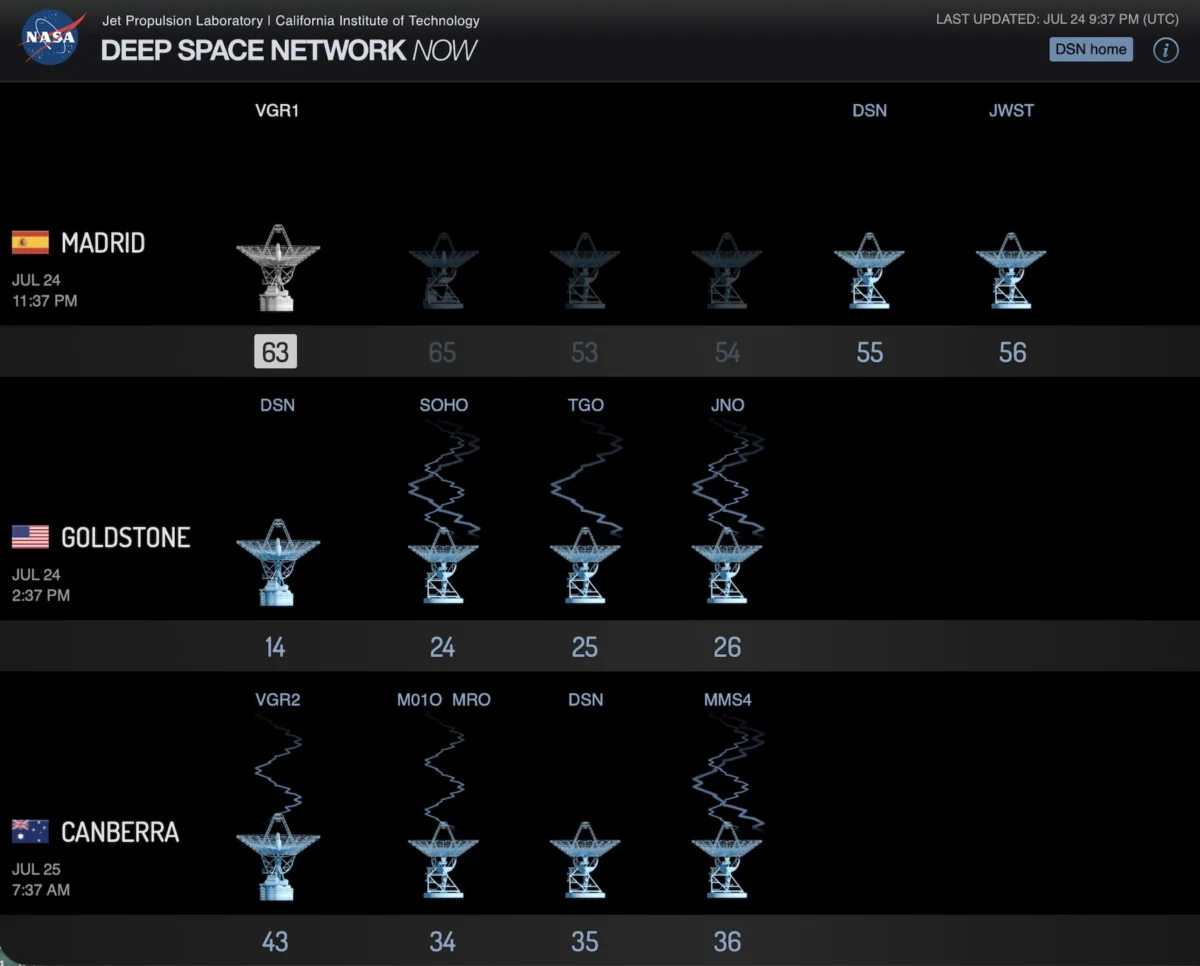
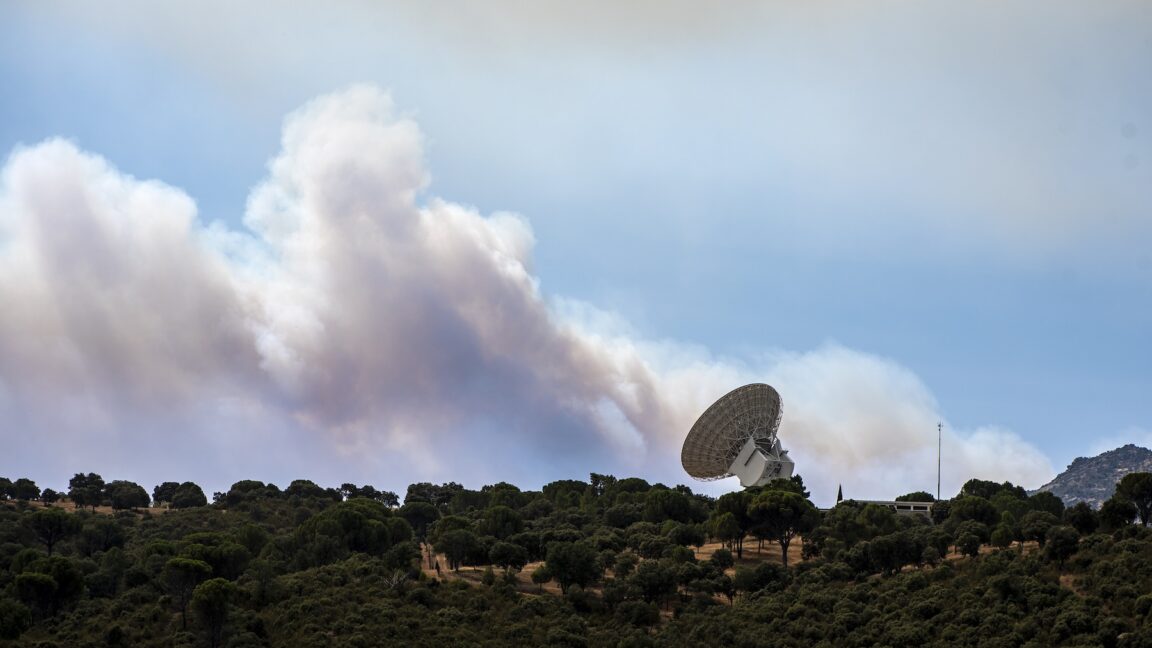
The NASA Deep Space Network facility in Madrid, Spain, has been forced to suspend operations and evacuate all personnel as aggressive wildfires sweep through the mountainous regions west of the Spanish capital, leaving the agency’s global communications infrastructure in a precarious state. On Friday afternoon, real-time status monitors for the Deep Space Network (DSN) confirmed a total cessation of activity at the Madrid Deep Space Communications Complex, while sister sites in Goldstone, California, and Canberra, Australia, struggled to shoulder the increased communication load for a fleet of spacecraft exploring the solar system and beyond. This emergency closure highlights a growing vulnerability in NASA’s ability to maintain constant contact with its most distant assets, including the Voyager 2 probe in interstellar space and the Juno orbiter at Jupiter.
The evacuation of the Madrid site follows a series of escalating environmental crises in the region, driven by a prolonged summer heatwave and chronic drought conditions that have turned the Spanish countryside into a tinderbox. According to reports from Spanish authorities, the fires originated in the mountains west of Madrid, prompting the mandatory evacuation of more than 19,000 residents across several towns. The scale of the disaster has necessitated a massive emergency response, with over 2,000 fire-fighting personnel and 10 specialized aircraft deployed to combat the advancing flames. The Madrid DSN complex, located near Robledo de Chavela, sits directly in the path of the environmental threat, leading NASA officials to prioritize the safety of ground crews over mission continuity.
A Critical Node in Global Space Communications
The Deep Space Network is a foundational element of modern space exploration. It consists of three ground stations spaced approximately 120 degrees apart in longitude: Goldstone in California’s Mojave Desert; Canberra, Australia; and Madrid, Spain. This strategic placement is designed to ensure that as the Earth rotates, at least one station remains in view of any given spacecraft at all times. When one of these nodes goes offline, a significant "blind spot" is created in the network’s coverage, forcing mission controllers to wait for the Earth’s rotation to bring the spacecraft back into view of the remaining operational sites.
The Madrid complex is particularly vital for missions operating in the northern celestial hemisphere. It houses several high-gain antennas, including a massive 70-meter (230-foot) dish capable of capturing the incredibly faint signals sent from the outer reaches of the solar system. Without the Madrid site, the DSN must rely on its Australian and American counterparts to pick up the slack. However, as of Friday afternoon, the network was already operating at a deficit.
NASA’s official statement emphasized that the safety of the workforce remains the paramount concern. "The safety and well-being of our personnel is our highest priority, and our thoughts are with the families and neighbors who are also experiencing the impact of the wildfires in the surrounding communities," the agency stated. "We will provide updates as conditions evolve." While the physical structures of the antennas are built to withstand many environmental stresses, the sensitive electronics, cooling systems, and the safety of the humans required to operate the complex make continued operations during a nearby wildfire impossible.
Regional Impact and the ESA Cebreros Station
The crisis is not limited to NASA’s infrastructure. A separate deep-space tracking station, owned and operated by the Spanish government in coordination with the European Space Agency (ESA), was also evacuated on Friday. The Cebreros tracking station, which forms a critical part of ESA’s Estrack network, is located only a few miles from the NASA facility. Cebreros is home to a 35-meter antenna that supports flagship European missions, including the Juice mission to Jupiter’s icy moons and the BepiColombo mission to Mercury.
Spanish news reports indicate that the fire’s proximity to these high-value scientific installations has created a localized state of emergency. The mountainous terrain of the Robledo de Chavela and Cebreros areas makes fire-fighting efforts particularly difficult, as steep slopes and dense vegetation provide ample fuel for the fast-moving blazes. The loss of both the NASA and ESA stations simultaneously represents a significant blow to international space cooperation, as both agencies often share tracking duties during critical mission phases.
Technical Vulnerabilities and the Goldstone Accident
The evacuation in Spain comes at a time when the Deep Space Network is already reeling from a major technical failure in the United States. The 70-meter antenna at the Goldstone complex in California—the primary high-gain instrument for the North American sector—has been offline since last year following a catastrophic mechanical accident.
According to NASA technical reports, the Goldstone antenna suffered an "over-rotation" incident during a routine maintenance or repositioning maneuver. The massive structure moved beyond its intended mechanical stops, causing severe damage to internal cabling and high-pressure water lines. The resulting breach flooded the base of the antenna with approximately 200,000 gallons of water. Complicating the cleanup was the presence of glycol, a chemical used in the antenna’s cooling systems to prevent freezing and overheating. The spill created an environmental hazard that required specialized remediation before repairs to the dish’s structural and electrical components could even begin.
The cost of repairing the Goldstone 70-meter dish is currently projected to be between $4.1 million and $4.6 million. NASA has opted to bundle these repairs with previously scheduled hardware upgrades to modernize the aging instrument, but the complexity of the work means the antenna is not expected to return to service until 2028.
With the California 70-meter dish out of commission and the Madrid site evacuated, the global Deep Space Network is currently reduced to just one operational 70-meter antenna, located in Canberra, Australia. While the smaller 34-meter antennas at each site remain capable of communicating with many spacecraft, they lack the sensitivity required for high-data-rate downlinks from the most distant probes, such as Voyager 1 and Voyager 2, which are currently billions of miles away in interstellar space.
Implications for Current and Future Missions
The immediate impact of the Madrid shutdown is felt most acutely by missions requiring constant monitoring or those currently performing time-sensitive maneuvers. Voyager 2, which is more than 12 billion miles from Earth, relies on the 70-meter dishes to receive commands and send back data regarding the heliopause. Similarly, the Juno mission at Jupiter depends on high-gain antennas to transmit the high-resolution imagery and gravity science data that define its mission.
Looking ahead, the fragility of the DSN poses a significant challenge for the Artemis program, NASA’s ambitious effort to return humans to the Moon. Artemis missions place an unprecedented demand on the network. Unlike robotic probes that send periodic bursts of data, human-rated spacecraft require constant, high-bandwidth telemetry and live video feeds to ensure the safety of the crew.
The timeline for Artemis has already seen adjustments that may provide a small window of relief for the DSN. Artemis III, which was originally intended to be a lunar landing, has been restructured to fly in low-Earth orbit (LEO). This mission will focus on testing the Orion capsule’s docking capabilities with commercial Moon landers developed by SpaceX and Blue Origin. By remaining in LEO, Artemis III will be able to utilize the Near Space Network and the Tracking and Data Relay Satellite System (TDRS), easing the burden on the DSN’s deep-space dishes.
However, Artemis IV—the program’s first planned lunar landing with astronauts—is targeted for no earlier than 2028. This date aligns precariously with the expected return-to-service date of the Goldstone 70-meter antenna. If the Madrid site suffers long-term damage from the wildfires or if the Goldstone repairs face further delays, NASA could find itself in a position where it lacks the communication redundancy necessary to safely support a crewed lunar landing.
Analysis: The Intersection of Climate Change and Space Exploration
The situation in Madrid is a stark reminder that the infrastructure of space exploration is inextricably linked to the health of the Earth’s environment. As climate change increases the frequency and intensity of extreme weather events, including heatwaves and wildfires, ground stations located in arid or forested regions face growing risks.
The DSN sites were originally chosen for their geographical isolation and dry climates, which minimize radio interference and signal attenuation from moisture. However, those same characteristics now make them hotspots for wildfire activity. NASA and other space agencies may soon be forced to invest in more robust fire-suppression systems, larger buffer zones, or even mobile communication assets to ensure that a local weather event does not result in a global loss of contact with the stars.
As the fires continue to burn in Spain, the international scientific community remains on edge. The immediate goal is the containment of the blaze and the safety of the residents and technicians in the Madrid region. Once the flames are extinguished, engineers will face the task of assessing the smoke and heat damage to the sensitive electronics of the Madrid Deep Space Communications Complex. Until then, the eyes of the world—and the ears of our spacecraft—remain focused on the remaining operational dishes in Australia and California, highlighting the thin, silver thread that connects Earth to its emissaries in the void.

