
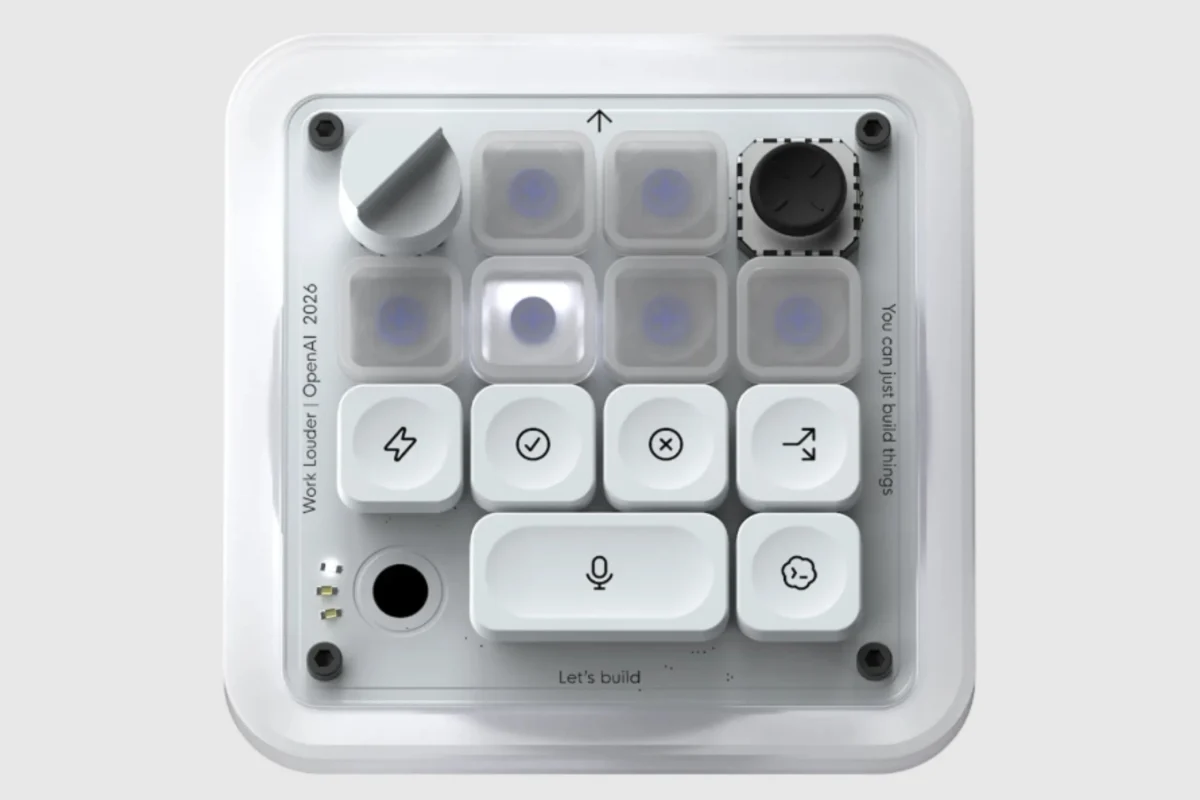
The launch of Micro, OpenAI’s debut entry into the consumer hardware market, represents a significant pivot for the San Francisco-based artificial intelligence laboratory. Developed in close collaboration with the boutique hardware designer Work Louder, the Micro is a specialized, artisanal macropad designed to streamline interactions with ChatGPT and its developer-centric counterpart, Codex. While the device has been met with enthusiasm from a niche segment of the technology community, its arrival is overshadowed by a high-stakes legal confrontation with Apple and a polarizing reception regarding its utility and price point. As OpenAI transitions from a software-dominant entity to a multi-faceted technology conglomerate, the Micro serves as a physical manifestation of the company’s broader ambitions to integrate artificial intelligence into the tactile daily workflows of professional users.
The Architecture of the Micro: Design and Functionality
The Micro is characterized by its compact, industrial design, which emphasizes durability and aesthetic precision. Weighing enough to be described by early reviewers as a potential "paperweight" should its electronic utility fail, the device signals a departure from the lightweight, plastic-heavy peripherals common in the consumer market. The collaboration with Work Louder, a firm known for its creator-focused mechanical keyboards, is evident in the Micro’s tactile feedback and minimalist layout.
The device features a distinct interface consisting of twelve primary keys. At the top of the pad sit six frosted "agent" keys. These are designed to be programmable, allowing users to map specific AI-driven tasks or "agents" within the ChatGPT ecosystem directly to a physical button. Below these are six command keys, intended for navigating the software or executing pre-defined scripts within the Codex environment. Connectivity is handled through both Bluetooth for wireless flexibility and a USB-C port for low-latency, wired configurations.
One of the most notable functional additions is a dedicated voice dictation button. By holding this key, users can bypass traditional typing, speaking directly to the AI model. This is paired with a neighboring "send" button, creating a streamlined, two-step process for input and execution. The device’s status is communicated through a color-coded LED system: white indicates an idle state, blue signifies the AI is processing or "thinking," green denotes a completed task, and red serves as an alert for errors or failed requests.
Integration and Customization within the OpenAI Ecosystem
To manage the Micro, OpenAI has integrated a dedicated configuration tab within the ChatGPT web and desktop interfaces. This software bridge allows users to customize the brightness of the RGB lighting and, more importantly, to bind specific ChatGPT sessions or coding projects to individual keys. For a developer working across multiple repositories, this offers a hardware-level "hot-swap" capability, allowing them to toggle between a debugging agent and a documentation-generation agent with a single press.
Despite these features, the device carries a steep learning curve. Users are required to memorize not only the color-coded signals but also the specific project assignments for each of the twelve keys. For those whose workflows do not already revolve heavily around AI-assisted coding or content generation, the utility of the device remains a subject of debate.
The Legal Context: Apple v. OpenAI
The release of the Micro comes at a time of unprecedented legal tension between OpenAI and Apple. Several weeks prior to the hardware launch, Apple filed a lawsuit against the AI lab, alleging the theft of trade secrets. This litigation centers on claims that OpenAI recruited high-level talent from Apple’s hardware and AI divisions to bolster its own burgeoning device department.
The timing and design of the Micro have only fueled these comparisons. Industry analysts have noted that the Micro’s packaging—a clean, white, minimalist box—bears a striking resemblance to Apple’s signature retail aesthetic. Furthermore, reports have surfaced regarding a second OpenAI hardware project currently in development: a screenless, mobile smart speaker. This secondary device is reportedly being spearheaded by a team largely comprised of former Apple engineers, further complicating the relationship between the two tech giants. As OpenAI moves deeper into the smart home and peripheral markets, the legal battle over intellectual property and talent acquisition is expected to intensify, potentially setting a precedent for how AI companies interact with established hardware manufacturers.

Market Reception and Community Critique
The Micro’s $230 price tag has become a primary point of contention within the tech community. For many, the cost is difficult to justify when compared to existing "off-the-shelf" macropads or DIY alternatives. Open-source platforms like QMK and VIA already allow enthusiasts to program standard mechanical numpads to perform similar macro functions at a fraction of the cost.
On platforms such as Reddit, the response from the "hard-core" developer community has been notably skeptical. Critics have labeled the device a "novelty" or a "prank," arguing that professional coders are unlikely to abandon their established keyboard shortcuts for a standalone 12-key pad. A review by the independent outlet Aftermath was particularly scathing, suggesting that the device felt "engineered to piss off" its intended audience by adding unnecessary friction to an already efficient digital workflow.
However, proponents of the device argue that the value lies in the seamless integration with OpenAI’s proprietary API. Unlike generic macropads, the Micro is "plug-and-play" with the ChatGPT ecosystem, removing the need for complex third-party scripting. For "power users" who spend several hours a day interacting with AI agents, the time saved through dedicated tactile controls may eventually offset the initial investment.
Chronology of OpenAI’s Hardware Evolution
The path to the Micro began long before its launch last week. To understand the significance of this device, one must look at the timeline of OpenAI’s expansion:
- Late 2022: The launch of ChatGPT triggers a global surge in AI adoption, prompting OpenAI to consider how to move beyond the browser.
- 2023: Reports emerge that OpenAI CEO Sam Altman has been in discussions with former Apple design chief Jony Ive regarding the creation of an "iPhone of AI."
- Early 2024: OpenAI begins aggressively hiring hardware engineers and supply chain experts, many of whom were veterans of the Apple and Google hardware teams.
- July 2024: Apple sues OpenAI over trade secret theft, specifically targeting the recruitment of key engineers.
- Late July 2024: OpenAI officially launches the Micro in collaboration with Work Louder, marking its first commercial hardware release.
Analysis of Implications: The "Agentic" Future
The launch of the Micro is more than just the release of a workplace accessory; it is a signal of the "agentic" shift in artificial intelligence. OpenAI is moving away from a model where AI is a passive chatbot and toward a future where AI "agents" perform specific, autonomous tasks. The Micro’s "agent keys" are a physical representation of this shift.
By providing hardware dedicated to these agents, OpenAI is attempting to create a "lock-in" effect. If a developer’s physical workspace is literally built around ChatGPT-specific buttons, the friction of switching to a competing model (such as Google’s Gemini or Anthropic’s Claude) increases significantly. This strategy mirrors the ecosystems built by Apple and Microsoft, where hardware and software are inextricably linked to ensure user retention.
Furthermore, the Micro serves as a low-stakes "beta test" for OpenAI’s supply chain and distribution capabilities. Launching a high-end, niche keypad allows the company to iron out the logistical challenges of manufacturing and shipping physical goods before it moves on to more ambitious projects, such as the rumored screenless smart speaker or wearable AI devices.
Conclusion
The OpenAI Micro is a polarizing debut. As a piece of hardware, it is impeccably built and aesthetically pleasing, reflecting the artisanal standards of Work Louder. As a tool, its utility is highly dependent on the user’s level of integration with ChatGPT. While critics view it as an overpriced novelty, it represents a crucial milestone for OpenAI as it navigates a transition into a hardware-software hybrid company.
Whether the Micro becomes a staple of the modern developer’s desk or remains a historical curiosity, its launch has successfully signaled OpenAI’s intent to compete on all fronts. Amidst lawsuits and community skepticism, the company has made its first move into the physical world, asserting that the future of artificial intelligence will not just be something we see on a screen, but something we can touch, press, and control from the palm of our hand.

