
Alphabet Inc. has delivered a resounding response to market skepticism regarding its aggressive artificial intelligence investment strategy, posting financial results for the latest fiscal quarter that significantly outpaced Wall Street expectations. The technology conglomerate, parent to Google, reported a dramatic surge in revenue and profitability, primarily fueled by an unprecedented acceleration in its cloud computing division and the widespread enterprise adoption of its generative AI tools. While investors had previously expressed public concern over whether the company’s multi-billion-dollar "AI buildout" would yield tangible returns, the latest figures suggest that the transition from experimental AI development to large-scale commercialization is well underway.
The Surge in Google Cloud and Enterprise AI Adoption
The most striking revelation of the earnings report was the performance of Google Cloud. Traditionally seen as a trailing third behind Amazon Web Services (AWS) and Microsoft Azure, Google’s cloud business has emerged as the company’s primary growth engine. Revenue for the cloud division climbed to $24.8 billion, representing a year-over-year increase of 82%. This figure eclipsed the $20 billion (63% growth) reported in the previous quarter and shattered the consensus analyst estimate of $22.46 billion.
The company attributed this "bountiful period" to two main factors: the adoption of enterprise AI solutions and the scaling of AI infrastructure. As corporations across the globe move beyond the "proof of concept" stage with generative AI, they are increasingly relying on Google’s Vertex AI platform and its custom-designed Tensor Processing Units (TPUs) to train and deploy their own models.
Perhaps more indicative of long-term stability is the company’s cloud contracting backlog. Alphabet revealed that it has secured $514 billion in future work—contracts signed but not yet converted into revenue. This massive reservoir of committed capital provides a significant buffer against macroeconomic volatility and suggests that the enterprise demand for AI-integrated cloud services is not a fleeting trend, but a structural shift in corporate IT spending.
Financial Highlights: Profitability and Revenue Streams
Alphabet’s overall financial health showed remarkable strength, with total revenue for the quarter reaching $119.8 billion, a 24% increase compared to the same period last year. This performance marks Alphabet’s 12th consecutive quarter of double-digit revenue growth, a feat of consistency that is rare for a company of its scale.
The most explosive metric was the company’s net profit, which hit $112.1 billion. This represents a staggering leap from the $28.1 billion reported in the corresponding quarter of the previous year. While some of this jump can be attributed to optimized operational efficiencies and the maturation of high-margin AI services, it also reflects the broader recovery of the digital advertising market.
The Google Services segment, which includes Search, YouTube, and the Android ecosystem, remains the bedrock of the company’s cash flow. Revenue in this segment jumped 15% to $94.5 billion. Despite the rise of AI-powered search competitors, Google Search has maintained its dominance, bolstered by the integration of AI Overviews and more intuitive, multimodal search capabilities that keep users within the Google ecosystem.
The Gemini Era: Consumer Adoption and Product Integration
On the consumer side, Alphabet is seeing rapid adoption of Gemini, its flagship AI chatbot and assistant. The company reported that the Gemini app currently services 950 million monthly active users, a significant increase from the 750 million reported in the fourth quarter of 2025.
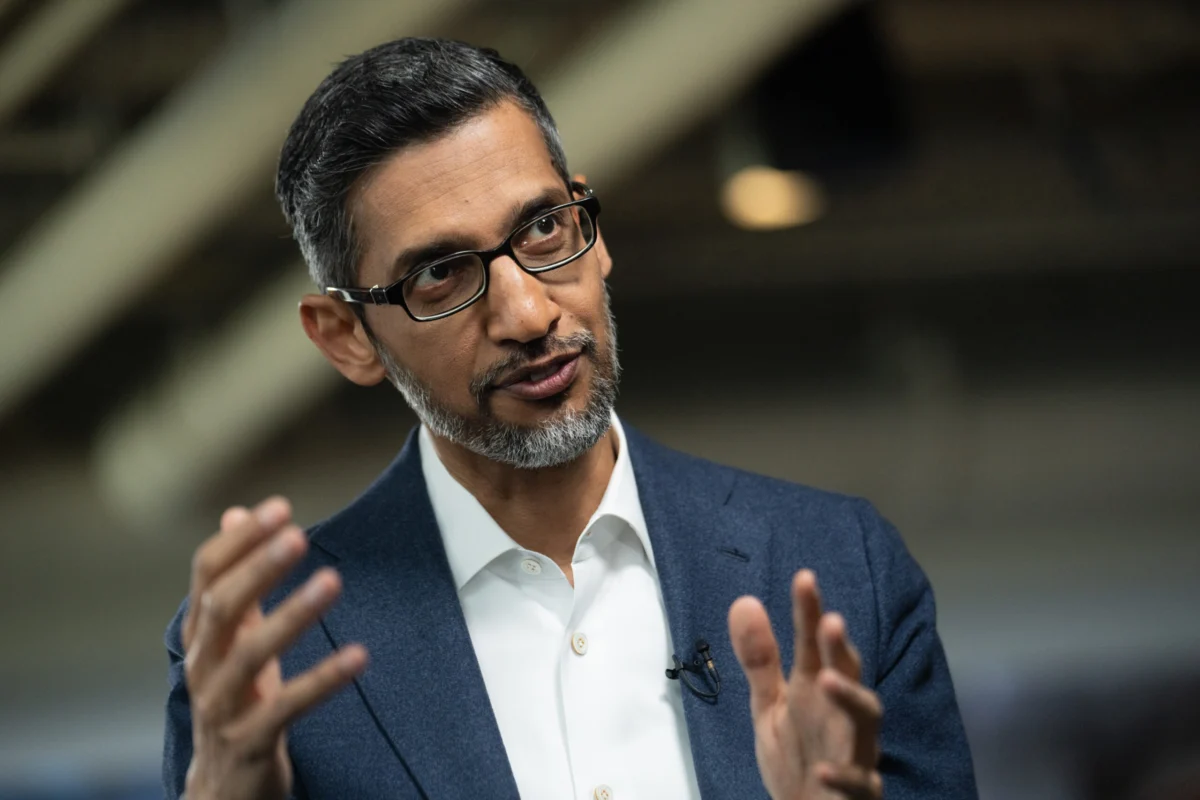
CEO Sundar Pichai emphasized that the "Gemini Era" is now fully integrated across Google’s product suite. From AI-driven creative tools in YouTube to automated coding assistants in Google Cloud, the company is leveraging its massive user base to refine its models through real-world feedback loops. "Our AI investments are redefining what’s possible across every part of our business," Pichai stated during the earnings call. "We have exciting momentum across the board."
The growth of Gemini is particularly important as Alphabet faces increased competition from OpenAI’s ChatGPT and Microsoft’s Copilot. By reaching nearly a billion monthly users, Google has demonstrated that its distribution advantage—pre-installation on Android devices and deep integration into the world’s most popular browser and search engine—remains a formidable barrier to entry for rivals.
A Chronology of the AI Buildout: From "Code Red" to Commercialization
To understand the significance of these results, one must look at the timeline of Alphabet’s AI evolution over the past several years.
- The 2023 Pivot: Following the public launch of ChatGPT in late 2022, Google reportedly declared a "Code Red," accelerating the merger of its two primary AI labs, Google Brain and DeepMind. This period was marked by intense pressure from shareholders who feared Google had fallen behind in the generative AI race.
- 2024 Infrastructure Foundation: Alphabet began a massive capital expenditure program, spending tens of billions on data centers and H100 GPUs while simultaneously ramping up production of its own TPU chips.
- 2025 Product Integration: The company rebranded its AI efforts under the "Gemini" umbrella, replacing previous iterations like Bard. It began rolling out AI features to Workspace and Search, testing the waters for monetization.
- 2026 Validation: The current earnings report serves as the validation phase. The 82% growth in cloud revenue suggests that the massive infrastructure investments of the previous two years are now translating into high-value enterprise contracts.
The Cost of Innovation: The $190 Billion Capital Expenditure Question
Despite the stellar revenue and profit figures, Alphabet’s spending remains a point of contention among some market analysts. The company’s capital expenditures—the funds used to build data centers, procure advanced semiconductors, and expand global fiber networks—are estimated to reach between $180 billion and $190 billion for the current year.
During Wednesday’s earnings call, analysts repeatedly questioned Pichai on the long-term return on investment (ROI) for these expenditures. The concern is that the "AI bubble" could burst if the productivity gains promised by AI do not materialize for the end-users (the enterprises paying for the cloud services).
Pichai, however, remained resolute. He pointed toward 2027 as a pivotal year for compute capacity. "We are seeing strong demand indicators, including long-term deals," Pichai noted. "The dynamics look healthier than where we were about a year ago, so that’s what gives us the confidence to undertake those investments."
He further argued that in the technology sector, the risk of under-investing in a foundational shift like AI is far greater than the risk of over-investing. For Alphabet, the infrastructure being built today is not just for current chatbots, but for the next decade of autonomous agents, AI-driven drug discovery, and quantum computing applications.
Broader Market Implications and Regulatory Context
Alphabet’s performance has broader implications for the "Magnificent Seven" and the tech sector at large. The results suggest that the "AI selloff" seen in earlier quarters may have been premature, as the largest players are beginning to show that they can indeed monetize generative AI at scale.
However, the road ahead is not without obstacles. Alphabet continues to navigate a complex regulatory landscape. The U.S. Department of Justice (DOJ) has pursued several antitrust cases against the company, focusing on its dominance in search and advertising technology. Analysts suggest that the pivot toward Cloud and AI is, in part, a strategic hedge against potential regulatory actions that could impact the core Search business. If Google can successfully transition from being a "Search company" to an "AI-Infrastructure company," it may find itself in a more defensible position against antitrust scrutiny.
Furthermore, the environmental impact of Alphabet’s expansion cannot be ignored. The massive increase in data center capacity required for AI training has led to a spike in energy consumption, challenging the company’s net-zero carbon goals. This will likely become a major narrative in future reporting cycles as investors increasingly weigh ESG (Environmental, Social, and Governance) factors against pure financial performance.
Analysis: The New Competitive Landscape
The 82% growth in Google Cloud puts the industry on notice. For years, the narrative was that Google Cloud was a distant third. Now, with a $514 billion backlog and a growth rate nearly double that of its main competitors in recent quarters, Google is positioning itself as the preferred partner for the "AI-native" enterprise.
The key to this success appears to be vertical integration. By designing its own chips (TPUs), developing its own models (Gemini), and owning the distribution network (Google Cloud and Android), Alphabet can offer a more cost-effective and integrated stack than competitors who must rely on third-party hardware or fragmented software ecosystems.
As the fiscal year progresses, the market will be watching to see if Alphabet can maintain this momentum. The primary risks remain the sustainability of enterprise AI spending and the potential for a "plateau" in model capabilities. However, for the moment, Alphabet has silenced the critics who claimed its AI spending was a "bubble." By showing that billions in investment can lead to even more billions in revenue, Alphabet has set a new benchmark for the age of artificial intelligence.
In conclusion, the latest earnings report paints a picture of a company in the midst of a successful transformation. While the costs of building the future of AI are historic, the early returns suggest that Alphabet is not just participating in the AI revolution—it is increasingly providing the infrastructure upon which that revolution is built. With nearly a billion Gemini users and a cloud business that is finally firing on all cylinders, Alphabet has fortified its position at the apex of the global technology landscape.

