
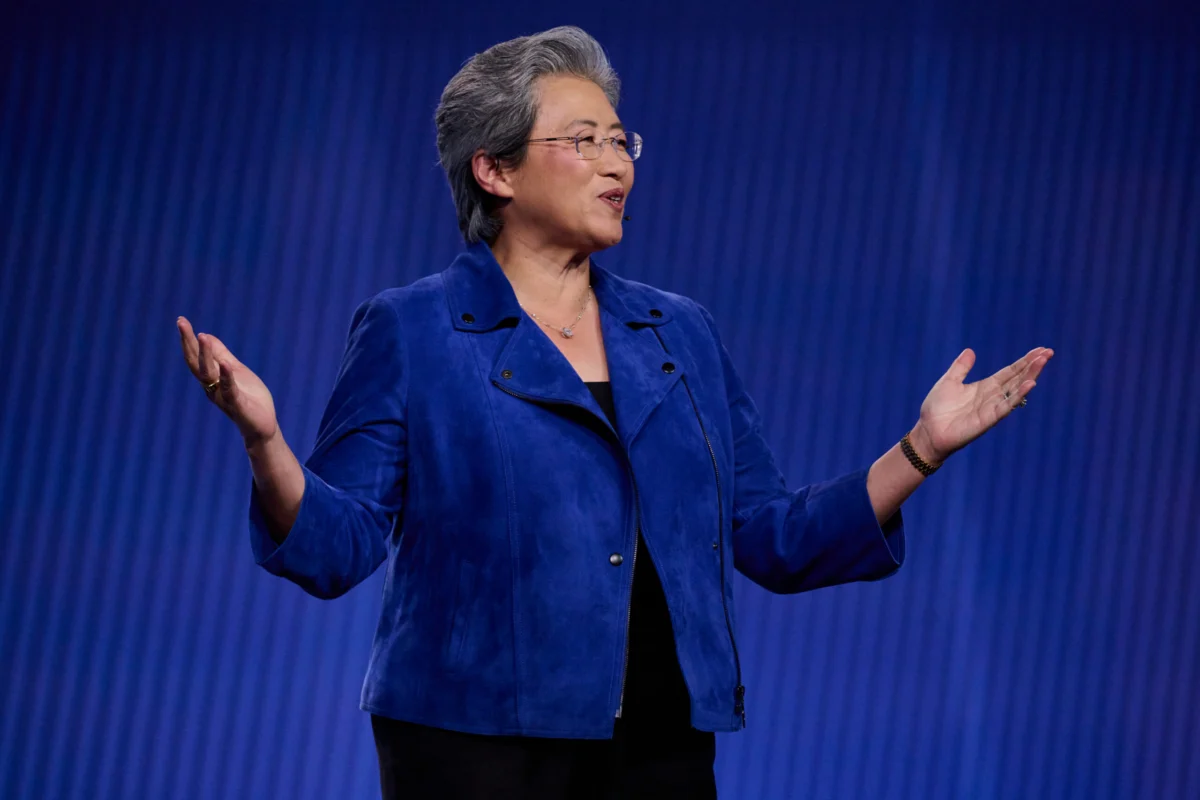
SAN FRANCISCO — Advanced Micro Devices (AMD) has officially escalated its competition with Nvidia by unveiling its most ambitious hardware suite to date, headlined by the "Helios" rack-scale system. At the company’s high-profile Advancing AI conference on Thursday, AMD Chair and CEO Dr. Lisa Su detailed a strategic pivot toward integrated, massive-scale computing solutions designed to satisfy the near-insatiable demand of the world’s leading artificial intelligence laboratories. The announcement marks a significant milestone in the semiconductor industry’s transition from selling individual components to delivering entire data center infrastructures as a single, cohesive unit.
The Helios system, which AMD expects to begin shipping in high volumes later this year, represents the company’s direct answer to Nvidia’s dominance in the high-end AI server market. During her keynote address, Su positioned Helios as the "highest-performance AI rack" in the technology sector, claiming it was engineered specifically to facilitate the training and deployment of "frontier models"—the largest and most complex AI systems currently in development. This move is widely seen as a challenge to Nvidia’s Blackwell and Vera Rubin architectures, which have historically held a near-monopoly on the high-performance compute (HPC) and AI training segments.
The Engineering Behind the Helios Rack-Scale System
A rack-scale system is a sophisticated integration of hundreds or even thousands of individual processors, high-speed networking components, and advanced cooling solutions into a unified, high-powered cabinet. Unlike traditional server setups where components are purchased and integrated by third-party vendors, Helios is a pre-engineered solution optimized for maximum data throughput and power efficiency.
According to technical specifications highlighted during the conference, Helios is designed to support the "gigawatt-scale" deployments required by hyper-scalers. The system integrates AMD’s latest Instinct MI450 series GPUs, which are built on the company’s next-generation architecture. Industry analysts have noted that Helios’s performance metrics are particularly competitive; recent reports suggest that the system may outperform Nvidia’s upcoming Vera Rubin architecture in several key benchmarks, including memory bandwidth and certain floating-point operations critical for large language model (LLM) training.
The shift to rack-scale computing is driven by the physical limitations of modern data centers. As AI models grow in size, the "bottleneck" is often not the raw speed of a single chip, but the speed at which data can move between chips. By controlling the entire rack architecture, AMD can implement proprietary interconnects and liquid-cooling solutions that allow thousands of GPUs to function as if they were a single, massive processor.
Strategic Partnerships and the "Agentic AI" Era
The success of Helios is already being underpinned by a roster of Tier-1 technology companies. AMD confirmed that its customer list for the new system includes industry giants such as Microsoft, Meta, Oracle, OpenAI, and Anthropic. The participation of these companies is not merely experimental; many have already integrated Helios into their long-term infrastructure roadmaps.
Microsoft CEO Satya Nadella reinforced this partnership earlier this week, confirming that the tech giant would significantly expand its Azure cloud infrastructure using Helios systems. This deployment is expected to provide Azure customers with more diverse options for running high-intensity AI workloads, potentially lowering costs through increased market competition.
Perhaps the most striking announcement came from Anthropic, the AI safety and research company. AMD and Anthropic have entered into a strategic partnership to deploy up to two gigawatts of GPU capacity via the Helios rack systems. To put this in perspective, two gigawatts is roughly equivalent to the power output of two large nuclear power plants, illustrating the sheer scale of the hardware infrastructure required to sustain the next generation of AI development.
Dr. Su attributed this massive surge in demand to the rise of "agentic AI." While previous generations of AI were largely reactive—answering questions or generating text upon request—agentic AI refers to systems capable of autonomous reasoning, multi-step problem solving, and tool utilization.
"When you ask an agent to do something, it actually has dozens of steps," Su explained during her remarks. "It has to reason, it has to call tools, it has to access data, and it has to keep doing it over and over until it solves the problem. You need lots of GPUs to do all that."
The Venice-X CPU and the 2027 Roadmap
While the Helios system and its GPUs took center stage, AMD also reinforced its traditional stronghold in the central processing unit (CPU) market with the introduction of "Venice-X." Scheduled for a 2027 launch, the Venice-X is a Zen 6-based processor specifically designed for high-performance computing and data center workloads.
The Venice-X is expected to feature 96 cores and a staggering 1152 MB of 3D V-Cache, with boost clocks reaching up to 5.15 GHz. While GPUs handle the heavy lifting of AI training, CPUs remain critical for data pre-processing, system management, and traditional enterprise workloads that run alongside AI applications. The introduction of Venice-X suggests that AMD is pursuing a "full-stack" strategy, ensuring that every component in the data center—from the primary processor to the specialized accelerator—is part of the AMD ecosystem.
Market Projections: The $1.4 Trillion Opportunity
The financial implications of AMD’s latest reveals are substantial. Dr. Su provided an updated forecast for the AI accelerator market, predicting it will reach approximately $1.4 trillion by the year 2030. If this projection holds true, the market for AI chips alone will be roughly the same size as the entire global semiconductor market is today.
"We do expect that GPUs are going to make up the vast majority of that market," Su stated. She noted that because AI algorithms are still in their "infancy," the workloads are constantly changing. This volatility favors "programmable" silicon like GPUs and high-end CPUs over fixed-function chips, as developers need the flexibility to adapt their hardware to new mathematical approaches in AI training.
This growth trajectory suggests a compound annual growth rate (CAGR) that exceeds almost any other sector in the global economy. For AMD, capturing even a fraction of the market share currently held by Nvidia could result in tens of billions of dollars in incremental annual revenue.
Chronology of Development
The path to the Helios announcement has been a multi-year journey for AMD:
- 2024: AMD began shipping the Instinct MI300X, its first major challenger to Nvidia’s H100, gaining significant traction with Meta and Microsoft.
- 2025: The Helios concept was first revealed to investors as a prototype for "total system integration."
- January 2026: A physical prototype of the Helios rack was showcased at the Consumer Electronics Show (CES), where its size and weight—comparable to two compact cars—made headlines.
- July 2026: The Advancing AI conference in San Francisco serves as the official launchpad for the production-ready Helios and the announcement of the 2027 Venice-X roadmap.
- Late 2026: Scheduled shipping of Helios systems to primary partners like Microsoft and Anthropic.
Analysis of Industry Implications
The rivalry between AMD and Nvidia is no longer just about who has the fastest chip; it is about who can manage the most power-efficient and scalable data center. AMD’s decision to focus on gigawatt-scale deployments addresses the primary constraint facing the AI industry today: energy.
By optimizing the Helios system for power delivery and cooling, AMD is attempting to lower the Total Cost of Ownership (TCO) for AI labs. If Helios can deliver more "tokens per watt" than Nvidia’s Rubin systems, it could become the preferred choice for companies like Meta and OpenAI, who are currently spending billions of dollars on electricity and cooling infrastructure.
Furthermore, the "open" nature of AMD’s software ecosystem, ROCm, continues to be a point of differentiation. While Nvidia’s CUDA platform is the industry standard, it is a closed system. AMD has been working aggressively to ensure that major AI frameworks like PyTorch and TensorFlow run seamlessly on ROCm, lowering the barrier for developers to switch from Nvidia to AMD hardware.
However, challenges remain. Nvidia’s first-mover advantage has created a deep-rooted ecosystem of software and developer familiarity that is difficult to disrupt. Additionally, the supply chain for high-bandwidth memory (HBM), which is essential for both Helios and Nvidia’s Blackwell, remains tight. AMD’s ability to meet its shipping deadlines will depend heavily on its partnerships with memory manufacturers like SK Hynix and Samsung.
Conclusion
The unveiling of Helios and Venice-X signals that AMD is no longer content being the "alternative" to Nvidia; it is positioning itself as a primary architect of the AI era. With a $1.4 trillion market on the horizon and the backing of the world’s most powerful software companies, the semiconductor landscape is entering a period of intense, high-stakes competition. As these gigawatt-scale systems begin to populate data centers later this year, the industry will finally see if AMD’s integrated approach can truly unseat the incumbent king of AI compute.

