
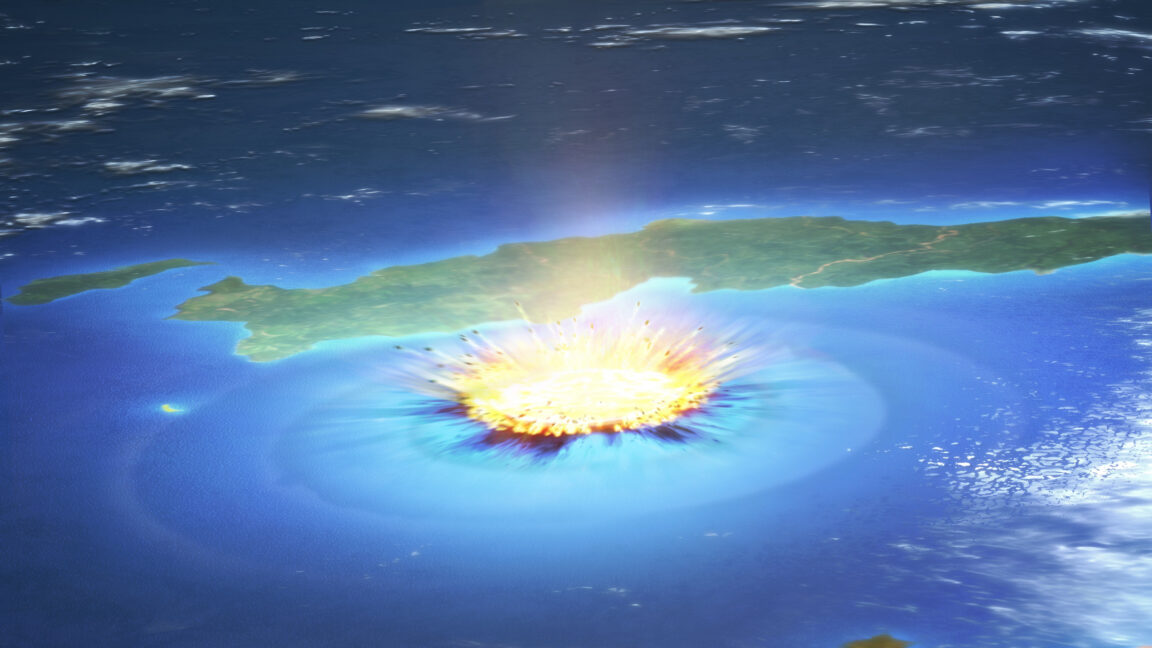
Approximately 66 million years ago, a colossal asteroid measuring roughly 10 to 15 kilometers in diameter slammed into the Yucatan Peninsula, an event that fundamentally reshaped the trajectory of life on Earth. While the immediate aftermath is defined by the mass extinction of non-avian dinosaurs and a rapid shift in the global climate, the geological legacy of the impact reveals a far more complex story of recovery and potential biological resilience. Recent scientific analysis indicates that the Chicxulub impact triggered a subterranean hydrothermal system that remained active for at least eight million years, providing a long-term, stable environment that may have served as a sanctuary for microbial life in the wake of planetary catastrophe.
The catastrophic collision resulted in the formation of the Chicxulub crater, a feature spanning approximately 180 kilometers in diameter. The sheer energy of the impact caused deep-seated geological deformation, with effects reaching as far as 35 kilometers beneath the Earth’s surface. This violent restructuring of the crust created a highly porous environment, allowing seawater to infiltrate deep into the hot, fractured rock layers. As the surrounding mantle provided a sustained heat source, the influx of water facilitated the development of a complex hydrothermal system, a phenomenon that has long been hypothesized to exist in large impact craters but was only recently quantified in terms of its duration and stability.
Chronology of a Subterranean Ecosystem
The understanding of this hydrothermal system has evolved significantly since 2016, when an international team of researchers, operating under the International Ocean Discovery Program (IODP) and the International Continental Scientific Drilling Program (ICDP), successfully drilled into the impact structure. By extracting rock cores from depths of up to one kilometer, scientists gained unprecedented access to the geochemical record of the immediate post-impact period.
Initial estimates suggested that the hydrothermal activity following the asteroid strike persisted for approximately two million years. However, a new study led by geologist Annemarie Pickersgill of the SUERC Center for Isotope Sciences at the University of Glasgow, published in the journal Communications Earth & Environment, has dramatically expanded this timeline. Through meticulous analysis of feldspar samples, the researchers determined that the hydrothermal system remained active for at least eight million years—four times longer than previous estimates had proposed.
The timeline of this system’s evolution is categorized into several distinct phases based on temperature fluctuations and fluid flux:
- 0–2 million years post-impact: The system experienced its most intense phase, with temperatures remaining extremely high, facilitating rapid chemical exchange and the circulation of mineral-rich fluids.
- 2–5 million years post-impact: The cooling phase began, with temperatures at the one-kilometer depth dropping to approximately 50°C (122°F). This range is considered ideal for the proliferation of various extremophile microorganisms.
- 5–8 million years post-impact: The hydrothermal activity gradually waned, with the fluid flow slowing significantly as the crust reached thermal equilibrium with its surroundings, eventually ceasing around 58 million years ago.
Analytical Methodology and Radioisotopic Dating
The determination of this eight-million-year lifespan relied on the precision of potassium-argon (K-Ar) dating. Feldspar, a common mineral found within the crater’s uplifted rocks, contains potassium-40, a radioactive isotope that decays over time into argon-40. Because argon is a gas, it escapes from rock when it is in a molten or highly heated state. Once the rock cools below a specific threshold, the argon is trapped within the crystal structure, essentially "resetting the clock."
By measuring the ratio of potassium-40 to argon-40 within the recovered feldspar samples, Dr. Pickersgill and her team were able to determine exactly when these rocks cooled. This isotopic data was subsequently verified through advanced computer simulations of hydrothermal circulation. These models confirmed that the heat flux generated by the impact was sufficient to maintain temperatures above 90°C for over two million years at a depth of one kilometer, and above 50°C for up to five million years. These conditions represent a "Goldilocks zone" for early life—warm enough to host chemical reactions but cool enough to prevent the destruction of biological molecules.
Implications for Prebiotic Chemistry and Habitability
The discovery that the Chicxulub crater functioned as a hydrothermal "incubator" for eight million years carries profound implications for the study of astrobiology and the history of life on Earth. Hydrothermal systems are widely recognized as potential sites for the origins of life, as they provide the necessary heat, chemical energy, and nutrient-rich fluids required for prebiotic chemical reactions to occur.
"Longer periods of hydrothermal activity will generate extended windows of opportunity for prebiotic chemical reactions to occur, life to develop, and micro-organisms to thrive and propagate beyond their point of origin," noted Dr. Pickersgill in the study. While the researchers emphasize that their findings do not constitute direct evidence that the crater was inhabited, they argue that the environmental conditions were unequivocally conducive to the establishment of microbial colonies.

This study shifts the focus from the destruction caused by asteroid impacts to their potential role as agents of habitability. If a crater of the size of Chicxulub could support such a robust system for eight million years, it follows that the larger, more frequent impacts characteristic of early Earth’s history may have provided widespread, long-lived habitats that accelerated the development of early life forms.
Comparative Planetology and Future Research
The Chicxulub crater is not a unique phenomenon in the solar system, though it is one of the most accessible for scientific study. Hydrothermal systems have been observed in numerous other impact basins on Earth, yet signs of life within these systems remain elusive. To date, only eight out of approximately 70 confirmed underwater impact craters have shown clear evidence of colonization by microorganisms.
The discrepancy between the presence of a habitable environment and the confirmed presence of life remains one of the primary challenges for planetary scientists. However, the data provided by the Chicxulub analysis offers a new framework for evaluating the habitability of impact sites on other celestial bodies, such as Mars. Given that the Martian surface is scarred by numerous large impact basins, researchers are now considering whether similar long-lived hydrothermal systems could have once existed on the Red Planet, potentially providing refuge for life as the Martian climate underwent its own radical shifts.
Conclusion
The research conducted by Dr. Pickersgill and her colleagues underscores the durability of the Earth’s geological processes in the aftermath of a global cataclysm. By confirming that the Chicxulub impact sustained a hydrothermal system for eight million years, the scientific community has gained a clearer understanding of how life might survive—or even emerge—under extreme conditions.
This eight-million-year window of opportunity represents a significant duration in evolutionary time, sufficient for microbial communities to evolve, diversify, and expand far from their initial points of colonization. As scientists continue to analyze the rock cores from the Yucatan Peninsula, the focus will likely turn toward identifying organic biomarkers that could provide a definitive link between the crater’s hydrothermal heat and the life that may have flourished within it. The Chicxulub impact, long synonymous with the end of an era, is increasingly being viewed as a site of potential rebirth, highlighting the profound capacity of life to persist in the most unlikely of places.