
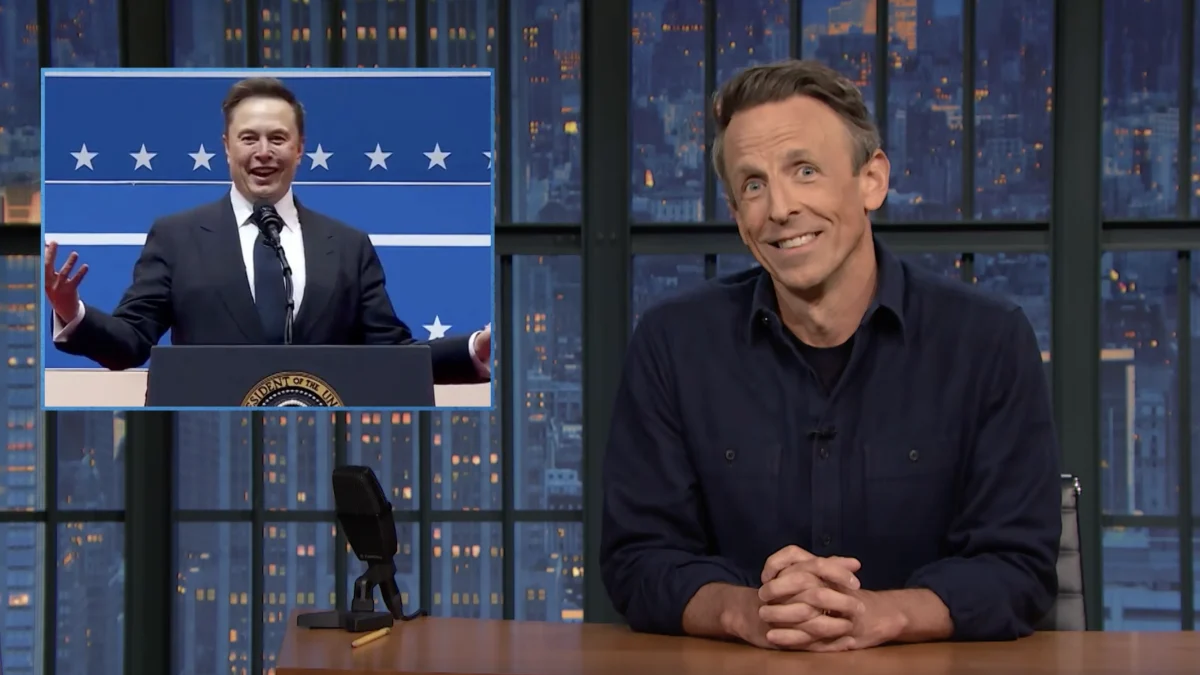
The intersection of generative artificial intelligence and classical literature has become the latest flashpoint in the ongoing cultural tension between Silicon Valley and the entertainment industry, as late-night host Seth Meyers recently leveled a scathing critique against Elon Musk’s plans to produce an AI-generated version of Homer’s The Odyssey. During a recent broadcast of Late Night with Seth Meyers, the comedian and writer dissected the technical and narrative logic behind the tech mogul’s latest venture, joining a growing list of public figures who have expressed skepticism regarding the creative viability of AI-driven cinema.
The controversy stems from a series of announcements regarding xAI, Musk’s artificial intelligence startup, and its intentions to leverage the Grok platform to create full-length cinematic content. Specifically, Musk’s proposal to create a "historically accurate" version of the ancient Greek epic has drawn significant scrutiny, both for its reliance on generative tools and its fundamental approach to mythological storytelling. Meyers’ commentary, characterized by a blend of humor and industry-specific critique, highlights the broader anxieties surrounding the replacement of human creative labor with algorithmic output.
The Late-Night Critique: Analysis of Meyers’ Commentary
During his "A Closer Look" segment or similar monologue formats, Meyers addressed the headlines surrounding Musk’s cinematic ambitions with immediate dismissiveness. "Wow, I can’t wait for that to suck," Meyers remarked, setting the tone for a broader discussion on the aesthetic and ethical implications of the project. His critique focused on three primary areas: the derivation of the technology, the likely quality of the dialogue, and the paradoxical nature of the "historically accurate" claim.
Meyers pointedly noted the friction between AI generation and original performance, stating that the project would essentially use "fake actors stolen from real actors to make a fake movie that’s a real version of a fake story." This comment touches upon the central legal and ethical debate currently facing the AI industry—the use of copyrighted materials and the likenesses of human performers to train large-scale generative models. By framing the AI actors as "stolen," Meyers aligned himself with the concerns voiced by organizations such as SAG-AFTRA, which have spent much of the mid-2020s advocating for protections against the unauthorized digital replication of performers.
Furthermore, Meyers poked fun at the current limitations of Large Language Models (LLMs) in capturing the nuance of epic poetry. He improvised a parody of what a Grok-generated script might sound like, imagining a version of Odysseus that speaks with the sterile, overly helpful tone of a customer service chatbot. "Odysseus, you must return home," Meyers posited, followed by the AI’s response: "You got it, I can’t wait to embark on this journey with you! Let’s keep it light and fun! And I’m here for whatever you need." This critique suggests that while AI can replicate the structure of a story, it often fails to capture the gravitas, darkness, and complex human motivation that define classical literature.
The Paradox of Historical Accuracy in Mythology
The most intellectually rigorous part of the critique centered on Musk’s use of the phrase "historically accurate." The Odyssey, attributed to the blind poet Homer, is a foundational work of Western literature composed in the 8th century BCE. However, it is an epic poem rooted in myth, featuring gods, sirens, cyclopes, and supernatural interventions.
Meyers seized on this contradiction, asking, "Also, what do you mean historically accurate? It’s a myth! Are you also making a historically accurate version of The Santa Clause?" The logic presented by Meyers reflects a common criticism of tech-driven storytelling: a tendency to apply literalist, data-driven frameworks to works of art that are inherently metaphorical and symbolic. Historians and classicists have long noted that while The Odyssey may reflect the social structures and maritime geography of the Bronze Age, the narrative itself is not a historical record. Critics argue that an obsession with "accuracy" in a story about a man blinding a one-eyed giant suggests a fundamental misunderstanding of the source material.
Chronology of the AI Cinema Debate
The friction between Musk’s xAI and the creative community has been building since the launch of Grok-1.5 and subsequent video-generation iterations. The following timeline outlines the progression of this specific controversy:

- Early 2024: xAI announces significant upgrades to Grok, emphasizing its "unfiltered" nature and its ability to process complex narrative structures.
- Late 2025: Musk begins teasing a foray into "AI-first" entertainment, suggesting that traditional Hollywood studios are bogged down by bureaucracy and "woke" tropes, and that AI can provide a more "objective" form of storytelling.
- Spring 2026: Reports surface that xAI is developing a proprietary video generation engine capable of producing long-form content. Musk specifically mentions The Odyssey as a pilot project, citing a desire for a version that adheres to "original historical contexts."
- July 2026: The project gains significant media traction. Guest hosts like Colman Domingo on Jimmy Kimmel Live! begin roasting the concept, followed shortly by Seth Meyers’ viral segment.
Industry Context: The State of AI in 2026
By mid-2026, the entertainment landscape has reached a precarious equilibrium regarding AI. While some independent creators have embraced AI for visual effects and pre-visualization, the major studios remain under strict contractual obligations regarding the use of generative AI in scripts and acting.
Musk’s proposal represents a "third way"—a tech-conglomerate-led production house that bypasses the traditional union-heavy ecosystem of Hollywood. This has led to a polarized reception. Supporters of the project argue that AI could democratize high-budget filmmaking, allowing for epic visuals without the $300 million price tag associated with traditional blockbusters. Critics, however, view it as a threat to the soul of cinema.
Data from recent industry surveys suggest that audience sentiment remains wary. A June 2026 poll indicated that while 40% of viewers are "curious" about AI-generated films, over 65% expressed concern that such films would lack "emotional depth" and "human soul." Meyers’ joke about the "light and fun" ChatGPT dialogue taps directly into this public anxiety.
Comparative Reactions from the Late-Night Circuit
Meyers is not the only voice in the late-night sphere to challenge the xAI project. Colman Domingo, serving as a guest host for Jimmy Kimmel, previously addressed the announcement, focusing on the potential displacement of diverse human voices in favor of a "tech-bro" interpretation of history. The consensus among these cultural commentators appears to be that Musk’s venture is less about the love of Homeric poetry and more about demonstrating the raw power of his proprietary technology.
The "historically accurate" claim has also been a point of contention for other satirists. Daily Show contributors have pointed out that "accuracy" in the context of Musk’s recent ventures often serves as a dog whistle for specific political or social perspectives, further complicating the reception of a text that is nearly three millennia old.
Broader Implications and Future Outlook
The controversy sparked by Seth Meyers’ roast of Elon Musk is more than a simple celebrity feud; it is a microcosm of the larger debate over the future of human expression. As AI tools become more capable of mimicking the "look" of a film, the focus of the critique has shifted toward the "feel" and "intent" of the work.
If Musk proceeds with the AI-generated Odyssey, it will serve as a high-profile test case for the viability of AI cinema. Should the project fail to resonate—as Meyers predicts—it may embolden those who argue that certain aspects of human creativity, such as the interpretation of myth and the performance of tragedy, are inherently non-computable. Conversely, if the technology manages to produce a compelling visual experience, it could mark the beginning of a fundamental shift in how global stories are told and consumed.
For now, the skepticism remains dominant in the cultural mainstream. Meyers’ critique underscores a vital point: storytelling is not merely the assembly of "historically accurate" facts or the generation of high-fidelity images; it is a communicative act between humans. By reducing The Odyssey to a technical challenge for an AI, critics argue that the project misses the very reason the story has survived since the Iron Age. As the industry watches xAI’s next moves, the line between "innovative disruption" and "artistic vacancy" continues to be the subject of intense, and often humorous, national debate.

