
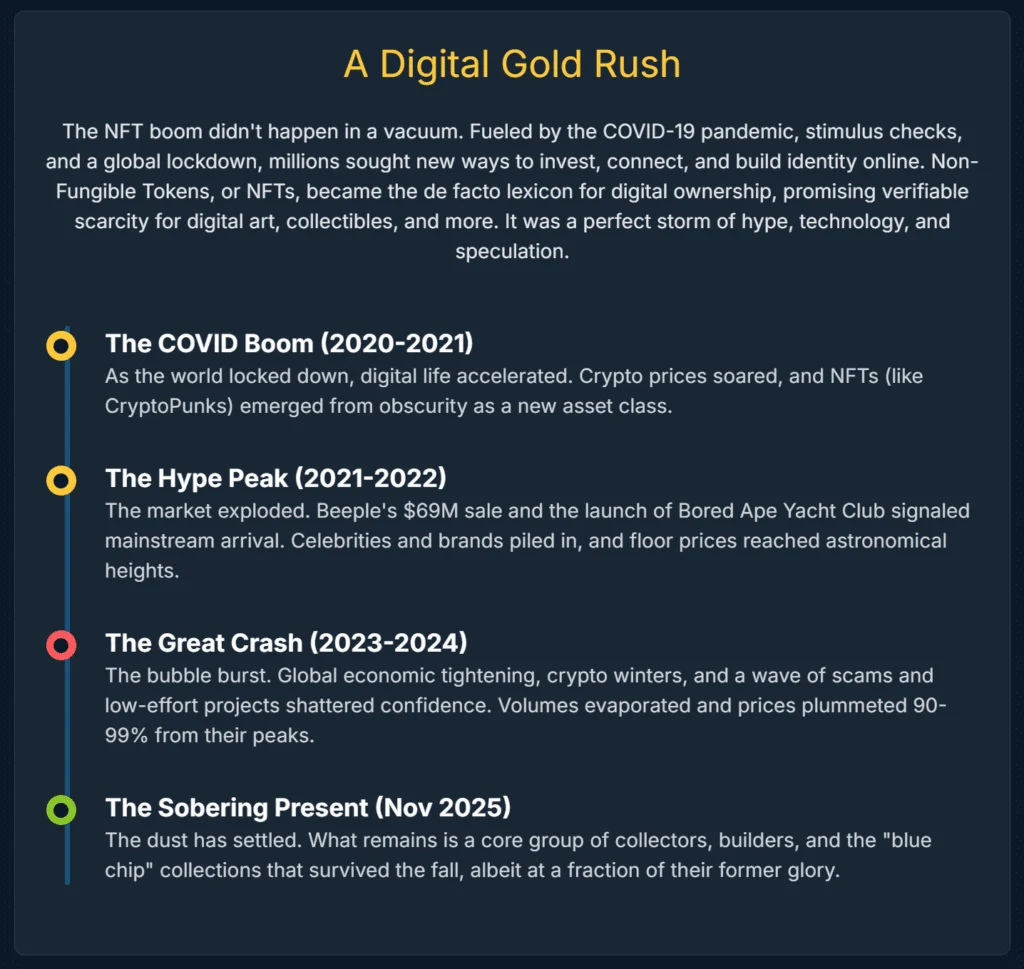
The 2021-2022 market boom for Non-Fungible Tokens (NFTs) was not an isolated event but rather a "perfect storm" of macroeconomic accommodation, widespread cultural lockdowns, and the sudden maturation of a technology that addressed a central dilemma of the digital age: the establishment of verifiable ownership for assets that can be infinitely duplicated. In a mere 24 months, collectible NFTs transitioned from a niche experiment into a global lexicon of digital ownership, creating a speculative empire built on digital art and social signaling. However, as of late 2025, the landscape has fundamentally shifted. The speculative fervor has evaporated, replaced by a cold, data-driven consolidation that prioritizes utility over hype and historical significance over celebrity endorsements.
The Genesis of the Empire: Macroeconomic and Social Catalysts
The rapid ascent of NFTs is incomprehensible without analyzing the global economic response to the COVID-19 pandemic. The crisis triggered a deep economic downturn, prompting the Federal Reserve to implement "unprecedented" monetary easing. By cutting the federal funds rate to a range of 0% to 0.25% and enacting massive purchases of government securities, the Fed injected trillions of dollars of liquidity into the global economy. Simultaneously, the U.S. Congress passed the Coronavirus Aid, Relief, and Economic Security (CARES) Act, providing an additional $500 billion in support.
This influx of capital coincided with a period where a global population, confined by lockdowns, was spending more time online than at any point in human history. This environment cultivated a new class of "armchair gamblers" who, flush with stimulus liquidity and excess time, sought high-risk investment avenues. NFTs represented the absolute apex of this risk curve.
While the macroeconomic environment provided the fuel, the technology provided the engine. For decades, digital assets were defined by their "endlessly duplicated" nature. The development of the ERC-721 and ERC-1155 standards on the Ethereum blockchain introduced the concept of digital scarcity. This reached a mainstream crescendo in early 2021 when the auction house Christie’s sold a digital collage by Beeple for $69.3 million. This event signaled that collectible NFTs had become the new "lexicon of digital ownership."
The Rise of the Profile Picture (PFP) and Social Signaling
The true social "genius" of the NFT boom was found not in fine art, but in the Profile Picture (PFP) collection. Projects such as CryptoPunks and Bored Ape Yacht Club (BAYC) became "blue chip" assets, serving as powerful social signifiers. Owning a verified Bored Ape and displaying it on social media platforms provided "emotional dividends" that traditional investments could not match.
This created a self-reinforcing feedback loop. High valuations led to increased media visibility, which attracted celebrities and high-net-worth individuals. Their participation further validated the asset class, driving prices higher and creating an exclusive digital "club." The blockchain’s public ledger allowed this social performance to be verified in real-time, making it the most culturally relevant status symbol of the era.
The Great Unwinding: 2022-2024 Chronology of Collapse
The "on-ramp" of easy money eventually became the "off-ramp" that decimated the market. As inflation peaked at 9.1% in June 2022, the Federal Reserve reversed course, beginning an aggressive cycle of interest rate hikes. This shift sucked speculative capital out of high-risk assets. NFTs, often the first assets to be liquidated during a de-risking phase, saw their trading volumes and floor prices crater.
The downturn was accelerated by a series of systemic failures within the crypto ecosystem:
- May 2022: The collapse of the Terra/Luna ecosystem, which wiped out $40 billion in market value.
- November 2022: The bankruptcy of FTX, one of the world’s largest cryptocurrency exchanges, which shattered institutional trust.
- 2023-2024: A protracted "Crypto Winter" where liquidity evaporated. By September 2023, reports indicated that 95% of the 73,000 identified NFT collections had a market capitalization of zero.
Psychologically, the NFT boom shared many traits with the 1637 Dutch Tulip Mania, driven by irrational exuberance and group psychology. However, analysts note a key technological distinction: tulip scarcity was an illusion caused by a virus, whereas NFT scarcity is "hardcoded" into the blockchain. The crash of 2022-2024 was not a failure of the technology’s ability to prove scarcity, but a catastrophic failure of valuation—a market-wide mispricing of "bragging rights."
A Snapshot of Consolidation: Market Data as of November 2025
Real-time market data from November 5, 2025, provides a definitive look at the post-crash landscape. The market is far from dead; instead, it has undergone a profound re-evaluation of value.
Current Market Hierarchy and Performance (24-Hour Snapshot):
- CryptoPunks: Reclaimed the #1 position with a floor price of $117,633 (approx. 40.5 ETH). It saw a staggering 325.48% increase in 24-hour volume, reaching $1.35 million.
- Pudgy Penguins: Secured the #2 spot with a floor price of $18,758 (approx. 6.45 ETH).
- Bored Ape Yacht Club (BAYC): Slipped to #3 with a floor price of $19,564 (approx. 6.7 ETH).
- Milady Maker & Meebits: Showed significant 24-hour volume spikes of 143% and 601%, respectively.
The most telling data point is the "Flippening" between Pudgy Penguins and BAYC. While BAYC was the "hype king" of 2021, its value has plummeted from an all-time high (ATH) of over $400,000 to less than $20,000—a decline of over 95%. In contrast, Pudgy Penguins has consolidated value by pivoting toward a "utility thesis."
The Utility Thesis: The Case of Pudgy Penguins
The success of Pudgy Penguins in 2025 serves as a blueprint for the future of the industry. After a leadership change in 2022, the project moved away from speculative tokenomics toward a "retail-first" strategy. This involved building a durable intellectual property (IP) brand that exists outside the blockchain.
By March 2025, the project had sold over 2 million "Pudgy Toys" in major global retailers like Walmart and Target, generating over $13 million in revenue. This real-world revenue and brand recognition have allowed the project to maintain a valuation nearly identical to BAYC, which relied primarily on community-driven hype. The market is now rewarding projects that generate external, tangible value.
The Rebranding of a Toxic Asset Class
By 2025, the term "NFT" has become culturally toxic, associated with scams and lost life savings. In response, major corporations have initiated a "Great Rebranding." The technology is being integrated into the consumer experience under the guise of "Digital Collectibles" or "Digital Passports."
- Reddit: Successfully launched "Collectible Avatars," avoiding the term NFT entirely and onboarding millions of users to blockchain wallets.
- Starbucks: Utilized the technology for its "Odyssey" loyalty program, framing it as a way to unlock "stamps" and exclusive experiences.
- Nike: Integrated digital assets into its ".SWOOSH" platform, focusing on the utility of digital wearables for gaming and virtual environments.
This shift suggests that the path to mass adoption is not through speculative trading but through "invisibility." When the technology is used to facilitate a loyalty program or a ticket purchase, the average consumer does not need to understand the underlying blockchain mechanics.
The Philosophical Shift: From Licensing to Ownership
Despite the market’s volatility, the persistence of blockchain-based assets is increasingly viewed as inevitable due to the fundamental flaws of the Web2 "licensing" model. Currently, when a consumer "buys" a digital movie on Amazon or a game on a console, they are merely purchasing a revocable license.
Recent instances of Sony and Nintendo shutting down access to digital libraries have fueled consumer frustration. Blockchain technology offers the only existing solution for "true digital personal property." It provides a public record of transactions that tracks ownership outside of a private corporation’s servers. The "right-click-save" criticism of the past ignored this core utility: the ability to prove provenance and transferability in a persistent way.
Future Implications: The Era of Authentication and Provenance
As the market matures beyond PFPs, new sectors are adopting the technology for non-speculative purposes:
- Luxury Goods: Brands like LVMH are using digital certificates to authenticate high-end products and combat counterfeiting.
- Real Estate: Tokenization is being used to fractionalize ownership of property, providing liquidity to a traditionally illiquid asset class.
- Ticketing: Platforms are adopting blockchain to eliminate secondary market fraud and ensure that royalties from resale return to the original event organizers.
Conclusion: The New Standard for Digital Assets
The "NFT Empire" of 2021, built on stimulus checks and social media status, has fallen. Its collapse was a necessary correction that washed away over-saturation and hopeful pricing strategies. The data from November 2025 confirms that the market has transitioned into a period of consolidation.
Value is no longer determined by celebrity tweets but by historical significance and real-world utility. While the "NFT" name may be discarded in favor of more consumer-friendly terminology, the underlying technology has become the new standard for authentication and ownership in the digital economy. The era of the speculative "JPEG" is over; the era of the diversified, utility-driven digital asset has begun.

