

The platform, which cultivated a dedicated following between 2019 and its initial closure in June 2024, has re-emerged in an invite-only beta mode. This revival marks a rare second act for a social network in a digital landscape where most platforms, once offline, fade into obscurity. Previous users are now able to reclaim their legacy usernames, wallets, and even digital assets, as the development team diligently works towards restoring the complete on-chain archive. This resurgence not only reignites a unique community but also offers a compelling real-world case study in the resilience and permanence of blockchain-recorded data.
The Genesis of Twetch: A Vision for On-Chain Social Economics
Twetch first launched in 2019, presenting itself as an alternative to mainstream social media platforms like X (formerly Twitter). While its user interface bore a superficial resemblance to its more established counterpart, Twetch’s foundational architecture was radically different, built entirely on the Bitcoin SV (BSV) blockchain. The core innovation lay in its economic model: every interaction—be it a post, a follow, a like, or a reply—was recorded as a microtransaction on the BSV ledger.
This "micropayment economics" model sought to fundamentally reorient the value exchange within social networking. Instead of relying on advertising and data harvesting, which are the dominant revenue streams for platforms like X and Facebook, Twetch proposed a direct, peer-to-peer value exchange. Users paid minuscule amounts (often fractions of a cent) to engage with content, and a portion of these payments was directly distributed to the creators they interacted with. The philosophical underpinning was to align economic incentives with content creation and engagement, empowering users and creators by monetizing their interactions directly, rather than through intermediary advertising models.
The choice of the BSV blockchain was pivotal to Twetch’s vision. Bitcoin SV (Satoshi Vision) is a cryptocurrency that purports to adhere strictly to the original Bitcoin protocol as envisioned by Satoshi Nakamoto, emphasizing massive on-chain scaling, low transaction fees, and a robust data ledger. These technical capabilities were deemed essential for a social network where every user action translates into a blockchain transaction, requiring high throughput and minimal cost per transaction to be viable. Twetch aimed to demonstrate that a truly transactional internet, where value flows freely and directly between participants, was not only possible but superior.
From its inception, Twetch garnered a "cult following." This community, often characterized by its embrace of internet memes, token trading, ironic trolling, and a self-deprecating "degenerate gambler" humor, formed a distinct digital culture. The platform’s unique blend of blockchain mechanics and an irreverent community fostered an environment where identity could be both a status symbol and a tradable asset, notably through its system of numbered user accounts, where lower numbers often carried significant prestige and market value.
The 2024 Shutdown: Acknowledging Challenges and Unveiling Data Permanence
Despite its innovative model and dedicated user base, Twetch encountered significant hurdles, ultimately leading to its shutdown in June 2024. Co-founder Billy Rose, known by his handle "nondualrandy," publicly acknowledged the platform’s failure to achieve sufficient scale for its micropayment model to sustain the business. With over 100,000 registered users, Twetch had built a respectable community for a niche blockchain project. However, this figure paled in comparison to the hundreds of millions of users on mainstream platforms, making it difficult to generate enough microtransaction volume to cover operational costs.

Rose also cited technical liabilities as contributing factors, including Twetch’s proprietary NFT system and what he described as "bloated databases and APIs." These issues highlighted the complexities of building and maintaining a blockchain-integrated social network, where the promise of decentralization often comes with its own set of development and scaling challenges. The company’s winding down was met with disappointment by its community, with many assuming Twetch would become another fondly remembered but ultimately failed experiment in the nascent Web3 social space.
However, the story of Twetch’s shutdown provided an unexpected and powerful demonstration of blockchain’s core value proposition: data permanence. Unlike traditional social networks where user data is typically held within proprietary databases controlled by the platform, Twetch’s fundamental interactions were recorded on the public, immutable BSV blockchain. When Twetch ceased operations, the underlying data — every post, every like, every interaction — remained indelibly etched on the ledger.
This resilience was soon underscored by the actions of Treechat, another BSV-based social application. Treechat successfully resurrected the entire Twetch post archive by leveraging the Bitcoin Schema protocol and JungleBus, turning the historical record into a searchable stream accessible independently of the original platform. This event served as a profound lesson: when posts are written to a public ledger, the platform itself can fail or disappear, but the user-generated data, content, and history do not perish with it. This concept of "platform-agnostic data" is a cornerstone of the decentralized web philosophy and offers a compelling counter-narrative to the ephemeral nature of content on centralized platforms.
The Unexpected Second Act: A Detailed Relaunch and Restoration
Now, two years after its closure, Twetch has embarked on a rare second act, currently operating in an invite-only beta mode. The developers are actively engaged in restoring the platform’s full functionality, allowing previous users to recover their digital identities and assets. This includes the restoration of old usernames, associated wallets, and even their digital collectibles. Users interested in regaining access can directly contact the development team to request an invitation.
Early testers of the new Twetch beta have reported that core functionalities are operational. The platform’s integrated wallet, which remains central to the user experience, is functional, and Twetch continues to support logins through other BSV-compatible wallets, such as HandCash. Direct messaging (DMs) and group features are also reported to be working. Crucially, the NFT marketplace is back online, although there are indications that the asset format may have transitioned from Twetch’s earlier proprietary Sigil protocol-based collectibles to a newer, more open standard, potentially aligning with 1Sat Ordinals. This shift would represent an adaptation to evolving blockchain standards and potentially enhance interoperability and accessibility for digital assets within the BSV ecosystem.
Despite the progress, the Twetch team has been transparent about the ongoing restoration efforts. In a recent post on X (formerly Twitter) on July 9, the official Twetch account stated it was "working on making sure everything is indexed for all our users" and candidly admitted that "lots of things (are) still missing." This transparency manages user expectations while highlighting the monumental task of rebuilding and re-indexing a blockchain-based social network archive.
A significant cultural artifact making its return is the system of numbered user accounts. These accounts, particularly those with lower numbers, carried considerable prestige within the original Twetch community and were often traded or auctioned, reflecting a unique blend of status and asset ownership. Their restoration is a subtle but meaningful signal to the community that the distinctive social economy and identity mechanisms that defined Twetch are being carefully reassembled, aiming to rekindle the platform’s unique culture.

Navigating a Crowded and Evolving Landscape: Network Effects, Competition, and Culture
Launching a social network in 2026 is inherently challenging, given the entrenched dominance of global platforms like X, Facebook, Instagram, and TikTok. The difficulty is further compounded when operating within a specific blockchain ecosystem like BSV, which, while technically capable, possesses a comparatively smaller addressable audience than the broader internet. Twetch’s return places it not only in competition with mainstream giants but also with other BSV-based alternatives that have emerged or persisted in its absence, such as Treechat, my2cents.io, and BsvBsv.com.
The competitive landscape for decentralized social networks is also evolving rapidly. The recent public launch of Zanaadu, another platform within the broader Web3 space, introduces a new competitor with a distinct technical philosophy. Zanaadu emphasizes open-source overlays, BRC100 wallet compatibility, covenant-enforced identity numbers, and timelocked posts, signaling a fresh approach to decentralized social media. In contrast, Twetch appears to be leaning on its established interface and existing community, rather than opting for a radical architectural redesign, hoping to leverage its brand recognition and nostalgic appeal.
The challenge of "network effects" looms large over any new or returning social platform. This economic principle dictates that the value of a network increases proportionally with the number of its users. Dominant platforms enjoy powerful network effects, making it incredibly difficult for new entrants to attract and retain users, as most people prefer to be on platforms where their friends and connections already reside. Twetch faces the arduous task of rebuilding these network effects, twice over: first within the niche BSV ecosystem, and then attempting to draw users from the broader social media landscape.
Despite these formidable obstacles, Twetch possesses several key advantages. It was one of the earliest and most prominent BSV social networks, which allowed it to cultivate a genuine and distinctive culture. The platform’s unique blend of memes, token trading, ironic humor, and its "degenerate gambler" ethos fostered a strong sense of community and identity. The core team, including Billy Rose, Josh Petty ("coinyeezy"), and rodsirloin, demonstrated a profound understanding of meme dynamics and social media promotion, enabling Twetch to "punch above its weight" in terms of attention and cultural impact, even with modest user numbers.
However, as the original shutdown demonstrated, attention does not always translate into retention or a sustainable business model. The fundamental problem persists: a platform that charges users for every interaction must deliver exceptional value to justify the cost, especially when established alternatives like X and Bluesky offer their core services for free and already host vast user bases. The delicate balance between monetized engagement and user adoption will be crucial for Twetch’s long-term viability.
The Enduring Promise of On-Chain Social and the Honest Math
The most compelling argument for Twetch’s return and its continued relevance is not that it will ultimately replace X or other mainstream platforms. Rather, it lies in its potential to serve as a fertile ground for developing and proving social media models that larger, centralized platforms are structurally unable or unwilling to copy. Features such as monetized engagement, on-chain permanence, censorship-resistant archives, and portable identities represent a paradigm shift that makes inherent sense on a scalable, low-fee blockchain like BSV. Twetch, through its initial run, successfully demonstrated that these theoretical benefits could work in practice.
The "honest math," however, acknowledges that the market for such specialized blockchain-based social networks remains relatively small. For Twetch to thrive in its second iteration, it will likely need to deepen its niche rather than attempt to broaden its appeal to compete directly with global giants. This implies leaning even harder into the distinctive culture that made it unique, providing creators and traders with compelling reasons to engage on a platform where their economic and social incentives are genuinely aligned. Avoiding the temptation to simply position itself as a generic alternative to X will be paramount.
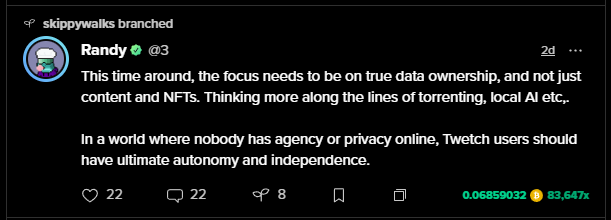
Twetch’s revival also serves as a potent reminder of the inherent resilience built into open blockchain protocols. Even if the platform had never returned, its entire content archive would have remained permanently accessible on the BSV ledger, a testament to the power of decentralized data storage. Now that it has indeed come back, the critical question shifts from data permanence to business durability: can the community and development team construct a business model that matches the inherent longevity and resilience of its on-chain data?
For now, Twetch is once again alive, diligently testing and rebuilding its infrastructure in private beta. This second chance is a privilege rarely afforded to social networks after a shutdown, highlighting the unique properties of blockchain technology and the unwavering dedication of its community. Whether it can transform this second opportunity into a lasting success story, forging a sustainable path for monetized, on-chain social interaction, remains a narrative that is still being written, and critically, still being recorded on the blockchain.
Broader Implications for Web3 and the Future of Social Media
Twetch’s journey, from pioneering concept to shutdown and now to rebirth, offers valuable insights for the broader Web3 and decentralized social media landscape. It underscores the dual nature of innovation in this space: the immense potential for user empowerment, data ownership, and novel economic models, alongside the significant challenges of user adoption, scalability beyond technical capacity, and overcoming deeply ingrained network effects.
The platform’s experience with data permanence, facilitated by Treechat’s resurrection of its archives, provides a compelling blueprint for how future social networks can ensure content longevity and user control, even if the hosting platform fails. This concept is central to the promise of a truly decentralized internet, where users are not beholden to single entities for the preservation of their digital lives.
Furthermore, Twetch’s ongoing experiment with micropayment economics remains a critical test case. As the internet grapples with issues of content monetization, creator compensation, and the ethics of data usage, models like Twetch’s offer a tangible alternative to the advertising-driven paradigm. Its success or failure will contribute valuable data to the ongoing debate about how value should flow in the digital economy.
The return of Twetch is more than just a nostalgic revival; it is a live demonstration of resilience, adaptation, and the enduring belief in a different way of building social connections online. Its future will be closely watched by those who champion decentralized technologies and seek to redefine the relationship between users, creators, and platforms in the digital age.

