
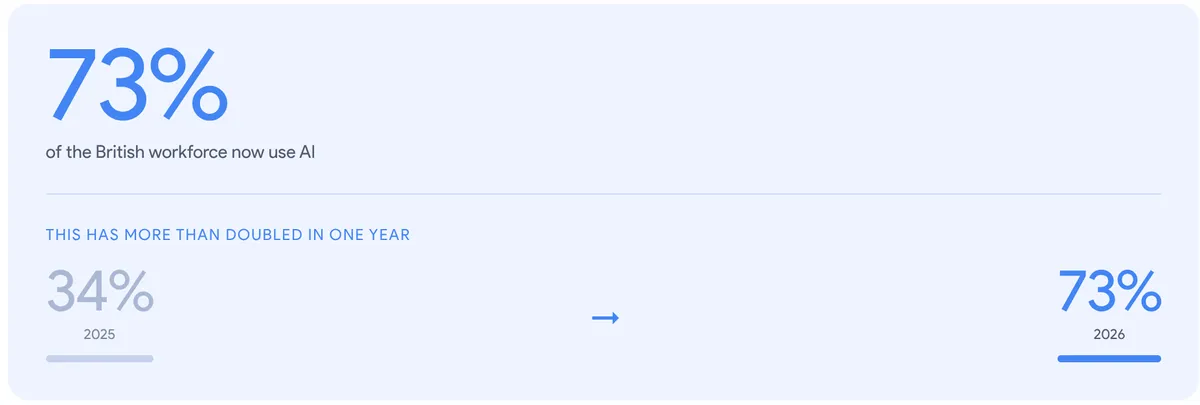
Artificial intelligence has transitioned from a speculative technological frontier to a central pillar of the British workplace in an unprecedentedly short timeframe. According to a landmark study conducted by Google in collaboration with the research agency Public First, workplace AI adoption in the United Kingdom has more than doubled over the past year, surging from 34% in 2025 to a staggering 73% in 2026. However, while the speed of adoption is remarkable, the distribution of its benefits remains starkly uneven. A new report authored by Kate Alessi, Vice President and Managing Director of Google UK & Ireland, highlights a growing "productivity gap" between a small elite of high-level users and the rest of the workforce. This divide suggests that while the nation is embracing the tools, it has yet to master the skills necessary to turn widespread experimentation into universal economic gain.

The Emergence of the AI Trailblazer
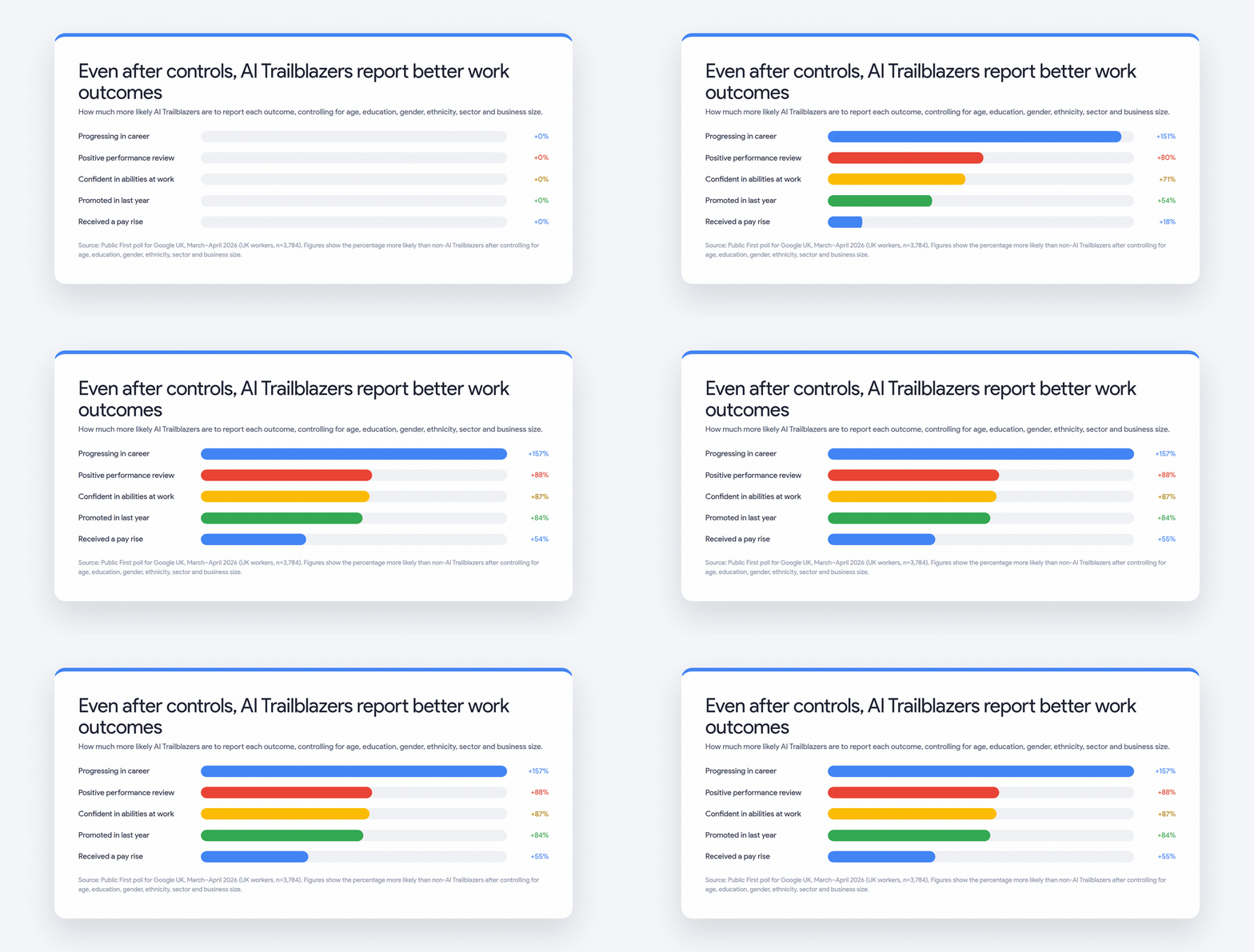
The research identifies a specific cohort of workers—roughly 15% of the total UK workforce—classified as "AI Trailblazers." These individuals represent the vanguard of the digital revolution, integrating AI into their daily routines in ways that go far beyond basic queries or automated scheduling. For this group, the professional rewards have been substantial. Trailblazers are significantly more likely to report positive performance reviews, accelerated career progression, and salary increases compared to their peers.
Perhaps the most compelling metric associated with this group is the "gift of time." The study finds that AI Trailblazers save an average of nearly eight hours per week across their professional and personal lives. In a standard five-day work week, this effectively grants these employees an extra day of productivity or leisure. By automating complex tasks, utilizing AI agents for workflow management, and leveraging creative generative tools for advanced problem-solving, Trailblazers have set a new benchmark for modern professional efficiency.

Mapping the Four Stages of Adoption
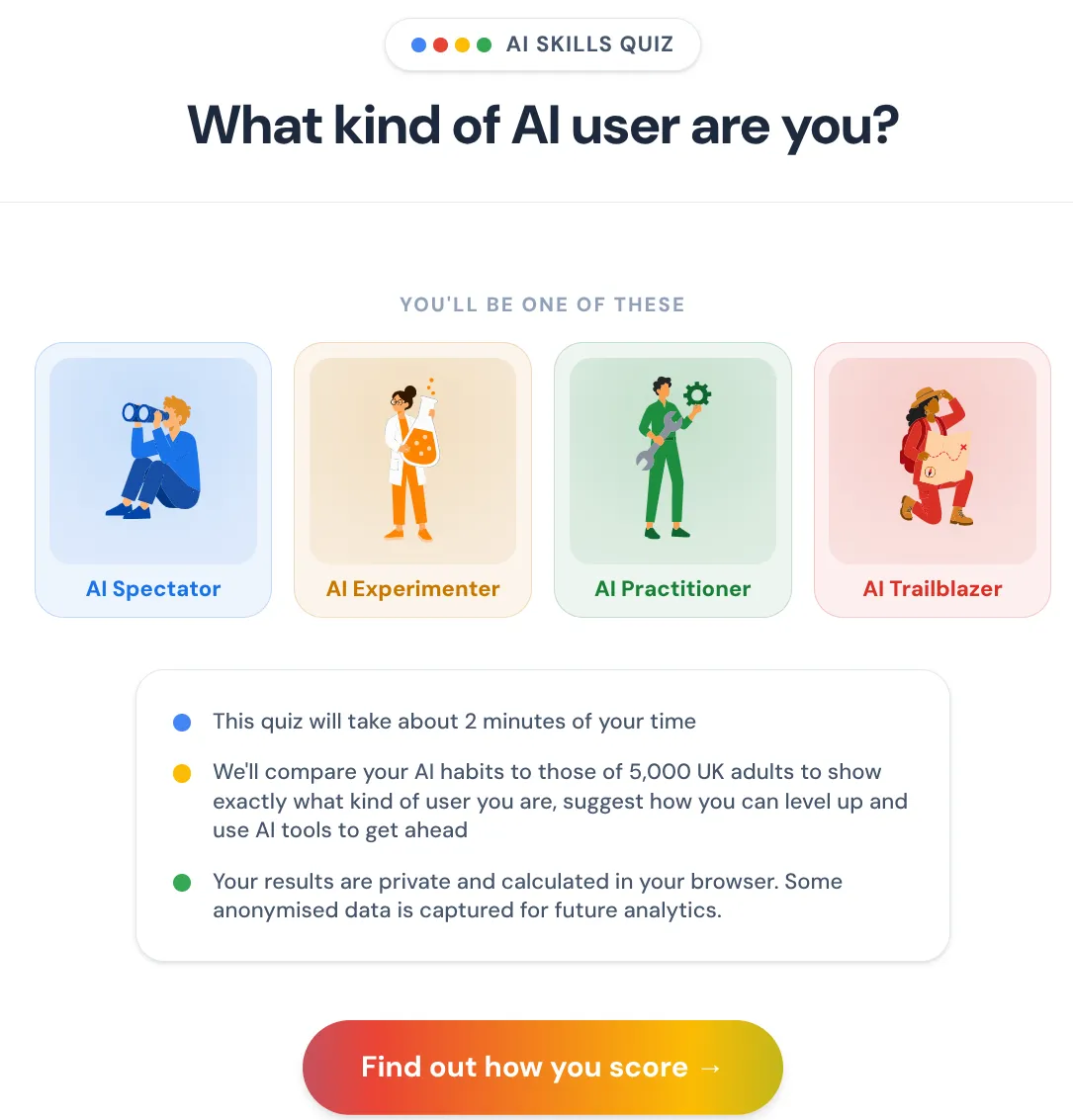
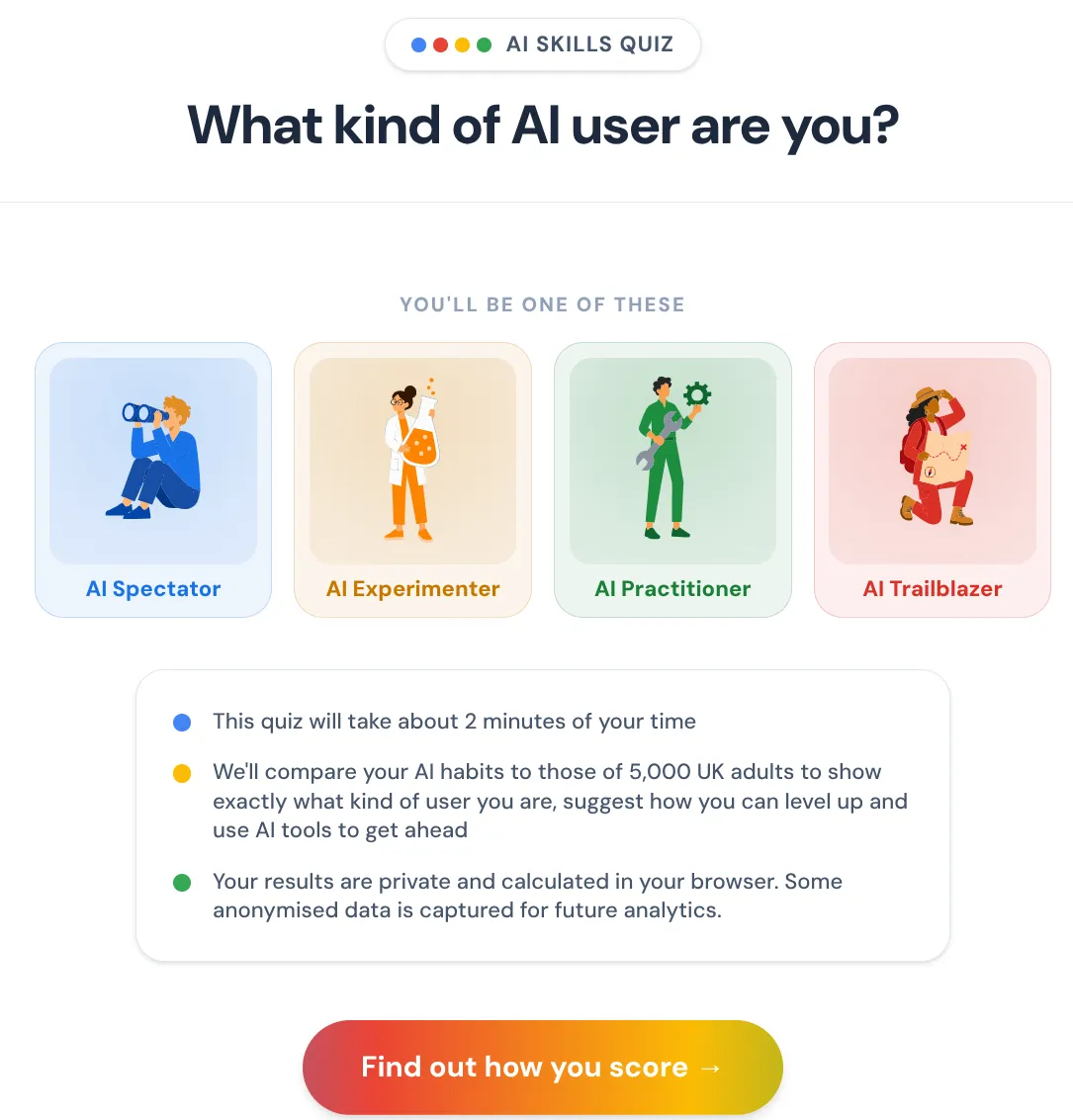
To better understand the current landscape of the British workforce, the Google and Public First study segments UK employees into four distinct categories based on their level of AI integration:
- AI Spectators (10%): These workers do not use AI in their daily lives or professional roles. They remain on the sidelines of the technological shift, either due to a lack of access, interest, or perceived relevance to their specific fields.
- AI Experimenters (38%): The largest segment of the workforce, experimenters use AI occasionally. Their engagement is typically limited to simple drafting tasks, such as writing emails, or using chatbots for quick factual questions. While they are aware of the technology, they have not yet integrated it into their core workflows.
- AI Practitioners (37%): This group uses AI regularly for research, problem-solving, and more detailed drafting. They are comfortable with the technology but primarily use it as a reactive tool rather than a proactive or creative partner.
- AI Trailblazers (15%): As the most advanced group, Trailblazers use AI in deep, creative ways. They automate multi-step tasks, employ specialized AI agents, and use the technology to handle high-level analysis, thereby unlocking the most significant career and time-saving benefits.
The challenge facing the UK government and private sector alike is the "85% problem." While nearly three-quarters of the workforce use AI to some degree, only a small fraction is using it at a level that drives meaningful personal and national economic growth.
Socio-Economic Barriers and the Risk of a New Digital Divide
Despite the rapid uptake of AI tools, the study warns that the current trajectory of adoption is exacerbating existing societal inequalities. The data reveals that deep AI usage is not evenly distributed across the population. Significant disparities exist based on age, gender, and geography. Younger workers and those in urban tech hubs like London and the South East are more likely to fall into the Trailblazer category, while older workers, women, and those in historically underserved regions risk being left behind.
Google’s analysis suggests that these disparities are not the result of a lack of technical aptitude, but rather behavioral and organizational barriers. Many workers report a "confidence gap," where they feel they lack the formal training to use AI for anything more than basic tasks. Others face organizational hurdles, such as restrictive workplace policies or a lack of direction from management on how to effectively deploy AI tools.

Economic Impact: A £140 Billion Contribution
The drive toward a nation of AI Trailblazers is not merely about individual career success; it is a fundamental requirement for the UK’s macroeconomic health. The report provides a retrospective look at Google’s impact on the British economy in 2025, noting that the company’s tools supported an estimated £140 billion in economic activity. This figure is roughly equivalent to the entire economy of Greater Manchester.
A significant portion of this impact—approximately £60 billion—was generated by small and medium-sized businesses (SMBs). These enterprises are increasingly using AI-driven tools in Search, Android, Cloud, and YouTube to compete with larger corporations and reach global markets. Furthermore, Google’s suite of products is currently estimated to save British workers 51 million hours per week. To put this in perspective, this is roughly equal to the weekly output of the entire National Health Service (NHS) workforce.
If the UK can successfully transition its "Experimenters" and "Practitioners" into "Trailblazers," the potential for productivity gains is immense. Closing the adoption gap could lead to a massive surge in GDP, driven by the increased efficiency of the 85% who are currently underutilizing the technology.
The Strategic Roadmap: AI Works for Britain
In response to these findings, Google has intensified its partnership with the UK government. A central component of this strategy is the "AI Works for Britain" initiative, a nationwide upskilling program designed to provide accessible training to every worker, regardless of their current skill level. This program builds on the existing Google Digital Garage, which has already provided digital skills training to over 1.2 million people in the UK over the last decade.
The initiative aligns with the government’s ambitious goal of training 10 million workers in AI skills by 2030. To facilitate this, Public First has launched an interactive "AI Skills Quiz." This diagnostic tool allows individuals to benchmark their current skills against the national average, identify which of the four categories they fall into, and receive a tailored roadmap for professional development.
The philosophy behind these programs is that becoming an AI Trailblazer does not require a degree in computer science or the ability to write code. Instead, it requires "AI literacy"—the ability to understand what the technology can do, how to prompt it effectively, and how to critically evaluate its output.

Fact-Based Analysis of Implications
The transition to an AI-driven economy represents the most significant shift in the British labor market since the Industrial Revolution. However, unlike previous technological shifts that primarily automated manual labor, AI is transforming cognitive and creative work. This has profound implications for the UK’s long-term competitive strategy.
First, the "productivity puzzle" that has plagued the UK economy since the 2008 financial crisis may finally have a solution. For nearly two decades, the UK has struggled with stagnant productivity growth compared to its G7 peers. Widespread AI mastery offers a "leapfrog" opportunity, allowing British firms to do more with less and compete more effectively in high-value services and manufacturing.
Second, the democratization of AI skills is essential for regional leveling up. If AI training is successfully rolled out to the "Spectators" and "Experimenters" in the Midlands, the North of England, and the devolved nations, it could decouple economic opportunity from geographic proximity to London.
Finally, there is the issue of global leadership. The UK has positioned itself as a global hub for AI safety and regulation, most notably through the Bletchley Park Summit. However, regulatory leadership must be matched by operational leadership. To remain a global AI superpower, the UK must not only be the place where AI is governed but the place where it is most effectively used.
Conclusion
The data from 2025 and 2026 suggests that the UK is at a critical crossroads. The initial hurdle—the adoption of the tools themselves—has largely been cleared, with 73% of the workforce now using AI. The next, more difficult challenge is the depth of that usage. The emergence of the AI Trailblazer provides a glimpse into a future of heightened productivity and better work-life balance.
However, the current unevenness in adoption serves as a warning. Without a concerted effort from the government, educational institutions, and the private sector to upskill the remaining 85% of the workforce, the benefits of AI risk being concentrated in the hands of a few. Through initiatives like "AI Works for Britain" and a continued focus on accessible training, the UK aims to ensure that the next era of productivity is one in which every worker has the opportunity to become a trailblazer.

