
The context window has emerged as the definitive core feature of every frontier large language model (LLM), serving as the primary mechanism for short-term memory and session-based reasoning. Measured in tokens, this window typically comprises the system prompt and an ever-expanding history of user prompts, model responses, and tool calls. However, as these windows grow to accommodate hundreds of thousands of tokens, researchers and developers are identifying a critical performance bottleneck known as "context rot." This phenomenon describes the gradual decline in a model’s output quality as a chat session progresses, driven by both the architectural limitations of transformer models and the accumulation of stale or contradictory information within the session history.
The Mechanics of the Context Window
To understand context rot, one must first recognize that the context window is not a passive storage system. Unlike a traditional database, an LLM holds no persistent internal state from one turn to the next. For every new token generated, the model must look back across the entire existing context window to predict the next sequence. This process is governed by the attention mechanism, which determines how much weight each previous token should have on the current output.
In the current landscape of generative artificial intelligence, the "long-context" race has seen models from Anthropic, OpenAI, and Google expand their capacities from a few thousand tokens to over a million. While this allows for the processing of entire codebases or long legal documents, it introduces a significant challenge: as the window fills, the signal-to-noise ratio inevitably shifts. Experts now categorize the resulting degradation into two distinct types: intrinsic rot and content rot.
Intrinsic Rot: The Architectural Floor
Intrinsic rot refers to the performance limitations inherent to a model’s architecture. It represents a performance "floor" that cannot be bypassed through better prompting. The crux of this issue lies in the mathematical function known as softmax, which is central to the attention mechanism. Softmax forces the attention scores across the entire context window to sum to exactly one. This creates a fixed "attention budget."

Because softmax is built on exponentials, no token’s share of the attention budget can ever reach zero. Consequently, every token in a window—no matter how irrelevant—competes for a slice of the same fixed budget. As the context grows, the margin between a highly relevant token and the "diffuse mass" of surrounding noise begins to erode. While a model might still identify the correct information, the "read" becomes blurred, mixed with thousands of faint, irrelevant contributions.
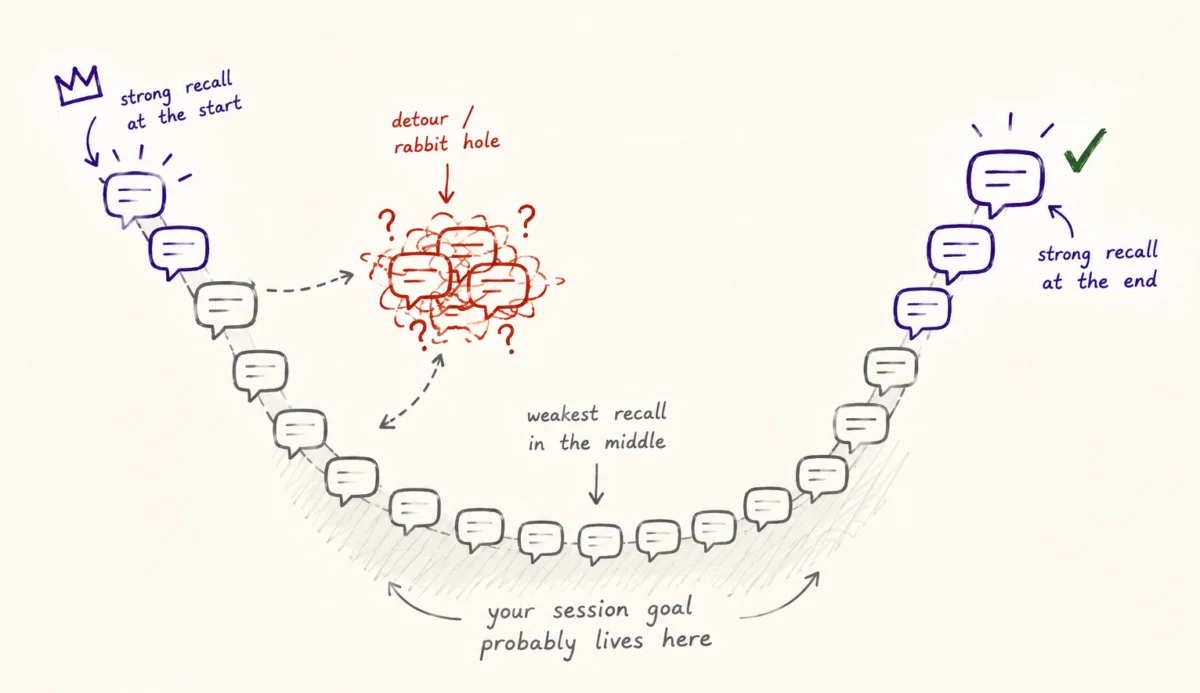
Research from Liu et al. (2024) has further identified that the position of information within the window significantly impacts retrieval accuracy. This study found that retrieval performance typically follows a "U-shaped" curve: accuracy is highest at the very beginning and very end of the context window, while dropping significantly in the middle. For a developer or researcher engaged in a multi-hour session, this "broad middle" is where the most critical content lives, making it the most vulnerable to retrieval failure.
Content Rot: The Feedback Loop of Errors
While intrinsic rot is a matter of mathematics, content rot is a byproduct of how sessions are managed. It is the accumulation of stale, incorrect, or contradictory information across a chat history. In agentic workflows—where tools like Claude Code or GitHub Copilot are given a degree of autonomy to read files and execute commands—content rot can become a self-reinforcing feedback loop.
Content rot typically manifests in four primary failure modes, as identified by researcher Drew Breunig:
- Confusion (Scope Bloat): Front-loading a session with too many tools, skills, and instructions. This bloat forces the model to expend its attention budget on tool definitions it may never use, leading to degraded reasoning.
- Clash (Sticky Diagnoses): When a model commits to a wrong theory early in a session, it often struggles to let go, even when presented with contradictory evidence later. The "path" of the conversation becomes sticky, and the model bends new observations to fit old, incorrect assumptions.
- Distraction (Look-alikes): Broad searches or directory dumps often pull in test fixtures, mocks, or similarly named functions. Models tend to treat all context as relevant, leading them to incorporate these "distractors" into their reasoning, even when they are unrelated to the task at hand.
- Poisoning (Stale State): This occurs when a model records its findings in a temporary file or note that is later rendered incorrect by changes in the code. If the note is not updated, it remains in the context window as a "claim waiting to be confirmed," often outliving the user’s verbal corrections in the chat history.
Supporting Data and Empirical Findings
Recent benchmarks highlight the severity of these issues. While vendors often tout "needle-in-a-haystack" tests showing perfect retrieval, more complex evaluations paint a different picture. The "NoLiMa" benchmark (Modarressi et al., 2025) demonstrates that when the easy word-overlap between a question and an answer is removed—forcing the model to match on meaning—performance drops significantly earlier than the headline context limit suggests.

Furthermore, studies on reasoning across long contexts (Du et al., 2025) indicate that a model’s ability to "think" with information degrades well before its ability to "find" that information. In practical terms, a model that can locate a specific fact at 100,000 tokens may still fail to use that fact to solve a complex logic puzzle within the same window.
In Letta’s "Recovery-Bench," researchers found that AI agents handed the full history of their failed attempts actually performed worse than agents starting from a clean slate. The "rotten" context of the previous failures actively dragged down the recovery process, suggesting that carrying forward a transcript of errors is often more harmful than helpful.
Chronology of the Context Expansion
The evolution of context management has moved through three distinct phases:
- The Constraint Era (2020–2022): Models like GPT-3 had windows as small as 2,048 tokens. Users had to be extremely selective, often using "summarization" loops to keep important information within reach.
- The Expansion Era (2023–2024): The release of Claude 2.1 and GPT-4 Turbo pushed limits to 128k and 200k tokens. The prevailing wisdom was that "more context is always better," leading to the practice of dumping entire documents into the prompt.
- The Governance Era (2025–Present): As the limitations of long-context retrieval became clear, the focus shifted toward "governed context." Tools are now being designed with features to "compact," "rewind," or "fork" sessions to maintain high signal-to-noise ratios.
Industry Responses and Best Practices
In response to these findings, developers of agentic tools are implementing features that allow for more granular control over the context window. Anthropic’s Claude Code, for example, utilizes a variety of commands designed to prune the window.
A "fresh start" is increasingly viewed as more valuable than a recovery path. Developers are encouraged to curate a CLAUDE.md or similar configuration file that acts as the "minimum required reading" for the model. This keeps the high-level project conventions persistent without cluttering the active session with every minor code change.

Another emerging strategy is the "Git Tree" approach to conversation. Instead of a single, linear thread, users are encouraged to "fork" sessions for messy investigations. Once a solution is found, it is distilled into a brief summary and "merged" back into the main thread, while the "rotten" context of the failed attempts is discarded. This prevents the "sticky diagnosis" failure mode by ensuring that only the final, verified truth survives in the primary context window.
Broader Implications for AI Autonomy
The recognition of context rot signals a shift in how the industry views AI "intelligence." It suggests that an LLM’s performance is as much a function of the data environment (the context window) as it is the underlying model weights.
For businesses deploying AI agents, this means that "human-in-the-loop" governance remains essential. An outside observer is required to recognize when a session has begun to degrade, as models rarely "hedge" or flag their own declining performance. Instead, a model deep in context rot will often continue to produce confident-sounding output that is increasingly disconnected from reality.
As AI labs continue to improve model architectures to mitigate intrinsic rot, the responsibility for managing content rot will remain with the user. The successful use of frontier models is moving away from a "maximum context" approach toward a "governed context" model, where the quality of the input is prioritized over the quantity of the tokens. This evolution underscores a fundamental truth in the age of generative AI: the context window is a workspace, not a storage unit, and like any workspace, it requires constant tending to remain productive.

