
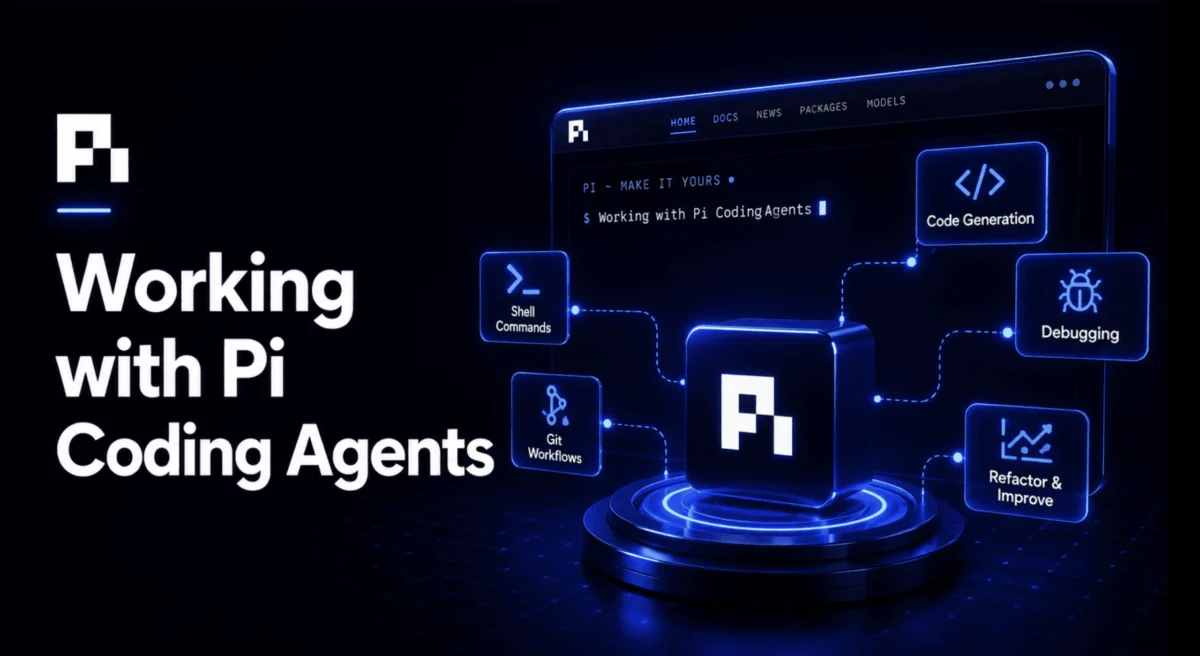
The landscape of artificial intelligence coding assistants has historically been defined by a feature-driven arms race. Major players such as Claude Code and Cursor have focused on providing comprehensive, "out-of-the-box" solutions that manage sub-agents, complex plan modes, and integrated development environments (IDEs). However, a significant shift in this trajectory emerged with the rise of Pi, a minimalist coding agent that has gained substantial traction by intentionally omitting features that its competitors treat as standard. By prioritizing transparency, low token overhead, and user-defined extensibility, Pi represents a structural rebellion against the "black box" nature of mainstream AI tools.
The Genesis of a Minimalist Rebellion
The project was conceptualized and built by Mario Zechner, a developer widely recognized in the software engineering community for his work on libGDX, a popular cross-platform game development framework. In November 2025, Zechner published a foundational essay detailing the motivations behind Pi’s creation. His critique of existing coding agents centered on the "invisible context" injected by mainstream harnesses. Zechner argued that these tools often modify their behavior between updates without sufficient documentation, leaving developers with limited visibility into the exact prompts and data being sent to the underlying large language models (LLMs).
Zechner’s response was to develop a "small core loop" designed to be as predictable as possible. This philosophy resonated quickly with high-level software architects. By January 2026, Armin Ronacher, the creator of the Flask web framework and the Jinja2 templating engine, publicly endorsed Pi. Ronacher described the tool not as a direct rival to products like Claude Code, but as a "harness rebellion" intended for developers who require granular control over their AI-assisted workflows.
The project’s rapid growth led to its acquisition in March 2026 by Earendil Inc., a company founded by Ronacher. Following the acquisition, Zechner transitioned into a major stakeholder role within Earendil. The company simultaneously launched Lefos, a companion cloud platform designed to provide hosted services for Pi users while maintaining the agent’s core as an open-source project.
Technical Architecture and Token Efficiency
At its core, Pi is defined by what it refuses to include. While competing agents often ship with pre-configured Model Context Protocol (MCP) support, built-in to-do lists, and automated background bash execution, Pi’s native toolset is restricted to four primary functions: read, write, edit, and bash.
This minimalist approach addresses a critical economic and technical challenge in the AI industry: token consumption. Industry data suggests that the system prompts for mainstream coding agents frequently range between 7,000 and 10,000 tokens. Because these instructions must be included in every API call to maintain the agent’s behavior, the recurring costs and context window usage are significant. In contrast, Pi’s system prompt is engineered to remain under 1,000 tokens.
The underlying thesis of this design is that frontier models—such as Anthropic’s Claude 3.5 Sonnet or OpenAI’s GPT-4o—have already undergone extensive reinforcement learning on agentic tasks. Therefore, they do not require thousands of tokens of instruction to function as coding assistants. By reducing the prompt size, Pi preserves more of the model’s context window for the actual codebase and the developer’s specific instructions, leading to higher accuracy in complex reasoning tasks.
Chronology of Development and Market Adoption
The trajectory of Pi from a niche developer tool to a major industry player is marked by several key milestones:
- November 30, 2025: Mario Zechner releases the first version of Pi along with a manifesto on the need for transparent AI harnesses.
- January 2026: Technical endorsement from Armin Ronacher triggers a surge in GitHub stars and community contributions.
- March 2026: Earendil Inc. acquires Pi. The transition is governed by RFC 0015, a document that formalizes the project’s open-core structure.
- Late March 2026: Pi surpasses 70,000 stars on GitHub. Version 0.80.3 is released, confirming the stability of the core binary and the maturity of its TypeScript extension API.
As of the latest release, Pi supports over 15 model providers. This list includes industry leaders such as Anthropic, OpenAI, and Google, as well as specialized high-performance providers like Groq and Cerebras. Notably, the tool also supports fully local execution through Ollama, allowing developers to run agentic workflows on their own hardware without sending data to external servers.
The Extension Ecosystem: Building What is Missing
The defining characteristic of Pi is its extensibility. Because the core tool lacks built-in safety rails or complex orchestration, users are expected to build these features using a TypeScript-based extension API. This allows teams to tailor the agent’s behavior to their specific security protocols and architectural preferences.
For example, a common criticism of minimalist agents is the lack of a "permission gate" for destructive commands. In a standard Pi installation, the model could theoretically execute a rm -rf command or a forced Git push without user confirmation. To mitigate this, developers can write a lightweight extension—often under 30 lines of code—that intercepts tool calls, scans for risky patterns using regular expressions, and triggers a terminal-based confirmation prompt.

The extension API also allows for the registration of custom tools. By using TypeBox for schema validation, developers can define new capabilities that the model can invoke, such as specialized word counters, database query runners, or internal API integrators. This structure ensures that the agent remains "lean" for those who want simplicity, while remaining infinitely customizable for enterprise environments.
Data Management and the Tree-Based Session Model
Unlike traditional AI chat interfaces that store conversations as linear logs, Pi utilizes a tree-based data structure for session management. Through the /tree command, developers can visualize the different branches of a conversation. This is particularly useful in exploratory programming, where a developer might want to try two different architectural approaches to the same problem.
In a linear model, switching approaches usually requires deleting previous messages or starting a new session, which loses valuable context. In Pi’s tree model, every branch is preserved in a single session file. This allows the developer to "time travel" back to a specific state of the conversation and initiate a new branch without overwriting the progress made in other directions. This technical choice reflects a deep understanding of the non-linear nature of software development.
Governance and the Fair Source Model
The acquisition by Earendil Inc. brought Pi under a formal governance structure defined by RFC 0015. This document is a commitment to the "Open Core" philosophy. The core coding agent remains licensed under the MIT License, ensuring it stays free and accessible to the public. However, the document also carves out space for "Fair Source" layers.
The Fair Source model is an emerging licensing strategy that allows software to be viewed and modified by anyone, while placing certain restrictions on commercial redistribution or large-scale scaling without payment. For Pi, this means that while the CLI and the base agent are open, advanced features or hosted services through the Lefos platform may operate under different commercial terms. This structure is intended to provide a sustainable path for the project’s long-term maintenance while avoiding the pitfalls of purely proprietary software.
Industry Implications and Comparative Analysis
The emergence of Pi has forced a re-evaluation of what constitutes a "productive" AI agent. For junior developers or those seeking rapid prototyping, integrated tools like Cursor may remain the preferred choice due to their low barrier to entry. However, for senior engineers and organizations with strict compliance and security requirements, Pi’s transparency is a significant advantage.
Strengths of the Pi Approach:
- Predictability: Because the system prompt is small and visible, the model’s behavior is more consistent across different versions.
- Provider Agility: The ability to switch between 15+ providers mid-session allows developers to use the best model for a specific task (e.g., using a fast model for boilerplate and a reasoning-heavy model for debugging).
- Low Latency: Smaller prompts result in faster Time To First Token (TTFT), improving the interactive feel of the terminal interface.
Challenges and Limitations:
- Configuration Overhead: The "do it yourself" nature of the tool means that safety features and complex workflows must be manually implemented via extensions.
- Documentation Gap: As a younger project compared to established IDEs, Pi’s documentation for edge cases and advanced extension development is still maturing.
- Community Size: While growing rapidly, the ecosystem of third-party extensions and community-driven solutions is smaller than that of more mainstream competitors.
Future Outlook
As the AI industry moves toward more autonomous agents, the tension between "automation" and "control" will likely intensify. Pi’s success suggests there is a significant market for tools that prioritize the latter. The project’s commitment to staying in the terminal and providing a "harness" rather than a "pilot" aligns with the traditional Unix philosophy of small, specialized tools that do one thing well.
The integration with the Lefos cloud platform and the continued refinement of the TypeScript extension API will be the primary drivers of Pi’s evolution in 2026. If the project can maintain its minimalist core while fostering a robust ecosystem of user-contributed extensions, it may become the standard infrastructure for professional AI-assisted development.
In conclusion, Pi is not merely a tool but a statement on the preferred relationship between a developer and their AI. By documenting what it refuses to build, Pi has created a space for developers to build exactly what they need, free from the constraints and costs of hidden context and unwanted features. For the modern engineer, the decision to use Pi often comes down to a fundamental question: is it better to have a tool that does everything for you, or a tool that allows you to do everything yourself with greater precision? For a growing number of developers, the answer is clearly the latter.

