• Home
  • About Us
  • Contact Us
  • Cookies Policy
  • Disclaimer
  • DMCA
  • Privacy Policy
  • Terms and Conditions
Dr Crypton
Secure Your Future in Crypto
Tech & Startup News

We tracked down iPhone 18 Pro, Pro Max, and iPhone Duo cases already available

by admin September 9, 2026
written by admin

The official unveiling of Apple’s latest mobile device generation has once again triggered an immediate surge across the mobile accessories market. Following the September 9, 2026 Apple Event, third-party manufacturers and luxury accessory brands wasted no time introducing protective gear tailored to the newly announced hardware. With consumers eager to safeguard investments that can cost upwards of $3,199 for maxed-out configurations, the race to provide early-market cases highlights a lucrative secondary industry operating in tandem with Apple’s hardware release cycle.

The launch event introduced several key updates to Apple’s lineup, most notably the iPhone 18 Pro, iPhone 18 Pro Max, and the highly anticipated debut of the company’s first foldable device, commercially designated as the iPhone Duo. As consumers navigate pre-orders and early shipments, the availability of protective cases presents a mixed landscape of immediate compatibility and unique design challenges.

The Ecosystem Shift: Compatibility and New Form Factors

For buyers upgrading to the iPhone 18 Pro or iPhone 18 Pro Max, the transition into new protective gear carries an unexpected perk. Industry tracking indicates that the physical dimensions and button layouts of the iPhone 18 Pro series maintain enough continuity with its predecessor that many iPhone 17 Pro and Pro Max cases remain functionally compatible. This cross-generation compatibility has allowed manufacturers to keep existing product lines active while simultaneously rolling out fresh aesthetics tailored specifically to Apple’s newly introduced colorways.

Chief among these design trends is the adaptation to the new burgundy colorway featured on the iPhone 18 Pro. Prominent accessory makers, such as Casetify, have rolled out targeted designs like the "Dark Cherry" case—a visual nod to pre-launch rumors that anticipated the deep red moniker. These early releases aim to capitalize on the desire for color coordination, allowing users to either match or contrast their device’s exterior finish.

iPhone 18 Pro, Pro Max, and iPhone Duo cases already available

The introduction of the iPhone Duo, however, represents a fundamental departure from traditional slab-style smartphones. As Apple’s maiden voyage into the foldable phone market, the device features a completely unique physical footprint, hinge mechanism, and dual-screen interface. Consequently, older inventory offers zero utility for early adopters of the foldable model.

Market Availability and Manufacturer Strategies

Launch-day availability for foldable phone accessories has historically lagged behind traditional handsets due to the precision engineering required for moving parts. For the iPhone Duo, the initial wave of protective options is notably constrained, restricted primarily to Apple’s own first-party offerings and a select group of established premium brands like Velvet Caviar and Nudient.

Major accessory vendors have adopted a two-tier release strategy:

  • Immediate Listings: Product pages and digital storefronts went live simultaneously with Apple’s keynote presentation, allowing consumers to browse upcoming designs and bookmark anticipated items.
  • Staggered Fulfillment: While digital catalogs are populated, many specialized items—particularly folio-style cases and complex hinge-protecting shells—remain in pre-order status, with shipping dates aligned to the actual delivery window of the hardware.

Industry analysts note that this compressed timeline places immense pressure on accessory supply chains. Manufacturers often rely on leaked dimensional schematics months in advance to finalize molds, ensuring their products hit the market concurrently with the tech giant’s official announcements.

Premium Pricing for Niche Protection

The economic reality of the iPhone Duo ecosystem is reflected directly in its accessory pricing. Apple’s official iPhone Duo Folio case, for instance, carries a retail price tag of $129.99. While steep for a protective accessory, market researchers contextualize the figure against the device’s baseline cost, particularly maxed-out configurations reaching up to $3,199.

iPhone 18 Pro, Pro Max, and iPhone Duo cases already available

The engineering behind foldable protection justifies part of the elevated price. Unlike rigid silicone or polycarbonate shells designed for standard handsets, foldable cases must accommodate dual chassis segments, maintain structural integrity around the central hinge, and often incorporate modular elements such as integrated kickstands. These features aim to bridge the operational gap between a traditional smartphone and a mini-tablet experience, providing stability whether the device is folded shut or fully extended.

Broader Industry Implications

The rapid mobilization of the mobile accessory sector underscores the high economic stakes tied to Apple hardware launches. For independent manufacturers, capturing early-adopter market share during the first month of a phone’s lifecycle accounts for a disproportionate percentage of annual accessory revenue.

Furthermore, the introduction of the foldable iPhone Duo signals a permanent diversification of Apple’s product architecture, forcing accessory designers to expand beyond monolithic molds into articulating, multi-part engineering. As consumer adoption of foldable technology matures, the accessory market will likely shift from a specialized niche to a primary battleground for design innovation, durability testing, and premium material utilization.

As early shipments of the iPhone 18 series and the iPhone Duo begin arriving at consumers’ doorsteps, the accessory market will continue to expand. Major manufacturers are expected to release broader design variations, expanded color palettes, and alternative protective classifications over the coming weeks, providing buyers with a wider array of choices beyond the initial launch-day ecosystem.


September 9, 2026 0 comment
0 FacebookTwitterPinterestEmail
Artificial Intelligence & Tech

7 Approaches Efficient LLM Training Limited Hardware

by admin September 9, 2026
written by admin

The rapid evolution of Large Language Models (LLMs) has created a significant divide in the machine learning landscape. While scaling laws—the empirical observations suggesting that performance improves predictably with more parameters, data, and compute—have driven the development of massive foundation models, these models typically require massive clusters of NVIDIA H100 GPUs connected by high-speed InfiniBand interconnects. For the vast majority of machine learning engineering teams, however, these resources are unattainable. Instead, these teams are constrained to localized, budget-capped hardware, such as dual or quad workstation setups utilizing RTX 4090s, A10Gs, or L40Ss. These consumer-tier devices are severely restricted by limited PCIe bandwidth and strict VRAM ceilings, typically ranging from 24 GB to 48 GB per card.

The traditional approach to training—initializing a standard 16-bit model with AdamW optimizers and relying on default autograd graph retention—is fundamentally incompatible with these hardware limitations. A standard 7B parameter model in FP16 or BF16 format occupies 14 GB of VRAM for static weights alone. When accounting for AdamW optimizer states—which require 8 bytes per parameter (two FP32 values)—a 7B model demands an additional 56 GB. Add to this the gradient tensors and dynamic activation memory, which fluctuates based on context length, and the system hits an out-of-memory (OOM) fault almost immediately. Consequently, engineers are forced to innovate, treating training as an exercise in memory hierarchy management rather than raw compute scaling.

The Evolution of Resource-Constrained Training

Historically, the bottleneck for LLM training was raw compute power. However, as model sizes ballooned from millions to hundreds of billions of parameters, the constraint shifted to memory capacity and the bandwidth required to shuttle data between the GPU and system memory. In the early 2020s, the introduction of ZeRO (Zero Redundancy Optimizer) by Microsoft marked a turning point, demonstrating that model states could be sharded across distributed devices. Since then, the community has seen a rapid succession of techniques designed to squeeze performance out of sub-optimal hardware, shifting from distributed strategies to local, per-device optimizations.

1. Quantized Low-Rank Adaptation (QLoRA and DoRA)

The most common strategy for fine-tuning on limited VRAM is QLoRA. By freezing base model weights in a highly compressed 4-bit representation (NormalFloat4 or NF4), engineers can dramatically reduce the memory footprint. To maintain precision, QLoRA injects trainable low-rank adapters into the attention and feed-forward layers. Recent advancements like Double Quantization (DQ) further refine this by quantizing the quantization constants, saving additional memory.

Weight-Decomposed Low-Rank Adaptation (DoRA) represents a sophisticated evolution of this approach. By decoupling magnitude and directional updates, DoRA allows the model to mirror the gradient trajectories of full fine-tuning more accurately than standard LoRA. While this provides a pathway for training 70B parameter models on consumer-grade hardware, it comes at a cost: dynamic on-the-fly dequantization of weights can degrade training throughput by 20% to 35%.

2. Gradient Low-Rank Projection (GaLore)

For teams attempting full-parameter learning without freezing layers, GaLore offers a compelling alternative to traditional AdamW. Standard optimizers maintain massive state buffers, but GaLore utilizes Singular Value Decomposition (SVD) to project high-dimensional gradient matrices into a lower-rank subspace. By tracking momentum and variance only for these compact projections, GaLore significantly lowers the memory overhead.

This method is particularly useful for domain adaptation where LoRA might struggle to capture complex feature distributions. However, the periodic SVD factorizations required to update these projections can cause latency spikes, and the method is hyperparameter-sensitive. Improper selection of rank or update frequency can lead to catastrophic loss divergence, requiring meticulous monitoring throughout the training cycle.

3. Fully Sharded Data Parallelism (FSDP) and Host Offloading

When a model is simply too large for the aggregate VRAM of a workstation, FSDP (or ZeRO-3) becomes essential. Under this paradigm, each GPU holds only a fraction of the model parameters, gradients, and optimizer states. The remaining data is stored in host CPU RAM and paged into the GPU via the PCIe bus as needed.

While this allows for the training of models exceeding 30B parameters on modest multi-GPU setups, the PCIe bus acts as a severe bottleneck. The speed of current PCIe Gen4 and Gen5 lanes is significantly slower than the internal memory bandwidth of an H100 or A100 GPU. As a result, GPU compute often waits for data transfers to complete, causing utilization to drop below 30% in many scenarios. This approach is best reserved for scaling runs where capacity, rather than speed, is the primary requirement.

4. Selective Activation Checkpointing

Activation memory is often the silent killer of training runs, as it scales linearly or quadratically with sequence length. Selective activation checkpointing addresses this by discarding intermediate tensors during the forward pass and recomputing them during the backward pass. While this adds approximately 30% to the total compute cost, it is often the only way to facilitate long-context training (e.g., 32k+ tokens) on limited hardware. Engineers must be wary, however; frequent reallocations can lead to CUDA memory fragmentation, which may trigger OOM errors even when sufficient gross VRAM appears available.

5. Hardware-Aware Tiled Kernels (FlashAttention-2)

Perhaps the most universal advancement in recent years is the development of memory-tiled kernels like FlashAttention-2. By restructuring attention computation to operate within the GPU’s on-chip SRAM rather than writing intermediate matrices to global HBM, FlashAttention minimizes memory round-trips. This technique is non-negotiable for modern training; it maximizes Streaming Multiprocessor (SM) occupancy and can improve training speed by 2x to 4x. The primary challenge remains technical: custom kernels are tightly coupled to specific GPU microarchitectures, and version mismatches can result in silent fallbacks to slower, un-fused PyTorch native operations.

6. Mixed-Precision Training with FP8

The introduction of FP8 formats (E4M3 and E5M2) with the Ada Lovelace and Hopper architectures has provided a new mechanism for doubling compute throughput. FP8 allows for more efficient matrix multiplications and cuts activation buffer sizes by half compared to FP16. The limitation lies in the narrow dynamic range of 8-bit floats; without robust, hardware-integrated scaling algorithms, deep models are prone to gradient vanishing or loss explosions. This technique is currently reserved for the latest hardware generations, but its adoption is rapidly becoming the industry standard.

7. RingAttention and Sequence Chunking

For ultra-long context windows, RingAttention provides a way to distribute sequence computation across multiple devices. By splitting the sequence across devices and passing blocks in a ring topology, models can process sequences that would otherwise exceed the memory of a single node. This technique works even over standard PCIe or local network interfaces, provided the communication is overlapped with compute. If network latency outweighs the block compute time, however, the pipeline stalls, effectively negating the benefits of the distributed setup.

Analysis and Implications

The shift toward efficient training is not merely a cost-saving measure; it is a fundamental shift in AI development. By decoupling weight precision and optimizing memory hierarchies, researchers and engineers can achieve performance levels previously restricted to enterprise-scale data centers. However, this increased complexity introduces new failure modes. Unlike traditional software, these hardware-constrained pipelines are susceptible to non-deterministic CUDA behavior, thermal throttling, and silent gradient divergence.

In practice, the success of these approaches depends on rigorous metric tracing. Engineering teams must monitor floating-point underflow rates, PCIe bus utilization, and GPU thermal performance to ensure that thousands of hours of computation are not lost to silent failures. As LLM development moves toward "agentic" and domain-specific applications, the ability to train performant models on commodity hardware will likely become the defining competitive advantage for lean, agile AI teams. The future of the field, therefore, rests not on the sheer brute force of hardware scaling, but on the intellectual ingenuity of memory-efficient optimization.

September 9, 2026 0 comment
0 FacebookTwitterPinterestEmail
Artificial Intelligence & Tech

Get ready for the game with new football features in Search

by admin September 9, 2026
written by admin

The Evolution of Digital Fan Engagement

The landscape of professional and collegiate football consumption has undergone a radical transformation over the past decade. According to industry reports from Nielsen and various sports media analysts, the "second-screen" experience has become the standard for the modern viewer. Fans are no longer satisfied with simply watching a broadcast; they demand immediate access to advanced metrics, live updates, and social discourse.

Google’s latest deployment addresses this behavior by integrating a Live Game Feed directly into the search results page. By simply querying an ongoing matchup, users are now met with a "Live" icon that serves as a gateway to a real-time dashboard. This interface aggregates a play-by-play timeline, key video highlights, and AI-powered insights, effectively reducing the latency between a game-changing play and the viewer’s ability to digest its statistical impact. Initially available on mobile platforms in the United States, this feature is set to expand its scope to include collegiate teams and international markets by the end of the month, reflecting the global growth of American football’s fan base.

Chronology of the Update and Technical Deployment

The rollout of these features follows months of iterative development within Google’s Search division. The company has focused on reducing the friction associated with tracking multi-game slates. The introduction of a "matchup carousel" allows users to monitor league-wide scores simultaneously without the need for repetitive, individual queries.

Historically, football enthusiasts have had to navigate through various sports news websites or dedicated league applications to compile a comprehensive view of weekly standings. By embedding this information directly into Search, Google is attempting to minimize the "time-to-insight" for the casual and professional fan alike. The technical architecture behind these updates relies on low-latency data feeds that sync with official league statistics, ensuring that the "Live" indicator is accurate to the second.

Deep Dive: Analytics and Statistical Depth

For the analytical fan, the new features offer an unprecedented level of granularity. The platform has expanded its statistical database to include deeper metrics that were previously reserved for specialized scouting or gambling platforms. Beyond traditional scoring leaders, users can now track specific metrics such as "yards after catch" (YAC), sack frequency, and forced fumbles.

This shift toward data-heavy presentation is consistent with the broader "Moneyball" influence in modern professional sports. By providing these statistics in a digestible format, Google is catering to the growing demographic of fans who participate in sports betting and daily fantasy leagues, where such metrics are critical for decision-making. Future updates are expected to include playoff bracket visualization and championship probability forecasts, which will provide predictive insights based on current league standings and historical performance data.

The Integration of Fantasy Football and AI Mode

Perhaps the most significant development in this release is the integration of fantasy football accounts directly into the Search ecosystem via "AI Mode." By allowing users to securely link accounts from platforms such as Yahoo Fantasy or Sleeper, Google is effectively acting as a personal digital assistant for team managers.

Get ready for the game with new football features in Search

The security architecture of this feature is designed with privacy at the forefront, requiring explicit user authorization to access league data. Once linked, the AI model can synthesize the user’s specific roster context. This eliminates the manual labor of cross-referencing waiver wire targets with existing team needs. For instance, a user can query the AI for "start/sit" recommendations, and the system will cross-reference the user’s live roster against expert projections and real-time player health data. This capability represents a significant leap forward in personalized AI application, moving away from generic search results toward highly contextual, user-specific outputs.

Industry Implications and Market Analysis

The implications of these updates extend beyond simple user convenience. By capturing the "fan journey" within Search, Google is insulating its ecosystem against competitors that provide similar services. Media analysts suggest that by becoming the primary hub for game-day activity, Google increases user dwell time on its platform, which is a vital metric in the competitive advertising market.

Furthermore, the emphasis on AI-driven insights signals a broader industry trend where search engines are evolving into "answer engines." Instead of presenting a list of blue links to external articles, Google is providing the synthesized answer directly. While this provides immediate value to the user, it also prompts questions regarding the future of sports journalism. If fans can obtain a comprehensive summary of a game, including social sentiment and video highlights, within a single search, the reliance on traditional sports media outlets for post-game recaps may shift significantly.

Official Responses and Future Outlook

Denise Ho, Senior Director of Product Management for Search, emphasized that the goal of these features is to deepen the connection between the fan and the sport. "We built this feature for fantasy fans of all levels," Ho stated, noting that the company is actively soliciting feedback via the "thumbs up" and "thumbs down" functions within AI Mode. This feedback loop is essential for the refinement of the AI’s recommendation engine, as it learns the specific preferences and risk profiles of individual users.

Looking ahead, the scalability of this technology is clear. While currently restricted to professional and collegiate American football, the underlying infrastructure—the ability to link third-party accounts, process real-time data, and serve it via conversational AI—could easily be ported to other sports, such as basketball, baseball, or international soccer.

Conclusion: A New Era of Sports Consumption

The integration of real-time statistics, live feeds, and personalized fantasy management into Google Search represents a fundamental change in how sports information is consumed. By leveraging artificial intelligence to bridge the gap between static data and actionable insights, the platform has successfully streamlined the fan experience. As the season progresses, the effectiveness of these tools will be measured not just by the number of users who engage with them, but by the extent to which they become an indispensable part of the weekly football ritual.

For the average fan, the complexity of managing a fantasy team, following league-wide standings, and keeping up with real-time game developments has been significantly reduced. The era of the "smart fan," supported by intelligent, data-driven search results, is officially here. As Google continues to refine these features based on user interaction, the boundary between passive viewing and active, data-informed participation will continue to blur, setting a new benchmark for digital engagement in the professional sports industry.

September 9, 2026 0 comment
0 FacebookTwitterPinterestEmail
Cryptocurrency News

Tether Alloy Gold-Backed Synthetic Dollar Reserves Cross $210 Million Milestone in Evolution of On-Chain Collateral

by admin September 9, 2026
written by admin

Tether’s innovative gold-backed synthetic dollar ecosystem, operating under the Alloy framework, has officially surpassed $210 million in total reserves, according to the latest data published on the company’s official transparency portal. This significant financial milestone highlights a growing appetite within the decentralized finance and broader cryptocurrency markets for alternative collateral models that successfully bridge traditional hard assets with digital liquidity. While Tether remains overwhelmingly dominant due to the circulating supply of its flagship fiat-backed stablecoin, the steady expansion of the Alloy product line underscores a deliberate push by the issuer to diversify its technological and financial offerings beyond traditional currency pegs.

The $210 million figure specifically represents the total value locked and utilized within the Alloy infrastructure and its primary synthetic asset, aUSDT. Financial analysts and industry observers emphasize that this distinction is crucial for market participants. Unlike standard USDT—which relies on a conservative reserve composition primarily consisting of cash, cash equivalents, and short-term United States Treasury bills—Alloy introduces a complex, overcollateralized structural design. By utilizing Tether Gold (XAUt) as the foundational collateral layer, the system enables users to mint a synthetic digital dollar known as aUSDT. This mechanism is meticulously engineered to provide participants with high-liquidity digital cash capabilities while ensuring they maintain their direct economic exposure to physical gold.

The Genesis and Architecture of Tether Alloy

To fully comprehend the significance of this $210 million milestone, one must examine the operational framework of Tether Alloy and the specific market gap it was designed to address. Introduced as part of Tether’s strategic expansion into specialized digital assets, Alloy represents an intersection between traditional commodity investments and the velocity of decentralized financial rails. For years, crypto-native investors seeking commodity exposure were forced to choose between liquid stablecoins used for trading and non-yielding hard assets like physical or tokenized gold.

Alloy resolves this dilemma through an overcollateralization model. Users who deposit XAUt into the protocol can generate aUSDT, effectively unlocking dollar-denominated purchasing power without triggering a taxable event or forcing them to liquidate their long-term gold positions. This functionality caters to a sophisticated segment of the digital asset population—traders, institutional participants, and decentralized finance enthusiasts who require stable, liquid capital to execute strategies, participate in lending protocols, or facilitate cross-border transactions while retaining a hedge against currency inflation through precious metals.

However, this sophistication introduces a fundamentally different risk profile compared to standard fiat-backed stablecoins. While USDT stability is anchored to the value and regulatory compliance of fiat currencies and short-term debt instruments, aUSDT’s integrity is inextricably linked to the performance, liquidity, and smart contract mechanics governing Tether Gold. Factors such as sudden volatility in precious metal markets, the accuracy of collateral ratios, liquidation thresholds, and the operational security of the underlying smart contracts all play a critical role in the ongoing health of the Alloy ecosystem. Consequently, financial experts and risk management firms repeatedly caution retail and institutional investors against conflating the two assets, noting that aUSDT carries distinct structural and market risks.

Chronology of Expansion and the Shift Toward Diversified Collateral

The journey of Tether Alloy from concept to a $210 million reserve base reflects a broader evolution within the digital asset economy. Over the past several cycles, the cryptocurrency market has transitioned from a landscape dominated by simple fiat stablecoins and volatile native tokens to an increasingly sophisticated ecosystem characterized by tokenized real-world assets (RWAs), on-chain yield products, and commodity-backed tokens.

When Tether initially launched its transparency metrics for specialized products, the market reaction was measured. Tokenized gold had long occupied a niche sector within digital finance, often overshadowed by the sheer volume of fiat-pegged liquidity. However, macroeconomic pressures, persistent global inflation, and shifting monetary policies by central banks worldwide reignited interest in hard assets. Investors increasingly sought ways to integrate safe-haven commodities into high-speed digital architectures.

By steadily growing its reserve base past the nine-figure mark, Alloy has demonstrated product-market fit within this specialized sector. Although $210 million represents a fraction of Tether’s multi-billion-dollar fiat stablecoin empire, achieving this scale validates the concept that digital asset users desire multifaceted collateral options. It signals that a dedicated cohort of investors is actively moving beyond single-asset dependency, favoring systems that allow them to leverage hard commodities on-chain without sacrificing utility.

Market Implications and the Broader Industry Impact

The crossing of the $210 million threshold carries several critical implications for the stablecoin issuer and the wider cryptocurrency market. First, it demonstrates Tether’s capacity to successfully deploy and scale alternative financial products outside its core competency. While regulatory scrutiny and market conversations around Tether have historically focused on the attestation quality and composition of standard USDT reserves, the transparent growth of Alloy showcases a willingness to innovate in programmatic, overcollateralized synthetic assets.

Second, the milestone reflects a broader trend among digital asset infrastructure providers. Competitors and decentralized protocols alike are racing to introduce multi-collateral stablecoins and synthetic assets that derive their value from diverse baskets of goods, including commodities, equities, and tokenized government debt. As institutional capital continues to flow into the digital asset space, the demand for sophisticated risk-mitigation tools and flexible collateral types is expected to intensify.

At the same time, the increasing prominence of synthetic dollars like aUSDT highlights the growing necessity for comprehensive user education and transparent risk disclosures. Because synthetic assets involve complex liquidation engines and dynamic collateral pricing, market participants must possess a clear understanding of how these systems react during periods of extreme market stress. A sudden, sharp decline in gold prices or unexpected liquidity crunches in underlying tokenized commodity markets could test the resilience of overcollateralized debt positions, making robust smart contract auditing and real-time transparency absolute prerequisites for sustained growth.

Looking Ahead: The Future of Commodity-Backed Synthetics

As the digital asset sector matures, the boundaries between traditional financial commodities and blockchain-native liquidity continue to blur. Tether’s Alloy experiment has moved past its initial speculative phase, cementing itself as a notable component of the issuer’s expanding ecosystem. Whether this momentum will accelerate depends largely on macroeconomic conditions, the ongoing performance of precious metals, and the appetite of decentralized finance participants for leveraged hard-asset exposure.

For now, the $210 million milestone serves as an empirical indicator of a shifting market preference—one where users increasingly demand flexibility, asset diversity, and programmatic utility from their digital holdings. As transparency data continues to update in real-time, regulators, analysts, and investors alike will be watching closely to see how Tether manages the scaling of these sophisticated financial products and whether other market participants will follow suit in bridging the gap between ancient safe-haven assets and modern blockchain infrastructure.

September 9, 2026 0 comment
0 FacebookTwitterPinterestEmail
Blockchain Technology

The Digital Wallet Paradox: Balancing Consumer Innovation Against Emerging Global Security Threats

by admin September 9, 2026
written by admin

The landscape of global finance is currently undergoing a seismic shift as digital wallets transition from simple payment conduits into comprehensive lifestyle ecosystems. However, this rapid evolution has created a dual-sided reality: while consumers are embracing the convenience of AI-integrated, borderless commerce, criminal elements are simultaneously exploiting these same platforms for sophisticated phishing schemes and large-scale money laundering. A flurry of recent reports from industry leaders like Alipay+ and international watchdogs such as the Financial Action Task Force (FATF) underscores the urgency of securing this digital infrastructure before the "commerce digitalization gap" becomes an irreversible vulnerability.

The Evolution of the Mobile-First Economy

The modern consumer’s relationship with digital wallets has moved beyond basic credit card storage. According to a collaborative study published on September 2, 2026, by Alipay+ and S&P Global, the global travel and commerce sectors are witnessing a move toward "intelligent interoperability." Surveying 6,000 consumers across nine diverse markets, the research highlights that travelers now expect their mobile wallets to serve as all-in-one travel companions—handling everything from flight bookings and hotel check-ins to real-time local rewards and AI-powered concierge services.

Ant International President Douglas Feagin emphasized that the next phase of global commerce will not be defined merely by the shift from cash to digital, but by the intelligence of the underlying ecosystems. "The world has already become mobile-first and borderless, and the challenge now is whether commerce infrastructure can evolve quickly enough to keep pace with consumer expectations," Feagin stated.

Yet, the report identifies a persistent "commerce digitalization gap." While 81.3% of consumers are already utilizing AI to research travel destinations, there remains a sharp decline in user confidence when the technology moves from planning to execution. Only 26% of respondents expressed comfort with AI-driven autonomous payments, citing significant privacy concerns. This data suggests that while the appetite for integrated apps is high—with 61% of global users demanding in-app reservation services—the industry must bridge the trust deficit before widespread adoption can be considered truly secure.

The Phishing Epidemic: Protecting the Binding Process

As digital wallets become more central to daily life, they have inevitably become the primary target for cybercriminals. The Hong Kong Monetary Authority (HKMA) issued a stern warning on September 4, 2026, regarding a rising trend in phishing scams specifically designed to compromise the "binding" process of payment cards.

In these attacks, fraudsters impersonate legitimate merchants or financial institutions, often using fabricated compensation claims to trick victims into disclosing sensitive credentials. Once a victim provides their card details and ATM PIN, the scammers manipulate the user into approving a card-binding request via a mobile banking app or a two-way SMS verification. This grants the attacker full control over the payment instrument, allowing them to initiate unauthorized transactions that bypass traditional security alerts.

The scale of this threat is staggering. Cybersecurity firm StationX reports that 3.4 billion phishing emails are dispatched daily, making it the most prevalent attack vector globally. Data from the Anti-Phishing Working Group (APWG) reveals that 2025 saw 3.8 million documented attacks, with Q2 of that year alone accounting for over 1.1 million incidents. Furthermore, SentinelOne estimates that phishing is responsible for 42% of all global security breaches, resulting in a staggering $25 billion in annual losses. The HKMA’s advisory serves as a critical reminder: in the digital age, the "binding" of a card to a new device is a high-risk transaction that requires rigorous authentication and user vigilance.

The Rise of Digital Hawala and Underground Banking

Beyond individual consumer scams, the FATF has raised the alarm on a more systemic threat: the convergence of traditional underground banking with modern digital assets. The practice of "hawala"—an informal, trust-based money transfer system—has evolved into what regulators now term "digital hawala."

In a report released on September 3, 2026, the FATF documented how criminal networks are utilizing encrypted messaging platforms like Telegram and WhatsApp to coordinate massive cross-border money laundering operations. These syndicates are increasingly integrating fintech apps, mobile wallets, and stablecoins to settle balances between illicit agents. In some cases, the FATF uncovered schemes that laundered over EUR 500 million ($580.69 million) in a matter of months.

More than 80% of jurisdictions surveyed by the FATF identified underground banking as a primary channel for professional money laundering. The report highlights that 70% of these operations now involve the integration of new technologies, including purpose-built "hawala apps" and AI-driven predictive tools that help criminals evade detection by automated transaction monitoring systems.

FATF President Giles Thomson characterized this development as a "serious risk multiplier." He noted that the efficiency of these commercially operated, cross-border laundering networks allows criminal syndicates to hide proceeds from a vast array of illicit activities, including cybercrime, human trafficking, and illegal gambling. The FATF is now urging member nations to implement stronger "public-private feedback loops," where banks and fintech providers share real-time data to disrupt these sophisticated infrastructures.

Chronology of Regulatory and Market Developments

  • March 2026: The FATF issues a global warning regarding the risks of stablecoins and peer-to-peer transactions conducted via unhosted wallets, calling for stricter AML/CTF (Anti-Money Laundering/Counter-Terrorist Financing) compliance.
  • September 2, 2026: Alipay+ and S&P Global release their joint report on the "commerce digitalization gap," revealing a strong consumer desire for integrated AI services, tempered by significant privacy and security concerns.
  • September 3, 2026: The FATF publishes its findings on the rise of "digital hawala," detailing how criminals use AI and encrypted apps to facilitate industrial-scale money laundering.
  • September 4, 2026: The Hong Kong Monetary Authority (HKMA) issues an urgent public advisory regarding phishing scams targeting the mobile payment card-binding process, citing an increase in unauthorized transactions.

Analysis: Implications for the Future of Fintech

The current state of the digital wallet market presents a paradox of progress. The technology is undoubtedly making the world more accessible, allowing for seamless travel and commerce that was unimaginable a decade ago. However, the reliance on these platforms has outpaced the development of robust, user-centric security protocols.

The "commerce digitalization gap" is not merely a UX issue; it is a fundamental challenge of trust. When 43% of consumers express privacy concerns, the burden of proof rests on fintech developers to build "privacy by design" into their AI tools. Similarly, the rise of digital hawala suggests that the next generation of financial regulation must be as agile as the criminals it aims to stop. Regulatory bodies are no longer just monitoring bank accounts; they are effectively policing a digital network of encrypted messaging apps and decentralized asset transfers.

For the average consumer, the path forward requires a new level of "digital hygiene." The advice from regulators is clear: the convenience of a one-click payment must be balanced by a rigorous refusal to engage with unsolicited messages, regardless of how convincing they may appear. As the lines between social media, banking, and commerce continue to blur, the strength of the global financial system will rely on the synergy between institutional oversight, technological innovation, and a more informed, security-conscious public.

The coming year will likely see a renewed push for global standards in digital identity verification. As the FATF and other international bodies refine their recommendations, it is expected that mobile wallet providers will be required to implement more transparent, audit-ready AI interfaces. Ultimately, the goal is to ensure that digital wallets remain a vehicle for legitimate economic growth rather than a gateway for the next generation of financial crime.

September 9, 2026 0 comment
0 FacebookTwitterPinterestEmail
Blockchain Technology

Matter Labs Open Sources Prividium Core as Deutsche Bundesbank Deploys Privacy-Focused Blockchain Platform

by admin September 9, 2026
written by admin

Matter Labs, the core development team behind the prominent Ethereum scaling and zero-knowledge protocol ZKsync, has officially open-sourced the foundational core of Prividium, its enterprise-grade, privacy-focused blockchain platform designed specifically for financial institutions. The release marks a significant milestone in the intersection of institutional finance and decentralized ledger technology, offering traditional banks and financial market infrastructures the ability to deploy highly secure, permissioned networks natively from publicly available code.

According to Matter Labs, the Deutsche Bundesbank has emerged as the first major institution to independently deploy the platform within its internal IT infrastructure. While the exact scope and operational purpose of the central bank’s deployment remain confidential, the self-hosted integration highlights a growing institutional appetite for zero-knowledge privacy architectures that comply with stringent regulatory and data sovereignty mandates.

The open-source release of Prividium’s core engine addresses a long-standing friction point in enterprise blockchain adoption: the tension between proprietary vendor lock-in and the need for transparent, verifiable infrastructure. By making the underlying source code freely accessible, Matter Labs is lowering the barrier to entry for regulated entities seeking to leverage Ethereum-compatible cryptographic guarantees without sacrificing institutional-grade data privacy.

Mechanics and Architecture of Prividium

At its technical core, the newly open-sourced engine governs administrative roles, permissions, and granular access rights on a dedicated Prividium chain. It functions as the ultimate arbiter of network governance, determining precisely which entities hold read and write privileges. Because significant portions of the broader ZKsync stack were already made open source in previous development cycles, financial institutions can now spin up, configure, and operate a fully functional permissioned blockchain network without entering into a preliminary commercial licensing agreement with Matter Labs.

However, the commercial model maintained by Matter Labs remains nuanced. While the fundamental ledger engine and smart contract execution layers are freely available to the public, certain specialized enterprise elements remain paid, proprietary products. Specifically, Matter Labs retains ownership over the centralized administration console, sophisticated user access management tooling, and critical enterprise connectors—most notably the integrations required to bridge the blockchain ledger with legacy core banking systems.

Prividium’s primary architectural advantage lies in its approach to data privacy. Traditional enterprise ledgers often struggle with a fundamental dilemma: either all network participants see all transaction data (which violates commercial confidentiality and banking secrecy laws) or the network is fragmented into isolated silos that cannot interoperate. Prividium resolves this by keeping all sensitive transaction data strictly localized within the physical or virtual infrastructure of the participating institution.

Matter Labs open sources Prividium core as Bundesbank tests it. Interoperability next

The only data that leaves the institutional boundary is a lightweight cryptographic proof—a zero-knowledge validity proof—certifying that the ledger state was updated correctly according to predefined business logic. This cryptographic attestation is then recorded on a public settlement layer, such as Ethereum or another compatible network, providing mathematical finality and global auditability without exposing underlying commercial values, counterparties, or transactional volumes.

Institutional Precedents and Early Adoption

The deployment by the Deutsche Bundesbank does not occur in a vacuum; it builds upon a growing foundation of enterprise experimentation with ZK-scaling technology across Europe and global financial markets. Financial institutions have increasingly gravitated toward zero-knowledge proofs due to their unique ability to reconcile public blockchain security with private institutional data requirements.

For instance, major institutions have previously tested similar infrastructures. Deutsche Bank’s DAMA 2 (Digital Assets Management Access) tokenized fund project utilized ZKsync technology to explore the issuance and lifecycle management of digital assets. Similarly, Swiss banking giant UBS conducted proof-of-concept trials leveraging the same technological stack to expand the global geographic reach and operational efficiency of its digital gold product offerings.

Furthermore, specialized networks like the Cari Network have officially adopted Prividium to underpin their tokenized deposit infrastructures. In such deployments, the proprietary core banking connectors maintained by Matter Labs play a vital role, acting as the secure translation layer between modern cryptographic ledgers and decades-old core banking software architectures.

Regarding the Deutsche Bundesbank’s deployment, Matter Labs confirmed that the German central bank has established a self-hosted instance of the platform. Under this configuration, all smart contract execution data, token ledgers, and transaction states remain entirely contained within the central bank’s secure perimeter. Matter Labs and the Bundesbank have engaged in collaborative design and testing phases to evaluate the technology’s performance under central banking conditions. To date, the Deutsche Bundesbank has declined to issue detailed public comments regarding the deployment, and the specific objectives of the internal testing phase remain undisclosed.

Strategic Vision and Interoperability Challenges

Addressing the release, Matter Labs Chief Executive Officer Alex Gluchowski characterized the open-source milestone as a foundational step rather than an ultimate destination. In statements accompanying the launch, Gluchowski emphasized that while enabling individual institutions to run secure, isolated permissioned chains is a critical technical achievement, it immediately introduces a much more complex systemic challenge: the problem of cross-chain and cross-market connectivity.

As individual commercial banks, central banks, and market infrastructures deploy their own isolated Prividium instances, the financial industry faces the classic fragmentation dilemma under a new technological paradigm. The critical question moving forward is not merely how a single bank runs a private ledger, but how these discrete, sovereign chains can securely and efficiently communicate with one another, settle transactions atomically across institutional boundaries, and bridge safely with public decentralized finance (DeFi) markets and open capital networks.

Matter Labs open sources Prividium core as Bundesbank tests it. Interoperability next

This architectural reality underpins why Matter Labs has chosen a hybrid commercial strategy. By giving away the core engine, the developer builds a broad base of technical familiarity and network standardisation. Simultaneously, by retaining control over advanced administrative dashboards, user identity management tools, and core banking connectors, the firm secures a sustainable enterprise business model centered around enterprise-grade integration, maintenance, and multi-chain interoperability solutions.

Market Implications and Future Outlook

The open-sourcing of Prividium’s core represents a maturation point for enterprise blockchain strategies. Over the past decade, corporate blockchain initiatives have swung wildly from hyper-permissioned, corporate-controlled consortium ledgers (which often suffered from low adoption and high friction) to unyielding demands for fully public, permissionless infrastructure (which institutions frequently rejected due to regulatory, privacy, and compliance barriers).

Zero-knowledge rollups and privacy-focused modular platforms like Prividium represent a pragmatic synthesis of these competing philosophies. By leveraging zero-knowledge cryptography, institutions can inherit the robust security, decentralization, and settlement guarantees of public networks like Ethereum while maintaining absolute control over their sensitive operational data.

For regulatory bodies and central banks such as the Bundesbank, exploring these platforms is increasingly viewed as an operational necessity rather than an exploratory luxury. As global financial markets slowly digitize—incorporating tokenized commercial bank money, central bank digital currencies (CBDCs), and institutional-grade digital assets—central banks must understand the technological underpinnings that will govern future wholesale settlements.

As the industry moves beyond the initial wave of isolated proofs-of-concept, the success of platforms like Prividium will depend heavily on the evolution of secure interoperability frameworks. Whether the financial sector can successfully bridge isolated institutional ledgers into a cohesive, global digital asset economy remains the defining question for enterprise blockchain development in the years ahead.

September 9, 2026 0 comment
0 FacebookTwitterPinterestEmail
Blockchain Technology

Google Commits €13B to Finland AI Infrastructure, Securing Its First Non-US Nuclear Deal

by admin September 9, 2026
written by admin

In a landmark shift for the global technology sector, Google has announced a €13 billion capital deployment aimed at expanding its artificial intelligence infrastructure across Finland. This massive investment, which represents the largest single capital commitment by the tech giant in Europe to date, marks a departure from traditional data center leasing models. By entering into a 22-year power purchase agreement (PPA) with the Finnish energy utility Fortum, Google is effectively evolving from a traditional "compute landlord" into a steward of sovereign energy infrastructure.

The strategic partnership centers on securing long-term, low-carbon baseload power from the Loviisa nuclear power plant. This agreement is not merely a supply contract; it serves as a financial lifeline that guarantees the operational lifespan of the plant, preventing its potential retirement in 2030 and ensuring continued output through 2050. As hyperscalers face increasing grid constraints, this model suggests that the future of large-scale AI is intrinsically tied to the direct financing of national energy assets.

A Multi-Site Expansion Strategy

Google’s €13 billion investment is distributed across four key Finnish locations: an expansion of its existing facility in Hamina and new developments in the municipalities of Muhos, Vaala, and Kajaani. The scope of this project extends beyond the mere assembly of server racks and cooling units. It encompasses a comprehensive integration of grid modernization efforts and advanced energy management systems.

A notable feature of the Kajaani site is the deployment of a 94 MW battery storage system, designed to balance the intermittent nature of renewable energy sources often paired with nuclear baseloads. This infrastructure play reflects a broader corporate strategy to mitigate the risks of energy price volatility while maintaining the 99% carbon-free energy profile that Google has championed in its European operations.

Chronology of the Deal and Operational Timeline

The agreement between Google and Fortum follows months of negotiations aimed at aligning the needs of high-density AI training clusters with the technical requirements of the Finnish national grid. The timeline for the implementation of this partnership is structured to ensure stability for both parties:

  • 2026 (September): Official announcement of the €13 billion investment and the signing of the 22-year PPA.
  • 2028: Scheduled commencement of the PPA, beginning with initial, smaller capacity allocations.
  • 2030–2049: The primary operational window where Google will procure 50% of the Loviisa nuclear plant’s total electricity output.
  • 2050: The current projected end date for the extended operational life of the Loviisa facility under the new regulatory and maintenance framework.

The Financial and Economic Rationale

For Fortum, the deal is a significant win for long-term capital certainty. The utility estimates that the 50% capacity contract will increase its return on net assets (RONA) by approximately 1.4 percentage points. This influx of capital allows Fortum to justify the significant maintenance and regulatory costs required to extend the Loviisa plant’s operational life.

The economic impact on the Finnish economy is substantial. Estimates suggest the construction phase will contribute approximately €3.6 billion to the national GDP. Furthermore, the completed infrastructure is expected to generate approximately 7,000 jobs, ranging from high-skilled technical roles in AI development to engineering and facility maintenance positions.

Shifting the Hyperscaler Paradigm

The tech industry has spent the last two years grappling with the "compute landlord" dilemma: how to scale AI operations when traditional power grids are already at capacity. Previous industry moves have largely been stopgap measures. For instance, the reported NVIDIA-Hugging Face partnership, SpaceX’s 10 GW data center ambitions, and various other high-density compute ventures have focused primarily on hardware acquisition and logistical power delivery.

Google’s Finland play introduces a new layer of "Sovereign AI." By tying its operational future to the preservation of existing European nuclear capacity, Google is bypassing the bureaucratic and technical bottlenecks that have slowed data center construction in other jurisdictions. Unlike the recent US-based nuclear deals—such as Microsoft’s move to support the reopening of Three Mile Island or Amazon’s 1.9 GW commitment via the Susquehanna plant—the Google-Fortum agreement is focused on life-extension and grid stabilization.

Official Perspectives and Strategic Intent

Ruth Porat, President and Chief Investment Officer of Alphabet and Google, emphasized the gravity of the move during the announcement. "This is Google’s first nuclear energy deal outside of the United States, and we think it’s a really important cornerstone to everything that we are doing here," Porat stated. Her comments underscore the company’s view that energy security is now the primary bottleneck for AI development.

From the perspective of regional policy, the Finnish government has viewed the deal as a validation of its energy policy. By fostering a climate that encourages large-scale investment in clean, baseload energy, Finland has positioned itself as a primary hub for European data sovereignty.

Broader Implications for the European Market

The question now facing investors and policy analysts is whether this model of "compute-as-infrastructure-preservation" will become the new industry standard. The current AI arms race requires massive amounts of consistent electricity—a demand that intermittent renewables alone cannot satisfy.

If this strategy proves successful, we may see a wave of similar agreements across Europe, where hyperscalers effectively become the underwriters for aging nuclear and hydroelectric infrastructure. This would mark a significant shift in the relationship between Big Tech and national governments, as corporations move from being mere consumers of utility services to being active participants in national energy planning.

However, the model is not without risks. The execution of such a large-scale integration of AI and nuclear energy faces significant regulatory and technical hurdles. Navigating the stringent safety protocols of the European nuclear sector, while simultaneously ensuring that grid integration meets the high-availability standards required for large-scale language model (LLM) training, will be a complex undertaking.

Conclusion: The New Cost of Energy Sovereignty

The "money lens" for the technology sector has definitively shifted. Where the focus once lay on the unit cost of H100 or Blackwell chips, the focus is now firmly fixed on the cost of energy. Google’s investment in Finland demonstrates that the most valuable commodity in the AI era is not just silicon, but the ability to guarantee the power required to run it.

Whether this model remains a bespoke solution for a company with a balance sheet as robust as Google’s, or whether it signals a systemic change in how the digital economy is powered, remains to be seen. What is clear is that the line between private infrastructure and national energy security has been permanently blurred. As data centers continue to expand, their role as financiers of the energy transition will likely become the defining narrative of the next decade of digital infrastructure development.

September 9, 2026 0 comment
0 FacebookTwitterPinterestEmail
Blockchain Technology

TechCrunch Disrupt 2026 Unveils Builders Stage Agenda with Focus on AI Scaling, Go-to-Market Strategies, and Startup Resilience

by admin September 9, 2026
written by admin

The technology industry’s premier gathering for early-stage innovation is officially setting its sights on the mechanics of hyper-growth. TechCrunch Disrupt 2026 has released the comprehensive agenda for its highly anticipated Builders Stage, marking a core component of the three-day conference scheduled to take place from October 13 to October 15 at the Moscone Center in San Francisco. Bringing together more than 10,000 startup founders, operators, venture capitalists, and technology leaders, the stage serves as an operational masterclass designed to address the stark realities of building, surviving, and scaling modern enterprises in an increasingly volatile macroeconomic and technological landscape.

As the tech ecosystem navigates the maturation of generative artificial intelligence and shifting venture capital paradigms, the Builders Stage curates tactical conversations led by some of the most prominent practitioners in the space. Confirmed speakers for the 2026 lineup include Gamma CEO and co-founder Grant Lee, Precedent.vc founder and general partner Leah Solivan, Google VP of Product Robby Stein, General Catalyst managing director Yuri Sagalov, and a host of other industry leaders. Through a blend of fireside chats, tactical panels, and real-world case studies, the programming addresses pivotal milestones across the startup lifecycle—spanning pre-seed fundraising, complex go-to-market (GTM) execution, AI integration, and organizational psychology.

The Evolution of TechCrunch Disrupt and the Role of the Builders Stage

Established over a decade ago as the definitive launchpad for disruptive technologies, TechCrunch Disrupt has evolved from a pure product showcase into a comprehensive ecosystem forum. In recent years, the conference has adopted a multi-stage architecture to address the specialized needs of different industry segments. For 2026, the Builders Stage stands as one of six specialized, industry-focused tracks, tailored explicitly for founders attempting to bridge the perilous gap between initial product validation and enterprise-scale sustainability.

Historically, early-stage entrepreneurship relied heavily on classic playbooks centered around steady customer acquisition, predictable funding milestones, and linear organizational growth. However, the current technological epoch—defined by rapid AI deployment and compressed funding cycles—has upended traditional trajectories. The Builders Stage was conceived to counter this turbulence by moving away from abstract visioncasting and focusing instead on actionable, execution-focused methodologies. Organizers emphasize that every session is curated to deliver frameworks that attendees can deploy immediately within their own organizations.

Navigating the Post-Hype AI Reality and Platform Defensibility

A dominant thread woven throughout the 2026 Builders Stage agenda is the recalibration of artificial intelligence within the enterprise stack. While venture capital markets have poured unprecedented amounts of capital into AI infrastructure and application layers, founders face unique systemic threats, most notably platform risk and intense market saturation.

The Builders Stage brings practical strategies for scaling startups to TechCrunch Disrupt 2026

Several key sessions directly confront these vulnerabilities. A panel titled “What Happens When OpenAI Ships Your Roadmap” addresses a primary anxiety plaguing early-stage AI founders: the existential threat of foundational model providers launching competing products natively. Featuring Airbyte CEO and co-founder Michel Tricot, Radical Ventures partner Rob Toews, and Webflow CEO Linda Tong, the discussion explores structural defensibility, proprietary data moats, and strategic pivoting when confronted with rapidly iterating frontier labs.

Simultaneously, the agenda acknowledges that enduring technology companies will not exclusively be built on pure AI models. The session “How to Win When You’re Not Building AI,” featuring Baillie Gifford investment manager Shan Shan and General Catalyst managing director Yuri Sagalov, shifts the focus back to traditional operational fundamentals. The panelists evaluate the mechanics of efficient growth, customer retention, and revenue quality in a market distracted by technological novelty, arguing that long-term business viability remains anchored in disciplined financial execution rather than market hype.

Further expanding on the macroeconomic dimensions of the AI boom, Blackstone N1 Global Head Jas Khaira will lead a session analyzing how contemporary AI startups demand unprecedented capital intensity at early stages. The discussion examines the criteria institutional heavyweights utilize when attempting to distinguish transient market momentum from category-defining businesses.

Operational Shifts: From Talent Acquisition to Product-Market Fit

Beyond product strategy, the Builders Stage agenda delves deeply into the internal mechanics of scaling organizations, focusing heavily on human capital, compensation, and product evolution.

Human Infrastructure and the Rise of AI Co-Founders

The hyper-competitive market for technical talent has forced startups to fundamentally rethink recruitment and retention. A dedicated panel featuring Wylder.co founder Matt Birnbaum, Runware representative Ioana Hreninciuc, and Redpoint Ventures talent network VP Atli Thorkelsson explores the complexities of compensation equity, secondary sales, and team-building in a constrained labor market.

Complementing this, Gusto CEO and co-founder Josh Reeves leads a forward-looking discussion on “Hiring When AI Is a Co-Founder.” As autonomous agents increasingly absorb foundational engineering, customer support, and administrative workflows, early-stage companies are beginning to construct hybrid workforces. The session investigates how founders balance human oversight with automated delegation without eroding corporate culture or operational accountability.

The Builders Stage brings practical strategies for scaling startups to TechCrunch Disrupt 2026

Redefining Traction and Product-Market Fit

The acceleration of development cycles has radically altered standard benchmarks for early success. The session titled “The 90-Day GTM: Why $0–$10M ARR Is the New Baseline (and How to Actually Get There)”—featuring Lovable CRO Ryan Meadows, Theory Ventures founder Tomasz Tunguz, and Polsia founder Ben Broca—analyzes how AI-enabled execution has compressed go-to-market timelines. Founders are now expected to achieve revenue milestones in months that historically required years of iterative testing.

This rapid pacing has also complicated the identification of true product-market fit (PMF). Sapphire Ventures managing director Rajeev Dham and Superhuman Mail founder Rahul Vohra host a critical examination of “PMF Red Flags,” offering frameworks to help operators distinguish durable customer retention from temporary, hype-driven usage spikes.

Funding Realities: Pre-Seed to Series A and Early M&A

Securing institutional capital remains a central preoccupation for attendees. The 2026 agenda provides tactical guidance across multiple funding horizons:

  • Pre-Seed Credibility: True Ventures managing partner Puneet Agarwal, Slauson & Co. managing partner Austin Clements, and Axiom Partners founder Sandhya Venkatachalam outline strategies for securing early-stage commitments in environments where investors increasingly demand validation before products are fully realized.
  • The 2027 Series A Landscape: Index Ventures partner Jahanvi Sardana, Peak XV managing director Shailendra Singh, and Bessemer Venture Partners partner Janelle Teng Wade brief founders on the evolving expectations for the upcoming funding cycle, detailing the metrics required to stand out as venture capitalists tighten their investment criteria.
  • Early-Stage M&A Strategy: M13 managing partner Karl Alomar and Mignano Law Group founder Lindsey Mignano discuss the integration of mergers and acquisitions into early-stage corporate strategy. Rather than building exclusively toward an initial public offering, founders are encouraged to design their product architecture and partnership models with strategic acquisition in mind from day one.

Broader Implications and Event Details

The comprehensive nature of the Disrupt 2026 Builders Stage reflects a maturing startup ecosystem that is shedding pandemic-era excesses in favor of sustainable, resilient growth models. By addressing topics ranging from the psychological toll of entrepreneurship—featured in a candid panel on founder mental health with Revenge Capital’s Nell Daly and Harvard Medical School associate professor David H. Rosmarin—to multi-model AI orchestration, the conference serves as a barometer for the technological sector’s strategic priorities.

With ticket prices scheduled to increase ahead of the October event, organizers are encouraging early registration for the conference at the Moscone Center. As the industry prepares for three days of high-stakes networking, pitch competitions, and strategic discourse, the Builders Stage stands ready to equip the next wave of founders with the operational blueprints necessary to navigate the complexities of the modern tech economy.

September 9, 2026 0 comment
0 FacebookTwitterPinterestEmail
Decentralized Finance (DeFi)

The Liquid Network Security Incident and the Unraveling of the Bitcoin Sidechain Peg

by admin September 9, 2026
written by admin

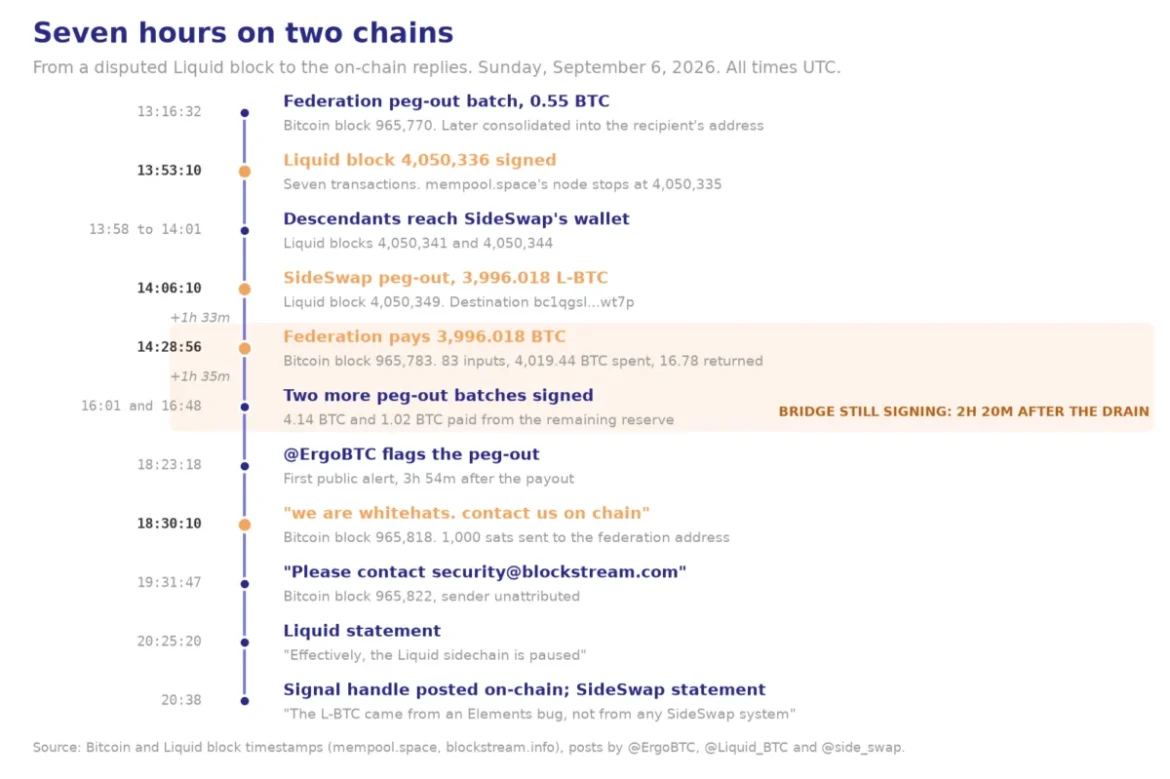
At 14:06:10 UTC on Sunday, September 6, 2026, a critical security event unfolded on the Liquid Network, a prominent Bitcoin sidechain operated by Blockstream. A peg-out transaction involving the movement of 3,996.01834922 BTC triggered an automated response from the Liquid Federation’s multisig infrastructure. This transaction, processed through the peg-out partner SideSwap, resulted in the transfer of nearly 4,000 BTC to a private address, effectively draining the federation’s primary reserves from approximately 4,200 BTC to fewer than 200 BTC within a matter of minutes.

The incident has sent shockwaves through the Bitcoin ecosystem, raising profound questions regarding the security model of sidechains, the inherent risks of confidential transactions, and the governance of decentralized finance (DeFi) bridges. While the Liquid Network was marketed as a robust, enterprise-grade solution utilizing a "Strong Federation" model, this event underscores the fragility of systems that rely on shared codebase consensus.

Chronology of the Exploit

The sequence of events began to manifest in the early hours of September 6. At 13:16 UTC, an initial, smaller peg-out of 0.55 BTC was processed by the federation. While this appeared to be a routine operation, it later served as a precursor to the larger breach.

The core of the incident centers on Liquid block 4,050,336, which was signed at 13:53:10 UTC. This block contained a large, 64-input transaction that, according to blockchain data, introduced anomalous data into the Liquid ledger. Crucially, a consensus divergence emerged: while the Blockstream-maintained explorer accepted the block as valid, independent nodes—notably the infrastructure powering the mempool.space Liquid explorer—rejected it.

At 14:06:10 UTC, the system executed the fraudulent peg-out. SideSwap, acting as a authorized intermediary with a valid Peg-out Authorization Key (PAK), submitted the request. By 14:28:56 UTC, the Bitcoin mainnet recorded the federation’s 83-input transaction (block 965,783) paying out 3,996.01834922 BTC to a third-party address.

The entity behind the transfer subsequently moved the funds to a consolidation address. At 18:30:10 UTC, in Bitcoin block 965,818, the recipient issued an OP_RETURN message stating: "we are whitehats. contact us on chain." Despite this declaration, the funds remain stationary at the time of writing, and no further movement has occurred.

The Mechanism of the Failure

To understand why the Liquid Federation’s security measures failed to prevent this, one must examine the role of the Hardware Security Modules (HSMs) and the PAK system. The Liquid Network’s architecture is designed to prevent the unauthorized movement of funds by requiring that all peg-outs be sent to a pre-whitelisted address.

In this instance, the multisig wallet functioned exactly as programmed. The HSMs, managed by the fifteen federation functionaries, verified that the destination address was whitelisted and that the amount of Liquid Bitcoin (L-BTC) being "burned" matched the BTC being requested. The failure occurred at a deeper level: the consensus layer. The system correctly verified that the peg-out was "authorized," but it failed to verify that the L-BTC being burned was legitimately created.

Because all fifteen functionaries run the same underlying software—the Elements blockchain framework—a bug within that software allowed the generation of illicit L-BTC. When the federation members verified the transaction, they were essentially confirming the validity of an illegal mint that had been masked by the network’s own consensus rules.

Liquid Network: $320M Pegged Out, Every Key Intact

Confidential Transactions: A Double-Edged Sword

The Liquid Network utilizes Confidential Transactions (CT), which leverage Pedersen commitments and range proofs to hide the amounts and types of assets being transferred. While this provides the privacy and fungibility that is a cornerstone of the Liquid value proposition, it also creates an "audit gap."

On a transparent blockchain, an anomalous minting event would be visible to all participants, as the total supply would deviate from expected norms. On Liquid, the minting of 4,000 L-BTC was effectively hidden from public view. Because observers cannot see the specific amounts within a CT output, the market was unable to detect the discrepancy until the federation’s Bitcoin reserve began to deplete. This design choice prioritized privacy over transparency, ultimately facilitating a theft that remained invisible to the wider network until the damage was complete.

Official Responses and Industry Reaction

Blockstream and SideSwap have both issued statements acknowledging the breach. Blockstream confirmed that the issue stems from a bug within the Elements software, though it has not yet provided a detailed technical breakdown of the vulnerability. SideSwap stated that its systems were not compromised, but rather that it processed a customer order that utilized L-BTC minted through the aforementioned bug.

The federation has taken the step of disabling bridge nodes, effectively pausing the Liquid sidechain’s peg-out functionality. While blocks are still being produced, the ability for users to move capital between Bitcoin and Liquid has been suspended. Exchanges and custodial services have also halted L-BTC deposits and withdrawals, leaving many users in a state of limbo.

Independent researchers, including those associated with mempool.space, have been instrumental in identifying the divergence in the chain’s history. The speed with which the community identified the discrepancy highlights the necessity of third-party monitoring in maintaining the integrity of custodial bridges.

Broader Implications for the Bitcoin Ecosystem

The incident raises fundamental concerns regarding the "Strong Federation" model. By relying on fifteen entities that all run identical software, the network suffers from a lack of diversity in its validation logic. If a single bug exists in the shared codebase, the entire multi-signature threshold is rendered ineffective.

Furthermore, the lack of an on-chain governance structure or a dedicated emergency treasury poses a massive risk to L-BTC holders. Unlike decentralized protocols that might have a DAO-controlled insurance fund, the Liquid Network is a centralized service. The question of who bears the loss—the federation, the partner, or the end-user—remains unanswered.

The potential existence of a bug fix in the Elements repository, specifically the commit regarding range proof cache binding, has sparked intense speculation. While there is no official confirmation that this specific change would have prevented the exploit, the timing of the pull request relative to the incident suggests that the vulnerability was known or suspected by the core development team shortly before or during the breach.

Conclusion and Future Outlook

The Liquid Network security incident is a sobering reminder that complexity is the enemy of security. Even with sophisticated multisig hardware and a whitelist-based authorization system, the underlying consensus software remains a single point of failure.

As the Bitcoin community reflects on this event, the focus will undoubtedly shift toward the necessity of more robust, transparent, and diversified validation mechanisms for sidechains. For now, the L-BTC holders are left to wait for a resolution, with the network effectively frozen and the stolen funds held in a single, silent wallet. The incident serves as a definitive case study in the risks of custodial bridges and the trade-offs between privacy-centric transaction models and the requirement for public, verifiable transparency. Whether the Liquid Federation can restore the peg and regain the trust of its users will depend on its ability to provide a full, transparent post-mortem and a clear path toward asset recovery or compensation.

September 9, 2026 0 comment
0 FacebookTwitterPinterestEmail
Cybersecurity & Hacking

U.S. Department of Justice and Global Task Forces Dismantle Xinbi Guarantee Scam Marketplace in Multi-Agency Crackdown

by admin September 9, 2026
written by admin

In a significant escalation of international efforts to combat transnational cybercrime, the United States Department of Justice (DoJ) announced a sweeping series of coordinated actions aimed at dismantling "Xinbi Guarantee," a notorious Telegram-based illicit marketplace that served as a central hub for global scam operations. The operation, which involved the seizure of critical digital infrastructure and the deployment of the Scam Center Strike Force to Madagascar, marks a turning point in the ongoing battle against organized criminal syndicates that have systematically drained billions of dollars from American citizens.

The crackdown resulted in the immediate freezing of approximately $52.8 million in cryptocurrency assets tied to 52 digital wallets, a move that brings the total value of illicit funds restrained by the Scam Center Strike Force to nearly $1 billion. Beyond the financial seizures, the operation successfully disrupted 13 high-intensity scam compounds in Madagascar, resulting in the processing of nearly 400 individuals, including 30 identified leaders of these operations who have since been repatriated to China.

The Anatomy of an Illicit Marketplace

Xinbi Guarantee functioned as a "one-stop shop" for cybercriminals, providing the necessary tools and infrastructure for "pig butchering" scams—a sophisticated form of long-term financial fraud often involving fake romance and investment opportunities. By operating primarily through the encrypted messaging platform Telegram, Xinbi acted as an intermediary between specialized vendors and the operators of scam compounds.

The services offered through this marketplace were comprehensive, covering the entire lifecycle of a fraud campaign. This included the development of custom-coded investment websites designed to mirror legitimate financial institutions, the laundering of proceeds through complex cryptocurrency networks, and the facilitation of human trafficking to source labor for scam compounds across Southeast Asia and, more recently, Africa.

U.S. Disrupts Xinbi Guarantee Scam Marketplace, Freezes $52.8 Million in Crypto

A critical component of Xinbi’s success was its escrow mechanism. By holding funds in transit until a service—such as the creation of a phishing site—was verified as complete, the marketplace established a veneer of professional trust within the criminal underworld. This structure allowed vendors to scale their operations, effectively professionalizing a sector of the dark economy that had previously operated in fragmented silos.

A Chronology of Escalation

The emergence of Xinbi Guarantee is the latest chapter in a broader saga of digital enforcement. Following the collapse of previous major marketplaces like "HuiOne Guarantee" and "Tudou Guarantee" last year, Xinbi rose to fill the power vacuum, quickly establishing itself as the second-largest illicit marketplace of its kind. Since its inception in 2022, blockchain analytics firm Elliptic estimates that the platform facilitated upwards of $30 billion in illicit transactions.

The timeline of this operation reflects a deepening collaboration between private-sector cybersecurity firms and government agencies:

  • 2022: Xinbi Guarantee begins operations on Telegram, quickly gaining traction among criminal syndicates seeking reliable vendor services.
  • Early 2025: Following the closure of competitor marketplaces, Xinbi solidifies its dominance, attracting high-profile criminal entities, including North Korean state-sponsored hackers and OFAC-sanctioned groups.
  • March 2026: The United Kingdom becomes the first nation to officially sanction Xinbi, citing the sale of stolen personal data and satellite internet equipment used to target victims.
  • January 2026: Dr. Tom Robinson of Elliptic notes that despite minor interventions by Telegram, the marketplace remained resilient, leading to a proliferation of smaller, fragmented markets.
  • June 2026: The U.S. Department of Justice launches a coordinated strike, seizing digital assets and initiating a global physical raid on infrastructure in Madagascar.

Official Responses and the Treasury’s Stance

The U.S. Treasury Department’s Office of Foreign Assets Control (OFAC) has concurrently intensified its pressure, sanctioning media outlets and entities that facilitate these criminal enterprises. Secretary of the Treasury Scott Bessent underscored the administration’s commitment to protecting the American financial system.

"Scam centers in Southeast Asia steal billions of dollars from American victims each year," Secretary Bessent said. "The Trump Administration is united in its efforts to dismantle these overseas criminal enterprises, and the Treasury will continue using its tools to disrupt the networks behind this egregious fraud and protect Americans."

U.S. Disrupts Xinbi Guarantee Scam Marketplace, Freezes $52.8 Million in Crypto

The Secret Service, which played a pivotal role in identifying the flow of funds, highlighted the misconception of anonymity that often emboldens these criminals. "After scamming money from hardworking Americans, criminals operating overseas laundered it through the Xinbi Guarantee network, which operated under the false assumption that they were out of the reach of U.S. law enforcement," stated Tara McLeese, Special Agent in Charge of the U.S. Secret Service Washington Field Office.

Technical Implications and Market Evolution

A defining feature of this crackdown was the targeted disruption of the criminals’ financial agility. Historically, Xinbi operated almost exclusively using Tether’s USDT stablecoin on the TRON blockchain. However, in response to the U.S. government’s ability to freeze USDT wallets, the marketplace attempted a tactical pivot to "Decentralized USD" (USDD).

Dr. Tom Robinson of Elliptic pointed out that while USDD claims to be decentralized and immune to central freezing, this is a contested reality. "It is still exposed to freezing risk, since USDD is partly collateralized with freezable USDT," Robinson explained. This transition highlights a desperate attempt by criminal networks to maintain liquidity in an increasingly hostile regulatory environment.

The shift toward USDD is viewed by experts as a "severe setback" for the criminal ecosystem. By demonstrating that even "decentralized" assets can be effectively traced and rendered inaccessible, law enforcement has introduced a new layer of risk for both the vendors and the criminal operators. This uncertainty is expected to fracture the trust required for these marketplaces to function, potentially leading to increased competition and lower operational security among remaining syndicates.

Global Impact and Future Outlook

The expansion of the Scam Center Strike Force’s mandate to target compounds globally—as evidenced by the Madagascar takedown—signals a shift in the global posture against cyber-organized crime. The seizure of over 3,200 electronic devices in Madagascar alone provides law enforcement with a treasure trove of intelligence, likely leading to further arrests and the identification of additional, previously unknown criminal nodes.

U.S. Disrupts Xinbi Guarantee Scam Marketplace, Freezes $52.8 Million in Crypto

The involvement of foreign governments, specifically China’s cooperation in the repatriation of 30 compound leaders, suggests that the scale of the "pig butchering" epidemic has finally reached a threshold where international diplomatic cooperation is no longer optional. These syndicates, which often prey on vulnerable populations, have increasingly moved their operations out of traditional strongholds in Cambodia and Myanmar into regions with weaker oversight, such as Madagascar, to evade regional crackdowns.

Analysis of the Strategic Shift

The dismantling of Xinbi Guarantee is not merely a tactical victory; it is a strategic blow to the operational efficiency of global scam networks. By attacking the "guarantee" mechanism—the very foundation of trust within the illicit marketplace—the Department of Justice has forced these organizations to revert to less efficient, more dangerous methods of interaction.

Furthermore, the integration of blockchain analytics into standard law enforcement procedures has effectively weaponized the transparency of public ledgers against the criminals themselves. As these syndicates attempt to move toward less transparent assets, they inevitably encounter higher costs, lower liquidity, and greater operational friction.

The broader implication is that the "Wild West" era of Telegram-based scam markets is drawing to a close. The success of the Scam Center Strike Force suggests that future efforts will likely focus on the infrastructure providers—such as the messaging platforms and decentralized finance (DeFi) protocols—that inadvertently host these activities. As the net tightens, the cost of doing business for cyber-syndicates will continue to climb, potentially rendering their massive, labor-intensive operations unsustainable in the long term.

In conclusion, the coordinated action against Xinbi Guarantee serves as a stark warning to criminal syndicates operating across borders. Through the fusion of financial intelligence, international diplomatic pressure, and decisive enforcement actions, the U.S. government has demonstrated that the digital sanctuary once enjoyed by these criminal networks is rapidly eroding. For the victims of these crimes, the recovery of nearly $1 billion in assets and the disruption of active compounds represent a significant step toward justice in an increasingly complex and interconnected digital landscape.

September 9, 2026 0 comment
0 FacebookTwitterPinterestEmail
Newer Posts
Older Posts

Recent Posts

  • Web3 Venture Capital Surges to $7.2 Billion in September 2025 as Late-Stage Deals and Token Megarounds Dominate the Landscape
  • The Evolution of the Web3 Wallet: From Private-Key Vault to the Command Center of the Agentic Web
  • Ethereum Foundation Announces Annual Protocol AMA Session Scheduled for September 16
  • Kraken Expands Its Digital Asset Offerings with the Official Listing of Doppler Finance (Xdp)
  • CSD BR and Ripple Collaborate to Integrate XRP Ledger into Brazilian Financial Market Infrastructure

Recent Comments

No comments to show.
  • Facebook
  • Twitter

@2021 - All Right Reserved. Designed and Developed by PenciDesign


Back To Top
Dr Crypton
  • Home
  • About Us
  • Contact Us
  • Cookies Policy
  • Disclaimer
  • DMCA
  • Privacy Policy
  • Terms and Conditions

We are using cookies to give you the best experience on our website.

You can find out more about which cookies we are using or switch them off in .

Dr Crypton
Powered by  GDPR Cookie Compliance
Privacy Overview

This website uses cookies so that we can provide you with the best user experience possible. Cookie information is stored in your browser and performs functions such as recognising you when you return to our website and helping our team to understand which sections of the website you find most interesting and useful.

Strictly Necessary Cookies

Strictly Necessary Cookie should be enabled at all times so that we can save your preferences for cookie settings.