
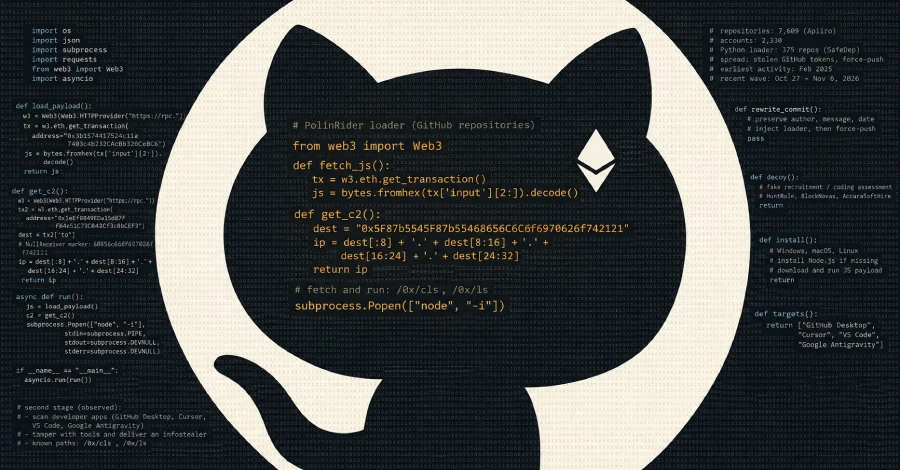
The cybersecurity landscape has been shaken by the emergence of a highly sophisticated supply chain infiltration campaign dubbed PolinRider. Attributed to state-sponsored North Korean threat actors, this operation represents a significant evolution in how malicious entities compromise developer environments to facilitate long-term persistence and data theft. Unlike traditional malware campaigns that rely on direct distribution, PolinRider utilizes a multi-stage loader hidden within innocuous-looking Python utilities, effectively turning legitimate open-source repositories into conduits for secondary, high-impact malicious payloads.
Recent investigations by industry-leading security firms, including SafeDep, Apiiro, and OpenSourceMalware, have revealed that the campaign is not a recent development but an evolving threat with roots stretching back as far as February 2025. By leveraging compromised maintainer accounts and integrating malicious code into trusted software build pipelines, the threat actors have successfully permeated thousands of public repositories.

Technical Anatomy of the PolinRider Loader
At the core of the PolinRider operation is a stealthy Python loader designed to bypass static analysis and traditional signature-based detection. The loader typically resides within small utility packages or configuration files such as conftest.py. Its primary function is to act as a bridge, initializing an execution chain that eventually retrieves and executes secondary payloads.
The mechanism is deceptively simple yet architecturally robust. Upon execution—often triggered by the mere act of importing the malicious file or opening the repository in an integrated development environment (IDE) like VS Code—the loader queries a specific Ethereum wallet address. This address acts as an immutable, decentralized command-and-control (C2) instruction manual. By reading the transaction history of this wallet, the malware extracts encoded JavaScript. This code is then decoded and passed to a Node.js environment, where it facilitates the transition into the next stage of the attack.
This technique, often referred to as "NullReceiver" or a successor to "EtherHiding," allows the attackers to decouple their infrastructure from the malware itself. Because the malicious instruction set is hosted on the blockchain, security teams cannot simply take down a domain or an IP address to neutralize the threat. Instead, the attackers can rotate their infrastructure by issuing a new transaction, ensuring that existing infections remain active and responsive to new commands.

Chronology and Evolution of the Campaign
The historical trajectory of PolinRider highlights a calculated progression from basic exploitation to a highly automated "worm" capability. Evidence suggests that the attackers began testing their methods as early as May 2025, when they targeted nine specific software packages by hijacking maintainer accounts. During this initial phase, the attackers pushed poisoned versions of these packages within a mere 90-minute window, a testament to the efficiency of their operational processes.
Throughout late 2025 and into 2026, the campaign gained significant momentum. By January 2026, the attackers had refined their delivery mechanisms. The most significant leap occurred in the latter half of 2026, when the campaign began exhibiting worm-like propagation behavior. According to researchers at Apiiro, the malware was pushed to over 2,000 repositories in the short period between October 27 and November 6, 2026. This surge brought the total number of affected repositories to over 7,600, spanning more than 2,300 unique developer accounts.
The persistence of this campaign is largely attributed to the "Contagious Interview" methodology. In these instances, the North Korean threat actors pose as legitimate recruiters or employers, luring developers into a fake hiring process. As part of this "technical onboarding," candidates are instructed to download "drivers" or complete "verification" tasks. These steps are carefully engineered to install the initial stage of the PolinRider malware on the developer’s local machine. Once the developer’s system is compromised, the attackers gain access to their GitHub credentials, allowing them to force-push malicious code into existing projects while maintaining the original author, commit message, and timestamp—a tactic designed to evade suspicion during manual code reviews.

Broader Implications for Software Supply Chain Security
The PolinRider campaign serves as a stark reminder of the inherent vulnerabilities within the modern software development lifecycle. By focusing on the developer’s workstation as the point of entry, the attackers bypass traditional perimeter security. When a maintainer’s account is compromised, the resulting "poisoning" of the codebase is often propagated through package managers and automated build systems, potentially reaching thousands of downstream users.
Palo Alto Networks’ Unit 42 has noted that state-sponsored actors are increasingly pivoting toward open-source registries as a primary vector for initial access. The ability to compromise a single account and leverage it to influence a broad range of cloud environments and enterprise infrastructures is a force multiplier for these groups. The implications are profound: a single infected dependency can turn a trusted tool into a vehicle for infostealer malware, which systematically harvests environment variables, session cookies, browser-stored passwords, and, most critically, cryptocurrency wallet keys.
Analysis of Defensive Measures and Mitigation
The decentralized nature of the C2 infrastructure used by PolinRider makes it particularly difficult to mitigate through conventional means. Because the malware retrieves its instructions from the blockchain, standard firewall rules and DNS sinkholing are ineffective. Addressing this threat requires a multi-layered defense strategy centered on identity management and behavioral integrity.

For individual developers, the primary defense remains rigorous credential hygiene. The use of hardware-based multi-factor authentication (MFA) for platforms like GitHub is essential to prevent unauthorized account access, even if a machine is compromised. Furthermore, developers should exercise extreme caution when interacting with "technical assessments" or "onboarding" tasks that require the installation of third-party software or the execution of obscure commands.
For organizations, the focus must shift toward "Shift Left" security—integrating automated scanning for malicious patterns directly into the CI/CD pipeline. Security teams are encouraged to monitor for anomalous activity within their repositories, such as unexpected commits that alter build scripts or the inclusion of suspicious conftest.py files. Tools that provide visibility into the provenance of dependencies are also becoming indispensable, as they allow organizations to identify and quarantine compromised packages before they are integrated into production environments.
The Human Element: A Persistent Challenge
Despite the technical sophistication of the malware, the success of the PolinRider campaign remains deeply rooted in social engineering. The "Contagious Interview" strategy exploits the professional aspirations of developers, using the lure of high-paying jobs or collaborative opportunities to lower their defenses. The psychological manipulation involved in these fake job interviews is highly refined, often including realistic video verification steps and technical challenges that mirror legitimate industry practices.

As of late 2026, the situation remains fluid. The fact that the attackers can "roll back the clock" on commit histories and maintain persistence through automated scripts suggests a high level of technical maturity. The cybersecurity community continues to monitor the Ethereum wallets associated with the campaign, but as researchers have pointed out, the ability of the threat actors to simply initiate a new transaction to point to a new C2 server underscores the difficulty of permanently dismantling this infrastructure.
The PolinRider campaign represents a sophisticated, well-resourced, and highly targeted threat. Its ability to weaponize the trust inherent in open-source development processes makes it a formidable challenge for the entire tech industry. Moving forward, the industry must prioritize the implementation of stronger verification for maintainer accounts and adopt a "zero trust" approach toward the tools and environments used in the software development process. Failure to adapt to these new realities of supply chain warfare could lead to even more widespread and damaging incidents in the years to come.

