
The Middle East is currently navigating an unprecedented transformation in its digital threat environment, as a convergence of geopolitical volatility, rapid digital transformation, and the weaponization of artificial intelligence creates a fertile ground for cyber-adversaries. According to the Middle East Cyber Threat Landscape 2025-2026 analysis published by the AI-powered monitoring firm CloudSEK, the region has transitioned from a landscape dominated by localized hacktivism to one defined by sophisticated, financially motivated ransomware campaigns and state-aligned digital espionage. This shift poses a severe challenge to the region’s critical infrastructure, including its vital oil and gas sectors, maritime chokepoints, and burgeoning digital economies.
The data, spanning from April 2025 to August 2026, illustrates a region under siege. While earlier periods were marked by ideological protest—driven largely by regional military tensions involving Israel, Iran, and the United States—the latter half of the reporting period saw a pivot toward more damaging, profit-driven intrusions. Ransomware, in particular, has emerged as the primary tool of choice for criminal syndicates, with attack frequency increasing by more than twenty-fold within a seventeen-month window.
A Chronology of Escalation: From Hacktivism to Ransomware
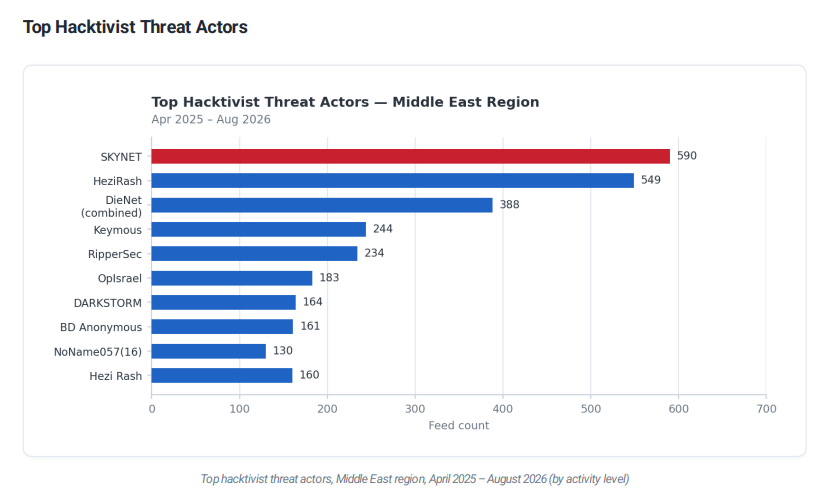
The timeline of cyber activity in the Middle East over the past year and a half reflects the broader geopolitical unrest of the period. In mid-2025, as military tensions reached a crescendo, the region saw a massive surge in hacktivist activity. Groups such as SKYNET, HeziRash, and DieNet orchestrated a sustained campaign of distributed denial-of-service (DDoS) attacks, website defacements, and SQL injection maneuvers. Israel bore the brunt of this activity, accounting for approximately 37.8% of all regional hacktivist events.

By April 2026, however, the landscape began to shift. While politically motivated disruption did not vanish, it plateaued, ceding the spotlight to professionalized ransomware operations. The most significant spike in ransomware activity occurred in June 2026, when 357 distinct activity signals were recorded—a stark contrast to the 17 signals logged in April 2025. This rapid escalation suggests that threat actors are no longer merely seeking to make a statement; they are seeking to monetize vulnerabilities in sectors that are critical to the region’s stability.
The facility management sector has emerged as the primary victim of these attacks, followed closely by infrastructure, manufacturing, and property management. This prioritization indicates a strategic focus on entities that cannot afford downtime, thereby increasing the leverage held by extortionists.
Geographical Distribution and Threat Sources
The geography of cyber risk in the Middle East is multifaceted. While Iran is often framed as a focal point of regional conflict, security analysts clarify that it serves primarily as a hub for threat actor development rather than the sole victim. Conversely, Türkiye has been identified as the most targeted nation for ransomware, followed by Israel, the United Arab Emirates, Egypt, and Saudi Arabia.
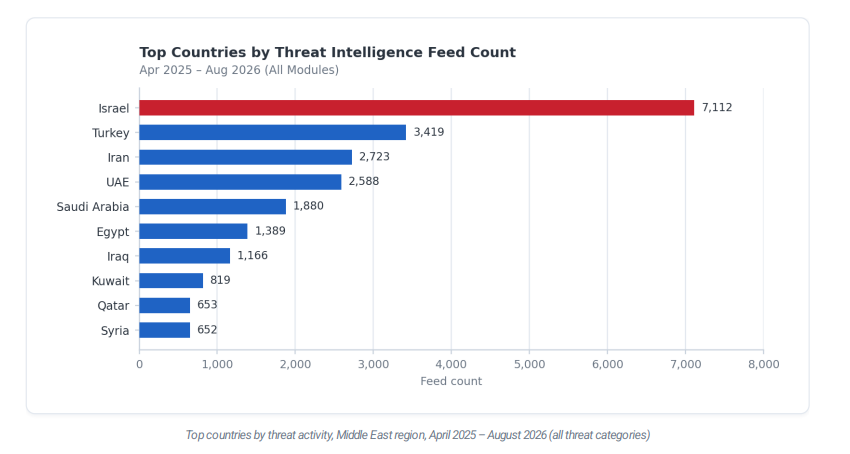
The dark web has become the backbone of this criminal ecosystem. In this hidden marketplace, stolen government credentials, financial data, and proprietary corporate intelligence are traded at a premium. Türkiye and the UAE exhibit the highest levels of darknet engagement, while Israel leads the region in total threat intelligence feed volume, with over 7,100 specific alerts documented in the study. The prominence of these nations reflects their high levels of digital adoption; as these economies modernize and integrate advanced e-commerce and banking systems, they inadvertently expand their attack surface.
The Weaponization of Artificial Intelligence
Perhaps the most alarming development in the 2025-2026 threat landscape is the integration of artificial intelligence into the cybercrime toolkit. AI has significantly lowered the barrier to entry for novice hackers while drastically increasing the efficiency of established criminal groups.
Ram Narayanan, Middle East country manager at Check Point Software Technologies, has noted that AI is now influencing nearly every stage of the cyber-kill chain. The most critical shift is the acceleration of the vulnerability exploitation cycle. Previously, there was a window of several days between the disclosure of a software vulnerability and its active exploitation by bad actors. Today, that window has shrunk to mere hours. AI-driven automation allows attackers to scan networks, identify weaknesses, and deploy payloads at speeds that human-led security teams struggle to match.
The implications of this are profound. As AI tools become cheaper and more accessible, the "cost per attack" continues to plummet, encouraging a surge in smaller, highly targeted campaigns that are difficult to attribute and even harder to mitigate.
Official Responses and Strategic Resilience
In response to these mounting pressures, regional governments are prioritizing "cyber-resilience" over traditional, perimeter-based security models. The United Arab Emirates has led the charge with the introduction of its V7 cybersecurity model, a sophisticated framework designed to automate malware detection and support continuous penetration testing. This initiative is complemented by a national commitment to reskilling the workforce, acknowledging that human error remains the weakest link in any security architecture.
However, the consensus among cybersecurity experts is that technological solutions alone are insufficient. The nature of modern threats—characterized by autonomy and rapid evolution—requires a fundamental change in corporate and government culture. Organizations are increasingly advised to adopt a "zero-trust" architecture, enforce rigorous identity and access controls, and maintain immutable, offline backups. The latter is considered essential in the face of ransomware attacks that specifically target cloud-based or networked backups to force a ransom payment.
Broader Economic and Geopolitical Implications
The persistence of cybercrime in the Middle East has tangible economic consequences. When critical infrastructure sectors like energy and manufacturing are targeted, the ripple effects can disrupt global supply chains, particularly given the region’s role as a major maritime corridor through the Straits of Hormuz and Bab el-Mandeb.
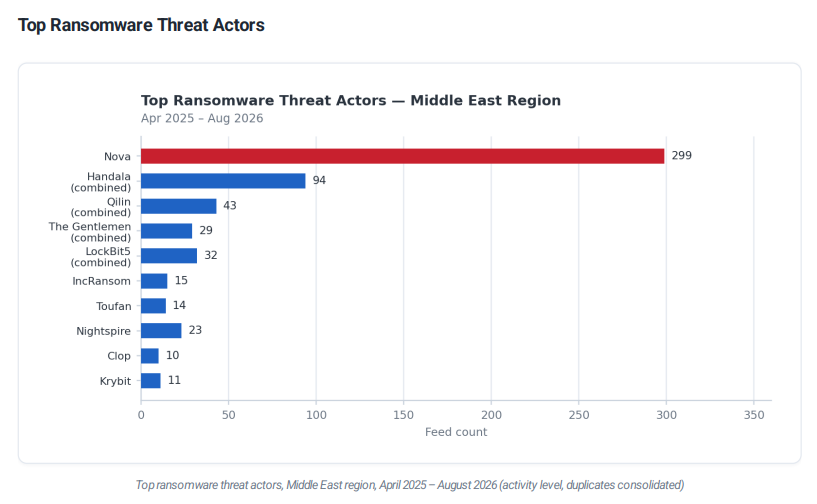
Moreover, the convergence of criminal and state-sponsored activity creates a complex attribution problem. When a ransomware group like Nova or Qilin attacks a government agency, it is often unclear whether the motive is purely financial or if the group is being utilized as a proxy for state-level interests. This ambiguity complicates international cooperation and legal response efforts, as traditional diplomatic channels are often ill-equipped to deal with decentralized, non-state actors operating from the dark web.
Looking Toward 2027: A Proactive Defense
As the region moves toward the end of 2026 and into 2027, the emphasis must remain on proactivity. The era of reactive security, where an organization waits for an alert before taking action, has passed. Proactive threat hunting, the use of AI to defend against AI, and the fostering of regional intelligence-sharing partnerships will be the defining factors of success.
The message for enterprises and government agencies is clear: the threat environment is not a temporary anomaly, but a permanent feature of the modern digital economy. Organizations that fail to integrate security into their core operations risk not only financial loss but also the erosion of public trust and the compromise of national security. As the Middle East continues to innovate, its ability to secure its digital foundations will ultimately determine its capacity to thrive in a global market that is increasingly defined by the security of information.
Summary of Key Findings
- Ransomware Surge: The most common form of attack, with a twenty-fold increase in activity signals recorded between early 2025 and mid-2026.
- Targeted Sectors: Facility management, industrial systems, and infrastructure are the most frequently targeted, signaling a focus on critical, high-impact systems.
- Leading Actors: Groups such as Nova, Handala, and Qilin continue to dominate the extortion landscape, often utilizing botnets and phishing as primary delivery mechanisms.
- Technological Shift: The adoption of AI by criminal groups has drastically reduced the time-to-exploit, making rapid, automated defense mechanisms mandatory.
- Strategic Imperative: Cyber-resilience is now an economic necessity, requiring a shift toward offline backups, constant threat monitoring, and robust identity management.
While the challenges are significant, the region’s commitment to building advanced, AI-driven defense models shows a recognition of the stakes. By fostering a culture of security and investing in both the technology and the talent required to manage it, the Middle East is positioning itself to withstand the next generation of digital conflict. The path forward is not to shun innovation, but to build it upon a foundation of absolute vigilance.