
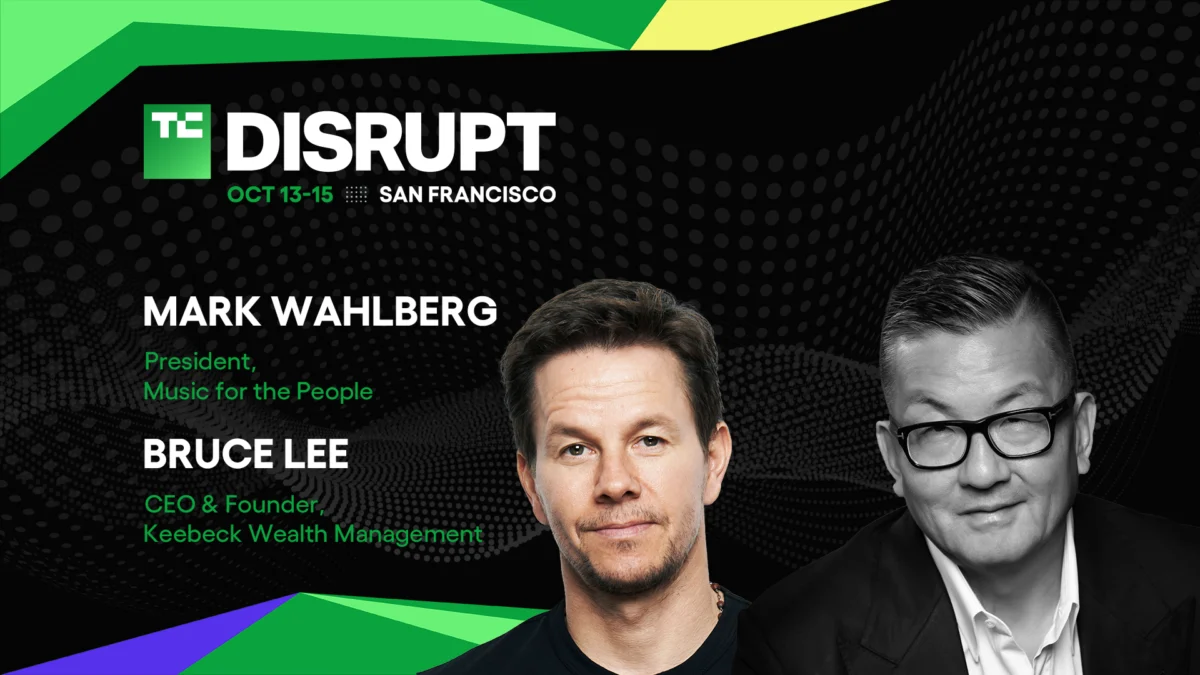
Mark Wahlberg is widely recognized for a cinematic career that has spanned nearly three decades, transitioning from a breakout performance in 1997’s Boogie Nights to a powerhouse producer and actor. However, the entertainment industry is no longer the sole focus of his professional life. As the landscape of celebrity investment continues to shift, Wahlberg has carved out a secondary identity as a calculated entrepreneur and investor. This evolution will take center stage at TechCrunch Disrupt 2026, where Wahlberg will join Bruce K. Lee, founder and CEO of Keebeck Wealth Management, for a keynote session exploring the intersection of cultural influence and institutional financial discipline.
The event, scheduled for October 13-15 at San Francisco’s Moscone West, serves as a high-profile platform for this discussion. For those looking to attend, ticket prices are set to increase after 11:59 p.m. PT tonight, marking a critical deadline for prospective attendees of the conference.
From Screen to Strategy: A Dual Career Path
Wahlberg’s trajectory reflects a broader trend among high-net-worth individuals in the entertainment sector who are increasingly leveraging their brand equity to gain access to private equity, venture capital, and operational management. His portfolio is notably diverse, encompassing the Mark Wahlberg Youth Foundation—established 25 years ago to aid inner-city youth—as well as restaurant chains, apparel lines, and fitness ventures.
While many celebrities enter the business world as passive brand ambassadors, Wahlberg has moved toward a more hands-on operational approach. By partnering with figures like Bruce K. Lee, he is signaling a shift toward institutional-level rigor. The conversation at Disrupt 2026 is expected to dissect how Wahlberg has transitioned from relying on gut instinct to employing data-driven, sophisticated financial strategies, particularly in the competitive sectors of healthcare and wellness technology.

The Professional Evolution: A Chronological Perspective
The arc of Wahlberg’s business career can be segmented into three distinct phases. The initial phase, spanning the late 1990s through the mid-2000s, was characterized by his establishment as a bankable Hollywood star. During this period, he founded his production company, which became instrumental in hits like HBO’s Entourage, a show that provided a meta-commentary on the business of Hollywood.
The second phase involved diversification. Between 2010 and 2020, Wahlberg moved beyond intellectual property development into consumer goods. This era saw the launch of fitness brands and food concepts, which demonstrated an ability to scale physical products. This period also required him to navigate the complex world of supply chain management and retail strategy, often in collaboration with institutional partners who provided the necessary infrastructure to scale these ideas globally.
The current, third phase of his career—which will be the primary focus of his talk with Lee—is defined by formalization. By engaging with Keebeck Wealth Management, Wahlberg has entered the realm of high-level wealth advisory and venture capital, where the focus is on long-term asset allocation and the evaluation of early-stage technologies. This represents a maturation from being an "entrepreneurial talent" to becoming an "investor of substance."
Industry Context and the Rise of Celebrity Capital
The involvement of major entertainers in the tech ecosystem is not a new phenomenon, but the nature of that participation has changed significantly. Data from various venture capital tracking firms suggests that the "celebrity VC" asset class has seen an uptick in deal flow, with athletes and entertainers contributing to significant funding rounds in sectors ranging from AI to sustainable energy.
However, industry analysts often point to the "survivorship bias" inherent in this trend. For every successful celebrity-backed venture, there are numerous failures caused by a lack of institutional oversight. This is where the partnership between Wahlberg and Lee becomes illustrative. By bringing a wealth management CEO onto the main stage at a premier tech conference, the organizers are highlighting the importance of professional guidance. The discussion will likely address the common pitfalls that high-profile individuals encounter, such as over-leveraging personal brand equity or failing to conduct adequate due diligence on underlying startup technologies.

The Mechanics of Access and Deal Flow
A central theme of the upcoming session is how "cultural intelligence" translates into "deal flow." In the venture capital world, access is often the most significant barrier to entry. Top-tier startups are frequently oversubscribed, and access is reserved for investors who bring more than just capital to the table. Wahlberg’s career, which has involved managing large-scale productions and high-stakes partnerships, has provided him with a network and a level of trust that few traditional venture capitalists possess.
The conversation with Bruce K. Lee will likely explore how to effectively monetize this trust. It is expected that they will discuss the "unlearning" process—the shift from a Hollywood mindset, where speed and hype are often prioritized, to a venture mindset, where risk mitigation and long-term viability are the standard.
Broader Implications for the Tech Ecosystem
TechCrunch Disrupt remains one of the premier venues for the global startup community. By hosting this session, the event organizers are underscoring the convergence of media, finance, and technology. As traditional funding sources tighten, the role of alternative capital—including high-net-worth individuals who act as strategic partners—is becoming increasingly vital for early-stage companies.
The presence of 10,000+ tech leaders at Moscone West signals that this is not merely a celebrity appearance but a substantive engagement with the mechanics of modern business. For founders in attendance, the insights shared by Wahlberg and Lee regarding mentorship, the identification of market gaps, and the navigation of a volatile economic landscape will be highly relevant.
Conclusion: Why This Matters
The shift from the silver screen to the boardroom is a complex transition that requires a departure from the creative chaos of film production toward the systematic discipline of finance. For Mark Wahlberg, this transition is currently in full swing. By focusing his attention on the healthcare and wellness sectors, he is placing bets on industries that require long-term vision and significant regulatory navigation.

The dialogue at Disrupt 2026 offers a rare, behind-the-curtain look at the strategies employed by those who have successfully bridged the gap between celebrity and corporate leadership. Whether one is an aspiring entrepreneur or a seasoned investor, the lessons in scaling, mentorship, and financial discipline are expected to be the defining features of this keynote.
Prospective attendees are encouraged to review the full agenda on the official conference website. With the event approaching and ticket prices shifting, the window to secure a spot for what is likely to be a high-demand session is closing. The combination of industry expertise and practical, real-world business application makes this conversation a highlight for those looking to understand the next generation of investment and innovation. As the tech landscape continues to evolve, the ability to synthesize disparate professional experiences—much like Wahlberg is doing—may become the hallmark of the most successful investors in the coming decade.

