
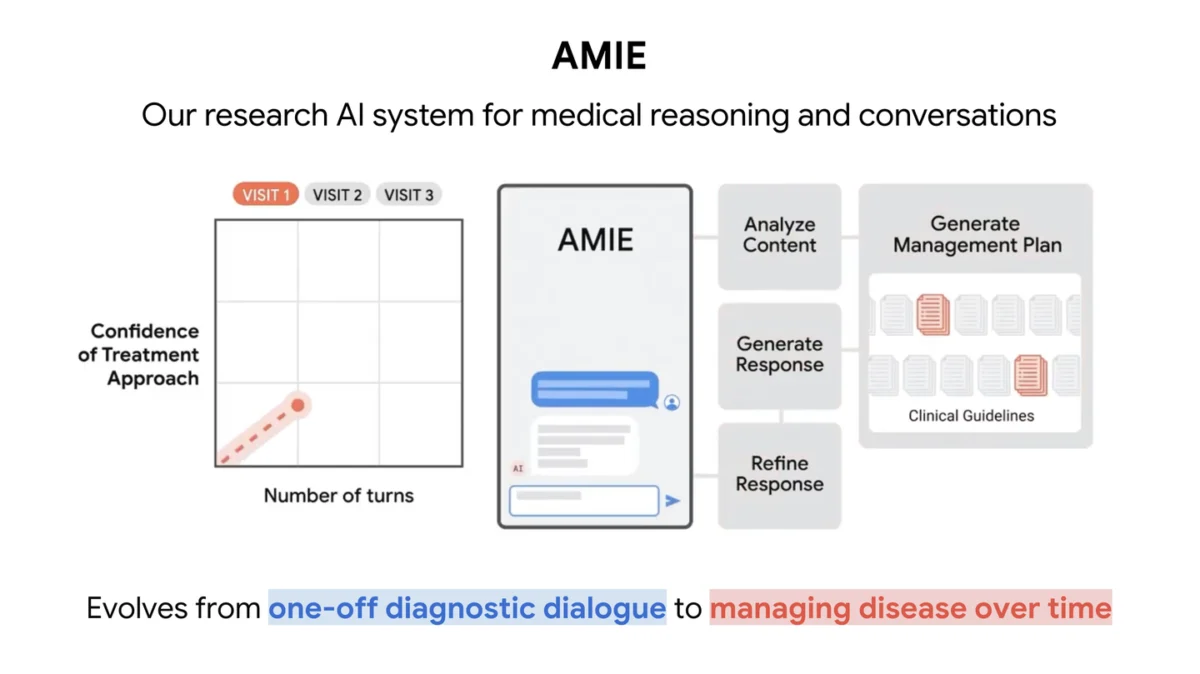
The landscape of modern healthcare is increasingly defined by the management of chronic conditions, a task that requires clinicians to synthesize vast amounts of historical data, evolving clinical guidelines, and real-time patient feedback. While initial diagnosis remains a critical milestone, the long-term oversight of health—tracking symptom progression across multiple years, adjusting medications, and adhering to complex protocols—presents a significant cognitive burden on medical professionals. Research published today in the journal Nature reveals a significant advancement in this field through the Articulate Medical Intelligence Explorer (AMIE), a research-grade AI system developed by Google. The study demonstrates that AMIE has evolved beyond one-off diagnostic interactions to handle the complexities of longitudinal disease management, matching or exceeding the performance of primary care physicians in several key metrics of reasoning and guideline adherence.
The transition from acute diagnostic AI to longitudinal management AI marks a pivotal shift in medical technology. For years, medical AI was primarily evaluated on its ability to identify a condition from a single set of symptoms. However, real-world medicine is rarely a singular event; it is a continuous process of observation and adjustment. The Nature study highlights how AMIE utilizes the long-context capabilities of Google’s Gemini models to maintain a "memory" of a patient’s medical journey, allowing it to parse hundreds of pages of clinical knowledge while simultaneously engaging in empathetic dialogue with the patient. This dual-capability approach—combining rigorous logic with human-centric communication—is designed to support a healthcare system currently strained by administrative overhead and physician burnout.
The Evolution from Diagnosis to Longitudinal Care
The primary challenge in managing chronic disease lies in the continuity of care. A typical patient with a condition such as hypertension or diabetes may see several different specialists over a decade, resulting in a fragmented medical record that is difficult for any single physician to review in the limited time allotted for a standard appointment. Furthermore, clinical guidelines are not static; they are frequently updated as new pharmacological data becomes available. A physician must not only remember the patient’s history but also cross-reference it against the most current medical literature.
AMIE was specifically engineered to address these hurdles. By leveraging large language models (LLMs) with expanded context windows, the system can process an entire patient history in a single session. This allows the AI to identify subtle trends in symptom reporting or lab results that might be overlooked during a brief human consultation. The research published in Nature indicates that this transition from "snapshot" medicine to "longitudinal" medicine is not only feasible but potentially more accurate in terms of guideline alignment than traditional methods.
Methodology of the Nature Study: Humans vs. Machines
To rigorously test AMIE’s capabilities, researchers conducted a blinded study involving "standardized patients"—professional actors trained to portray individuals with specific medical conditions. These actors interacted with both AMIE and a group of 21 primary care physicians. To ensure an unbiased evaluation, the interactions were transcribed and anonymized. A panel of specialist physicians then reviewed the consultations without knowing whether the responses were generated by a human doctor or the AI system.
The study focused on three primary domains: diagnostic reasoning, management reasoning, and communication quality. Management reasoning is particularly complex, as it involves deciding on the next steps of treatment, such as ordering specific tests, adjusting drug dosages, or scheduling follow-up appointments based on the patient’s response to previous interventions. The specialist reviewers used a standardized rubric to score the participants on the preciseness of their plans and their adherence to established clinical guidelines.
Analyzing the Results: Precision and Guideline Alignment
The results of the Nature study suggest a significant parity between the AI and human clinicians, with the AI showing a distinct advantage in specific technical areas. In the category of overall management reasoning, AMIE matched the performance of the 21 primary care doctors. However, the AI scored significantly higher in two critical areas: plan preciseness and guideline alignment.
Plan preciseness refers to the specificity and clarity of the recommended medical actions. While human doctors, often under time pressure, might provide generalized advice, AMIE generated detailed, step-by-step management plans that left little room for ambiguity. Perhaps more importantly, the AI demonstrated superior alignment with clinical guidelines. In a clinical environment where medical knowledge doubles every few months, keeping up with every updated protocol is a Herculean task for humans. AMIE, by contrast, can be programmed with the latest drug formularies and authoritative clinical knowledge, ensuring that its recommendations are always based on the most current evidence-based medicine.
Furthermore, the study measured the "empathy" of the interactions. Historically, AI has been viewed as cold or robotic, but the "empathetic dialogue agent" within AMIE was rated highly by the patient actors. This suggests that the AI can maintain a supportive tone while processing complex medical data, a combination that is essential for patient compliance in long-term disease management.
The Technological Backbone: Gemini and Long-Context Reasoning
The success of AMIE is largely attributed to the underlying architecture of Google’s Gemini models. Unlike earlier iterations of medical AI that could only process a few thousand words at a time, Gemini’s long-context capabilities allow the system to "read" and "remember" vast amounts of information. This is critical for medical reasoning, where a single lab result from three years ago might be the key to understanding a patient’s current resistance to a medication.
AMIE functions through a bifurcated system. The first component is the empathetic dialogue agent, which is optimized for real-time conversation. It focuses on gathering information from the patient in a way that feels natural and supportive. The second component is the deep-thinking management reasoning agent. This agent operates in the background, cross-referencing the patient’s input against a massive database of clinical guidelines and pharmacological data. By separating the "social" and "analytical" tasks, the system can provide a human-like interaction without sacrificing scientific rigor.
Addressing the Global Healthcare Crisis and Physician Burnout
The implications of this research extend far beyond the laboratory. The global healthcare system is currently facing a crisis of scale. According to the World Health Organization, there is a projected shortage of 10 million health workers by 2030. In the United States, physician burnout has reached record levels, with many doctors citing administrative tasks and the struggle to keep up with clinical documentation as primary stressors.
If an AI system like AMIE can handle the "heavy lifting" of data synthesis and guideline adherence, it could fundamentally change the day-to-day life of a physician. Instead of spending 20 minutes of a 30-minute appointment reviewing old records and checking drug interactions, a doctor could use that time to focus on the physical examination and the nuances of the patient-doctor relationship. The AI acts not as a replacement, but as a high-level clinical assistant that ensures no detail is missed and every protocol is followed.
Chronology of Google’s Medical AI Development
The journey to AMIE has been a multi-year effort within Google Research and Google Health. The timeline of this development reflects the rapid acceleration of AI capabilities in the medical domain:
- 2022: Med-PaLM: Google introduced Med-PaLM, the first large language model to pass the U.S. Medical Licensing Exam (USMLE) style questions. While impressive, it was primarily a knowledge-retrieval system rather than a conversational tool.
- Early 2023: Med-PaLM 2: This iteration improved upon the original by providing more nuanced answers and demonstrating a better understanding of medical ethics and safety.
- Late 2023: The Introduction of AMIE: Researchers shifted focus toward "Articulate" intelligence, prioritizing the ability of the AI to conduct a diagnostic interview.
- 2024: Longitudinal Expansion: The current research published in Nature marks the expansion of AMIE into disease management, moving beyond the initial diagnosis into the "what happens next" phase of care.
- Present and Future: Google has launched a nationwide randomized study to assess the efficacy of AI in real-world virtual care settings, marking the transition from simulated actors to actual clinical environments.
Safety, Ethics, and the Road to Clinical Implementation
Despite the promising results, the researchers and the broader medical community emphasize that AI is not yet ready for autonomous clinical practice. The Nature study was conducted in a controlled, blinded environment with actors, not in a chaotic emergency room or a real-world clinic where patients might have multiple, conflicting comorbidities.
Safety remains the paramount concern. AI models are known to occasionally "hallucinate" or provide incorrect information with high confidence. To mitigate this, AMIE’s reasoning agent is designed to cite its sources from authoritative clinical knowledge. Furthermore, the "human-in-the-loop" model remains the gold standard. In this framework, the AI provides recommendations, but a licensed physician makes the final decision.
Ethical considerations also include data privacy and bias. Ensuring that the AI performs equally well across different demographics—regardless of race, gender, or socioeconomic status—is a major focus of ongoing research. The nationwide study currently underway aims to collect diverse data to ensure that the AI’s reasoning is equitable and applicable to the broad spectrum of the human population.
Broader Impact and the Future of Virtual Care
The successful deployment of a system like AMIE could democratize access to high-quality medical expertise. In rural areas or developing nations where specialists are scarce, an AI that has "memorized" the latest global clinical guidelines could provide a baseline of care that was previously unavailable.
In the realm of virtual care, which saw an explosion in use during the COVID-19 pandemic, AMIE could serve as a triage and management tool. By conducting the initial longitudinal review and symptom tracking, the AI can prepare a comprehensive briefing for the physician before the virtual visit even begins. This ensures that the limited time spent between patient and doctor is as productive as possible.
The publication of this research in Nature serves as a formal validation of the potential for AI to move into the more complex, nuanced areas of medical practice. While the transition from a research system to a bedside tool will require years of further testing, regulatory approval, and integration into existing electronic health records, the data suggests that the path toward AI-augmented longitudinal care is now clearly defined.
As Google continues its exploration into clinical settings and virtual care studies, the focus will remain on how these tools can reduce the cognitive load on healthcare providers while improving the precision of patient care. The ultimate goal, as suggested by the AMIE researchers, is a future where technology handles the complexity of data management, giving physicians the freedom to return to the heart of medicine: the human connection.

