
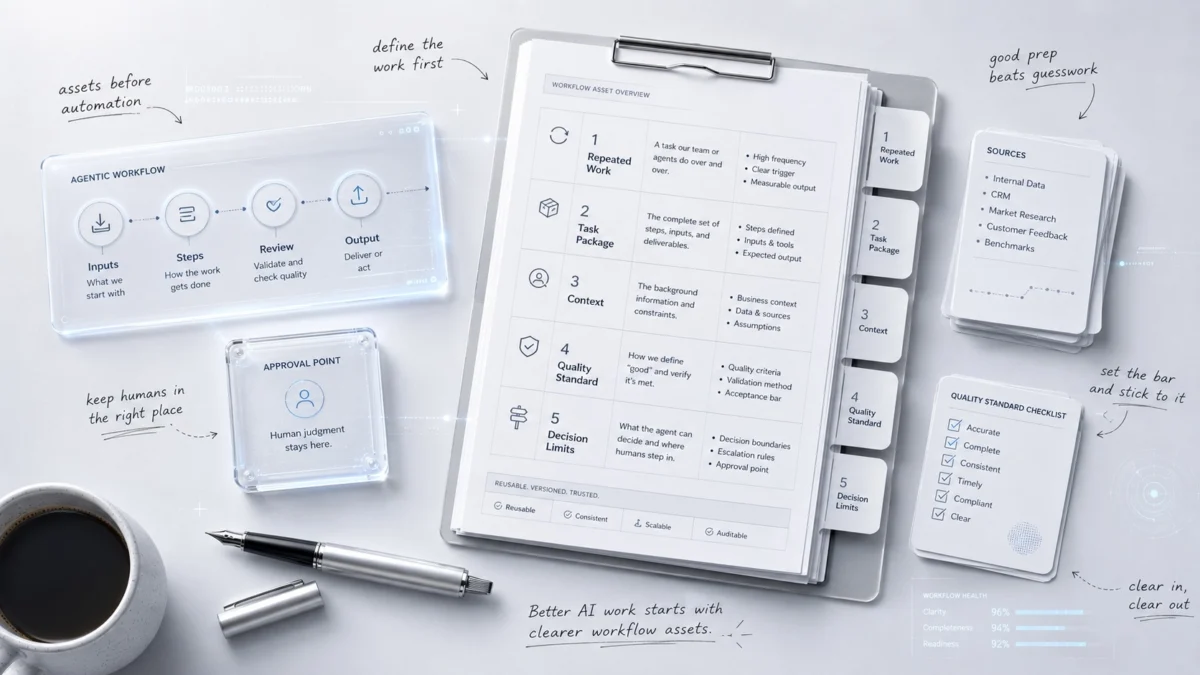
The rapid integration of artificial intelligence into the corporate environment has reached a critical inflection point, shifting from a period of experimental novelty to a demand for operational reliability. As organizations move beyond individual productivity tools and isolated pilot programs, a fundamental challenge has emerged: the gap between advanced AI capabilities and the lack of clearly defined business workflows. Industry experts and operational strategists now argue that the prerequisite for scaling AI is not the acquisition of more powerful models, but the rigorous redesign of the work itself. This transformation requires the creation of five specific reusable assets—Repeated Work, Task, Context, Acceptance Test, and Permission—to ensure that AI agents function as reliable components of a professional product lifecycle rather than mere conversational novelties.
The current landscape of enterprise AI is characterized by a "productivity paradox" where access to high-level Large Language Models (LLMs) does not automatically translate into organizational efficiency. This discrepancy often stems from the reliance on "chat-based" interactions, which begin with vague requests such as "analyze this" or "summarize these files." In contrast, an operationalized workflow requires a well-defined job description that outlines specific outcomes, authoritative sources, and clear boundaries for autonomous decision-making. Without these definitions, even the most sophisticated models are forced to make assumptions that can lead to confident but incorrect outputs, creating significant risks in high-stakes business environments.

The Evolution of AI Integration: A Chronology of Implementation
The journey toward AI-enabled operations has followed a distinct timeline over the last several years, reflecting the maturation of the technology and the organizational response to it.
- Phase 1: The Exploration Era (Late 2022 – Mid 2023): Following the public release of ChatGPT, organizations focused on individual exploration. Use cases were largely ad-hoc, centered on drafting emails or generating basic code snippets. The emphasis was on "prompt engineering" as a primary skill.
- Phase 2: The Pilot Purgatory (Late 2023 – Early 2024): Companies began launching departmental pilots. However, many struggled to move these projects into production due to inconsistencies in AI performance and a lack of integration with existing business processes.
- Phase 3: The Workflow Redesign Era (Mid 2024 – Present): Current industry leaders have recognized that prompts are ephemeral and model-dependent. The focus has shifted toward building "agentic workflows"—reusable frameworks that treat AI as a functional team member with specific responsibilities and constraints.
This chronological shift highlights a growing realization among Chief Information Officers (CIOs) and Chief Technology Officers (CTOs): the value of AI lies not in the tool itself, but in the institutional knowledge packaged for the tool to execute.
Strategic Assets for AI Enablement
To move from experimentation to value, organizations are encouraged to develop five core assets that document and standardize how AI interacts with business logic.

1. The Repeated Work Asset: Identifying High-Value Targets
The first step in operationalizing AI is the creation of a comprehensive inventory of recurring tasks. Not all work is suitable for AI intervention; the most effective candidates are those that occur regularly, follow consistent steps, and consume significant human bandwidth. By documenting tasks such as weekly reports, contract reviews, and quarterly planning, teams can prioritize automation based on frequency, effort, and risk. A standardized "Workflow Organization Assistant" framework allows teams to classify tasks as better suited for one-time conversations, reusable agentic workflows, or strictly human-led processes.
2. The Task Asset: Eliminating Hidden Assumptions
A common failure point in AI deployment is the "vague request" trap. When an AI is asked to "prepare a presentation," it must infer the audience, the tone, the source priority, and the quality threshold. The Task Asset serves as a structured assignment package. It defines the objective, business purpose, authoritative sources, execution steps, and acceptance criteria. By removing these hidden assumptions, organizations ensure that the AI’s output aligns with strategic goals from the outset.
3. The Context Asset: Providing the Business Lens
AI models lack the inherent "tribal knowledge" of an organization. The Context Asset is a living document that provides the AI with essential background information: who the user is, current project objectives, preferred communication styles, and critical business rules. This asset prevents the need for repetitive explanations in every interaction and ensures that the AI understands the difference between stable information and data that may expire or require verification. Crucially, it acts as a filter, informing the AI about what it must never say or share, thereby maintaining brand and policy alignment.

4. The Acceptance Test Asset: Defining the Standard of Excellence
Quality assurance is perhaps the most neglected aspect of AI implementation. The Acceptance Test Asset requires teams to define what failure looks like before an AI agent is deployed. This involves providing the AI with examples of previously accepted and rejected work. By establishing a set of test cases—including normal cases, edge cases, and missing-information scenarios—organizations can create a measurable quality standard. This systematic approach allows for the detection of "hallucinations" or fabrication and identifies exactly when a task must be escalated to a human for judgment.
5. The Permission Asset: Establishing Governance and Boundaries
As AI agents gain more autonomy, the need for a clear permission policy becomes paramount. The Permission Asset categorizes activities into three tiers: actions the AI can perform directly, actions that require a human draft-and-approve cycle, and actions that are strictly prohibited. This is particularly vital for irreversible actions such as deleting files, modifying production systems, or making financial commitments. A robust permission asset ensures that there is always a clear record of accountability and that the "human-in-the-loop" remains the final authority for high-risk decisions.
Market Data and the Economic Imperative for Redesign
Supporting data suggests that the push for workflow redesign is driven by economic necessity. According to recent industry surveys, while 70% of executives believe AI will significantly change their business, only about 15% have successfully scaled AI beyond initial testing. A major factor cited for this gap is the lack of "process readiness."

Furthermore, the "cost of error" in AI implementation is rising. As models become more advanced, their errors become more subtle and harder for non-experts to detect. Research indicates that organizations that invest in "AI Governance" and "Process Standardization" early in their adoption cycle see a 30% higher return on investment compared to those that focus solely on tool acquisition. This data underscores the fact that the most valuable asset in the AI era is not the model, but the structured data and process definitions that the model acts upon.
Industry Reactions and Professional Implications
The shift toward structured AI assets has drawn reactions from both the tech sector and corporate leadership. Many CIOs have expressed that the era of "unfettered AI experimentation" is closing, replaced by a focus on "Responsible AI" and "Operational Excellence."
"The goal is no longer just to ‘use AI,’ but to integrate it so seamlessly that it becomes a predictable part of our production chain," noted one industry analyst specializing in digital transformation. "This requires a level of documentation and process discipline that many modern offices have let slide. In a way, AI is forcing us to be better managers by requiring us to define exactly what ‘good work’ looks like."

For the workforce, these developments signal a change in the required skill set. The ability to document logic, define quality standards, and manage complex permissions is becoming as important as the ability to interact with the software itself. This represents a professionalization of the "AI user" role, moving it toward a role more akin to a "Workflow Architect."
Broader Impact: From Experimentation to Business Value
The long-term implication of this workflow-centric approach is the stabilization of AI within the enterprise. By decoupling the business logic (the five assets) from the specific AI model being used, organizations create a "future-proof" infrastructure. As new models or platforms emerge, the core assets—the context, the tasks, and the acceptance tests—remain valid and can be transferred to the new technology.
This methodology transforms AI transformation from a series of disjointed experiments into a sustainable business strategy. When an AI is given the scene, the materials, and the standards, it can move from "guessing" what a user wants to "executing" what the business needs. The transition from chat-based prompts to asset-based workflows marks the true beginning of the AI-integrated economy, where the value is found not in the novelty of the technology, but in the reliability of the results.

In conclusion, the path to AI maturity does not lead through more complex prompts, but through more rigorous business definitions. Organizations that take the time to document their recurring work, define their tasks, curate their context, establish acceptance tests, and set clear permissions will be the ones to realize the true promise of the agentic era. The era of asking AI to "help me" is ending; the era of commanding AI to "execute this process" has begun.

