
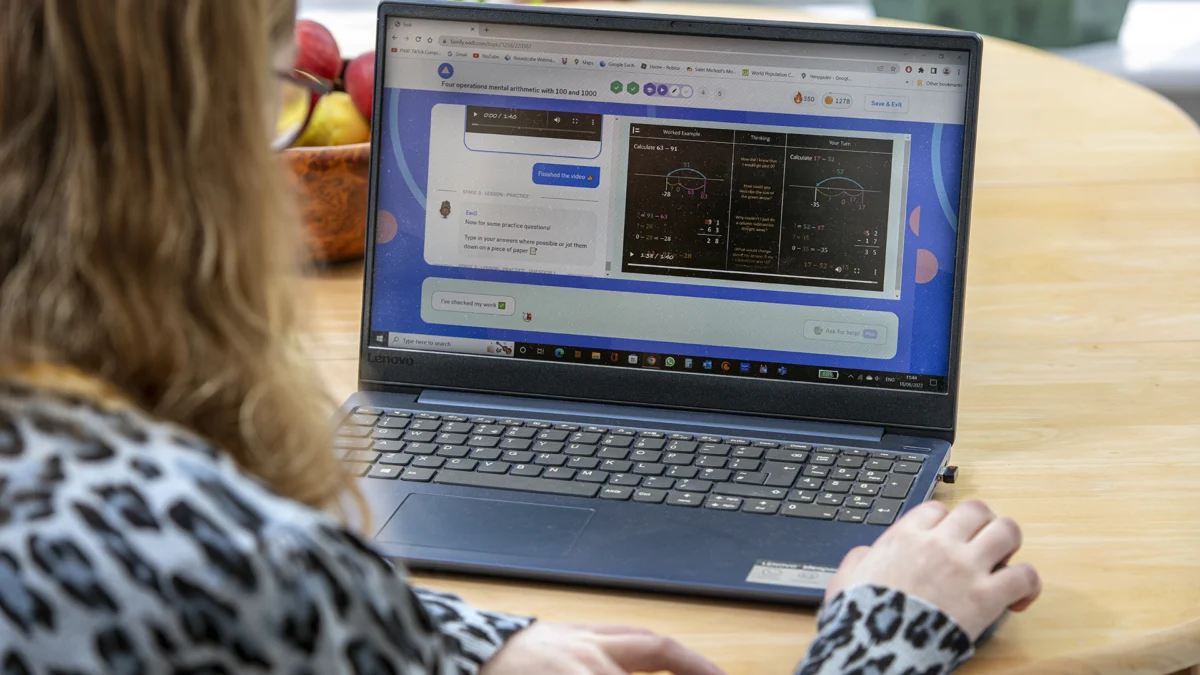
For fourteen-year-old Eithne, a student in Chorley, United Kingdom, the return to academic normalcy following the COVID-19 pandemic presented a daunting challenge. Like millions of her peers globally, Eithne faced significant gaps in her mathematical foundation after more than a year of disrupted schooling. The transition from Year 7 to Year 8, critical years for establishing algebraic and geometric principles, had been compromised by the limitations of remote learning and the lack of consistent classroom interaction. In June 2021, her parents, Arianna and her husband, sought a solution through Eedi, an online math tutoring service that has integrated cutting-edge artificial intelligence to diagnose and rectify student misconceptions.
The struggle Eithne faced is representative of a broader global phenomenon known as "learning loss." According to reports from the World Bank and UNESCO, the pandemic caused the largest disruption to education systems in history, affecting nearly 1.6 billion learners in more than 190 countries. In the United Kingdom, Department for Education data suggested that by the end of the 2020/21 academic year, secondary school students were, on average, several months behind in mathematics compared to pre-pandemic cohorts. For students like Eithne, the primary hurdle was not a lack of effort, but rather a series of "missing links" in her knowledge base—fundamental concepts that were glossed over or missed entirely during lockdowns.
The Diagnostic Power of the Next-Best-Question Model
The core of Eedi’s effectiveness lies in its initial assessment tool: a dynamic quiz comprising ten multiple-choice diagnostic questions. Unlike traditional standardized tests that merely provide a score, this quiz is designed to identify exactly where and why a student is struggling. This technology is powered by machine learning algorithms developed by researchers at the Microsoft Research Lab in Cambridge, UK, who specialize in decision-making AI.
Cheng Zhang, a Microsoft principal researcher who led the development of the machine learning model, describes the process as a digital version of a one-on-one teacher-student dialogue. The AI utilizes a "next-best-question" model, which evaluates each of the student’s answers in real-time. If a student answers a question incorrectly, the AI does not simply move to the next topic; instead, it calculates the probability of the student’s success on thousands of other potential questions. It then selects the most informative next question to pinpoint the specific misconception.
For example, if a student fails to solve a multiplication problem involving the number seven, the AI might backtrack to check if the student understands basic addition or simpler multiplication tables. This adaptive approach ensures that the assessment is neither too easy—which would provide little data—nor too difficult, which might discourage the learner. By the end of the ten questions, the system generates a comprehensive map of the student’s "growth topics" and "comfort topics," allowing for a highly personalized learning pathway.
From the Classroom to the Cloud: The Philosophy of Diagnostic Questions
The pedagogical foundation of Eedi is rooted in the work of Craig Barton, a math teacher, author, and co-founder of Eedi. Barton’s journey into EdTech began in the classroom, where he realized that traditional teaching methods often left teachers playing "detective" to figure out why a student was failing. In a class of 30 students, this individualized investigation is often an impossible task for a single educator.
Barton discovered the power of diagnostic questions through formative assessment training. A well-constructed diagnostic question features one correct answer and three incorrect answers, each of which is carefully designed to reveal a specific misconception. "Maths lends itself quite well to this kind of multiple-choice assessment because more often than not there’s a right answer and these wrong answers; it’s much less subjective than some of the humanities subjects," Barton explained.
To be effective, a diagnostic question must meet five strict criteria:
- It must be clear and unambiguous.
- It must check for only one concept at a time.
- It must be answerable in under 20 seconds.
- Each incorrect answer must be linked to a specific, known misconception.
- A student must be unable to arrive at the correct answer while still harboring the key misconception.
For instance, when testing a student’s understanding of "multiples," a poorly designed question might allow a student who confuses "factors" with "multiples" to still select the correct answer by chance. Eedi’s questions are vetted to ensure that the "wrong" answers are as valuable as the "right" ones for data collection. When a student chooses an incorrect option, the system knows immediately whether the student is confused about the definition of a term, a calculation step, or a broader conceptual framework.
The Healthcare Connection: Project Azua and Decision-Making AI
The collaboration between Eedi and Microsoft Research represents a unique cross-disciplinary application of technology. Before the algorithm was applied to mathematics, Microsoft researchers were utilizing it in healthcare settings under "Project Azua." The goal was to help doctors make more efficient decisions regarding patient diagnostics.
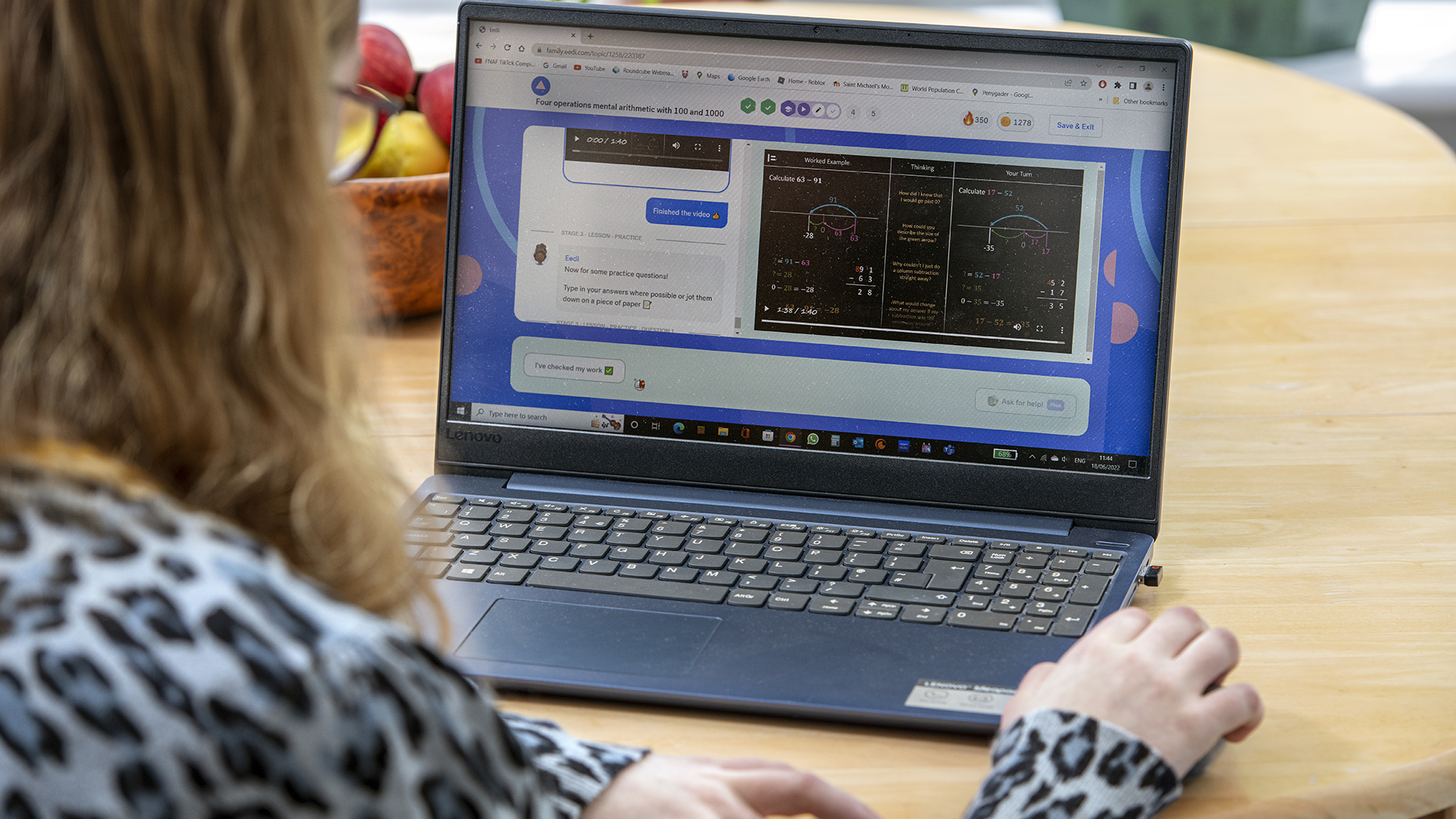
In an emergency room setting, a doctor must decide which tests to order based on a patient’s symptoms. If a patient presents with a broken arm, asking if they have a sore throat is an inefficient use of resources. The AI was trained to automate this information-gathering process, identifying which "test" (or question) would provide the most diagnostic value for the specific patient.
When Eedi’s chief data scientist, Simon Woodhead, was introduced to Zhang’s team, the parallels were immediate. Just as a doctor uses symptoms to diagnose an ailment, a tutor uses answers to diagnose a misconception. By training the Microsoft model on Eedi’s massive dataset of diagnostic questions, the team was able to create a system that could predict student misconceptions even before they occurred. Crucially, the system operates on patterns of logic rather than personal data, ensuring student privacy. It requires no names or email addresses to function, only the data points of the answers provided.
Quantitative Success and the Path to Confidence
The impact of this technology is measurable. Eedi’s internal data indicates that the platform resolves approximately 95% of identified student misconceptions. For Eithne, the results were transformative. After being placed on a learning pathway that reviewed Year 8 topics and introduced Year 9 geometry, she entered the new school year with a level of confidence she had previously lacked.
"I was like, ‘I can do this,’" Eithne recalled. "I can actually explain to the people around me how to do the problems." This shift from struggling student to peer mentor is a hallmark of successful intervention. By addressing the "why" behind the errors, the platform removes the frustration associated with repetitive failure.
Beyond the academic metrics, the platform addresses the psychological barriers to learning math. Mathematics anxiety is a well-documented phenomenon that can hinder a student’s performance regardless of their actual ability. By breaking down complex problems into manageable diagnostic steps and providing a clear pathway forward, Eedi helps mitigate this anxiety. The platform also includes a rewards system to incentivize consistent practice, turning what could be a chore into an engaging, gamified experience.
Broader Implications and the Future of Causal Machine Learning
The success of the Eedi-Microsoft partnership has paved the way for even more sophisticated educational tools. The teams are currently working on a next-generation model based on "deep end-to-end causal inference." While current AI is excellent at identifying correlations (e.g., "Students who struggle with X often struggle with Y"), causal machine learning seeks to understand cause and effect.
In education, this means the AI could determine the optimal order of topics for an individual student. While the standard curriculum might dictate that Topic A must always precede Topic B, causal AI might discover that for a specific type of learner, reversing that order—or introducing a third Topic C—leads to better long-term retention.
"Every student learns differently," Zhang noted. "Maybe for one student the order should be switched, and for another student we need to revisit some other topic." This move toward true personalization represents the "holy grail" of educational technology: a digital tutor that understands a student’s unique cognitive process as well as a human teacher, but with the ability to scale to millions of users.
As the global education sector continues to grapple with the long-term effects of the pandemic, the integration of AI in the classroom—and the home—offers a scalable solution to the tutoring gap. High-quality, one-on-one human tutoring is prohibitively expensive for many families. AI-driven platforms like Eedi provide a middle ground, offering the benefits of personalized diagnostic attention at a fraction of the cost.
For parents like Arianna, the value is clear. "It’s a great idea that there might be personalized learning pathways or lessons for students," she said. "Not all students learn at the same pace or in the same way." As these technologies evolve, the goal remains the same: to ensure that no student is left behind due to a misunderstanding that could have been solved with the right question at the right time. The partnership between Microsoft and Eedi stands as a testament to how advanced research in machine learning can be harnessed to solve one of society’s most pressing challenges: the equitable education of the next generation.

