
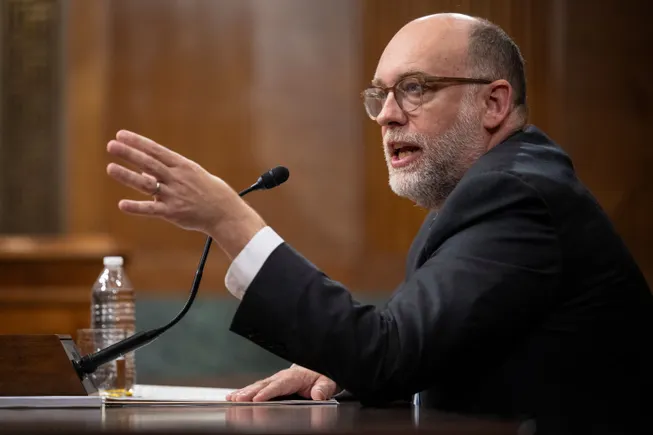
Mick Mulvaney’s tenure as acting director of the Consumer Financial Protection Bureau (CFPB) has been marked by significant efforts to reshape the agency’s mission and operations, drawing both praise from Republicans and sharp criticism from Democrats. Vought, who also serves as the director of the Office of Management and Budget, has spearheaded a drive to fundamentally alter the CFPB’s trajectory, signaling intentions to "shutter the bureau" within a few months of his appointment in February 2025. His appearances before congressional committees this week have provided a platform for him to articulate his vision and defend his actions against a backdrop of mounting political and economic debate over the agency’s role and effectiveness.
A Shift in Direction: Vought’s Rationale for CFPB Restructuring
During his testimony before the House Financial Services Committee on Wednesday, Vought asserted that upon assuming leadership of the CFPB in February 2025, he encountered an agency he characterized as "weaponized, out of control, and had gone far beyond its statutory mandate." He argued that under previous administrations, the CFPB had imposed "huge costs on the American people and stifled the innovation and resourcefulness that is necessary for a strong economy." In contrast, Vought stated, his administration has "steered the bureau toward operating with humility, accountability and fiscal responsibility."
This approach has manifested in several concrete actions. The agency, under Vought’s direction, has initiated efforts to reduce its workforce, reportedly attempting to lay off hundreds of employees. Furthermore, a significant volume of previous guidance documents has been rescinded, and numerous enforcement actions and lawsuits have been dropped. In an effort to reorient the agency’s historical narrative, the CFPB has also purged its public records, deleting press releases, speeches, and other materials that predate the Trump administration’s second term. As of Thursday, Vought reported that the CFPB’s current employee count stands at 1,071.
Vought elaborated on the strategic shift in enforcement philosophy, telling senators on Thursday that the CFPB has focused on canceling enforcement actions based on what he termed "novel legal theories that we didn’t have the statute to do." Instead, the agency’s priority has been on "identifiable victims, actual consumer harm that’s material and measurable." This signifies a move away from what Vought perceives as overly aggressive or expansive interpretations of the CFPB’s authority. He also indicated a greater reliance on state regulators and other federal agencies, stating, "we will fill in the gaps" where other bodies are already taking the lead.
A Contested Legacy: Democratic Counterarguments and Economic Impact
The actions taken by Vought and his administration have drawn intense scrutiny from Democrats, who contend that these changes are undermining consumer protection and costing American consumers billions of dollars. A report released on Thursday by committee Democrats estimated that Vought’s "attack" on the CFPB has resulted in an economic impact of approximately $26.5 billion for American consumers. This figure includes an estimated $7.5 billion in the first half of 2026 and $19 billion in 2025, largely attributed to the rescission of rules concerning credit card late fees and overdraft fees.
Democrats also highlighted the substantial amount of money the CFPB has returned to consumers since its inception in 2011, totaling $21 billion. They have also voiced strong opposition to the treatment of federal employees under the Department of Government Efficiency’s pursuit of agency cuts, particularly Vought’s alleged remarks about putting federal workers "in trauma."
Specific cases have become flashpoints in the debate. The CFPB’s reversal of an order requiring Navy Federal Credit Union to pay $95 million has been criticized as a failure to protect military service members. Vought clarified that the credit union did pay a $15 million civil penalty, but the CFPB canceled the order for an additional $80.6 million in consumer redress.
Furthermore, Senators Mark Warner (D-VA) and Lisa Blunt Rochester (D-DE) have publicly criticized the administration’s stance on community development financial institutions (CDFIs). Vought’s assertion that many such lenders were "incredibly woke" during the Biden administration and that the agency has "concerns with that" has been interpreted by critics as a politically motivated attempt to curtail support for these vital institutions.
Republican Support and the Debate Over Agency Structure
Conversely, Republicans have largely applauded Vought’s reforms, framing them as a necessary correction to an agency that had become too powerful and intrusive. Senator Tim Scott (R-SC) argued that "the best way to protect consumers is through competition, choice and clear rules, not through heavy-handed Washington control that leaves consumers with fewer and fewer options." This perspective emphasizes market-based solutions and individual liberty over extensive regulatory oversight.
Senator Pete Ricketts (R-NE) echoed this sentiment, suggesting that the CFPB is an unnecessary layer of bureaucracy. "The CFPB is just another added layer of bureaucracy on top of regulatory organizations who are responsible for doing this," he stated, implying that existing agencies adequately fulfill consumer protection mandates.
A core point of contention raised by Vought concerns the CFPB’s funding structure, which is independent of the annual congressional appropriations process and funded through the Federal Reserve. Vought argued that this exemption from congressional oversight is a more significant flaw than the agency’s single-director structure. "The main defect was putting it under the [Federal Reserve], in which you have no ability to have any sense of responsibility to come to Congress and justify how you’re running the agency," Vought said on Thursday. This criticism suggests a desire for greater congressional accountability over the agency’s budget and operations.
The Transition: A New Nominee and Lingering Warnings
Mick Mulvaney’s tenure as acting director is set to conclude on August 1. The White House has nominated Brian Johnson, a former CFPB deputy director and current Capital One executive, to lead the agency. A nomination hearing before the Senate Banking Committee is scheduled for July 23, indicating the ongoing political maneuvering surrounding the CFPB’s future leadership.
As Vought’s time at the helm nears its end, the political tensions remain palpable. Representative Maxine Waters (D-CA), the ranking member of the House Financial Services Committee, issued a stern warning to Vought during his testimony on Wednesday. "You should preserve all of your emails, text messages, and other forms of communication with respect to your CFPB work," Waters stated. "While your work may be done and a new director may be confirmed, let me be clear, we are not done with you." This statement suggests a potential for further investigation and scrutiny into Vought’s actions and decisions during his leadership of the CFPB, underscoring the deeply divided opinions on his legacy and the agency’s path forward.
Timeline of Key Events
- 2011: The Consumer Financial Protection Bureau (CFPB) is established as part of the Dodd-Frank Wall Street Reform and Consumer Protection Act.
- October [Year Prior to Vought’s Appointment]: Vought, then Director of the Office of Management and Budget, indicates his intention to "shutter the bureau" within two to three months.
- February [Year of Vought’s Appointment]: Vought assumes the role of acting director of the CFPB.
- February 2025 onwards: Vought’s administration implements significant changes, including workforce reductions, rescission of guidance, and termination of enforcement actions.
- [Recent Date, prior to Wednesday’s hearing]: A report by committee Democrats estimates $26.5 billion in costs to consumers due to Vought’s actions.
- Wednesday [Current Week]: Vought testifies before the House Financial Services Committee.
- Thursday [Current Week]: Vought testifies before the Senate Banking Committee. A report from committee Democrats is issued.
- July 23 [Upcoming Date]: Nomination hearing for Brian Johnson before the Senate Banking Committee.
- August 1 [Upcoming Date]: Vought’s tenure as acting director is scheduled to end.
Broader Implications and Analysis
The intense debate surrounding Mick Mulvaney’s leadership at the CFPB reflects a broader ideological struggle over the appropriate scope and power of federal regulatory agencies. Republicans, generally advocating for deregulation and free-market principles, view Vought’s actions as a necessary recalibration, aimed at reducing government overreach and fostering economic growth. They emphasize competition, consumer choice, and clear, limited rules as the most effective means of protection.
Democrats, conversely, see the CFPB as a crucial bulwark against predatory financial practices and a vital mechanism for ensuring fairness and transparency in the consumer finance market. They argue that dismantling or weakening the agency leaves consumers, particularly vulnerable populations, exposed to financial harm and exploitation. The substantial figures cited regarding the economic impact of Vought’s decisions underscore their concerns about the tangible consequences of reduced regulatory enforcement.
The future of the CFPB under Brian Johnson remains a subject of speculation. His prior experience as deputy director suggests a potential for continuity with some of the agency’s established functions, but his background in the private sector and the political climate surrounding his nomination indicate that the agency’s direction will continue to be a focal point of partisan contention. The ongoing legal and political battles over the CFPB’s authority and actions will likely shape the landscape of consumer financial protection for years to come. The warning issued by Representative Waters also suggests that the current administration’s actions regarding the CFPB may be subject to retrospective examination, potentially leading to further scrutiny and accountability measures.

