
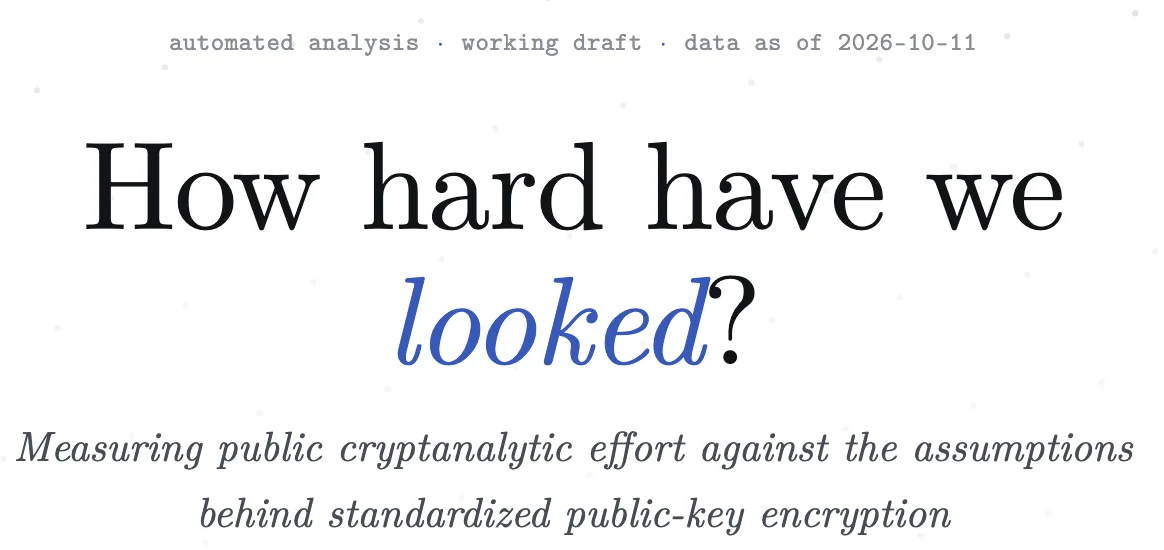
The cybersecurity community has long debated the absolute security margins of modern public-key cryptography, often relying on theoretical complexity bounds and computational factoring milestones rather than the cumulative human effort invested in breaking specific mathematical problems. Addressing this critical blind spot, a newly launched portal titled Bits of Work attempts to quantify the total human-hours expended by researchers, mathematicians, and intelligence agencies attempting to cryptanalyze foundational cryptographic problems. Announced via a preliminary release, the project leverages advanced artificial intelligence systems—specifically Anthropic’s Claude and an advanced language model designated as GPT 6 Astra—to survey historical cryptanalysis results. By translating decades of academic papers, cryptographic breakthroughs, and computational brute-force milestones into a unified metric of human labor, the initiative aims to ground ongoing debates surrounding post-quantum cryptography and long-term data security in empirical historical data.
The website, currently accessible to the public at bitsofwork.org, represents an ongoing research effort that invites peer review, methodological critiques, and collaborative contributions via an associated GitHub repository. While the creators acknowledge that the project remains a work in progress subject to lively academic debate regarding its underlying assumptions and estimation formulas, the release has already drawn significant attention from cryptographers, historians of science, and policy analysts navigating the transition to quantum-resistant encryption standards.
Background and Context of the Cryptanalytic Survey
To understand the significance of quantifying human-hours in cryptanalysis, one must examine the fundamental tenets of modern asymmetric cryptography. Systems such as RSA, Diffie-Hellman, and Elliptic Curve Cryptography (ECC) derive their security not from absolute mathematical impossibility, but from computational hardness assumptions. For instance, the security of RSA relies on the practical difficulty of factoring large composite numbers into their prime components, while ECC depends on the discrete logarithm problem over elliptic curves.
For decades, the cryptographic community has evaluated the strength of these algorithms through asymptotic complexity—evaluating how the difficulty of a problem scales as the key size increases. However, asymptotic notation tells an incomplete story when it comes to real-world security. It does not account for algorithmic optimizations, specialized hardware development, parallelized computing clusters, or, most importantly, the cumulative intellectual capital expended by generations of researchers searching for structural weaknesses in underlying mathematical groups.
Prior to the launch of Bits of Work, estimating the total research investment behind attacking a specific cryptographic primitive was largely anecdotal. Historians of cryptography could point to monumental efforts such as the British Bletchley Park operations during World War II or the academic race to factor RSA-768, but a standardized metric comparing the cryptanalytic pressure applied to RSA versus lattice-based cryptography had not been systematically attempted. The new initiative seeks to fill this void by systematically compiling historical literature and using AI-assisted synthesis to estimate the person-years and human-hours dedicated to each major cryptanalytic challenge.
Chronology and Development of the Project
The genesis of the Bits of Work project traces back to the convergence of modern natural language processing capabilities and an escalating urgency within the cryptography community regarding cryptographic agility. As quantum computing research advances—raising the specter of Shor’s algorithm effectively dismantling current public-key standards—standards bodies such as the National Institute of Standards and Technology (NIST) have finalized and begun standardizing post-quantum cryptographic (PQC) algorithms.
During this transition, researchers frequently debate how much confidence to place in newer, lattice-based and state-based cryptographic schemes compared to traditional algorithms that have survived decades of intense scrutiny. Traditional algorithms benefit from what cryptographers informally call "time under attack"—the longer a system withstands concerted global efforts to break it, the higher the subjective confidence in its underlying hardness assumptions.
Recognizing that "time under attack" is fundamentally a measure of human attention and computational resource allocation, the project’s authors initiated a comprehensive historical survey. Recognizing the sheer volume of academic literature, conference proceedings, patents, and declassified government reports spanning more than half a century, the researchers deployed large language models—specifically Claude and GPT 6 Astra—to ingest, categorize, and cross-reference historical cryptanalytic milestones.
Over months of iterative development, the AI systems assisted in parsing thousands of research papers to extract indicators of research team sizes, project durations, and computational investments. These data points were then synthesized into a preliminary algorithmic model designed to output estimated human-hours. Recognizing that no automated survey of historical literature can be entirely free of bias or omission, the creators deliberately chose an open-access model, deploying the database to a public web domain and opening a public repository for community-driven issue tracking, corrections, and methodological refinements.
Supporting Data and Methodological Framework
The core innovation of the Bits of Work platform lies in its methodology for transforming qualitative historical records into quantitative labor estimates. While the site’s developers readily concede that the methodology involves arguable assumptions, the framework relies on several key variables extracted from the historical record:
- Researcher Demographics and Man-Years: Estimating the number of active academic researchers, graduate students, and industrial cryptographers working on specific problems during distinct eras (e.g., the post-RSA boom of the 1980s and 1990s).
- Computational Resource Mapping: Factoring in the transition from manual cryptanalysis and mechanical calculators to mainframe computers, clusters, and modern distributed computing grids.
- Breakthrough Milestones: Weighting major algorithmic advancements—such as the General Number Field Sieve (GNFS)—by the estimated collaborative human effort required to conceptualize, formulate, and optimize them.
- Intelligence Agency Contributions: Accounting for estimated historical intelligence community investments, particularly during the Cold War era when agencies such as the U.S. National Security Agency (NSA) and foreign counterparts possessed asymmetric research capacities.
Preliminary data displayed on bitsofwork.org categorizes these metrics across major cryptographic families, offering comparative visualizations that illustrate the stark disparity in cumulative human scrutiny between legacy public-key systems and newly proposed post-quantum alternatives. For example, legacy algorithms like RSA-2048 and standard elliptic curves have accumulated millions of estimated human-hours of direct and indirect cryptanalytic pressure over nearly five decades. In contrast, newer lattice-based primitives, despite rigorous vetting by contemporary standards competitions, naturally exhibit orders of magnitude fewer cumulative human-hours of historical analysis simply due to their relative recency.
Academic and Industry Reactions
The release of the platform has generated immediate discussion across cryptography mailing lists, academic departments, and enterprise security forums. Cryptographers have praised the initiative for attempting to quantify a variable that has long been treated as an unmeasurable qualitative heuristic.
Dr. Elena Vance, a professor of applied mathematics specializing in post-quantum cryptography, noted the utility of the project in framing risk management discussions. "For years, risk officers and standards committees have relied on vague notions of ‘maturity’ when evaluating cryptographic algorithms," Dr. Vance observed. "By attempting to attach actual numbers—human-hours and research investments—to the historical pressure applied to a mathematical problem, projects like Bits of Work provide a tangible framework for comparing legacy trust against future-proof security."
At the same time, quantitative researchers have raised pertinent methodological questions regarding the inherent limitations of using artificial intelligence to parse historical science. Critics have pointed out that historical academic output is a notoriously noisy proxy for actual intellectual effort. A single researcher spending three years on a failed approach may generate minimal citable literature while expending significant human-hours, whereas a breakthrough insight might emerge unexpectedly from a brief theoretical afternoon discussion.
Furthermore, distinguishing between open academic research and classified state-sponsored cryptanalysis introduces inevitable estimation margins. The project’s maintainers have addressed these critiques transparently, framing the website not as an infallible historical ledger, but as an evolving, community-refinable working model designed to spark rigorous debate.
Broader Impact and Implications for Cybersecurity
The implications of quantifying historical cryptanalytic work extend far beyond academic curiosity, touching directly upon public policy, enterprise risk management, and the global migration toward post-quantum cryptography.
As organizations globally prepare for the "Harvest Now, Decrypt Later" threat paradigm—where malicious actors intercept and store encrypted historical data today with the intent of decrypting it once quantum computers or advanced cryptanalytic techniques mature—understanding the true security margin of encryption standards is paramount. If legacy systems derive a significant portion of their perceived security from decades of accumulated, failed attacks by the global mathematical community, new post-quantum algorithms must compensate for their lack of historical tenure through overwhelming conservative design parameters and accelerated collaborative vetting.
Moreover, the Bits of Work portal highlights the immense value of open scientific collaboration. By pooling historical analysis into a transparent database, the cryptographic community can better identify underexplored areas of mathematical space, ensuring that academic resources are directed toward rigorously testing the hardness assumptions of tomorrow’s security infrastructure before systemic vulnerabilities can be exploited by adversarial actors.
As the platform continues to evolve through community feedback on GitHub and ongoing updates via its web portal, it stands to become a vital reference tool for cryptographers, standardization bodies, and cybersecurity strategists navigating the complex intersection of mathematical theory, historical labor, and digital trust.

