

The modern internet stands at a profound crossroads, balancing
the demands of security, regulatory compliance, and user privacy. For over a year, cryptographers and computer security experts have warned that anonymous authentication is one of the most critical topics facing the digital landscape. Driven largely by a proliferation of artificial intelligence, automated scraping bots, and an aggressive wave of global legislation, the web is rapidly moving away from its historically casual approach to identity. As policymakers push for stricter accountability online, the tension between verifying user credentials and preserving fundamental privacy rights has intensified into a central debate of the digital age.
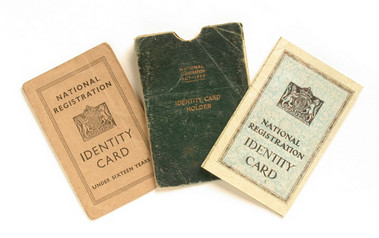
The Evolution of Internet Authentication and the Rise of Mandatory ID Checks
Since the commercialization of the internet, user authentication has evolved from rudimentary username-and-password combinations to advanced multi-factor authentication (MFA) and cryptographic passkeys. However, platforms that did not require direct user logins typically relied on lightweight friction mechanisms, such as basic anti-bot puzzles, CAPTCHAs, or long-lived cookies, allowing for a largely pseudonymous browsing experience.
In recent years, this paradigm has shifted dramatically. Driven by the commercial incentives of advertising-driven networks seeking precise user profiling and a sweeping legislative push for mandatory age verification, the internet is undergoing a structural transformation. At least 25 U.S. states and more than a dozen countries have enacted laws requiring digital service providers to verify the age of users before granting access to mature or user-generated content.
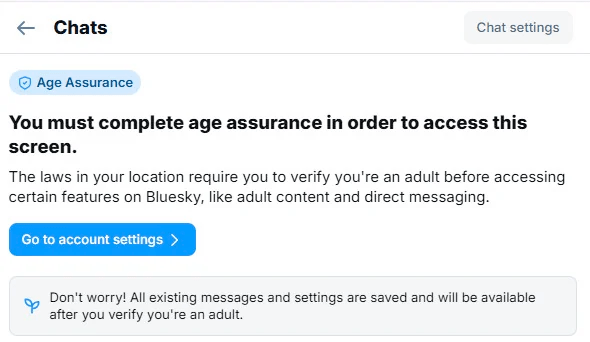
Originally framed as measures to protect minors from harmful content, these regulations have practically expanded identity checks across major social media ecosystems, gaming networks, and information repositories. Major platforms, including Facebook, BlueSky, X, and Discord, have integrated identity-assurance workflows. Even encyclopedic platforms like Wikipedia have faced immense pressure regarding user privacy compliance under sweeping regulatory frameworks such as the United Kingdom’s Online Safety Act.
The widespread implementation of routine government-issued ID checks creates unprecedented privacy vulnerabilities. Without robust technical safeguards, these verification procedures risk generating a permanent, centralized transcript of an individual’s online activity. While some legislative frameworks encourage data minimization—permitting platforms to discard identity documents immediately after verification—commercial incentives heavily favor data retention. In a digital economy saturated with non-monetizable AI bots, precise human identity carries immense financial value for advertisers. Consequently, the core challenge facing technologists is clear: how society can adapt to routine age verification and human authentication without completely dismantling digital privacy.
The Cryptographic Roots of Anonymous Credentials
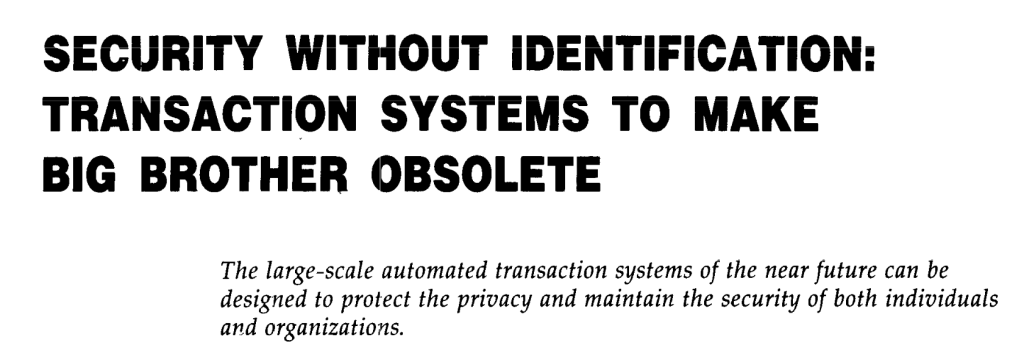
To address the friction between accountability and anonymity, computer scientists look back to foundational cryptographic research. In the 1980s, cryptographer David Chaum anticipated the privacy implications of a digitized society and proposed the concept of the "anonymous credential."
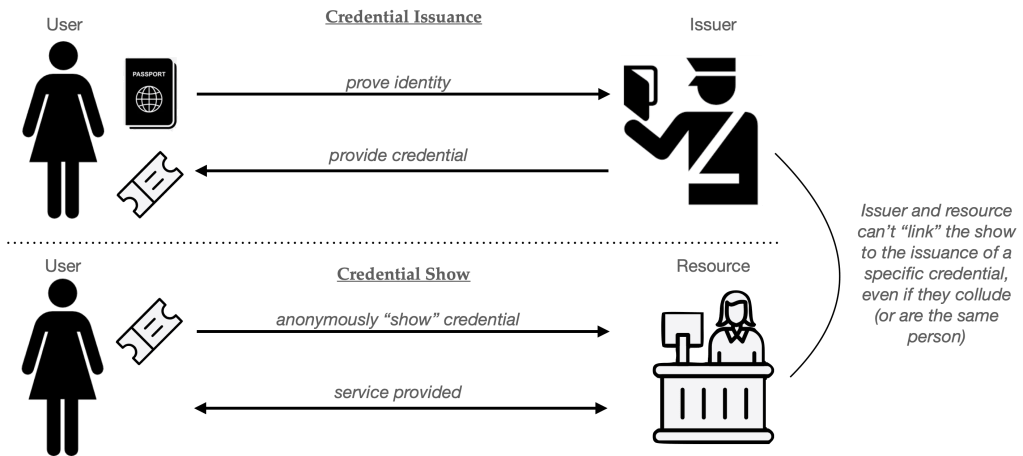
In a standard, non-anonymous authentication model, a user—often conceptualized as Alice—must present a credential tied directly to her real-world identity to access a specific resource or website. Whether acquired via a credit card subscription or a verified government-issued driver’s license, this credential creates a persistent linkage. Every time the user accesses the resource, the service provider or an advertising network can track and correlate those visits back to her actual identity.
Chaum’s proposed innovation broke the cryptographic linkage between the issuance and the usage of a credential. Under an anonymous credential model, when a user presents a credential to a resource, the system verifies only that the bearer holds a valid, authorized credential. Crucially, the resource learns nothing about the specific identity of the user, nor can it link multiple visits together. Even if the resource colludes directly with the credential issuer, the user remains hidden within an anonymity set composed of all individuals who received valid credentials.
This architecture functions digitally much like a physical wristband issued at the door of an age-restricted venue. After showing identification to a door attendant to receive an unlabeled wristband, a patron can interact with bartenders and service staff using solely the wristband as proof of age, without repeatedly exposing personal identification documents.
The Technical Challenge of Preventing Credential Cloning
Implementing digital anonymous credentials introduces unique vulnerabilities absent in the physical world. While physical items like wristbands or paper tickets are difficult to duplicate, digital data can be copied effortlessly. If a malicious actor compromises a user’s device and steals a single digital credential, they could theoretically duplicate it an infinite number of times. This duplication could power a vast army of automated bot accounts or facilitate widespread circumvention of age-restriction laws.
In traditional non-anonymous systems, credential duplication is mitigated through continuous authentication and monitoring. Platforms analyze traffic patterns, flagging accounts that log in from geographically disparate locations or display anomalous usage frequencies. However, true anonymous credentials render these monitoring techniques ineffective, as every valid presentation of the credential is cryptographically indistinguishable from another.
To reconcile anonymity with abuse prevention, modern credential systems integrate strict mechanisms to limit duplication. Cryptographers utilize several paradigms to enforce boundaries on credential usage without compromising user privacy.
Single-Use Credentials and Blind Signatures

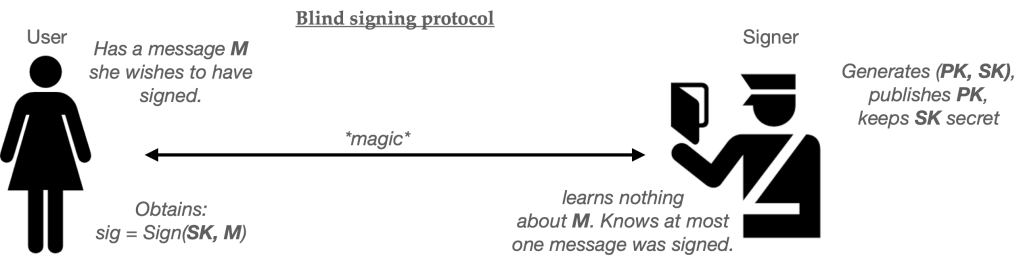
The earliest implementation of anonymous credentials, pioneered by Chaum, relied on single-use credentials powered by blind signature schemes. A blind signature is an extension of digital signatures wherein a user interacts with a signing authority to obtain a signed message. Through an interactive cryptographic protocol, the signing authority verifies the user’s eligibility and applies its digital signature, but remains entirely blind to the contents of the message being signed.
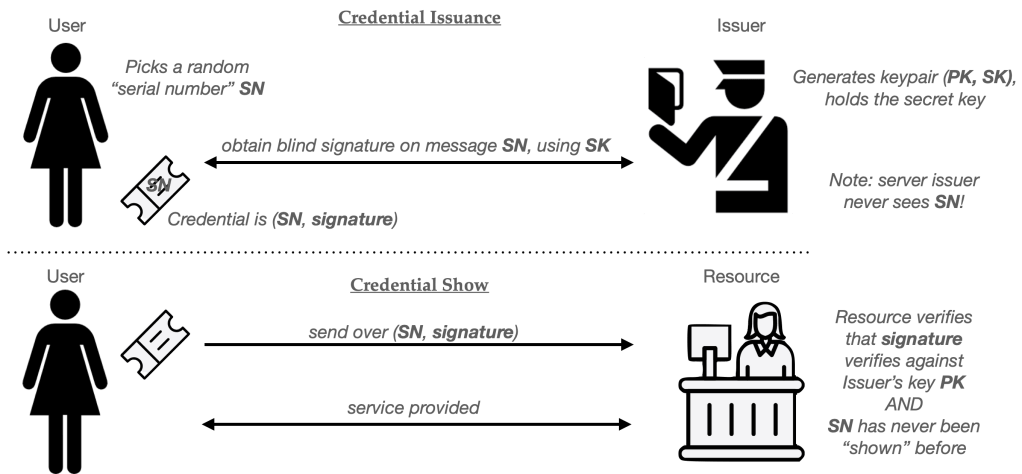
In this workflow, the user generates a random serial number, blinds it, and presents it to the issuer alongside proof of eligibility (such as a verified identity document). The issuer returns a blind signature on the serial number. When accessing a resource, the user unblinds the signature and presents the pair of the serial number and the signature. The resource verifies the issuer’s public signature and checks a local or centralized database to ensure the serial number has not been used previously.
While effective, single-use credentials present scalability and efficiency challenges. Users who access platforms frequently would need to obtain and transmit thousands of single-use credentials daily, creating heavy computational overhead.

Expressive Credentials and Zero-Knowledge Proofs
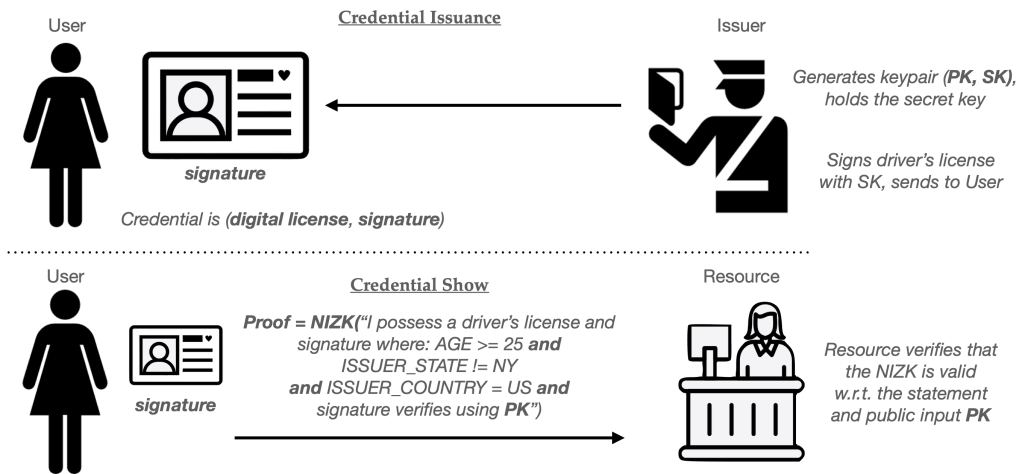
Simple single-use credentials often lack expressiveness, carrying only binary information—such as whether a user is over a specific age. In real-world scenarios, however, applications frequently demand complex, multi-variable attestations. For instance, a financial platform might require proof that a user resides within a specific jurisdiction, falls within a designated age bracket, and holds a specific financial rating, without wanting to inspect a full, unredacted identity document like a state-issued driver’s license.
To achieve this, modern cryptography utilizes non-interactive zero-knowledge (NIZK) proofs. Zero-knowledge proofs allow a prover to demonstrate to a verifier that a specific statement is true—and that the prover possesses secret underlying data satisfying precise constraints—without revealing any information beyond the validity of the statement itself.
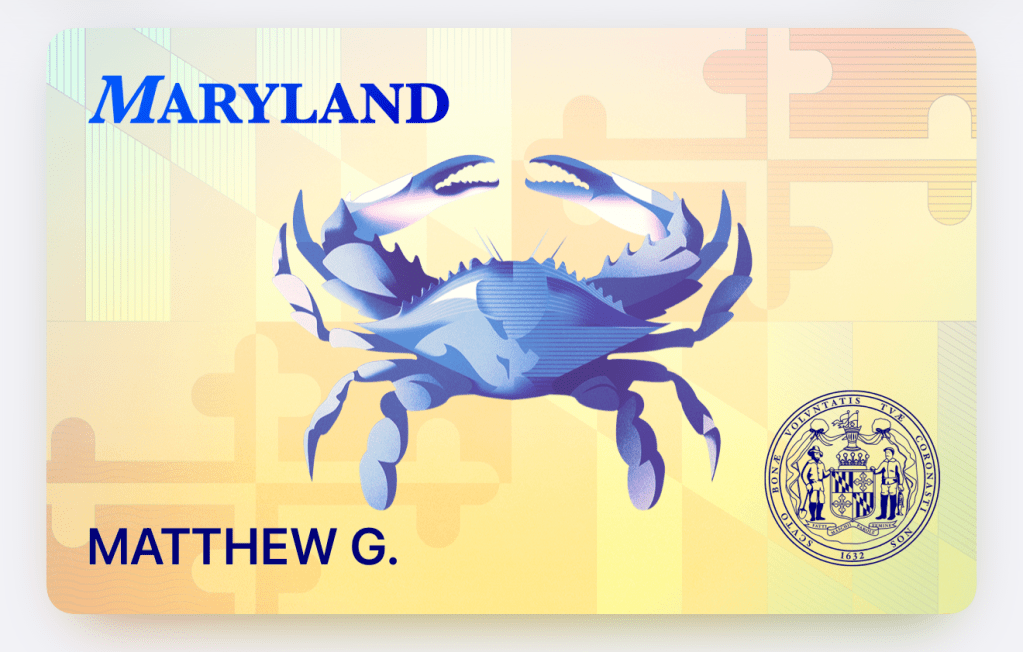
By embedding structured data (such as a digitally signed driver’s license) into a zero-knowledge proof, a user can selectively prove compliance with specific criteria. For example, a user can mathematically prove they are older than 21 and reside in an eligible state without disclosing their home address, date of birth, or legal name. Furthermore, zero-knowledge proofs enable credential reusability, allowing a single underlying digital document to power multiple distinct verification sessions without linking the sessions together.
Mitigating Cloning Risks in Reusable Systems
Because reusable credentials eliminate the built-in safeguards of single-use serial numbers, they introduce heightened risks of credential theft and cloning. If an attacker extracts a reusable credential from a compromised device, the entire security model risks collapse.
To combat this, contemporary architectures deploy hardware-backed security elements, such as secure enclaves integrated into modern smartphones, to anchor credentials to physical hardware. However, because the consumer hardware ecosystem comprises devices of varying security standards—ranging from high-end flagship smartphones to budget devices—relying exclusively on hardware security introduces systemic fragility.
Consequently, advanced cryptographic frameworks implement "N-time use" limitations and programmatic expiration rules. By incorporating pseudorandom functions (PRFs) into the zero-knowledge credential structure, issuers can mathematically restrict the maximum number of times a credential can be presented within a given timeframe—such as a maximum of 100 uses per day. If a compromised credential exceeds its designated usage limit, duplicate serial numbers are inevitably generated, allowing resource providers to detect and block the abusive activity without identifying the legitimate user.
Revocation and Banlist Management
A fundamental requirement of any scalable credential ecosystem is the ability to revoke access or ban bad actors who violate terms of service. In traditional non-anonymous systems, platform operators simply append a user’s account identifier to a banlist. In an anonymous environment, however, enforcing revocation requires sophisticated cryptographic workarounds.
Advanced zero-knowledge credential protocols resolve this by integrating dynamic banlists. When a user registers a credential, a secret key is embedded to generate pseudorandom revocation tokens. If a user commits a policy violation, the platform registers the associated token onto a public banlist. During subsequent authentication requests, the user must provide a zero-knowledge proof demonstrating that their credential’s derived token does not match any entry on the current banlist. While this approach introduces minor computational overhead that scales with the size of the banlist, it preserves anonymity while equipping platform operators with necessary moderation tools.
Broader Implications and Future Outlook
As regulatory bodies continue to advance age-assurance and identity mandates worldwide, the deployment of anonymous credentials represents a critical frontier for digital civil liberties. Frameworks such as the IETF’s PrivacyPass standard and emerging vendor proposals from major technology conglomerates signal a growing industry recognition that privacy-preserving authentication is no longer merely an academic exercise.
The transition toward privacy-preserving cryptographic primitives will determine whether the future of the internet accommodates regulatory accountability without devolving into a ubiquitous surveillance state. As technical standardization progresses, the success of anonymous credentials will depend heavily on the willingness of platform operators, policymakers, and software developers to adopt architectures that prioritize cryptographic privacy by default.

