
The geopolitical and financial spheres have collided following the largest cryptocurrency heist in recorded history, which saw approximately $6.3 billion in digital assets siphoned from Binance, the world’s leading cryptocurrency exchange. As international investigators move to assign responsibility, the North Korean government has issued a sharp rebuttal, dismissing allegations of state involvement as "absurd rhetoric." This diplomatic friction arrives at a delicate moment in international relations, as the digital asset industry grapples with the fallout of the massive security breach and the subsequent volatility impacting the Binance ecosystem.
A Chronology of the Security Breach
The crisis began in late October 2026, when unauthorized access to Binance’s infrastructure led to the rapid exfiltration of assets. The magnitude of the theft sent shockwaves through the global financial markets, forcing the exchange to temporarily suspend withdrawals as it scrambled to assess the scope of the damage. Forensic analysts and the United States Federal Bureau of Investigation (FBI) were mobilized almost immediately to trace the flow of the stolen funds.
By early November, the investigation had turned its focus toward a specific entity identified by the FBI as "TraderTraitor." This group, described by U.S. officials as an elite, state-sponsored cyber-warfare unit operating out of North Korea, has been implicated in a series of high-profile digital heists over the past several years. The FBI’s preliminary report suggested that the sophistication and scale of the Binance attack bore the distinct hallmarks of the group’s established operational patterns, which typically involve complex obfuscation techniques designed to evade international sanctions and financial oversight.
North Korea’s Official Stance
The response from Pyongyang was swift and characteristically defiant. Through the state-run Korean Central News Agency (KCNA), Kim Yo Jong—the influential sister of leader Kim Jong Un and a prominent figure in North Korean policy—categorically denied the accusations. In a statement released on Tuesday, she characterized the FBI’s findings as a "grave political provocation."
"The FBI is trying to brand the Democratic People’s Republic of Korea (DPRK) as a ‘cyber criminal state,’ claiming that it obtained information that a hacking organization supported by the DPRK was involved in the incident," the statement read. Kim Yo Jong further argued that the U.S. is using these claims to mislead the international community, asserting that North Korea is being unfairly scapegoated for a broader spectrum of global cybercrimes. Her statement underscores a long-standing pattern of diplomatic tension where North Korea consistently denies involvement in cyber activities, despite mounting evidence presented by international intelligence agencies.
Data Analysis: The Rise of State-Sponsored Crypto Crime
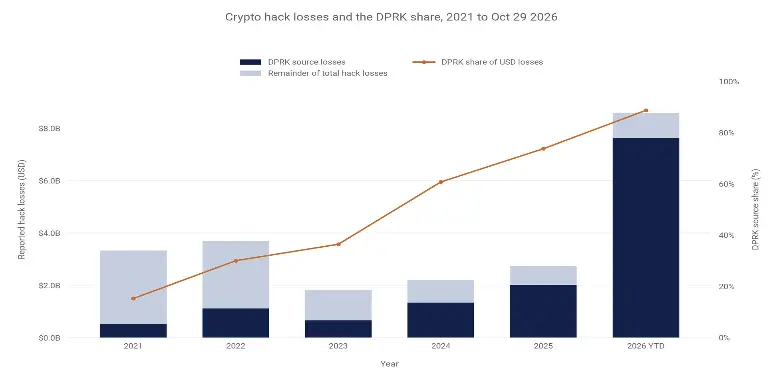
The controversy surrounding the Binance hack is not an isolated incident but rather a continuation of an escalating trend. According to data provided by blockchain analytics firm Chainalysis, the influence of North Korea-linked actors in the cryptocurrency ecosystem has grown exponentially. In 2021, DPRK-linked hacks accounted for approximately 15% of total losses in the sector. By 2026, that figure had surged to an alarming 89%.
The financial impact is equally stark. Reports indicate that the average loss per hack attributed to suspected DPRK-linked entities has risen from $50.65 million in 2021 to $185.65 million in 2026, representing a 3.7-fold increase in intensity. Cumulatively, these incidents have resulted in the theft of approximately $13.24 billion since 2021, which accounts for roughly 59% of the total $22.34 billion lost in reported global crypto hacks during the same period. These figures suggest that digital asset theft has become a core component of the state’s economic strategy, likely utilized to circumvent the stringent economic sanctions imposed by the United Nations and other international bodies.
Market Volatility and Exchange Recovery
The impact of the hack extends well beyond the loss of assets; it has also triggered a significant market reaction, particularly regarding the Binance Coin (BNB). On October 29th, the day the security breach was confirmed, the price of BNB experienced an 8% decline, breaking through a crucial $705 support level. Technical analysts noted that this movement followed a "head and shoulders" pattern—a classic indicator often associated with trend reversals and increased selling pressure.
As of early November, the price has failed to regain its previous momentum, hovering around the $693 mark. Market projections suggest that if the downward trend continues, the asset could face a further 9% decline, potentially testing the next support level at $632.
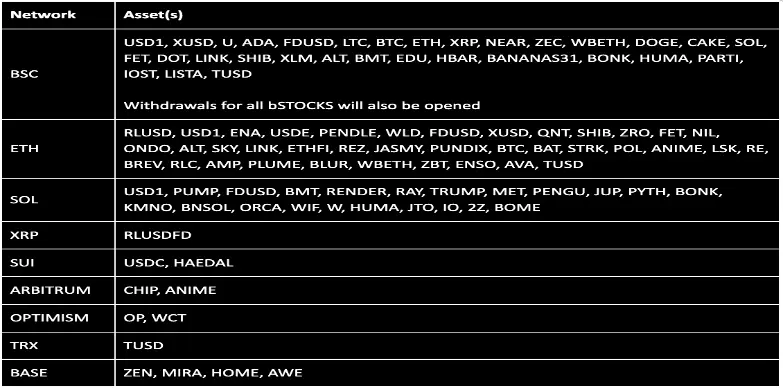
To mitigate the financial impact on its users, Binance has initiated a recovery strategy centered on its Secure Asset Fund for Users (SAFU). The exchange confirmed it has transferred 7,499 BTC—representing roughly half of the fund’s total holdings—to compensate for the losses incurred during the breach. Furthermore, the exchange has begun a phased restoration of withdrawal services. As of November 3rd, 04:00 UTC, Binance started re-enabling withdrawals for selected assets, a process being managed through rigorous security and readiness checks to ensure the integrity of the platform moving forward.
Geopolitical Implications and Diplomatic Stasis
The timing of this incident is particularly sensitive. In recent months, there have been public overtures from the United States, specifically under the administration of President Donald Trump, attempting to revive personal summit-level diplomacy with Kim Jong Un. These efforts aimed to address nuclear non-proliferation and regional security concerns.
However, the current climate of accusation and denial has cast a shadow over potential diplomatic progress. Pyongyang’s silence regarding the U.S. summit proposals, contrasted with its aggressive rhetoric regarding the FBI’s investigation, indicates a period of heightened friction. Analysts suggest that the U.S. government’s willingness to publicly attribute the Binance hack to North Korean state actors serves as a signal that the U.S. is moving toward a more assertive posture regarding the intersection of national security and financial crime.
The Broader Impact on Cryptocurrency Regulation
The $6.3 billion heist has served as a catalyst for renewed discussions regarding the regulatory framework of the global cryptocurrency market. For years, the sector has operated with a degree of autonomy that many policymakers now believe is unsustainable. The scale of the theft has prompted calls from international bodies for enhanced "Know Your Customer" (KYC) and Anti-Money Laundering (AML) protocols that transcend national borders.
Furthermore, the involvement of a sovereign state in a private enterprise’s security breach raises complex questions about international law. If the accusations against the DPRK are substantiated, it challenges the traditional boundaries of cyber warfare and state liability. Should countries be held accountable for the activities of their state-sponsored cyber units when those units target private global financial infrastructure? This remains a point of intense debate in legal and security circles.
Looking Ahead
As the investigation continues, the focus for the industry remains on two fronts: the technical hardening of exchange infrastructure and the diplomatic management of state-sponsored cyber threats. For Binance, the primary objective is to restore user confidence and maintain liquidity during a period of extreme market stress. For the international community, the challenge lies in effectively curbing the ability of state actors to weaponize the digital asset economy for geopolitical ends.
While the rhetoric between Washington and Pyongyang remains heated, the reality of the situation is that the crypto-financial landscape has been fundamentally altered. The sheer scale of the theft serves as a stark reminder of the vulnerabilities inherent in centralized digital asset storage and the increasingly sophisticated nature of the threats facing the global financial system. Whether this leads to a new era of international cooperation on cyber security or a deepening of the current divide remains to be seen, but the events of October 2026 will undoubtedly serve as a landmark case study for years to come.

