
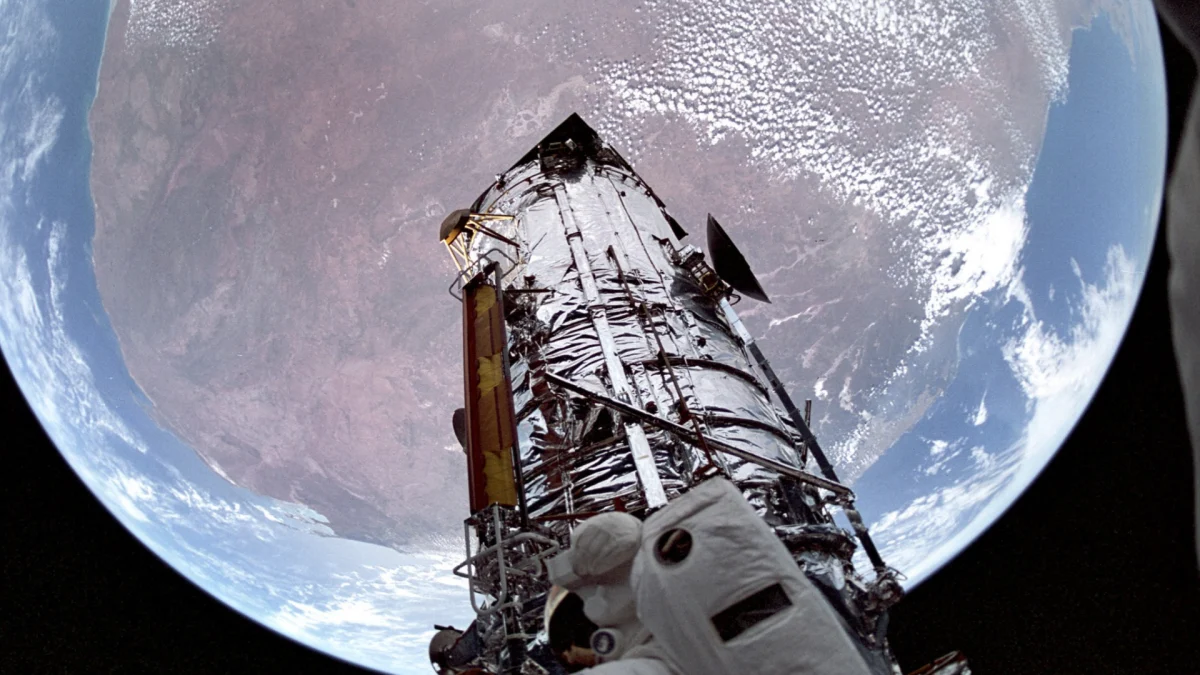
Since its deployment into low-Earth orbit in April 1990 aboard the Space Shuttle Discovery during mission STS-31, the Hubble Space Telescope has fundamentally reshaped humanity’s understanding of the cosmos. Responsible for capturing some of the most scientifically profound and visually breathtaking imagery in human history, the legendary observatory has spent more than three decades peering deep into the universe. From confirming the existence of supermassive black holes at the centers of galaxies to helping calculate the precise rate of expansion of the universe known as the Hubble Constant, the telescope has exceeded every initial engineering expectation.
However, time and orbital physics remain undefeated. Today, the iconic observatory finds itself on a slow, inexorable descent toward a fiery atmospheric re-entry. Affected by subtle traces of the Earth’s upper atmosphere—which fluctuate based on solar activity—Hubble is gradually losing altitude. According to projections from aerospace analysts, without intervention, the telescope is expected to re-enter Earth’s atmosphere and break apart between 2033 and 2034. While the vast majority of the observatory would burn up during descent, components capable of surviving the thermal stress could pose potential risks to populated regions on the surface, making a controlled de-orbit or an altitude boost an operational imperative for NASA.
The Looming Budget Constraints and the RFI Strategy
Addressing Hubble’s declining orbit requires significant capital and technical ingenuity—resources that are currently constrained under NASA’s rigid fiscal planning for its science division. Historically, NASA maintained and upgraded the observatory through direct human intervention via the Space Shuttle program. Famous servicing missions, such as STS-109 in 2002 aboard the Space Shuttle Columbia, replaced vital components, installed corrective optics, and boosted the telescope into a healthier, higher orbit. With the retirement of the Space Shuttle fleet in 2011, NASA lost its dedicated heavy-lift crewed servicing capability, leaving the agency without a direct, in-house mechanism to replicate those historic rescue missions.
Faced with these limitations, NASA has issued an official Request for Information (RFI) targeting the rapidly maturing commercial space sector. The agency is actively seeking proposals from private aerospace companies capable of executing one of two primary objectives: either securely boosting Hubble into a significantly higher, safer orbit to extend its operational lifespan for another decade or more, or executing a precise, controlled de-orbit maneuver that guides the massive observatory down into a remote ocean sector, eliminating any risk to human life.
The Technical Challenge of an Orbital Boost
Achieving a successful orbital rescue for Hubble is an extraordinarily difficult engineering challenge. According to NASA’s RFI documentation, elevating the telescope to a safe operating altitude would require an ascent of more than 370 miles (600 kilometers) above its current decay path. This requires rendezvous, docking, and propulsion capabilities that push the boundaries of current robotic in-space servicing technology.
Unlike the International Space Station, which was purposefully designed with standardized docking fixtures and systems that accommodate frequent cargo and crew vehicles, Hubble was built during an era when automated robotic docking was in its infancy. Servicing the telescope originally relied heavily on the precise maneuvering of human astronauts working inside and outside the Space Shuttle payload bay, using the mechanical Canadarm to capture and berth the facility. Any modern commercial attempt would likely necessitate advanced autonomous rendezvous sensors, highly adaptable robotic manipulation arms, and a dedicated propulsion module capable of safely attaching to the aging spacecraft without damaging its sensitive solar arrays, thermal insulation blankets, or optical apertures.
Evolution of the Commercial Space Sector
NASA’s pivot toward private industry reflects a profound paradigm shift in how civil space exploration and orbital management are conducted. In earlier decades, deep-space and near-Earth infrastructure maintenance was the exclusive domain of sovereign space agencies. Today, the landscape is dominated by agile commercial entities that have driven down the cost of access to space while rapidly advancing orbital autonomy, reusable rocketry, and in-space rendezvous capabilities.
Nicky Fox, associate administrator for NASA’s Science Mission Directorate, emphasized the strategic importance of this collaboration in a formal agency statement. She noted that the commercial industry has evolved at an unprecedented pace, developing sophisticated capabilities for satellite capture, repair, and orbital transfer. Given the timeline leading up to Hubble’s projected atmospheric decay, NASA officials have expressed eagerness to evaluate the full spectrum of commercial innovations. This initiative runs parallel to the development of the Nancy Grace Roman Space Telescope and the continued scientific yield of the James Webb Space Telescope, ensuring that astronomical data collection remains robust even as agency resources are balanced across multiple flagship missions.
Furthermore, NASA leadership, including agency administrators, has repeatedly underscored a fiduciary and moral responsibility to maximize the scientific return on taxpayer-funded assets. Because Hubble remains fully functional and continues to produce cutting-edge astrophysical data—often working in tandem with infrared observations from newer space-based observatories—keeping the telescope operational represents a high-value proposition for the global scientific community.
Potential Industry Competitors and Precedents
The RFI is expected to draw considerable interest from industry leaders capable of executing complex orbital maneuvers. Companies such as SpaceX, renowned for its Falcon and Starship architectures and proven history of autonomous docking with the International Space Station, possess the heavy-lift capacity and orbital navigation tools required for such a mission. Similarly, firms like Rocket Lab—which gained widespread industry acclaim for successfully capturing returning rocket boosters mid-air with helicopters and developing specialized photon spacecraft buses for deep-space and Earth-orbit missions—have demonstrated an aptitude for precision aerospace engineering and agile satellite operations.
The precedent for relying on commercial partners during critical orbital contingencies is well-established. In recent years, NASA has increasingly turned to private contractors to resolve complex logistical challenges in low-Earth orbit. A prominent example occurred when NASA utilized SpaceX’s Dragon spacecraft to safely return stranded astronauts Suni Williams and Butch Wilmore from the International Space Station, highlighting the reliability and responsiveness of commercial crew and cargo transportation systems in emergency or off-nominal scenarios.
Chronology of the Hubble Space Telescope
- April 24, 1990: Space Shuttle Discovery launches on mission STS-31, successfully deploying the Hubble Space Telescope into low-Earth orbit.
- December 1993: Astronauts on Space Shuttle Endeavour (STS-61) execute the First Servicing Mission, installing corrective optics to fix the telescope’s infamous primary mirror aberration.
- February 1997: The Second Servicing Mission (STS-82) replaces older instruments with advanced spectrographs, expanding the telescope’s ultraviolet and infrared capabilities.
- December 1999: The Third Servicing Mission, designated as Phase A (STS-103), is hastily organized after multiple gyroscope failures threaten to halt telescope operations entirely.
- March 2002: Space Shuttle Columbia launches mission STS-109, successfully installing the new Advanced Camera for Surveys and experimental cooling systems, significantly enhancing deep-space observation capabilities.
- May 2009: The final servicing mission (STS-125) conducted by Space Shuttle Atlantis installs the Wide Field Camera 3 and the Cosmic Origins Spectrograph, ensuring peak scientific productivity well into the 21st century.
- July 2011: The retirement of the Space Shuttle fleet concludes human-tended servicing missions, leaving Hubble dependent solely on its onboard station-keeping systems and natural orbital decay.
- Late 2020s–Early 2030s: Atmospheric drag accelerates as solar cycle maximums heat the Earth’s upper atmosphere, pulling the telescope steadily toward its projected re-entry window.
- 2033–2034: Projected timeline for Hubble’s uncontrolled atmospheric re-entry and descent, barring any successful commercial intervention or planned orbital boost.
Broader Scientific and Cultural Implications
The potential loss of the Hubble Space Telescope extends far beyond the technical metrics of aerospace engineering; it represents a poignant chapter in modern scientific history. Operating primarily in the ultraviolet, visible, and near-infrared spectra, Hubble occupies a unique observational niche that complements, rather than duplicates, the infrared capabilities of the James Webb Space Telescope. While Webb looks deeper into the early universe through infrared wavelengths, Hubble provides critical optical context, monitoring planetary weather across our solar system, tracking stellar nurseries, and observing distant supernovae with unmatched clarity.
Moreover, Hubble serves as a vital cultural touchstone. For over three decades, its publicly accessible imagery has democratized astronomy, sparking curiosity among millions of students, educators, and amateur stargazers worldwide. It transformed abstract astrophysical concepts into tangible, awe-inspiring visual realities, cementing astronomy as a discipline deeply connected to the public imagination.
Whether the commercial sector can successfully rise to the challenge of rescuing this orbiting icon remains to be determined. As evaluation of the RFI submissions proceeds, the international aerospace community watches closely. A successful public-private rescue mission would not only extend the life of humanity’s most famous observatory but would also establish a vital operational precedent for the future management, servicing, and orbital cleanup of high-value space infrastructure. If history is any indicator, the ingenuity that placed humanity among the stars may yet find a way to keep its most beloved telescope shining a little longer.

